
Introduction to the Railway Myth of the Swiss Alps
In an era dominated by the urgency of air travel and the supersonic speed of bullet trains, an alpine corridor exists where time seems to dissolve, giving way to technical and scenic contemplation. The Glacier Express, linking the legendary stations of Zermatt and St. Moritz across the Swiss cantons of Valais, Uri, and Graubünden, is far more than a tourist attraction: it represents one of the pinnacles of global railway engineering. Over the course of nearly eight hours, this convoy traverses 291 bridges, pierces 91 tunnels, and conquers the imposing Oberalp Pass at 2,033 meters above sea level.
Far from express routes oriented toward maximum productivity, this journey defies Europe’s most rugged topography through a precise combination of narrow-gauge tracks, rack-and-pinion systems, and seamless operational coordination between two of Switzerland’s most prestigious railway companies: the Matterhorn Gotthard Bahn (MGB) and the Rhätische Bahn (RhB). Analyzing this transport system means delving into a universe where friction physics, extreme weather management, and technical sustainability unite to keep a vital artery alive in the beating heart of the Alps.
Origins and Evolution of a Shared Alpine Network
The genesis of the Glacier Express was born not from aesthetic whim, but from the pressing need to connect isolated valleys and link two high-altitude tourist and economic hubs. At the dawn of the 20th century, the expansion of mining, the nascent ski industry, and the influx of an international public hungry for health and nature spurred the construction of independent railway sections that seemed impossible on paper.
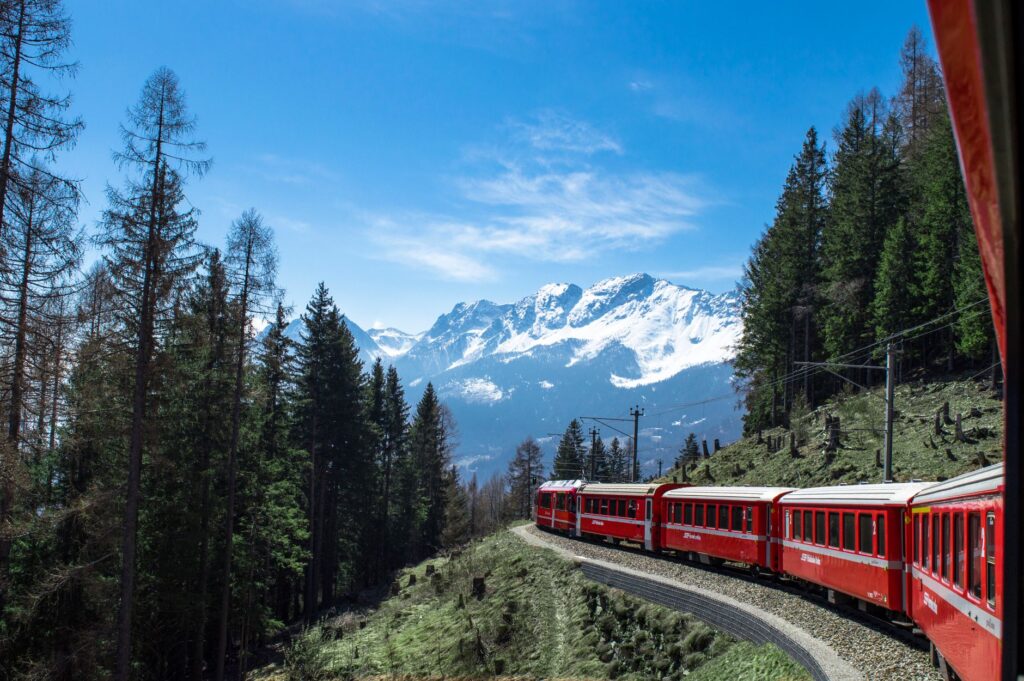
The first milestone arrived with the opening of the Furka railway and the connection with the canton of Graubünden, but it was in the summer of 1930 that the first official convoy directly united Zermatt with St. Moritz. Early infrastructure relied on steam locomotives capable of withstanding extreme gradients—a titanic effort that consumed vast amounts of coal and demanded constant maintenance due to harsh winter conditions. The progressive electrification of the network during the mid-20th century radically transformed operational efficiency, enabling continuous traction and lowering emissions in an extremely fragile natural environment.
Track Anatomy: Narrow Gauge and Rack Systems
The technical secret of the Glacier Express lies in its adaptation to vertical topography. Unlike standard European rail networks, virtually the entire route runs on narrow-gauge track, meaning a distance of 1,000 millimeters between rails. This narrower gauge allows for much tighter curve radii, essential for winding through the steep gorges of the Rhine and Rhône rivers.

However, true technical complexity becomes apparent when gradients exceed the physical limit of adhesion between steel wheels and rails. On the steepest sections, such as the climb toward the Oberalp Pass or the descent into Andermatt, the Abt rack-and-pinion system comes into play. A third toothed rail, positioned in the center of the track, meshes with a gear wheel coupled to the train’s driving axle, allowing the composition to pull safely on inclines of up to 11 percent. This system demands perfect synchronization between electric power and emergency magnetic brakes, guaranteeing a controlled descent even under severe blizzards.
Monumental Civil Engineering: Bridges and Tunnels at Europe’s Roof
Conquering the Alps requires colossal infrastructure that defies geological elements. The route features 91 tunnels, the most iconic being the Furka base tunnel, opened in 1982 to enable year-round rail transit and prevent winter blockages that once paralyzed the upper pass. This tunnel, spanning over 15 kilometers, marked a milestone in drilling engineering through solid rock.
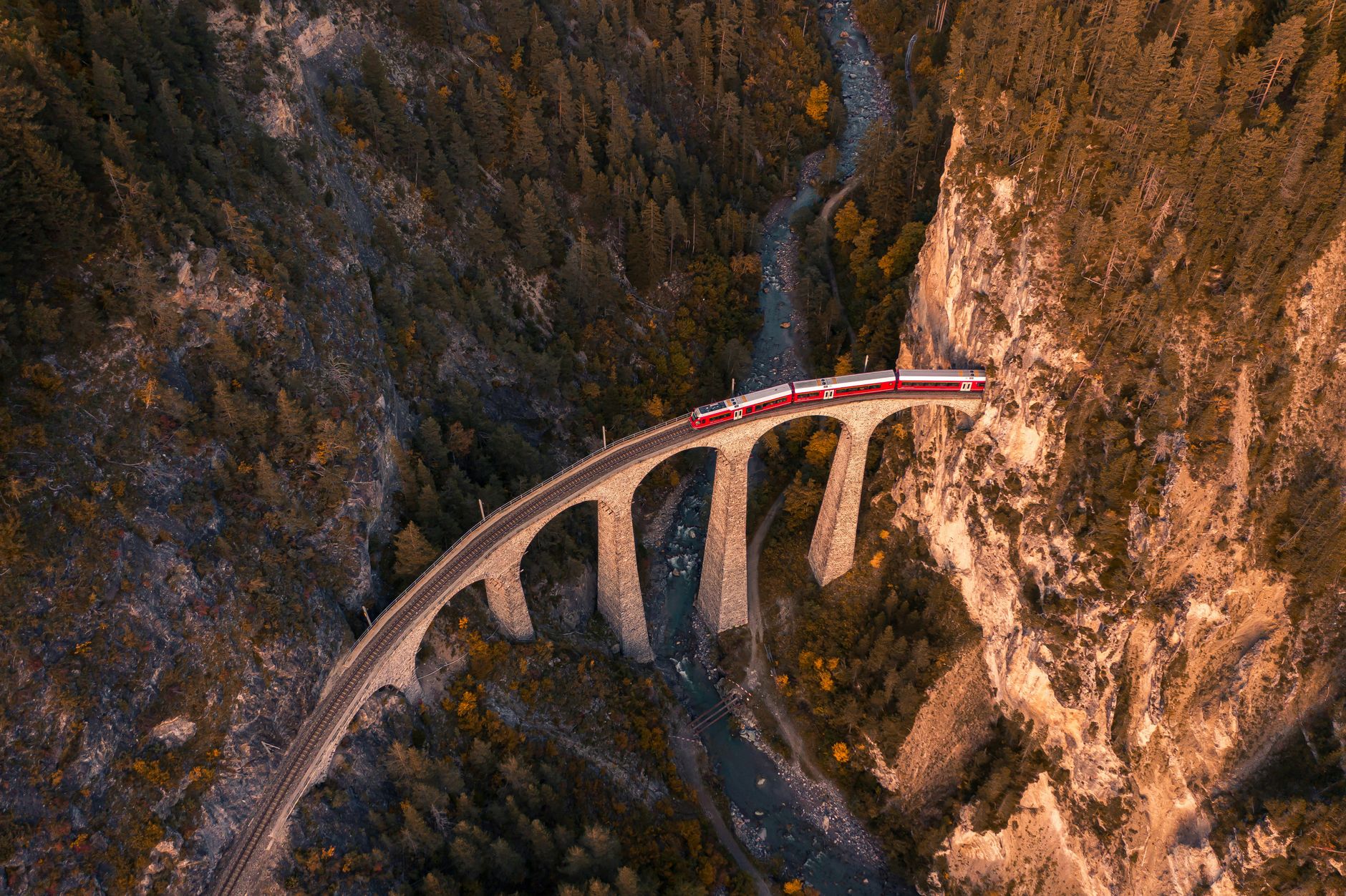
Equally impressive as the subterranean stretches are the open-air masonry works. The Landwasser Viaduct, near Filisur, is a masterpiece of railway architecture with its dark limestone arches emerging directly from the cliff face to launch across a sheer drop above the Landwasser River. Each of these bridges undergoes rigorous structural inspections using lasers and vibration sensors to detect any material fatigue caused by the freeze-thaw cycles typical of high-altitude mountains.

The true measure of alpine engineering is not the speed with which it conquers territory, but the absolute respect with which it integrates into fragile geology to ensure uninterrupted transit.
Rolling Stock: The Evolution of Panoramic Coaches
The travel experience aboard the Glacier Express has undergone a radical transformation in interior and exterior design. For decades, traditional compartment coaches with drop-down windows limited vertical views—a major drawback on a route where the greatest attractions lie in towering peaks and overhead abysses.
At the turn of the 21st century, the introduction of first- and second-generation panoramic coaches marked an industrial revolution. These vehicles feature tinted glass curving upward into the roof, offering a 360-degree perspective without optical distortion. To prevent greenhouse heating generated by solar radiation in high valleys, the glass incorporates thermal-control films and independent climate control systems that regulate interior temperature with millimetric precision. Additionally, the train includes an integrated galley car where meals are prepared on board—a high-precision logistical challenge due to limited space and continuous track inclinations.
Operations and Logistics: The Challenge of Railway Integration
Coordinating the passage of the Glacier Express over single-track lines is a masterpiece of railway traffic control engineering. A large portion of the journey operates on alternating single tracks, forcing convoys to halt at specific crossing stations with second-level precision. Any accumulated delay in the western sector managed by the Matterhorn Gotthard Bahn can collapse the timetable mesh of the eastern Rhätische Bahn network.
The centralized control center in Landquart monitors the real-time position of each train through advanced signaling systems and satellite positioning beacons. Furthermore, electrical supply management is critical: substations transform hydroelectric energy generated within the Swiss glaciers themselves to power the catenary at 11,000 volts and 16.7 Hz, a historical technical standard specifically tailored to mountain railway traction in Central Europe.
Sustainability and Conservation in the Face of Climate Change
The greatest challenge facing the Glacier Express corridor in the 21st century is not technical, but environmental. The accelerated retreat of Swiss glaciers, which give the train its name, directly alters the surrounding landscape and slope stability. Railway authorities have intensified geotechnical monitoring protocols to prevent rockfalls caused by thawing permafrost at high elevations.
Regarding energy, both MGB and RhB operate on electricity sourced 100% from renewable sources, principally alpine hydroelectric power. Regenerative braking systems return a significant share of consumed energy back to the grid during prolonged descents, turning gravity itself into an efficient energy resource. This commitment to decarbonization turns the train into a model of sustainable mobility in ecologically fragile zones.
Practical Information for the Technical Traveler
Planning a journey aboard the Glacier Express requires understanding its operational and commercial structure, which differs significantly from conventional regional trains.
- Mandatory Reservation: Since international demand exceeds panoramic car capacity, seat reservation is strictly mandatory and must be arranged months in advance, especially during peak summer and winter months.
- Fares and Supplements: Standard ticketing from Zermatt to St. Moritz is covered by international passes like the Swiss Travel Pass, but requires paying an additional high seat-reservation surcharge due to exclusive onboard services.
- Operational Seasonality: The full service typically runs from mid-December through mid-October. During autumn and early winter maintenance weeks, sections are covered by combined replacement bus services.
- Intermodal Connectivity: Terminal stations are designed to connect directly with regional commuter trains, allowing passengers to continue onward toward Zurich, Milan, or the wider Helvetian network without logistical friction.
The excellence of a transport system is measured not solely by its commercial speed, but by its capacity to transform a technical commute into an experience of absolute integration with the landscape.
Conclusion: The Enduring Value of Slowness on Rails
The Glacier Express transcends the category of simple tourist attraction to establish itself as a living monument of railway engineering and cooperation. In a world obsessed with shortening distances at any cost, this line proves that calculated slowness, supported by a millimetric technological deployment of racks, bridges, and tunnels, is the key to preserving and enjoying the planet’s most demanding natural heritage.