Crossing the Alps is not merely an exercise in geographical displacement; it is an ontological transition between two worlds that often seem irreconcilable. On the journey connecting the Mediterranean warmth of Tirano, Italy, with the icy sophistication of St. Moritz, Switzerland, the Bernina Express stands as one of the most audacious engineering feats of the 20th century. Unlike other mountain railways that rely on rack-and-pinion systems to grip steep inclines, this Rhaetian Railway (RhB) line relies exclusively on the adhesion of its wheels on steel, overcoming gradients of 7% in a dizzying ascent that redefines our perception of the vertical landscape.
This report unravels the anatomy of a route declared a UNESCO World Heritage site, where every tunnel and viaduct acts as a vital organ in a body of iron that breathes to the rhythm of the seasons. From the palm trees that greet the traveler in the Valtellina valley to the ancient glaciers guarding the Ospizio Bernina at 2,253 meters above sea level, the journey is a testament to how human technique, far from violating the environment, can integrate into it through a geometry of spirals, stone arches, and an aesthetic sensitivity that transforms transport into a form of contemplative art.
The Engineering of the Spiral: The Brusio Circular Viaduct
A few kilometers after leaving the Italian border, the train faces its first major topographical challenge. The valley narrows, and the slope becomes impractical for a linear track. It is here that the Brusio circular viaduct emerges, a structure that synthesizes the philosophy of the line: the elegance of the curve over the brute force of drilling. This nine-arch stone viaduct is not just a technical solution to gain height in a confined space; it is a monument to the constructive patience of 1908.
As the train traverses its 110-meter length, passengers experience a sensation of controlled weightlessness. The train rises above itself in a 360-degree turn, allowing the rear of the convoy to be visible from the front windows, creating a metallic choreography that seems to defy the laws of physics. The choice of local stone for its construction was not merely a matter of logistics but a commitment to durability and visual integration within the landscape of the Rhaetian Alps.
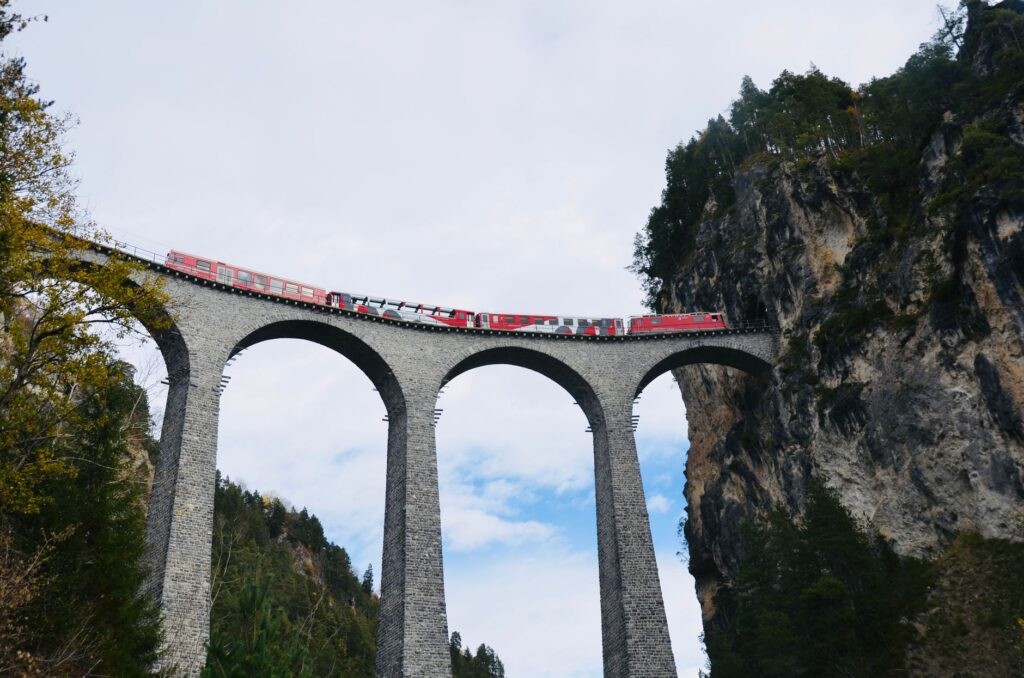
The importance of Brusio lies in its ability to demonstrate that simple adhesion—without the aid of additional gears—is viable even in extreme Alpine conditions. The engineers of the time, led by figures who understood the railway as a circulatory system, designed a layout that avoids excessive gradients through an extended longitudinal development, making the Bernina Express the highest adhesion railway in Europe.
The Ascent Toward Alp Grüm: The Palü Overlook
As the red carriages gain altitude, deciduous vegetation gives way to coniferous forests and, finally, to Alpine tundra. Reaching Alp Grüm marks an emotional milestone in the journey. This station, accessible only by train or on foot, sits at 2,091 meters and offers one of the most moving panoramas in the entire range: the Palü Glacier, a tongue of ice descending from the peaks of Piz Palü toward a lake of milky waters.
The architecture of the Alp Grüm station, built of solid stone to withstand the rigors of winter, functions as a high-mountain refuge and a logistical hub. Here, the air grows thinner, and the silence is interrupted only by the hiss of the train’s compressed air brakes. It is a turning point where the traveler realizes they have definitively left the temperate southern climate to enter the domain of the eternal.
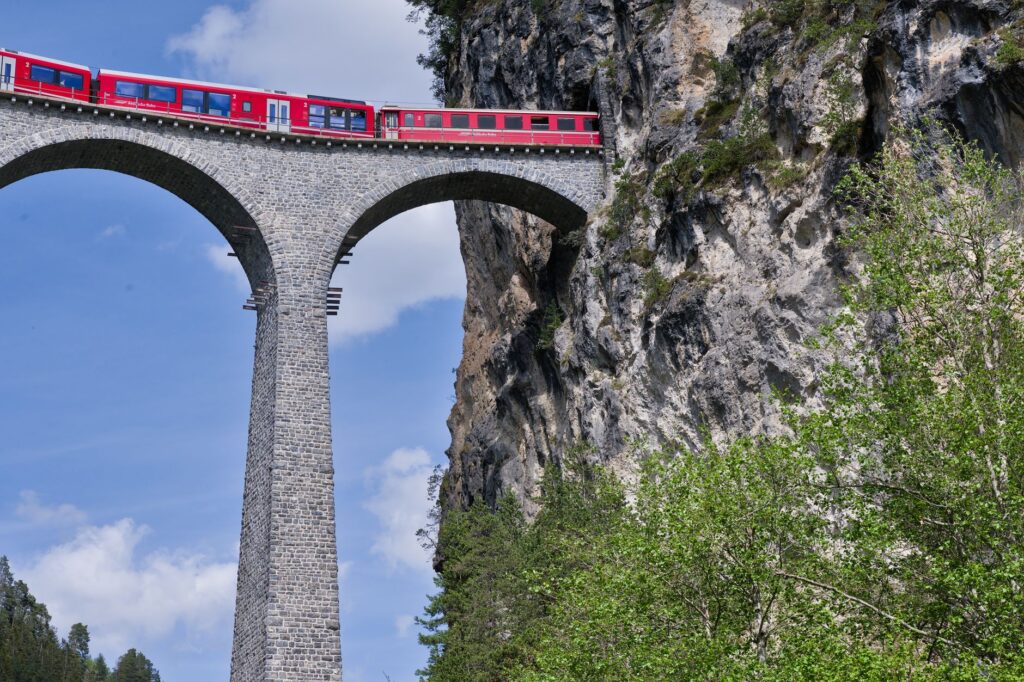
“Engineering here is not an imposition upon nature, but a choreography that respects the relief to elevate humanity toward the sublime.”
The design of the horseshoe curves preceding this station is a lesson in applied geometry. Every turning radius has been calculated to minimize wear on the wheel flanges, ensuring a smooth ride that allows the passenger to focus exclusively on the magnitude of the surroundings. In this stretch, the Bernina Express does not just transport people; it transports a renewed perspective on the fragility of high-altitude ecosystems.
Ospizio Bernina: The Roof of the Railway World
The climax of the journey is reached at Ospizio Bernina, 2,253 meters above sea level. In this windswept moorland, the train skirts the shores of Lago Bianco and Lej Nair. The toponymy is not accidental: Lago Bianco receives glacial meltwater, loaded with mineral sediments that give it a whitish hue, while Lej Nair, fed by underground springs, is deeply dark. This watershed also marks a linguistic and cultural boundary between Romansh, Italian, and German.
Infrastructure at this point must withstand extreme cold and snow accumulations that can exceed six meters. To keep the line operational year-round, the Rhaetian Railway employs state-of-the-art rotary snowplows, heirs to the ancient steam machines that performed the same task a century ago. The resilience of the track at Ospizio Bernina is a testament to Swiss technological sovereignty over a territory that, by natural logic, should be inaccessible during winter.
Walking around the station allows one to observe the pioneer vegetation surviving at these altitudes. These are plants that have adapted their life cycle to just three months of thaw, a reminder of life’s brevity against the geological scale of the mountains surrounding the pass. The train stops here briefly, allowing the freezing air to cleanse the travelers’ lungs before beginning the descent into the Engadin.
The Metamorphosis of the Landscape: From Ice to the Engadin
After crowning the pass, the Bernina Express begins a no less spectacular descent toward the Engadin valley. In this section, the landscape transforms once again. Sharp peaks give way to wide, luminous valleys, dotted with turquoise lakes and villages of traditional Engadin architecture, characterized by facades decorated with the sgraffito technique.
Passing through the Montebello curve offers the closest view of the Morteratsch Glacier. It is a moment of visual reflection on climate change: marks on the rocks indicate where the ice tongue was just a few decades ago, evidencing the retreat of Alpine glaciers. The railway, in its silent and electrified progress, presents itself as a sustainable alternative to observe this transformation without directly contributing to environmental degradation.
The arrival in Pontresina and, finally, St. Moritz, completes the cultural circle. From Italian exuberance, we move to Helvetic sobriety. St. Moritz is not just a luxury destination; it is the birthplace of winter tourism. However, for the Bernina Express traveler, the destination is secondary to the experience of the transit. The town, with its frozen lake and crystalline light, acts as the perfect epilogue to a journey that has crossed not only political borders but climates and geological eras.
Sustainability and the Legacy of the Rhaetian Railway
The success of the Bernina Express lies not only in its scenic beauty but in its management model. The Rhaetian Railway has managed to maintain a line that is loss-making in purely commercial terms as an essential public service and a top-tier tourist asset. The electrification of the line, completed shortly after its inauguration, was a visionary decision that today allows the train to run on 100% renewable energy, largely sourced from the region’s hydroelectric plants.

This commitment to ecology extends to the maintenance of original structures. Instead of replacing stone viaducts with concrete, meticulous restoration processes have been carried out to preserve the 1910 aesthetic. The integration of the railway into the social fabric of the Poschiavo and Engadin valleys is absolute; the train is the umbilical cord that allows life in these communities during months of winter isolation.
The Logistics of Comfort: Panoramic Coaches
To maximize the sensory experience, the Bernina Express uses panoramic coaches with large windows that curve toward the roof. This design removes visual barriers between the passenger and the peaks, allowing for total immersion in the environment. The on-board audio system provides historical and technical information in several languages, transforming the trip into a masterclass in Alpine geography and sociology.
- Thermal Glazing: The windows are designed to prevent fogging, ensuring visibility even during snowstorms.
- Accessibility: Despite the complexity of the terrain, stations and carriages are adapted for people with reduced mobility.
- Cultural Connection: The on-board catering service offers local products, from Engadin cheeses to Valtellina wines.
Practical Guide
To undertake this route with rigor, it is essential to plan the trip considering seasonality, as the landscape changes radically between summer and winter. The full journey between Tirano and St. Moritz takes approximately two and a half hours, though many travelers choose to extend it to Chur, Switzerland’s oldest city.
Documentation and Reservations: While the regional train follows the same route and does not require a reservation, the Bernina Express (panoramic train) requires a seat reservation fee. It is advisable to book at least two months in advance during peak season (July-August and December-January). EU citizens only need a valid ID or passport to cross the border between Italy and Switzerland.
Recommended Gear: Even in summer, temperatures at Ospizio Bernina can be low. Dressing in layers and wearing non-slip soles is recommended if you plan to get off at any intermediate stations for short hikes. Do not forget UV-protection sunglasses, as the light reverberation on Lago Bianco or the snow is intense.
Connections: From Tirano, there are frequent connections to Milan via Italian regional trains (Trenord). On the Swiss end, St. Moritz is perfectly connected to Zurich and the rest of the Swiss Federal network (SBB). If traveling with a Swiss Travel Pass, the journey is included, and you only need to pay the panoramic coach reservation fee.
“The Bernina Express is proof that the shortest path between two points is not a straight line, but the curve that allows us to understand the magnitude of what we are crossing.”
The visual closing of this journey occurs when the sun begins to descend over the Engadin peaks. The intense red of the train stands out against the bluish-white of the glaciers, creating an image that has traveled around the world. It is not just a photograph; it is the culmination of a dialogue between human ambition and the immutability of the rock. In the end, what remains is not just the memory of a landscape, but the certainty that the railway remains the most human and elegant way to explore the edges of our planet.