The Living Rock Gallery Beneath the Scandinavian Surface
Beneath the cobblestone streets and elegant Parisian-style 19th-century blocks of the Swedish capital lies a silent, monumental, and deeply vibrant territory. Stockholm’s T-Bana, or Tunnelbanan, is far more than a high-capacity mass transit system designed to relieve surface traffic congestion; it represents one of the most singular artistic and civil engineering achievements in modern Europe. Since its official inauguration in the mid-twentieth century, the network has evolved into an underground art museum stretching over one hundred kilometers, where metro stations transcend mere logistical utility to function as aesthetic capsules carved directly into the primeval granite of the Baltic Shield.
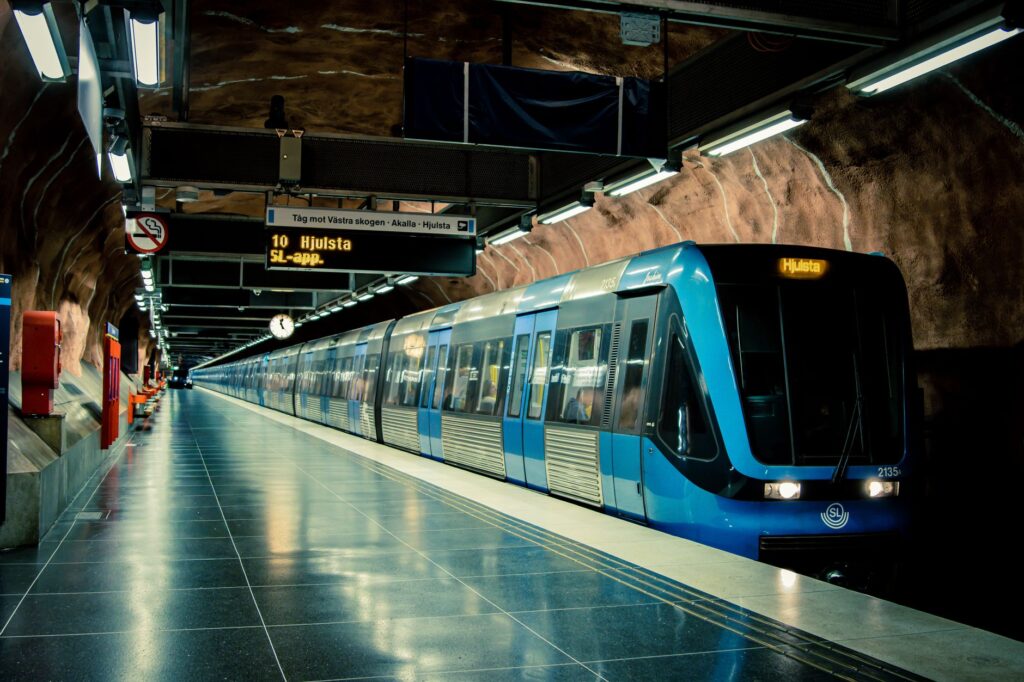
To understand the true scale of this urban undertaking, one must discard the conventional notion of the subway as a sterile, grey space of functional transit. Here, the raw bedrock was deliberately left exposed rather than covered with smooth concrete panels or anonymous industrial tiles across the majority of the historic lines. Instead, the engineers and geologists of the past decided to preserve the dynamite-scarred cavity walls, transforming utilitarian tunnels into organic caverns that visual artists utilized as monumental canvases. The result is a network of three primary corridors—green, red, and blue—connecting the historical center with peripheral archipelagos and residential districts, weaving a visual narrative that mirrors both Swedish social identity and its historical commitment to universal cultural access.
Geometric Engineering and Excavation Within the Baltic Shield
The development of the T-Bana demanded extraordinary technical solutions from its inception in the 1940s. Stockholm’s subsoil is composed primarily of Precambrian gneiss and granite, a geological formation of extreme hardness that guaranteed the long-term structural stability of the tunnels while simultaneously posing a colossal challenge to the excavation methods of the era. Controlled blasting techniques, rock bolting to secure vaulted ceilings, and complex groundwater drainage systems marked milestones in Swedish engineering, enabling engineers to carve kilometer-long galleries beneath historic foundations, lakes, and canals without destabilizing the surface.

Unlike subways excavated in soft clay or alluvial sediments using massive tunnel boring machines, the Stockholm model required a meticulous, artisanal approach during its structural opening phase. Each station on the blue line, for instance, presents a unique geological morphology that dictated the artist’s intervention. The application of sprayed concrete, or shotcrete, served as a foundational base for vibrant paintings, ceramics, and three-dimensional sculptures that interact directly with the irregularities of the stone. This ongoing dialogue between geological brutality and Scandinavian aesthetic delicacy grants every stop an unrepeatable atmosphere, where the commuter experiences a seamless transition between the deep nature of the Earth and contemporary design.
The Aesthetic Pact: Democratizing Art in Public Spaces
The integration of art within the T-Bana responds to a deeply rooted socio-political vision that blossomed in post-war Sweden. The fundamental premise dictated that art should not remain sequestered within elitist museums or private galleries accessible solely to wealthy classes, but rather integrated seamlessly into the daily routine of ordinary citizens. In 1956, municipal authorities launched the first official competition to decorate T-Centralen, the network’s grand central interchange. Since then, more than one hundred and fifty artists have left their mark across the system, transforming everyday commutes into permanent exhibitions of mural painting, mosaics, reliefs, and lighting installations.
Public transport ceases to be a mere conduit for mobility and transforms into a democratic agora where cultural heritage belongs equally to those who travel out of necessity and those who travel for contemplation.
The impact of this policy is clearly visible in iconic stations such as Kungsträdgården, where artist Ulrik Samuelson designed an underground baroque universe featuring authentic archaeological artifacts recovered during urban excavations, or Stadion, famous for its intense rainbow painted against the blue rock to commemorate the 1912 Olympic Games and celebrate sexual freedom. These interventions are far from superficial ornaments; they function as core identity reference points for the neighborhoods they traverse, dramatically reducing vandalism rates and fostering a profound sense of community ownership over public infrastructure.
Intermodality and Metropolitan Connectivity on the Surface
The efficiency of the T-Bana does not end with its subterranean layout or its artistic value; its true triumph lies in its seamless intermodal articulation with the rest of Stockholm’s regional transport ecosystem. The network operates in precise synchronization with commuter trains known as Pendeltåg, the historic urban tram network, electric buses, and marine ferries connecting the countless islets of the archipelago. This operational fluidity allows a commuter to traverse the metropolis from the northern pine forests to the docks of the Baltic Sea using a single digital contactless ticketing platform.
Stockholm’s urban planning has traditionally revolved around the concept of Transit-Oriented Development (TOD), where the growth of new residential and commercial districts is subordinated to the prior expansion of the metro line. Thanks to this strategic framework, peripheral neighborhoods like Tensta or Skarpnäck lie less than thirty minutes away from the financial core, ensuring equitable mobility and curbing private automobile dependency in a European capital renowned for its environmental standards. The punctuality of the trains, exceeding ninety-five percent annually, stems from rigorous preventive maintenance and automated control centers monitoring passenger flows second by second across the entire network.
Technical Sustainability and Subterranean Maintenance
Maintaining an infrastructure spanning over seven decades carved directly into living rock requires a continuous, highly specialized technical deployment largely invisible to the casual passenger. Engineers from Storstockholms Lokaltrafik (SL), the public transport authority, constantly monitor the structural integrity of the vaults using laser sensors and geotechnical audits. Natural seepage water trickling down through granite fissures is captured via concealed drainage systems that prevent erosion and protect delicate art installations from moisture and mineral decay.
Furthermore, the network has implemented ambitious energy-efficiency programs in recent years, replacing legacy lighting with low-consumption LED systems that highlight the artwork’s colors without generating excess heat inside the tunnels. Ventilation systems harness the natural thermal inertia of the rock to stabilize ambient temperatures across all four seasons, drastically reducing the carbon footprint associated with artificial climate control. This symbiosis between cutting-edge technology and heritage preservation positions the T-Bana as a global benchmark in the sustainable management of complex underground infrastructure.
The Traveler’s Experience: Cartography of a Daily Journey
For the traveler descending into the depths of Stockholm for the first time, the metro ride transforms into an exercise in anthropological wonder. The escalators, exceptionally long in deep stations like Solna Centrum, plunge toward a horizon where the hurried pace of urban life pauses momentarily. Observing local commuters reading newspapers beneath a blood-red painted bedrock ceiling or waiting for a train beside classical marble sculptures demonstrates how familiarity with beauty reduces the psychological friction of mass transit.

The true luxury of contemporary urban mobility lies not in the sterile speed of displacement, but in the physical environment’s capacity to enrich the attention and sensitivity of the passerby.
Every station tells a different story about Swedish society: from the ecological stewardship and environmental awareness depicted in the stylized forests of Näckrosen to tributes honoring the industrial working class at northern stops. This visual journey acts as an antidote against the anonymous isolation characteristic of modern metropolises, turning subterranean transit into a shared space of cultural recognition and collective belonging.
Practical guide
How to get around: The T-Bana network consists of three main lines (green, red, and blue) interconnected at the central hub of T-Centralen. Paper tickets are obsolete; access is managed entirely via contactless payment cards, smartphones with digital wallets, or the reloadable SL Access card. Single tickets remain valid for 75 minutes, permitting unlimited transfers across buses, commuter trains, and ferries within the metropolitan zone.
When to travel: To experience the art stations without crowds, avoid weekday rush hours (07:30 to 09:00 and 16:30 to 18:00). Weekend mornings offer the ideal window to explore the most photogenic stops in total tranquility. SL occasionally organizes free guided tours in English focusing on the network’s artistic heritage during the summer months.
Essential stations: Do not miss T-Centralen (for its iconic blue murals by Per Olof Ultvedt), Solna Centrum (famous for its striking red and green landscape evoking 1970s environmental concerns), Kungsträdgården (featuring archaeological and palatial remnants), and Stadion (featuring its signature rainbow arch against a sky-blue backdrop).
Stone Silence and Light on the Final Platform
When the final late-night train halts its motors and doors glide open into the marbled silence of empty stations, the T-Bana reveals its most intimate and contemplative dimension. In that fleeting moment when the passenger flow ceases, the carved rock walls reclaim their ancient stillness, conversing quietly in the dim light with the vibrant colors artists left upon their rough surfaces. Far from the noise of the surface world, this refuge carved deep within the bowels of Scandinavia demonstrates that civil engineering can transcend practical utility to become an enduring legacy of human sensitivity, reminding us that even in the darkest depths, shared beauty can be built.