Introduction to the Capital’s Rail Colossus
Arriving in Tokyo for the first time and facing its urban transit network is an exercise in awe and, for many travelers, respectful intimidation. With a population exceeding thirteen million residents and a metropolitan area surpassing thirty-seven million, the Japanese capital daily moves a volume of people equivalent to entire countries. Far from collapsing, this massive flow operates with a chronometric precision that defies Western logic. The secret lies not in chance, but in a complex symbiosis between millimeter-level urban planning, deeply rooted civic culture, and seamless technological integration among dozens of private and public operators.
Understanding this network requires abandoning the Western assumption that a subway system belongs to a single corporation. In Tokyo, guided transit is an archipelago of corporations competing and collaborating simultaneously. From traditional underground lines to commuter trains that magically transform into regional express services upon crossing city limits, the system demands a clear grasp of its structures. This report offers a deep dive into the mechanics of its connections, essential navigation tools, and practical keys to moving about like a true local.
The Structural Duality: Tokyo Metro versus Toei Subway
The underground heart of the city is primarily divided into two major networks that operate in a coordinated yet independent manner: Tokyo Metro and Toei Subway. The former, partially privatized after decades of state management, operates nine lines covering the most important commercial, financial, and tourist axes. Its iconography is easily recognizable by letters and colors assigned to each route, such as the Ginza Line (orange) or the Marunouchi Line (red). Meanwhile, Toei Subway manages four additional lines, notably the Oedo Line, which draws a loop around the city, and the Asakusa Line, crucial for airport connections.
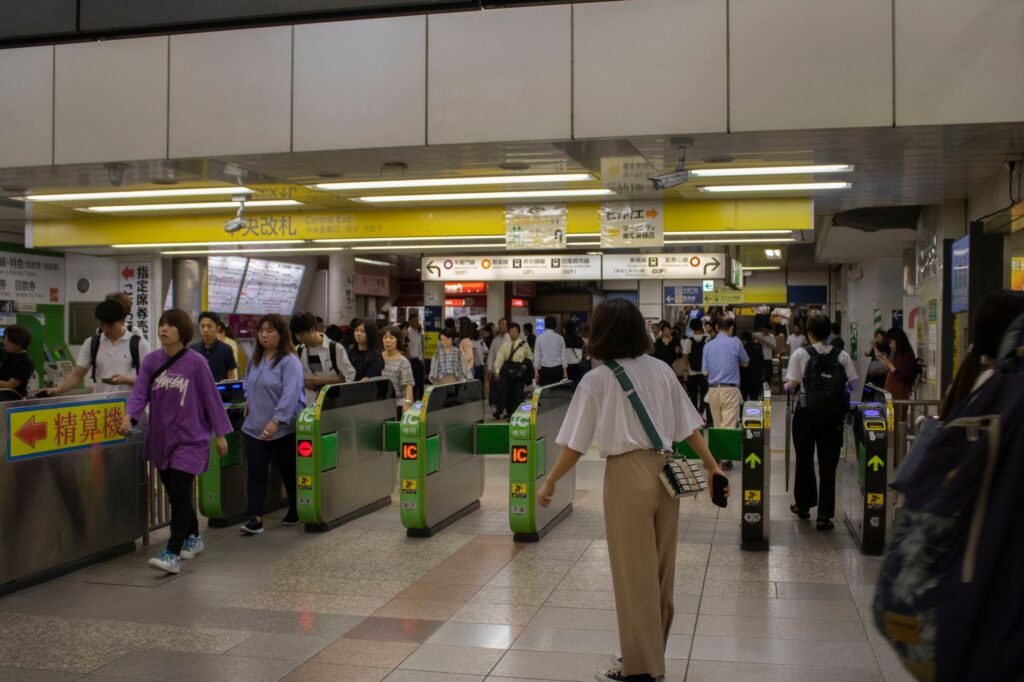
The coexistence of both operators means that transferring between a Tokyo Metro line and a Toei line occasionally requires physically exiting the turnstiles and re-entering. Although the introduction of unified smart cards has mitigated the economic impact of these changes, the physical separation still requires paying close attention to signage. Stations are alphanumerically coded—a providential system for those unfamiliar with Japanese kanji—featuring a letter for the line and a number indicating the sequential stop order.
“Tokyo’s rail system is not merely a means of getting from one point to another; it is the circulatory system that keeps the largest metropolitan organism on Earth alive and synchronized.”
The Backbone of Commuter Lines and JR East
If the subway defines the center, the JR East (Japan Railway) network defines the metropolitan scale. The most famous line in this web is the Yamanote Line, an elevated railway loop circling central Tokyo and connecting vital hubs like Shinjuku, Shibuya, Tokyo Station, and Ueno. Completing the full loop takes approximately one hour, with trains running at frequencies of barely two minutes during peak hours. Alongside it, the Chuo Line and the Keihin-Tohoku Line cut across the city from east to west and north to south respectively, absorbing millions of daily commutes.
The true magic of Japanese infrastructure occurs when commuter trains from private companies like Odakyu, Tokyu, or Tobu operationally couple with subway tracks. This allows a train originating from a residential suburb forty kilometers away to continue its journey directly through the city’s entrails without forcing passengers to change cars. This interconnectivity drastically reduces congestion at major interchanges and demonstrates a user-oriented engineering vision.

The Art of Intermodality in Colossal Stations
Stations like Shinjuku, which holds the Guinness World Record for handling the highest volume of daily passengers in the world (surpassing three and a half million users), are veritable underground cities. With over two hundred exits, integrated shopping malls, and kilometer-long corridors connecting multiple train and subway lines, orientation can easily turn into a maze. The most common mistake among visitors is searching for a specific exit without paying attention to cardinal points or the names of adjacent department stores.
To survive these colossi, overhead signage serves as the ultimate compass. Ceilings display permanent hanging signs indicating the direction toward connecting lines and numbered exits. One should never advance without checking visual indicators, as a wrong turn can result in a fifteen-minute underground walk. Impeccable cleanliness and overhead lighting mitigate claustrophobia, while signage in English, Korean, and Chinese simplifies reading in high-traffic international zones.
The Invisible Revolution: IC Cards and Digital Payments
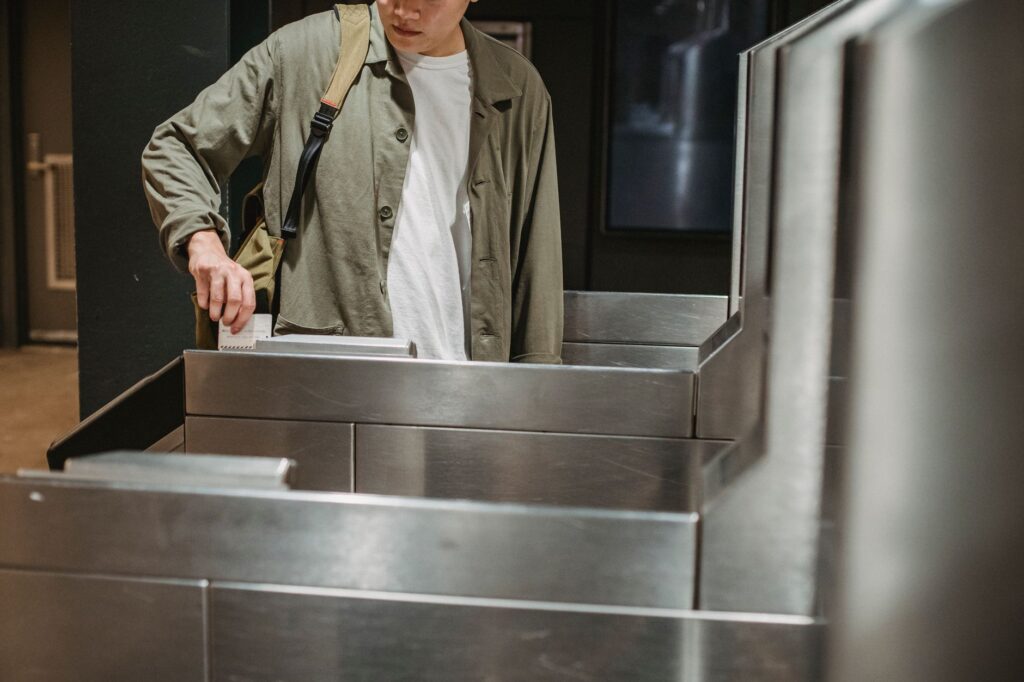
The era of buying individual paper tickets for every single journey is almost entirely relegated to confused tourists or highly specific routes. Suica and Pasmo rechargeable smart cards are the indispensable passpartout for getting around Tokyo. These contactless cards allow smooth passage through turnstiles via a quick tap and serve not only for rail transit but also for buses, trams, vending machines, and convenience store (konbini) purchases.
In recent years, the global semiconductor shortage temporarily affected the issuance of traditional physical cards, boosting the adoption of digital versions integrated into smartphones via virtual wallets. For international travelers, acquiring a temporary tourist version (such as the Welcome Suica or Pasmo Passport) or setting up the card directly on a mobile device prior to arrival saves valuable time at ticket vending machine queues and eliminates the need to calculate exact fares in advance.
Etiquette and Social Order in Public Transport
The smooth operation of the Tokyo network cannot be explained solely through civil engineering; it heavily relies on a strict, tacit code of conduct respected by locals and visitors alike. Silence is an imperative rule inside railcars: phone calls are strictly prohibited, and mobile devices must be set to silent mode. Conversations are kept at a very low tone so as not to disturb fellow passengers’ rest or reading.
On platforms, floor markings delineate with millimeter precision the exact spot where train doors will align. Passengers form orderly lines and strictly respect boarding turns, allowing exiting passengers to disembark first. Likewise, on escalators, there is an unwritten yet strict rule regarding positioning: in Tokyo, users invariably stand on the left side, leaving the right lane open for those walking in a hurry.
Airport Connections: The Bridge Between the World and the Metropolis
Arriving in Tokyo from abroad involves landing at one of its two major international airports: Narita (located in neighboring Chiba Prefecture, about sixty kilometers from the center) or Haneda (situated much closer to Tokyo Bay). Each offers specific transit solutions optimized for arrival times based on the traveler’s budget and final destination.
From Narita, the express train Narita Express (N’EX) operated by JR connects directly to key stations like Tokyo, Shinagawa, Shinjuku, and Ikebukuro in approximately one hour. As an alternative, the Skyliner service by Keisei links the airport to Ueno Station in just forty-one minutes, making it the fastest option for the north of the city. From Haneda, access is remarkably smoother thanks to the Tokyo Monorail, which reaches Hamamatsucho in under twenty minutes, or via Keikyu commuter lines running straight into the Toei Subway network.
“The integration between airports and Tokyo’s urban core proves that geographical distance is irrelevant when infrastructure operates with intermodal coherence.”
Practical Information, Apps, and Advanced Planning
Planning journeys in Tokyo analogically is a strategic mistake. Although global mapping apps work with notable precision in the Japanese capital, specialized tools like the Japan Official Travel App or local platforms provide real-time data on delays, specific platforms, optimal exit gates, and exact fare breakdowns according to the operator.
It is essential to remember that, unlike European systems where a single ticket covers any route within a zone, Tokyo fares are calculated based on the travel distance between the origin and destination stations. Upon exiting the turnstiles, if the IC card lacks sufficient balance due to a longer journey than anticipated, fare adjustment machines are available before the exit gates. Mastering this minor detail avoids awkward situations and guarantees constant fluidity in daily commutes across the capital.
Epilogue: The Unshakable Pulse of a City in Motion
Mastering Tokyo’s transit system radically transforms the travel experience. What initially feels like an undecipherable hieroglyph of intersecting lines and obscure names reveals itself, after a couple of days, as a flawless machinery of precision and mutual respect. The Tokyo rail network is much more than asphalt and steel; it is the physical reflection of a society that deeply values others’ time, collective efficiency, and harmony in public space. At the end of the journey, the chime of turnstiles validating IC cards ceases to be mere mechanical noise and becomes the steady soundtrack of one of the planet’s most fascinating urban adventures.