Introduction to the Desert Frontier and Its Logistical Pulse
In the southwestern corner of the African continent, where the Namib Desert drops abruptly into the cold waters of the Atlantic Ocean, human survival and industrial development have historically depended on a transport infrastructure as fragile as it is resilient. Shifting sands, driven by constant winds that sculpt colossal dunes, permanently threaten any attempt to map stable routes. In this territory of vast, unmeasurable expanses, connectivity is not merely a matter of convenience, but a vital lifeline supporting both mineral resource extraction and the survival of communities isolated by geography.
The study of communication routes in this extreme environment reveals a complex interplay between colonial engineering audacity and relentless geomorphological forces. From the metallic remains of ancient locomotives swallowed by the sand to modern supply routes servicing the mining enclaves along the Skeleton Coast, the region functions as an open-air laboratory where the physical limits of land mobility are tested. Understanding this system requires looking beyond the photogenic landscape and delving into the logistical gears that allow the circulation of goods, fuel, and people through apparent emptiness.
The Genesis of Railway Engineering on the Atlantic Coast
The history of connectivity in Namibia is inextricably linked to the discovery of diamonds at the beginning of the twentieth century. The mineral rush transformed an inhospitable coastal strip into a premier economic hub overnight, forcing German colonial authorities to project railway lines capable of penetrating the desert. The pioneering section between Lüderitz and Aus, inaugurated in 1906, represented a titanic engineering feat executed under extreme weather conditions, where workers had to cope with an absolute scarcity of drinking water and the relentless advance of the dunes.

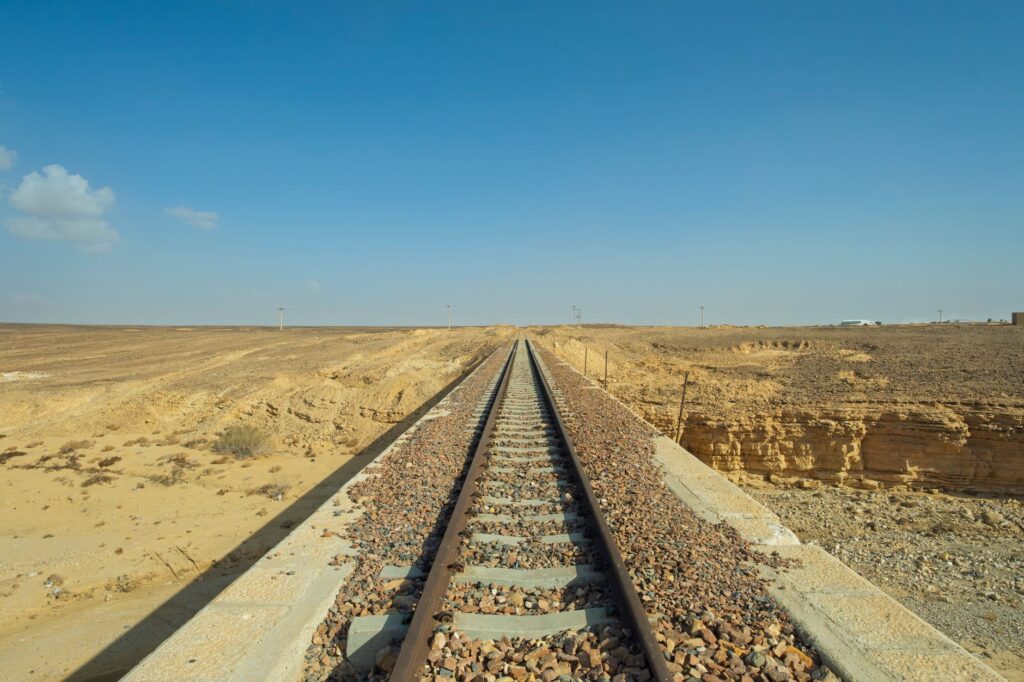
These narrow-gauge lines were designed to transport raw ore and heavy machinery inland, establishing an economic corridor that defied sandy topography. However, maintaining these tracks required permanent crews dedicated exclusively to clearing the sand that buried the rails every morning. This continuous effort demonstrates that, in the Namib, infrastructure is not a static work, but a dynamic process of negotiation with nature requiring uninterrupted vigilance to prevent the total paralysis of the network.
Engineering Against the Advance of the Dunes
Designing and maintaining transport infrastructure in an active aeolian ecosystem constitutes one of the greatest challenges for civil engineers specializing in arid regions. Barchan dunes, driven by dominant southern winds, move at a variable yet constant pace, invading embankments, bridges, and entire stations. To combat this phenomenon, historical and modern planners have resorted to a combination of windbreak barriers, sand-fixing techniques using vegetative mulch, and automated detours that allow routes to be reconfigured according to heavy traffic needs.

Along current logistical corridors, the use of advanced geospatial technology allows engineers to monitor the millimeter-scale displacement of sands in real time. The off-road trucks and heavy freight trains connecting uranium and base metal deposits with the ports of Walvis Bay and Lüderitz rely on these early warning systems. Precision in maintenance management prevents costly derailments and ensures that industrial supply chains operate without unexpected interruptions in the middle of nowhere.
The Phenomenon of Mining Towns and Their Logistical Dependence
The settlement of the Namib has historically been dictated by mining boom cycles, giving rise to a peculiar nomadic urbanism where settlements are born, flourish, and, in many cases, become extinct when resources are exhausted. Kolmanskop, the iconic mining town today partially devoured by the dunes, constitutes the clearest example of this dynamic. Its very existence was made possible by an industrial railway connecting daily diamond extraction with processing centers and maritime shipping points.
Today, enclaves such as Swakopmund and Walvis Bay act as the true logistical lungs of the central coast, concentrating port terminals, air connections, and operational bases for the extractive industry. The land connectivity originating from these nodes toward the interior of the desert is the umbilical cord supplying both large mining operations and the rural and tourism communities venturing into the national park, evidencing a complex and highly specialized network of economic interdependencies.

Maritime Transport and the Port Interface
If land routes face the fury of the sands, Namibia’s Atlantic facade presents its own challenges linked to oceanic dynamics and the absence of natural harbors along hundreds of kilometers of coastline. The port of Walvis Bay stands out as the strategic exception, a protected bay recently expanded through the construction of new container docks to consolidate its position as the commercial gateway to southern Africa and neighboring landlocked countries such as Botswana and Zambia.
The efficiency of this port depends on seamless synchronization between maritime operations, heavy freight rail transport, and heavy-duty truck fleets. Port authorities coordinate the reception of mother vessels unloading everything from heavy machinery to food supplies, which are immediately redistributed through trans-African corridors. This constant flow demonstrates that Namibia’s coastal connectivity projects its influence far beyond its national borders, functioning as a pivotal axis for continental commerce.
Ecological Challenges and Conservation in Transport Corridors
The expansion and maintenance of transport infrastructure in the Namib Desert do not occur in an ecological vacuum. The region harbors endemic ecosystems of extreme fragility, adapted to coastal fog and hyper-arid conditions, whose survival is threatened by habitat fragmentation caused by paved roads and railway lines. Reptile, insect, and mammal species suffer the consequences of the physical barrier represented by these logistical corridors, forcing a rethinking of spatial planning policies.
In response to these challenges, environmental managers and transport engineers collaborate in designing specific wildlife crossing structures, speed limits in sensitive sections, and the restoration of degraded areas following the closure of temporary mining operations. The balance between economic development driven by mining and the preservation of the landscape integrity of the national park is a delicate exercise that defines the modernization of transport policies in the country, seeking a truly sustainable development model in one of the most vulnerable environments on the planet.
Practical guide
Planning a trip or a logistical analysis in the desert coast of Namibia requires rigor and technical preparation due to extreme climatic and geographical conditions. Below are the essential recommendations for understanding and traversing this territory safely and with proper documentation:

- Best time to visit: The months between May and October coincide with the dry and cool season, offering moderate daytime temperatures and lower incidence of dense coastal fogs.
- Recommended vehicles: The use of robust 4×4 vehicles is essential, equipped with dual fuel tanks, tire pressure control systems for driving on sand, and at least two spare tires in good condition.
- Access permits: Much of the coastal territory is part of national parks or private mining concessions; obtaining the corresponding permits in advance through the Ministry of Environment or authorized agencies is mandatory.
- Fuel logistics: Distances between service stations can exceed 350 kilometers on gravel tracks; a journey should never be started without carrying extra fuel and sufficient reserves of drinking water.
- Connectivity and navigation: Mobile phone signal is nonexistent in the interior of the desert; carrying satellite communication devices, physical topographic maps, and updated GPS systems is vital.
- Road safety: Driving on gravel tracks requires drastically reducing speed to avoid skidding and loss of control due to loose gravel; extreme caution must be exercised when passing heavy-duty trucks.
Mineral Silence and Memory in the Sand
Beneath the unrelenting midday sun, the petrified wooden ties and fragments of oxidized iron emerging from the Namib dunes are not merely remnants of a colonial past, but silent witnesses to a human ambition that attempted to subdue the immensity of the desert through the sheer force of engineering.
The traveler contemplating these vestiges understands that the true magnitude of the desert lies not only in its geomorphological beauty, but in its capacity to absorb and silence the footprint of civilization. Along the Atlantic coast, mobility remains a constant dialogue between the urgency of economic progress and the unwavering sovereignty of the sand, a permanent reminder that in the most extreme corners of Earth, the routes we trace are always ephemeral and the landscape always prevails.