In the heart of Spain’s interior, where the horizon unfolds in an uninterrupted succession of clay plateaus, high plains, and wind-carved ravines, the question of mobility has ceased to be a mere technical challenge and has become a pact of territorial survival. The province of Teruel, characterized by one of the lowest population densities in Europe, has faced demographic erosion and geographic isolation for decades. However, in recent years, a silent yet radical transformation has begun to redraw the maps of displacement. This is not about grandiose pharaonic infrastructure or high-speed highways that ignore the landscape, but rather a capillary network based on the electrification of rural transport, the recovery of ancient bridle paths as pedestrian-cyclist corridors, and decentralized energy management that turns the region’s climate into its primary engine.
This paradigm shift responds to a clear thesis: territorial cohesion in low-density areas does not depend on imitating the mass transit models of large metropolises, but on designing human-scale solutions that connect dispersed settlements with energy efficiency, heritage respect, and long-term economic viability. Mobility engineers, in close collaboration with rural councils, agricultural cooperatives, and neighborhood associations, have devised a hybrid system that combines the high technology of solid-state batteries with ancestral wisdom in route planning. The result is a territory where moving without leaving a carbon footprint is no longer a theoretical aspiration, but the daily foundation supporting the lives of entire counties such as Jiloca, Sierra de Albarracín, and Maestrazgo.
The demand-responsive transport network: algorithms and autonomy in the territory
The first major milestone of this metamorphosis has been the replacement of traditional fixed-route bus lines—frequently empty and operating at a loss—with a flexible demand-responsive transport system managed through digital platforms accessible via mobile applications and physical totems in village squares. This network connects dozens of smaller municipalities with regional service hubs on a daily basis, optimizing journeys according to real user demand, the majority of whom are elderly citizens requiring medical assistance or essential administrative procedures. The fleets consist of 100 percent electric microbuses adapted for dirt roads and steep slopes, equipped with high-capacity batteries that withstand the harsh thermal oscillations characteristic of the Teruel plateau.
The autonomy of these vehicles has ceased to be an Achilles’ heel thanks to the strategic installation of fast-charging stations powered entirely by small community-owned wind farms and solar panels installed on municipal rooftops. This model of energy microgrids ensures that public transport does not depend on the general electrical grid, which remains vulnerable during heavy snowfall or gale-force winds. Furthermore, drivers, specifically trained in efficient driving techniques and environmental knowledge, also act as local revitalization agents, facilitating the transport of proximity parcels and small commercial supplies, thereby reinforcing the circular economy of the villages.
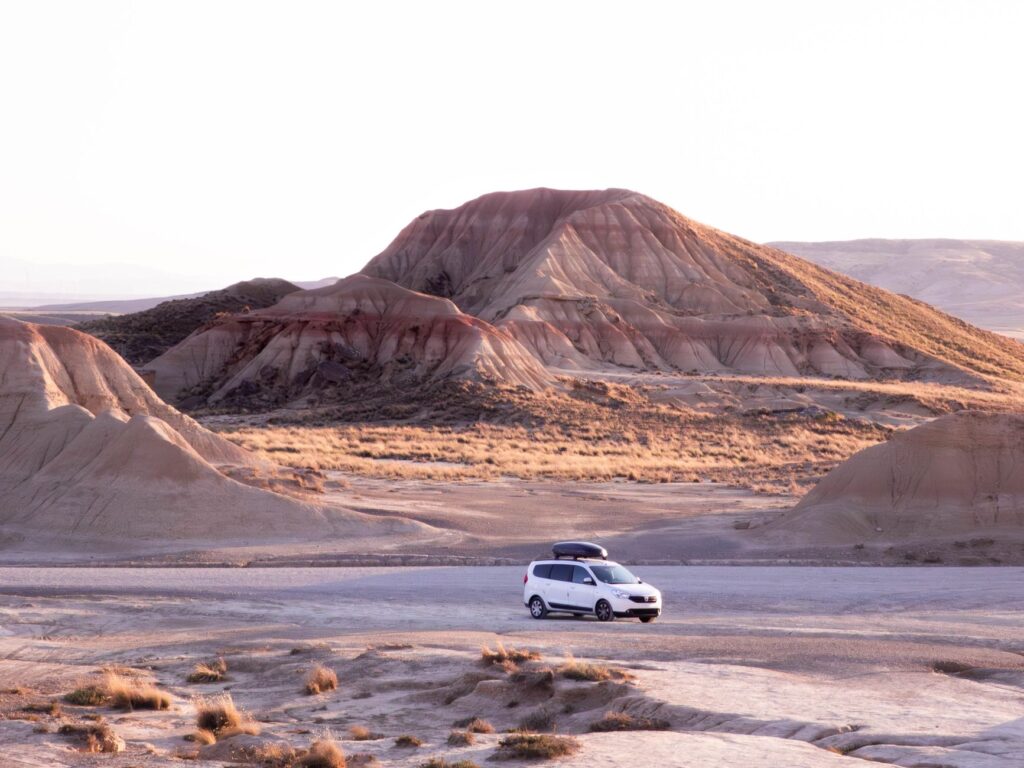
The integration of these services with the scarce regional trains crossing the province has been another technical battleground. Main stops have been redesigned as lightweight intermodal hubs, where passengers can switch from the electric bus to electrically assisted bicycles available at municipal loan points. In this way, the interurban journey is articulated fluidly, eliminating dependence on private vehicles in a province where the motorization rate per capita is unusually high precisely due to the historical lack of effective public alternatives.
Bridle paths and livestock trails: recovering the heritage of pathways
Alongside the revolution in road transport, Teruel institutions have promoted an ambitious plan to recover the historical network of bridle paths, drovers’ roads, and royal cattle tracks. For centuries, these routes were the primary arteries through which transhumance, agricultural trade, and social relations between valleys took place. With the arrival of asphalt and motorization, much of this pathway heritage fell into abandonment, invaded by vegetation or fragmented by intensive agricultural operations. Today, their restoration does not seek a purely recreational or tourist function, but aims to equip the region with a parallel network of soft, safe mobility for pedestrians, cyclists, and horse riders.
Recovery works are carried out under strict landscape and ecological restoration criteria. The use of cement or concrete on surfaces is avoided, employing traditional soil stabilization techniques with local aggregates and lime, which allows paths to maintain their hydrological permeability and prevent erosion processes caused by summer storms. Likewise, historical fountains, troughs, and ancient dry-stone culverts have been restored, bringing back not only transit but also the rich ethnographic heritage associated with water in semi-arid zones.
This network of green paths fulfills a strategic function in the new territorial model: it allows inhabitants of neighboring villages to travel on foot or by mountain bike between nearby settlements without having to share the roadway with heavy or agricultural traffic. The routes are marked with low-visual-impact signage made from treated wood and QR codes that provide information on local biodiversity, terrain geology, and rules for respecting the natural environment, turning every daily commute into an experience of direct connection with the steppe landscape.
Energy microgrids and local storage: the pulse of self-sufficiency
The long-term viability of an electric transport fleet in an area of high geographic dispersion and rigorous climate requires a supply of energy that is as robust as it is decentralized. In Teruel, the response has consisted of the development of intelligent microgrids linking renewable generation directly to public transport consumption points and municipal infrastructure. Unlike large energy projects that often generate social friction due to their visual or territorial impact, these installations are dimensioned at a county scale, harmoniously integrating into old agricultural warehouses or unproductive slopes.
Storage systems using second-life batteries—often sourced from retired electric vehicles from large urban fleets—make it possible to accumulate surplus energy generated during hours of peak solar radiation or wind intensity. This stored energy is released in a controlled manner during night-time hours or on the coldest winter mornings, when the energy expenditure for bus climate control and battery recharging reaches its maximum values. The result is a transport system whose operational carbon footprint approaches net zero.
The control of these microgrids is carried out through predictive management software that analyzes local weather, expected passenger flows, and battery capacity in real time. This level of technological sophistication, managed from county technical centers, demonstrates that digital innovation is not exclusive to dense urban environments, but can be applied with enormous efficacy to solve structural problems in depopulated rural Spain, while also generating specialized technical employment in the countryside.
The architecture of intermodality: design and functionality on the high plain
The design of transport infrastructure has required deep aesthetic and functional reflection to avoid the intrusion of discordant elements in a landscape of high visual value. The new shelters, charging points, and modal transfer centers have been conceived under the principles of bioclimatic architecture and the use of vernacular materials. Structures of local laminated timber, reinforced rammed earth walls, and dry-stone panels configure stops that enter into direct dialogue with the traditional architecture of Teruel farmhouses and hamlets.
These facilities are not mere shelters against inclement weather, but small hubs of community activity. Many of them incorporate information screens on route status, book-sharing points, smart mailboxes for e-commerce pickup, and solar panels integrated into sloped roofs that optimize energy capture. Landscape integration is cared for to the extreme, using green roofs on some modules to favor urban biodiversity and improve indoor thermal comfort without the need for artificial air conditioning systems.

The planning of these spaces has relied since its initial phase on the active participation of residents through participatory design workshops. This methodology has made it possible to detect specific needs that technicians had overlooked, such as the inclusion of ergonomically high benches for the elderly, secure spaces for securing shopping carts, or shaded areas adapted to intense summer solar radiation. The result is urban furniture that respects the identity of the territory and fosters a sense of belonging and collective care for the facilities.
Depopulation and mobility: rewriting the demographic future
The relationship between the improvement of public transport and demographic retention in Teruel constitutes one of the most relevant subjects of study for sociologists and economists specialized in rural demography. The lack of autonomous mobility options for young people and family dependence on older adults for any medical or commercial trip have historically been two of the main factors driving exodus toward the urban belts of Zaragoza, Valencia, or Barcelona. By guaranteeing dignified, flexible, and sustainable connectivity, one of the invisible barriers condemning small villages to isolation is broken.
True rural sustainability does not consist of freezing time in an idyllic postcard, but in providing its inhabitants with the mobility tools and autonomy that guarantee a dignified, modern, and connected life without renouncing the identity of the territory.
Preliminary data collected by county socioeconomic observatories indicate an increase in the stability of young people who decide to establish their residence in the rural environment thanks to the possibility of partial teleworking and having reliable transport to access advanced services. Likewise, weekend sustainable tourism has found a decisive incentive in this soft mobility network, allowing visitors to explore the territory without the need to use private cars, which drastically reduces congestion in protected natural areas and encourages a slower, more respectful consumption of the local economy.

This comprehensive approach demonstrates that ecological transition and territorial cohesion are two sides of the same coin. When mobility policies are designed by listening to the geographic and cultural specificities of a territory as singular as Teruel, transport ceases to be a factor of exclusion and transforms into the main engine of revitalization and future.
Practical guide
For travelers, researchers, or professionals interested in experiencing firsthand this model of rural transport transformation in Teruel, practical keys for exploring the territory sustainably and efficiently are detailed below.
Route planning and demand-responsive transport: The demand-responsive electric bus service can be consulted and booked through the unified county mobility platform (available on the web and mobile app under the name Movilidad Rural Teruel). Booking must be made at least 12 hours in advance to optimize routes and guarantee the availability of adapted seats.
Bridle paths and livestock trails network: The recovered network features over 300 marked kilometers suitable for hiking and cycle tourism. Downloading official updated tracks from the tourism portals of the Jiloca, Albarracín, and Maestrazgo counties is recommended, where drinking water points, rest areas, and elevation profiles are detailed.
Charging infrastructure and shared vehicles: Electric bicycle loan points and fast-charging stations for private vehicles compatible with the county network are located next to the main intermodal stops. Access to bicycles is managed via a rechargeable municipal card or digital application.
Recommended seasons and weather: The steppe plateau presents extreme thermal contrasts. Spring months (May and June) and autumn (September and October) offer optimal conditions for using pedestrian-cyclist routes. Checking weather forecasts for potential strong wind episodes or sudden drops in temperature is essential.
Accommodation and circular economy: Staying in rehabilitated farmhouses and rural accommodations adhering to the county sustainability seal is recommended, as they source predominantly local agri-food products and feature their own charging points integrated into energy microgrids.
The horizon of stone and wind: a future in balance
As one contemplates the sunset over the Teruel high plains, where the silhouettes of wind turbines blend with clay ridges and centuries-old olive groves, it is possible to witness the materialization of a new era. The silence accompanying the passage of electric buses along rehabilitated paths is not the silence of depopulation and oblivion, but the serene murmur of a community that has known how to find its own technological and ecological rhythm. Mobility in this corner of the plateau no longer measures distance in terms of isolation, but in degrees of harmony with the surroundings.
The lessons drawn from this rural laboratory of sustainable transport transcend provincial borders by far. They demonstrate that the ecological transition is not an exclusive privilege of large cities, but an urgency and vital opportunity for territories with low demographic density. By intertwining the precision of contemporary electrical engineering with the millenary memory of bridle paths, Teruel has shown that the future of sustainable mobility passes, irremediably, through knowing how to listen to the deep pulse of the earth and responding to its needs with rigor, intelligence, and unwavering respect.