
Nestled at the bottom of a narrow valley where the Ego River runs tightly confined between intensely green hillsides, the town of Eibar has been synonymous with steel, spark, and fire for centuries. Traditionally known as the armory capital of Gipuzkoa, this Basque locality harbors a secret that transcends the military utility of weapons to enter the most subtle realms of fine jewelry and ornamental art. We are speaking of damascening, an ancient technique consisting of the inlay of ultra-fine threads of gold and silver onto previously scored iron or steel surfaces, resulting in pieces of breathtaking elegance. Far from constituting a museum relic trapped in dusty display cases, this craft survives thanks to the silent obstinacy of a few masters who keep the flame of the old workshops alive.
The journey toward the productive and aesthetic heart of this craft cannot be understood without grasping the physical and human geography that gave birth to it. The rugged Basque terrain, rich in iron ore and endowed with the necessary hydraulic power to move the trip hammers of ancient ironworks, fostered an early industrial ecosystem. However, damascening is not a purely local invention, but rather the hybrid fruit of ancestral trade routes that united the Near East, Damascus—from which it takes its Western name—, Toledo, and finally the lands of Gipuzkoa in the 19th century. Today, stepping into the Eibar workshops requires an attentive gaze, capable of shedding contemporary haste to tune into the mechanical rhythm of the file, the compass, and the steady pulse.
The Genesis of Metal: The Art of Preparing the Steel Canvas
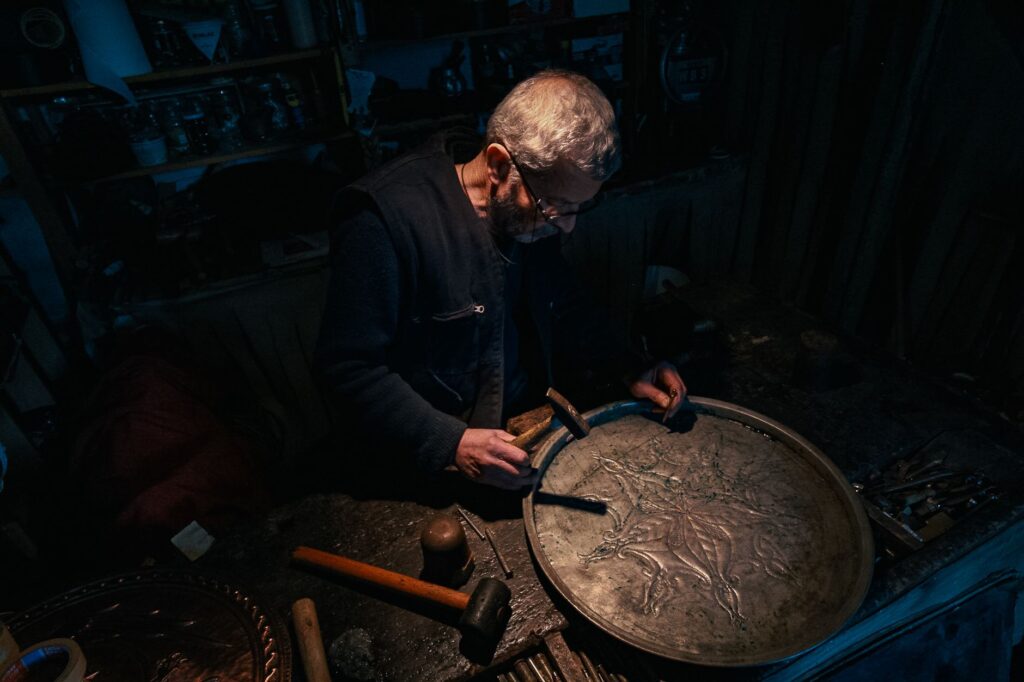
Everything begins with a high-carbon steel plate or forging of excellent quality. Before any trace of precious metal touches the surface, the artisan must subject the piece to a rigorous process of mechanical and thermal preparation. The first step consists of hatching the steel using a fine chisel and a small hammer, creating a tiny web of crisscrossed lines acting as a microscopic textile weave. This cross-hatching, executed freehand with a density that often exceeds one hundred lines per linear centimeter, provides the necessary bite for the gold to anchor permanently.
Master artisans insist that the success of the entire work lies in this invisible phase. If the hatching is too shallow, the gold wire will detach over time; if it is excessive, the steel structure will weaken. It is an exercise in physical and mental balance that requires years of accumulated practice. In contemporary Eibar workshops, this work is carried out with the same monastic patience employed by the guild’s ancestors in the late 19th century, an era when the decoration of hunting weapons reached its artistic zenith in the region before diversifying into trays, rings, and luxury cases.
The Pulse of Gold: From Flat Wire to Ornamental Geometry
Once the support is prepared, the operator proceeds with the selection and application of the noble metal. Twenty-four-karat pure gold wires or very thin silver sheets are patiently stretched through sapphire or carbide drawplates until reaching thicknesses of less than a tenth of a millimeter. With precision tweezers and the aid of a small hammer or pressure punch, the artisan deposits the wire over the incisions opened in the steel, following complex geometric patterns, floral motifs inspired by Renaissance art, or stylizations of local fauna and flora.
Damascening does not imitate nature; it imprisons it within a cage of black steel so that its brilliance flashes with the sober dignity of the land that forged it.
This process demands absolute concentration. A sneeze, an involuntary tremor, or a tenth of a millimeter of deviation forces the artisan to lift the material and start over. The designs are rarely rigidly drawn onto the piece; the artisan carries them imprinted in the visual memory accumulated after decades of craftsmanship, adapting the frets, scrolls, and cartels to the capricious curvature of each object, whether it is the guard of a collector’s saber or the lid of a classic pocket watch.
The Alchemy of Fire: Bluing and Final Fixation
When the gold and silver design completely covers the metal surface, the piece still presents a matte appearance, where the noble metals contrast with the dull gray of the base steel. It is then that the most delicate and transformative phase of the entire process comes into play: chemical and thermal bluing. The piece is immersed in special salt baths or subjected to the controlled action of direct fire and acid vapors to selectively oxidize the exposed steel part, darkening it until it reaches a deep jet-black tone.
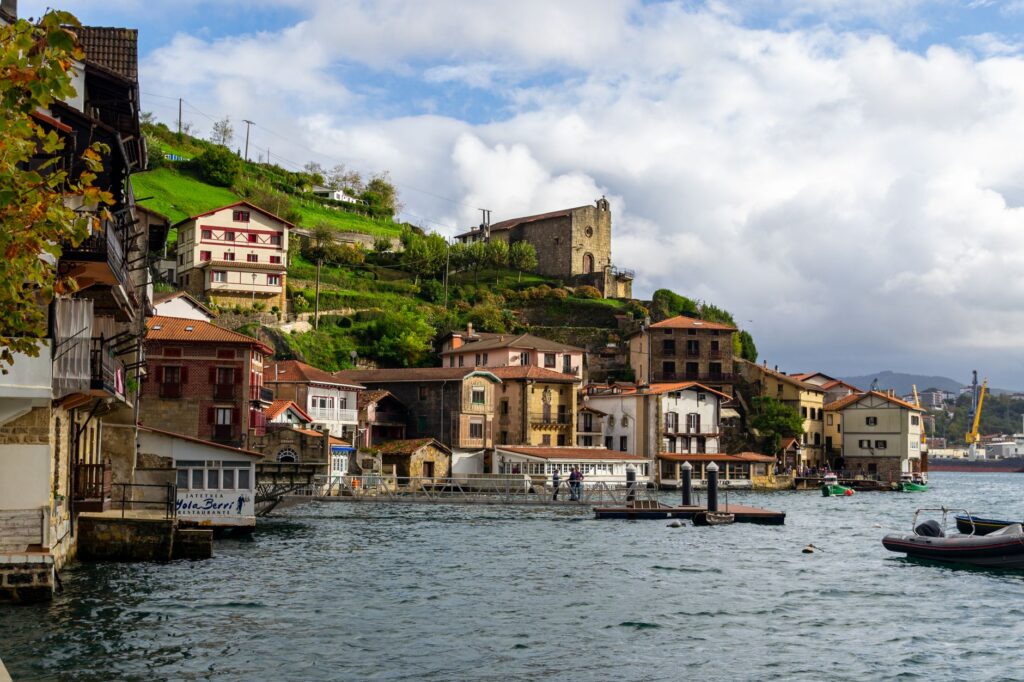
The visual miracle occurs in a matter of seconds. While the surrounding steel turns as black as night, the gold and silver remain unaltered, emitting a warm and vibrant glow that contrasts dramatically with the dark background. This chromatic opposition is the unmistakable signature of Eibar damascening, differentiating it from other international variants through its geometric sobriety and absolute disdain for baroque excess. Next, the piece is rubbed with an agate burnisher or polished steel to permanently compact the gold and provide the ensemble with a satin, durable finish.
Generational Relay: Between Tradition and Digital Resistance
The great challenge facing Eibar damascening in the 21st century is not technical, but demographic. With a very high average age among the last certified masters, traditional workshops struggle against a tide of mass production and counterfeits coming from Asian markets that imitate the visual appearance through laser engraving or industrial screen-printing techniques. However, tactile authenticity—the imperceptible yet real relief left by gold wire when hand-hammered—remains unattainable for machines.
Local institutions and technical training schools in the Basque Country have launched specific programs to attract young creators interested in the intersection between contemporary design, goldsmithing, and vanguard craftsmanship. Fashion designers, sculptors, and visual artists are beginning to collaborate with veteran masters to apply this ancient technique to high-end eyewear frames, technological device casings, and conceptual art pieces, proving that tradition is not a museum of ashes, but a living fire fueled by the audacity of the present.
Living Heritage: Museums and Archives of the Armory Town
To understand the historical magnitude of this art, it is essential to tour the institutional spaces that safeguard Eibar’s collective memory. The Armory Industry Museum, located in the Portalea building, offers an exhaustive tour of the locality’s technological and artistic evolution. Its halls house everything from profusely damascened flintlock pistols for European royal courts to workshop tools, 19th-century pattern books, and private collections donated by local armorer families.
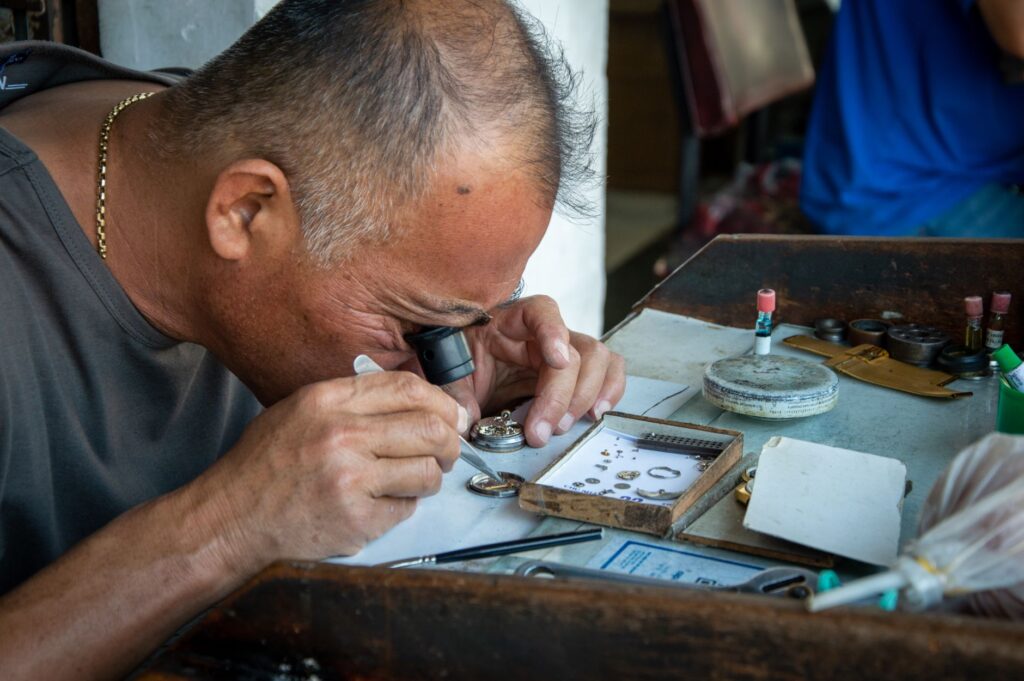
Visiting these documentary collections makes it possible to trace the network of exchanges that turned the Gipuzkoan town into a global benchmark. Masters like Plácido Zuloaga, a towering figure of nineteenth-century damascening whose works are exhibited in museums in London, Paris, and New York, elevated local craftsmanship to the category of Fine Arts. The museum’s display cases not only showcase the final result but also the measuring instruments, hammers worn down by use, and mineral samples that explain the material context of a working-class culture deeply proud of its savoir-faire.
Workshop Routes: Stepping into the Sanctuaries of Metal
Visiting active Eibar workshops requires planning that respects the rhythms of artisanal production. Unlike commercial spaces geared toward mass tourism, these workshops are workplaces where silence and concentration are sacred laws. Some of these small family businesses and independent studios allow access to small groups of enthusiasts by prior appointment coordinated through local tourist offices or regional cultural associations.
During these guided tours led by the artisans themselves, the traveler has the unique opportunity to observe the gestation of a piece up close. Seeing how a gold wire visually merges with steel under the action of a millimetric hammer is an aesthetic experience that subverts the tyranny of digital immediacy. It is not about buying a quick souvenir, but about understanding the real value of time invested in matter, recognizing the human effort beating behind every golden flash amid the dimness of the workshop.
Practical guide
Getting there: Eibar is perfectly connected by road via the AP-8 highway, linking Bilbao and San Sebastián. By public transport, Euskotren trains offer regular frequencies from both Basque capitals, placing the Eibar station right in the urban center after a winding journey through the Gipuzkoan valleys.
When to go: Spring and autumn are the most favorable seasons to explore the interior Basque Country, combining workshop visits with hiking trails through surrounding mountains, such as Mount Urko or the Kalamua range.
Accommodation: Although the local hotel offer is functional and urban in character, there are excellent rural agritourism options in the neighboring Debabarrena valleys, ideal for connecting with the region’s green nature.
Workshop visits: Places to access artisanal workshops are extremely limited. It is essential to contact the Eibar tourist office or the Gipuzkoa Artisans Association well in advance to arrange invitations or scheduled visits.
Ethical shopping: When acquiring a damascened piece, ensure it includes the certificate of authenticity issued by the local workshop and the guarantee seal certifying the use of precious metals and traditional manual execution.
Recommended reading: To delve deeper into the town’s artistic history, the catalogs edited by the Armory Industry Museum on the Zuloaga dynasty are an indispensable and rigorous bibliographic reference.
The sun begins to set behind the sharp peaks surrounding the Eibar valley, dyeing the rooftops of the armory town in copper-gray. Inside the workshop, the light of a halogen lamp illuminates the workbench where a small steel plate rests. The master removes his magnifying glasses, sighs softly, and runs his fingertips over the freshly burnished surface. There, trapped between the invisible grooves of the dark metal, the gold wire gleams with a serene intensity, indifferent to ephemeral trends and the noise of the outside world. It is the silent victory of matter worked with patience, a tangible reminder that true human beauty continues to reside in the millimeter, in the constancy of the pulse, and in the unalterable memory of fire.