
In the heart of the Swiss Alps, where vertical limestone walls rise toward peaks perpetually crowned by glaciers, mobility has ceased to be a mere technical challenge and has become an exercise in ecological balancing. The Bernese Oberland, featuring deep valleys such as Lauterbrunnen and gradients that defy gravity, has faced for decades an unsustainable paradox: how to accommodate millions of annual travelers without degrading the fragile alpine ecosystem that attracts them. Today, this pioneering region is leading a radical transformation of its transport system, demonstrating that high-altitude mountains can shed fossil fuels without losing an ounce of their legendary efficiency.
This transition is not the result of a recent whim, but rather of a consolidated territorial planning strategy that integrates the century-old electrification of its railway tracks with cutting-edge technological innovations. While major European cities debate urban traffic restrictions, the communities of the Oberland have redesigned their mobility map by connecting cogwheel trains, historic funiculars, and a new fleet of green hydrogen-powered buses. This report examines how these infrastructures operate, what role local cooperatives play in their management, and what the real limits are of a model that aspires to mirror global alpine sustainability.
The Heritage of Iron and Electricity in High Mountains
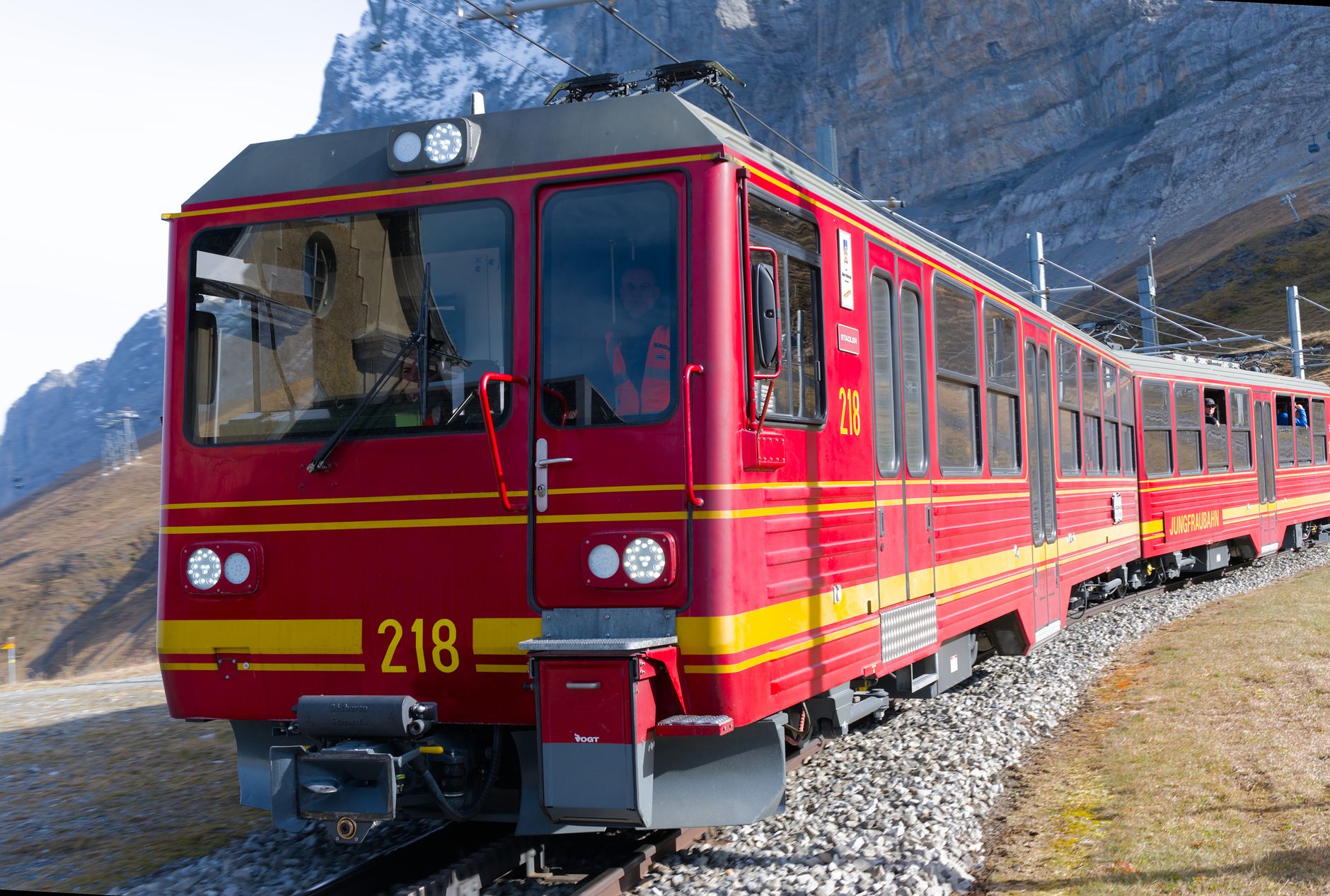
To understand the current transport network of the Bernese Oberland, one must look back to the late 19th century, when Swiss engineers conceived the first high-mountain railway lines. At a time when coal ruled the industrial revolution, Switzerland decisively opted for hydroelectricity to power its trains. Cascades rushing furiously down glacial valleys became the driving force of a system that remains the backbone of regional mobility today. The metric tracks and cogwheel systems of the Bernner Oberland Bahn and the legendary railway ascending toward the Jungfraujoch are not merely tourist relics, but the foundations of current decarbonization.
Over the past two decades, the region’s railway companies have modernized their rolling stock by implementing regenerative braking systems. When a convoy descends loaded with passengers from alpine stations toward Interlaken or Grindelwald, its electric motors act as dynamos, feeding energy back into the local grid. This principle of partial energy self-sufficiency reduces dependence on external sources and optimizes consumption during peak winter and summer influxes. Local engineers have proven that optimizing existing infrastructure far outweighs the environmental impact of building new roads.

The Technological Leap: Hydrogen Buses in Inaccessible Valleys
Despite the efficiency of the trains, the topography of the Bernese Oberland includes numerous villages and hiking trailheads that the railway never reached. Traditionally, these secondary routes depended on diesel buses that generated polluting emissions and noise in valleys where silence is a patrimonial asset. The response to this problem has arrived through hydrogen fuel cell technology, implemented with caution and technical rigor in municipalities such as Grindelwald and Meiringen.
These fuel cell buses emit nothing more than water vapor and operate with a range perfectly adapted to the demands of alpine routes, characterized by extreme gradients and low winter temperatures. The hydrogen used in the regional fleet is produced via electrolysis using exclusively electricity sourced from local hydroelectric power plants. This closed loop ensures that the carbon energy chain is completely emissions-free, a standard that requires rigorous environmental audits and sustained public-private investment over time.
True sustainability in high mountains does not consist of moving more people with cleaner technologies, but of redesigning the relationship between the traveler and the territory so that displacement becomes part of respecting the landscape.
However, the deployment of this technology has not been without logistical challenges. The scarcity of dedicated refueling stations for heavy hydrogen vehicles in high-mountain areas forced cantonal authorities to design a modular supply network. This decentralized infrastructure allows buses to operate uninterrupted even during the worst winter storms, when secondary access roads are completely isolated from the rest of the valley.

Community Governance and the Restriction of Private Vehicles
The foundational pillar upon which the success of the Bernese Oberland model rests is not purely technological, but normative and social. Iconic villages like Wengen and Mürren have completely banned internal combustion engine automobiles for decades, permitting only the circulation of small electric service vehicles and those of local residents under strict quotas. This decision, made long ago by local municipal councils with the backing of resident communities, prioritizes air quality and acoustic tranquility above the individual comfort of the visitor.
To serve motorists arriving from Zurich, Bern, or other European capitals, the region has consolidated a network of large peripheral parking lots directly connected to valley train stations, such as Lauterbrunnen and Grindelwald Terminal. The institutional message is clear: the private car is useful for reaching the threshold of the region, but it becomes obsolete and unnecessary once inside the alpine valley system. Parking rates are structured to penalize long stays of stationary vehicles, incentivizing their exclusive use as a transition point toward soft mobility.
Infrastructure for Soft Mobility: Trails and Cycling Networks
The decarbonization of transport in the Bernese Oberland is not limited to large mechanical vehicles. Tourism and cantonal authorities have significantly invested in upgrading pedestrian paths and mountain biking routes, formally integrating them into the multimodal public transport system. Signposted trails are not mere recreational paths, but corridors for everyday and tourist transit connecting railway stations with high-altitude refuges and minor urban centers.
The boom in electric mountain bikes has transformed summer flows, allowing visitors from a much broader demographic spectrum to explore mountain passes that once required exceptional physical fitness. To prevent conflicts between hikers and cyclists, regional administration has implemented strict zoning of paths, accompanied by awareness campaigns and the installation of solar-powered battery charging points in the busiest mountain refuges.

Tariff Integration and Digitalization of Alpine Transport
One of the major obstacles to the mass adoption of public transport in mountainous areas is often the fragmentation of tariffs among different private and public operators. In the Bernese Oberland, this issue has been mitigated through unified digital platforms and integrated tickets such as the Regional-Pass Bernese Oberland. This pass allows coordinated use of trains, buses, boats on lakes Thun and Brienz, and most cable cars with a single digital medium.
Digitalization has also optimized capacity management on high-demand railway lines. Through predictive algorithms based on historical occupancy data, railway companies adjust convoy frequency in real time and offer fare incentives to travelers who choose off-peak hours. This demand management prevents train overcrowding during morning rush hours and guarantees a smooth, respectful travel experience within the capacity limits of the alpine infrastructure.
The contemporary challenge for mountain destinations is not attracting more visitors, but managing the invisible flow of those who transit through them without leaving a trace on their fragile ecosystems.
Practical guide
How to get there: The main access to the Bernese Oberland region is via the Swiss railway network (SBB), connecting directly from Zurich and Geneva airports through high-frequency trains with transfers in Bern and Interlaken.
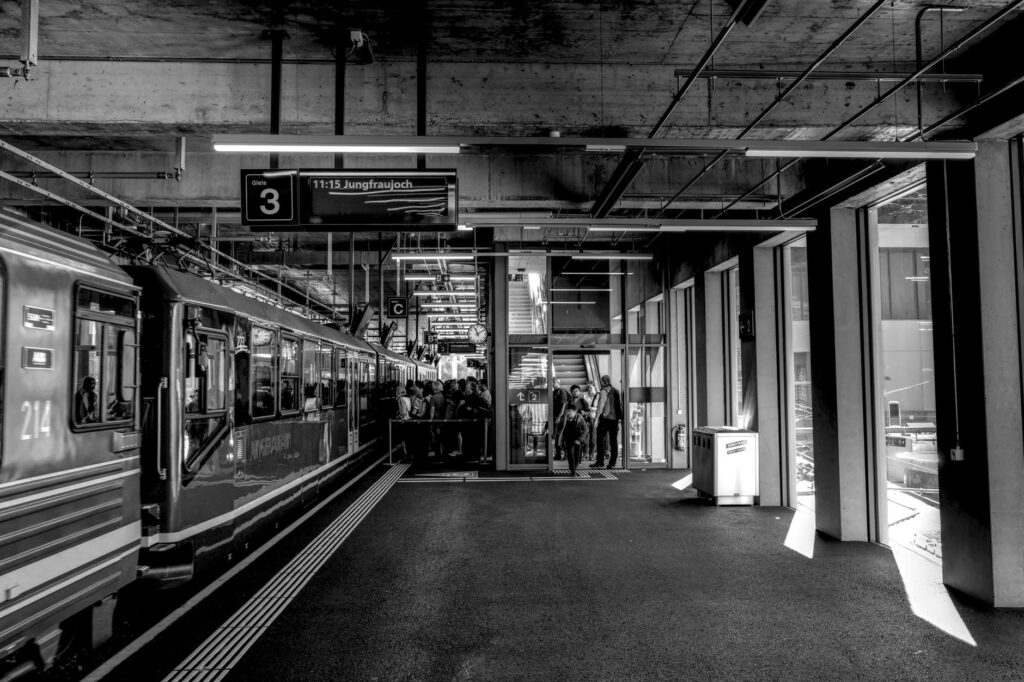
When to travel: The months from June to September offer optimal conditions for hiking and full operation of the multimodal network. The winter season, from December to April, is ideal for skiing and intensive use of cogwheel trains, although some high-altitude routes remain closed for safety reasons.
Local transport options: Use the Bernese Oberland Pass to integrate all journeys by train, bus, and boat. In villages like Wengen and Mürren, get around exclusively on foot or via local electric taxis.
Recommended accommodation: Choose hotels and guesthouses certified with the Swisstainable label, many of which operate on 100% renewable energy and collaborate in local biodiversity conservation programs.
Code of conduct: Strictly respect the ban on driving combustion vehicles in restricted zones, leave no litter on the trails, and use the recycling points provided at the terminal stations of each valley.
Estimated budget: The cost of public transport in Switzerland is high but highly efficient. Purchasing regional passes by days is recommended to optimize spending if multiple daily trips are planned.
The Horizon of Alpine Mobility Facing Climate Change
While the glaciers of the Bernese Oberland continue to recede at an alarming rate due to rising global temperatures, the pressure on transport infrastructure is only increasing. The engineers and geologists monitoring the region’s slopes face new risks, such as slope instability and accelerated erosion of historical paths. The resilience of the transport system no longer depends solely on the energy transition, but on the physical adaptability capacity of railway tracks and roads to a natural environment in deep transformation.
This scenario of climatic uncertainty has forced local communities to rethink their long-term future. Mobility plans for the next decade include the progressive replacement of older cable cars with high-efficiency systems featuring kinetic energy recovery and the partial automation of lower-traffic lines to ensure their economic viability. Ultimately, the Bernese Oberland stands as an open-air laboratory where climate urgency meets Swiss engineering precision, offering valuable lessons for mountainous regions worldwide seeking a balance between development and conservation.