
The Railway Line Tracing the Contour of the Great River
The distant whistle of a diesel unit announces the arrival at the Saumur station, a railway hub where steel tracks seem to merge with the ochre hue of tuffeau limestone. Along the middle reaches of the Loire, the railway infrastructure is not merely a means of transport, but a backbone articulating the cultural landscape of one of the most fertile and contested regions in Western Europe. During the nineteenth century, the advent of the railway radically transformed the region’s economy, enabling wine, vegetables, and quarried stone to travel swiftly toward the markets of Paris and the Atlantic coast.
Traveling on regional trains winding between Orleans, Tours, Saumur, and Angers offers a unique perspective that conventional highways rarely reveal. The rails run just meters away from river dikes, known locally as levées, originally designed during the Middle Ages to contain the unpredictable floods of France’s longest river. From the window, the traveler witnesses a geometric succession of river islands, willow groves, and the walls of medieval fortresses abruptly emerging through the morning mist of the interior estuary.
Nineteenth-Century Engineering Confronting River Dynamics
Building a railway line in a valley prone to seasonal floods required monumental technical solutions by the engineers of the Compagnie du Chemin de Fer de Paris à Orléans. Embankments had to be raised on deep foundations to prevent ballasts from washing away during major Loire floods, a hydrological phenomenon known for its sudden violence. The metal and masonry bridges crossing main tributaries—such as the Cher, the Indre, and the Vienne—represent milestones of Second Empire industrial architecture.
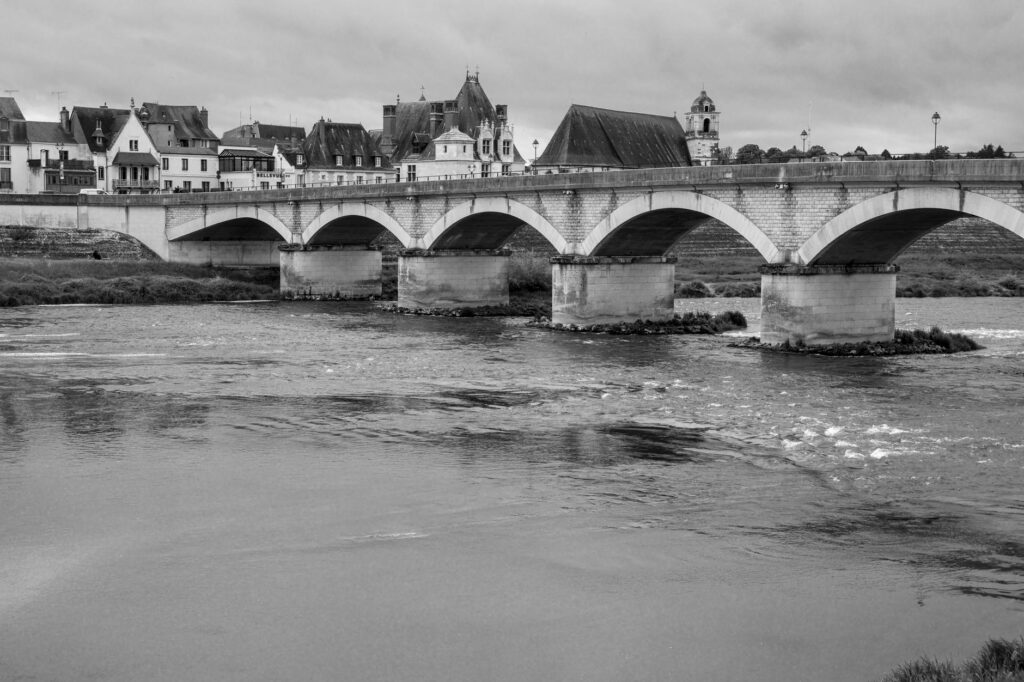
The choice of materials responded to a logic of proximity and durability. Tuffeau stone, a whitish calcareous material quarried from the very hillsides excavated to create wine cellars and troglodyte dwellings, was used for viaduct abutments and passenger buildings. This porous stone absorbs light uniquely, shifting from ivory white to golden amber depending on the sun’s inclination. The interaction between wrought-iron engineering and traditional stonework defines a railway aesthetic that has remained virtually intact since the 1850s.
The train in the Loire does not slice through the landscape; it accompanies it with the discretion of a line drawn by hand on a fluvial parchment.
Troglodyte Architecture and the Excavated Subsoil
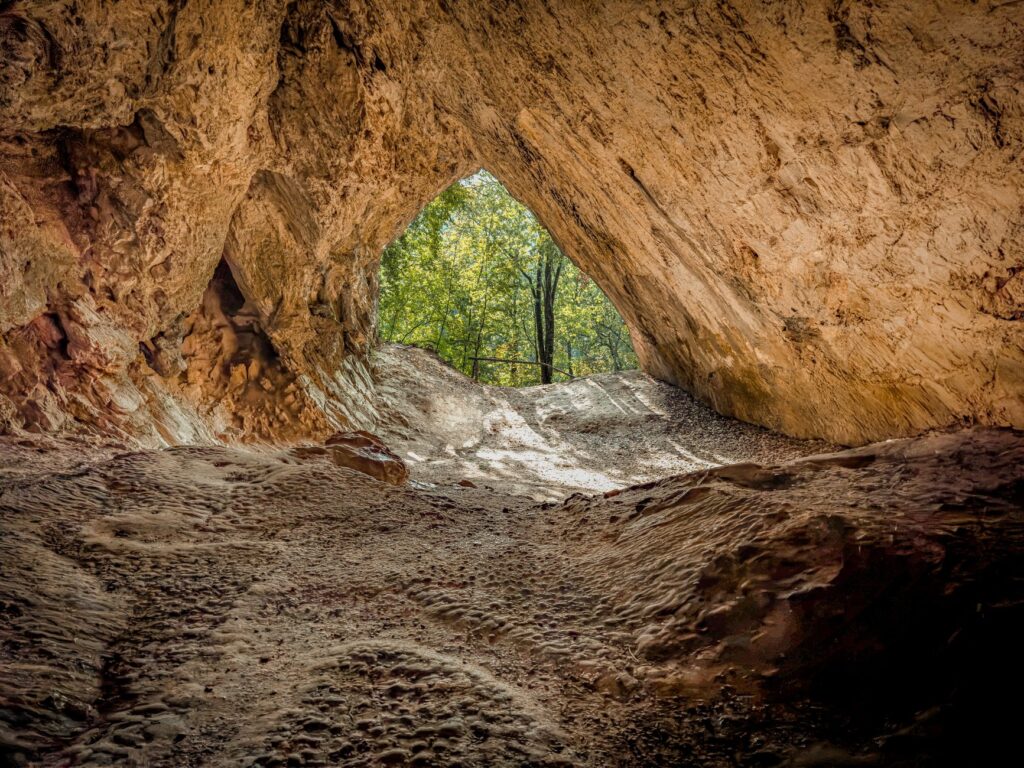
As the convoy moves westward, the cliffs bordering the river reveal a fascinating network of artificial cavities. For centuries, the massive extraction of stone to build Renaissance castles and fortified towns left a labyrinth of underground galleries that today house everything from artisanal mushroom farms to centennial sparkling wine cellars. From the train seat, arched entrances to these troglodyte dwellings are frequently visible, where temperatures remain constant at around 13 degrees Celsius year-round.
This particular geology conditioned the layout of the tracks. Across several sections between Tours and Saumur, engineers had to bore short tunnels directly into the bedrock or carve deep trenches that acoustically insulate passing convoys. The coexistence between the inhabited subsoil and the surface traversed by regional trains illustrates an exemplary adaptation of the territory. Local winemakers, whose vineyards extend directly above these galleries, have learned to leverage the proximity of stations to ship their harvests without disrupting the delicate ecological balance of the clay-limestone soils.

Sloping Vineyards and Fluvial Microclimates
The winemaking success of the Loire is intrinsically linked to its status as a river valley. The river acts as a gigantic thermal mirror, absorbing solar radiation during the day and slowly releasing it during cold autumn nights. From the elevated perspective of the railway embankment, the vineyard plots of appellations such as Bourgueil, Chinon, or Saumur-Champigny unfold in perfectly aligned terraces sloping down toward the riverbed.
The railway network facilitates low-intensity wine tourism, allowing travelers to reach secondary stations on foot or by bicycle through connections with signposted routes like the Loire à Vélo. Unlike mass highway tourism, travelers stepping off at stops like Montsoreau or Port-Boulet gain direct access to wine estates without needing a private vehicle. This intermodality reinforces a territorial development model where journey slowness forms a substantial part of the cultural experience.
Stone Strongholds and Political Power
No description of the Loire corridor would be complete without examining its fortified heritage. The railway tracks run in the shadow of fortresses that shaped French history, from the royal castle of Amboise to the imposing fortress of Chinon, perched on a rocky promontory overlooking the Vienne River. These monuments were not conceived merely as pleasure residences, but as strategic strongholds for customs and military control over river and land trade routes.

The arrival of the railway in the nineteenth century profoundly altered the function of these monuments. Far from representing a threat to heritage, nineteenth-century stations were often designed respecting the visual scale of surrounding castles, using neo-Gothic or neoclassical elements on their facades. Today, contemplating the stony bulk of Langeais from the window of a regional train crossing the river on a metal viaduct evokes a seamless synthesis of defensive medievalism and industrial modernity.
Biodiversity Recovery along Riverbanks
The gradual abandonment of heavy commercial river navigation over the twentieth century allowed the Loire to recover part of its natural dynamics, becoming the last wild river in Western Europe. The railway tracks, situated on the edges of the wider floodplain, delineate an ecological corridor cohabited by European beavers, purple herons, and colonies of migratory birds using sand islands as protected nesting grounds.
Railway operators collaborate closely with environmental authorities to minimize the acoustic and lighting impact of nighttime convoys in special bird protection areas. Vegetation management on track slopes is carried out using selective mechanical methods, avoiding chemical herbicides to protect the underground aquifers feeding surrounding wetlands. Thus, the railway line functions as a privileged mobile observatory from which to study the resilience of a fluvial ecosystem subjected to intense human pressure.

The true measure of a train journey along the Loire is not calculated in kilometers traveled, but in the capacity to attune to the geological rhythm of water and stone.
Practical guide
How to get there: The Loire railway axis connects directly from Paris via Montparnasse station (toward Tours and Bordeaux) or Austerlitz station (toward Orleans, Blois, Tours, and Nantes). Regional TER trains operate with high frequency between the valley’s main towns.
When to go: The months of May through June and September through October offer optimal weather conditions, lower tourist crowds, and the opportunity to witness the grape harvest or the blooming of river groves.
Internal transport: The best way to explore the region combining train and bicycle is using the free Train+Vélo service, available on most regional TER trains during weekends and the summer season.
Accommodation: It is recommended to prioritize historical hotels in urban centers such as Saumur or Tours, as well as traditional troglodyte houses converted into unique lodgings along secondary valley slopes.
Gastronomy and wines: Tasting local goat cheeses such as Ste-Maure de Touraine is essential, paired with light Cabernet Franc reds and dry Chenin Blanc whites produced on the hillsides adjacent to the railway tracks.
The Final Whisper of Water Among Viaduct Arches
At dusk, when the sun dips below the western horizon and dyes the waters of the Loire a deep copper tone, the last regional train crosses the great stone viaduct with a low, rhythmic rumble. On the banks, fishermen pack up their tackle while the lights of riverside settlements begin to flicker in the gloom. In that moment of temporal suspension, the traveler understands that the true essence of this territory lies not in the grandiosity of its monuments, but in the subtle harmony with which time, river, and steel have sculpted one of the most inhabited and respected landscapes on the European continent.