
Conquering the Norwegian Roof on Rails
The journey between Oslo and Bergen is much more than a simple transit between two urban centers; it stands as one of the most daring engineering feats on the European continent and a privileged observatory of Norway’s dramatic geography. Officially inaugurated in 1909 after decades of meticulous planning and titanic labor under extreme weather conditions, the Bergen Railway challenged the absolute limits of physics and human endurance. Engineers of the era were tasked with charting a route capable of subduing barren plateaus, withstanding perpetual snowstorms, and boring dozens of tunnels through solid bedrock to link the forested eastern valleys with the rugged western Atlantic coast.
Today, this railway corridor preserves its strategic and scenic value entirely intact, operating as a vital lifeline for isolated mountain communities and a global benchmark for sustainable high-mountain mobility. Spanning over 370 kilometers of track, the train ascends gradually from sea level to reach an altitude of 1,222 meters at Finse station, the highest inhabited point on the Norwegian railway network. This continuous climb radically transforms the visual surroundings, guiding the traveler from lush river valleys into an arctic desert of stone, ice, and absolute silence.
Mountain Architecture and the Climate Challenge
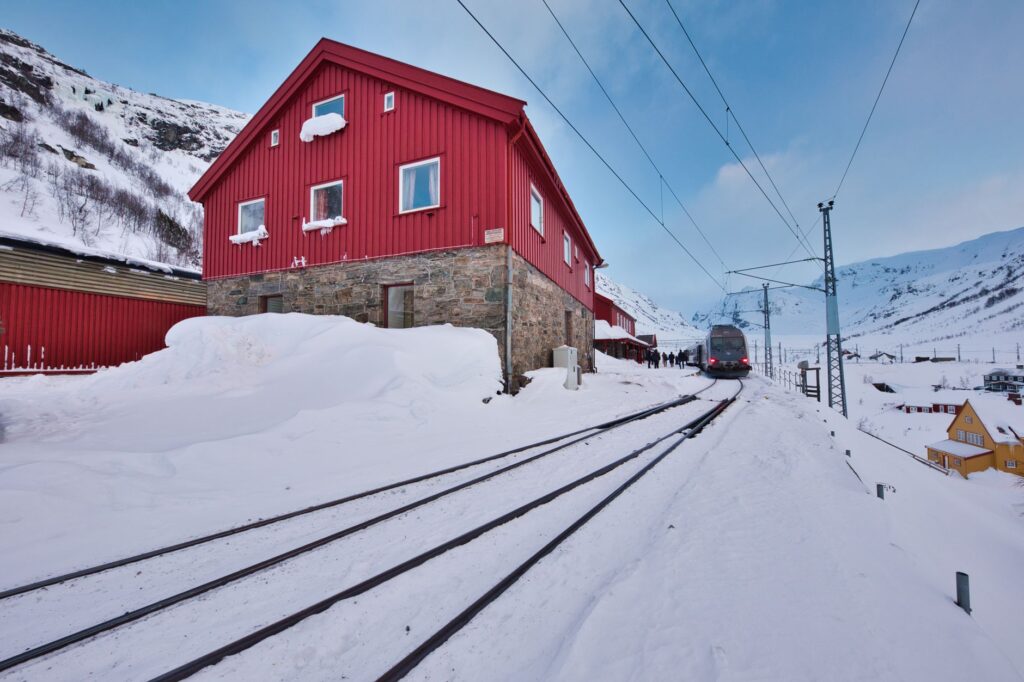
Constructing and maintaining a rail line across the Hardangervidda plateau requires monumental infrastructure engineered to withstand the full fury of the arctic winter. Large sections of the route run protected behind kilometers of solid timber snowsheds and heavy stone retaining walls designed to prevent avalanches and drifting snow from blocking the tracks. This winter defense architecture, originally built using massive timber beams and local quarried stone, blends soberly into the volcanic and glacial landscape, reminding passengers of the perpetual tension between human artifice and the implacable force of nature.
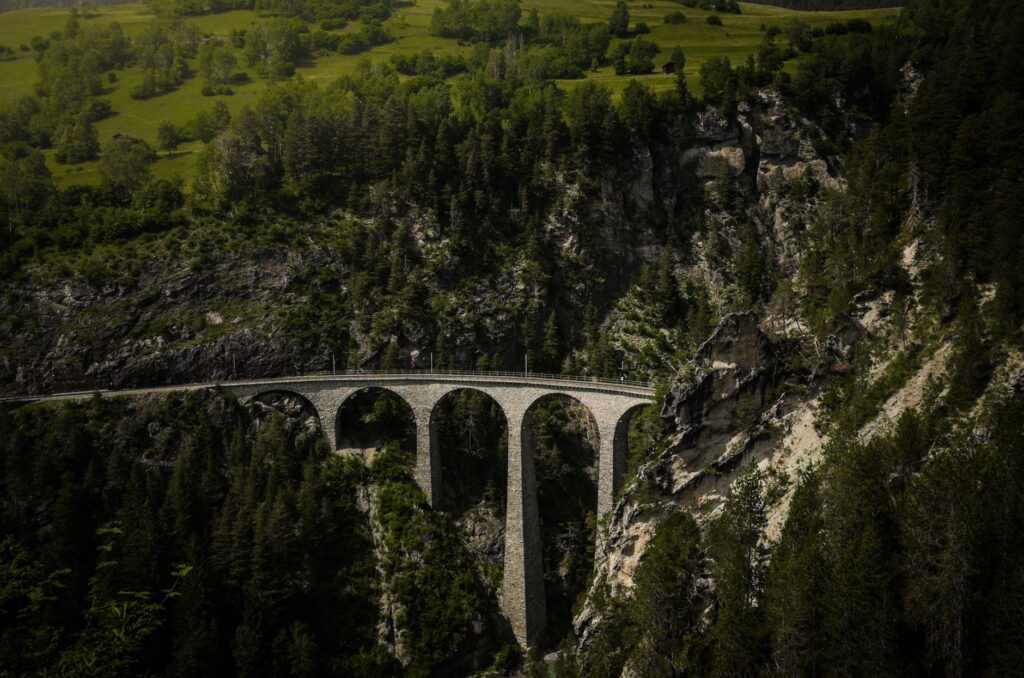
Beyond the snow tunnels, the route is defined by granite viaducts and iron bridges that span dizzying chasms over roaring glacial torrents. Finse station, nestled in the heart of the route, functions as a true meteorological laboratory and operational base for maintenance crews and expedition teams. At this elevated outpost, Norwegian engineers perfected rotary plow systems and reinforced steam locomotives that have since been succeeded by powerful diesel and electric units capable of clearing paths through zero-visibility blizzards.
The Vertical Rhythm of Valleys and Landscape Transition
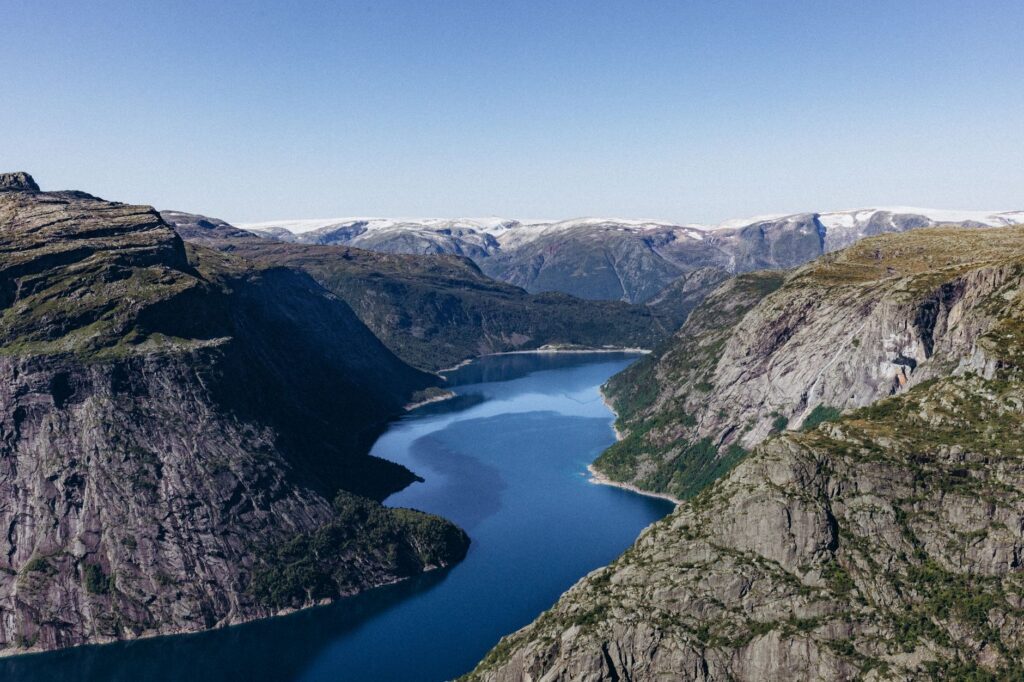
As the train departs the Oslofjord basin, the topography begins to fold and rise sharply. Agricultural fields and birch-fringed lakes gradually give way to the rugged gorges of the Hallingdal valley, where rushing rivers carve deep canyons into the granitic bedrock. Throughout this initial stretch, local communities have preserved a vernacular architecture featuring dark timber farmsteads with living turf roofs, designed to withstand crushing snow loads and provide natural bioclimatic insulation.
Crossing the Hardangervidda plateau marks the geographical climax of the journey. Here, all arboreal vegetation vanishes, replaced by resilient lichens, glacier-polished boulders, and frozen lakes that remain locked in ice for most of the year. It is within this vast white or grey expanse that solitude acquires a tangible physical dimension. Passengers gaze through panoramic windows as the weather shifts within minutes, transforming bright sunlight over snowfields into a dense horizontal fog that erases the horizon between earth and sky.
The Bergen Railway is not merely a communication route; it is a machine of time and space that tests human tenacity against the vastness of boreal elements.
The Descent to the Fjords: The Flåm Branch
After crowning the high plateau and beginning the descent toward the western slopes, the train snakes toward Myrdal, the pivotal junction where it connects with the renowned Flåm Railway. This secondary branch, widely considered a masterpiece of global civil engineering, drops 866 meters over just twenty kilometers down to the shores of the Aurlandsfjord, an arm of the majestic Sognefjord. Featuring gradients of up to 5.5 percent and a route incorporating spiral tunnels carved directly into the mountain interior, Flåm offers a radically vertical perspective of plunging waterfalls and sheer rock walls.
The engineering prowess of this detour complements the main journey by revealing how Norway’s rail system branches out to service otherwise inaccessible coastal settlements. Thundering waterfalls, such as Kjosfossen, flank the tracks as trains decelerate strategically to allow travelers to absorb the scale of an environment where human presence is manifested solely through the millimeter precision of steel and stone.
Life in Remote Stations and Traffic Control
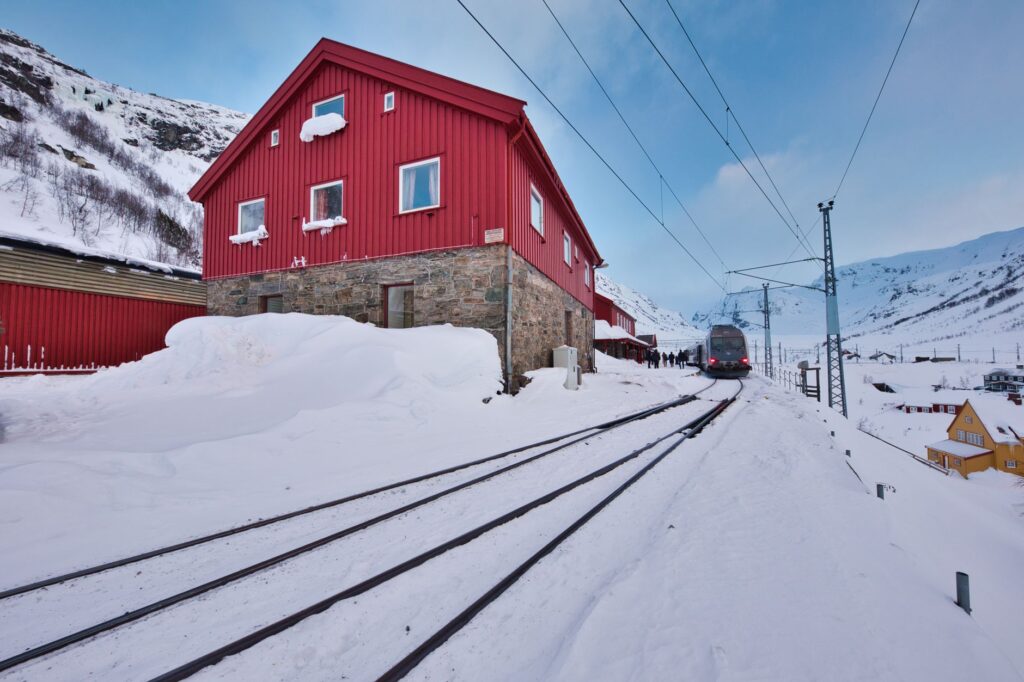
Far from being ghost stops, outposts like Finse, Hallingskeid, and Ustaoset maintain an identity deeply intertwined with the passage of the train. During the decades of railway construction, these stations originated as temporary labor camps that eventually evolved into mountain lodges and vital basecamps for cross-country skiers, glaciologists, and hikers. The arrival of the daily convoy serves as the umbilical cord connecting these isolated spots to the rest of the country, delivering fuel, provisions, and mail to temporary residents and scientific researchers operating in the harsh upland wilderness.
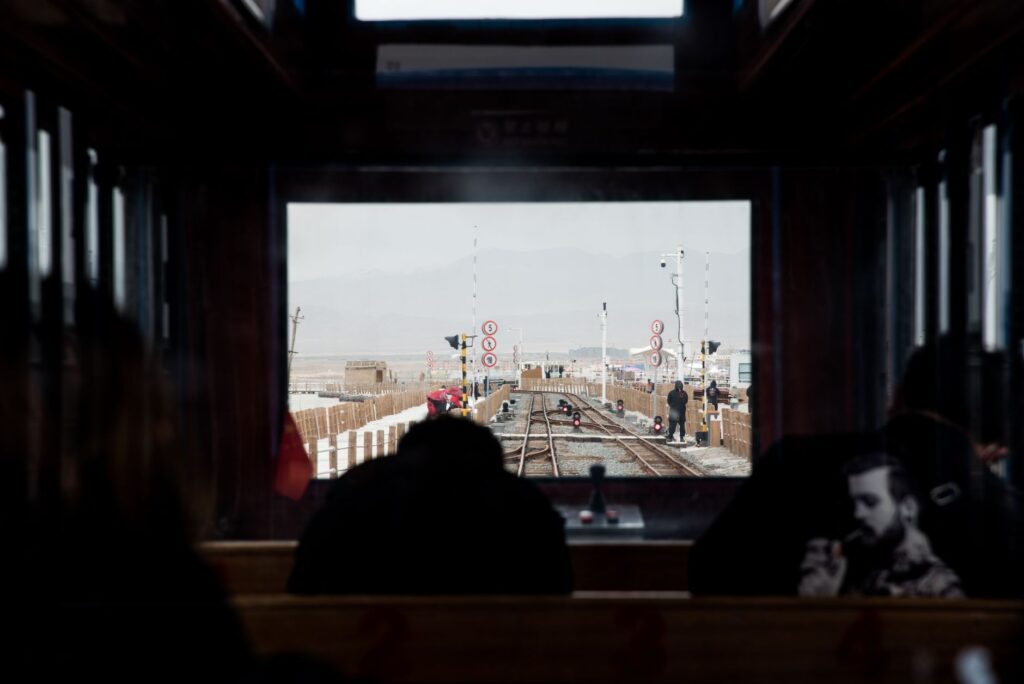
From an operational standpoint, managing the line demands millimetric coordination between traffic control centers in Oslo and Bergen. Extreme weather conditions require continuous monitoring of rail temperatures, slope snow accumulation, and embankment stability. Despite the automation of signaling systems, the human factor remains decisive in determining when to halt traffic or dispatch heavy snow-clearing trains to guarantee year-round operational integrity across this mountain corridor.
Sustainability and the Future of the Alpine Corridor
Amid Europe’s broader energy transition, the Bergen Railway stands out as a low-carbon transport model. Fully electrified since the 1960s, the line runs almost exclusively on locally sourced hydroelectric power, cementing its status as a viable and efficient alternative to air travel between Norway’s two largest cities. National railway authorities continue to invest in signaling modernization and fleet renewal to guarantee punctuality and passenger comfort without disrupting the fragile ecological balance of the protected natural reserves crossed by the tracks.
This commitment to environmental preservation extends to waste management and infrastructure maintenance conducted without invasive heavy machinery in protected zones. Modern travelers thus experience a quiet, landscape-respecting journey where the predominant sound is the rhythmic clatter of steel wheels over rail joints and the whistling of wind against double-glazed windows designed to shut out polar cold.
Traveling on the Bergen Railway forces a deceleration of thought, reminding us that the true magnitude of a territory is best understood when moving at the exact pace dictated by mountains and history.
Practical guide
- Getting there: The main terminals are Oslo Central Station (Oslo S) and Bergen Station (Bergen Stasjon), both seamlessly connected to their respective international airports via express train services and metropolitan trams.
- Tickets and reservations: Tickets should be purchased in advance via the national railway operator Vy (vy.no). Reserving seats in the panoramic carriages on the northern side during the ascent to the plateau is highly recommended.
- Recommended season: To witness seasonal duality, early summer (June) offers frozen lakes alongside blooming meadows, while winter (February to April) showcases the arctic landscape at its most dramatic.
- Luggage and clothing: Mountain weather is notoriously volatile. Dressing in layers is essential, including windproof waterproof outerwear and non-slip footwear, even during the summer months.
- Fjord connection: The detour to the Flåm Railway (Flåmsbana) branches off at Myrdal station. Combined tickets covering the train journey, fjord ferry, and connecting bus can be booked as a single itinerary.
- Route accommodation: Outposts like Finse feature historic mountain hotels (such as Finse 1222) originally built as engineering bases, which now offer specialized lodging for hikers and ski expeditions.
Epilogue at the Atlantic Terminal
When the convoy finally negotiates the final downward gradients and glides smoothly into the Bergen terminal, travelers experience a serene sense of internal transformation. The dark granite walls, the steep gables of the port city, and the salty Atlantic humidity welcome the train like a final harbor after an overland oceanic voyage. The hours spent amid snow-capped peaks and century-old tunnels condense in memory into an unbroken sequence of geometric steel lines that successfully conquered the indomitable roof of Norway.