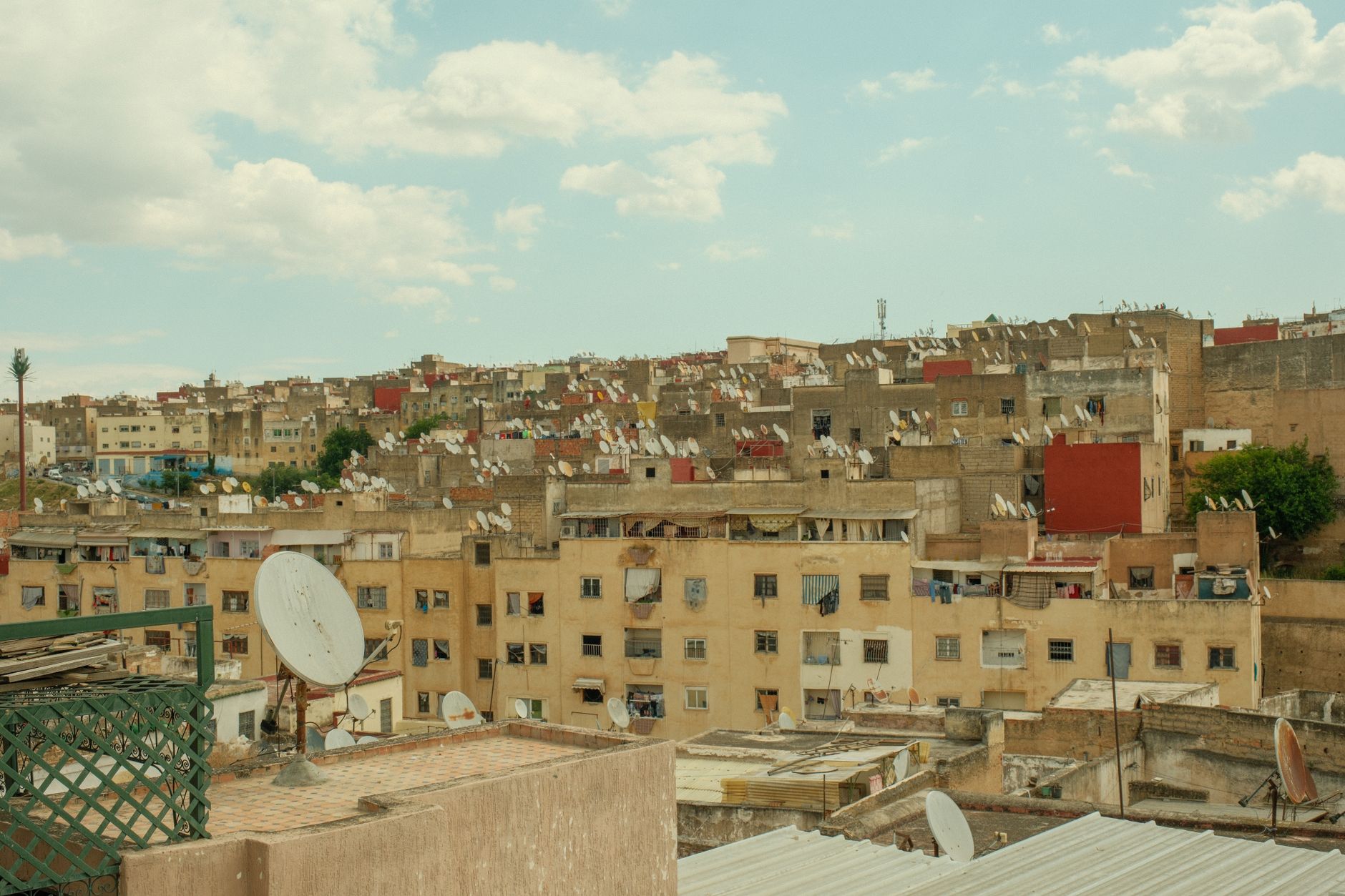

The medina of Fez, in Morocco, is a maze of alleys where time is measured in repeated gestures. Founded in the 9th century and capital of the kingdom under the Marinids in the 13th and 14th centuries, the city preserves an urban fabric that UNESCO describes as one of the most extensive and best conserved in the Arab-Muslim world. Within its 280 protected hectares, traditional trades are not an attraction for visitors: they are the quiet infrastructure that keeps houses, mosques, madrasas and fountains standing.
This report draws on documentary sources and public information from the World Heritage file. There are no invented testimonies or fictional travel experiences. What follows is an approach to the urban trades that, according to heritage records, remain active in Fez el-Bali and Fez Jedid.
A city built by specialised hands
The UNESCO file notes that the medina of Fez contains a remarkable variety of religious, civil and military monuments. Behind each one is a trade: the mason working with earth and lime, the tile cutter shaping glazed pieces, the carpenter assembling cedar ceilings, the blacksmith forging grilles and nails. The authenticity of the site, according to the same document, depends largely on the survival of these technical skills.
The city is not a frozen museum. It is an organism that requires constant maintenance. Every intervention in an old house, every restoration of a fountain or a madrasa, mobilises artisans whose skills are passed from generation to generation.
The Medina of Fez is considered one of the most extensive and best conserved historic towns of the Arab-Muslim world. Its urban space conserves the majority of its original functions and attributes.
Leather and water: the tanners of Chouara
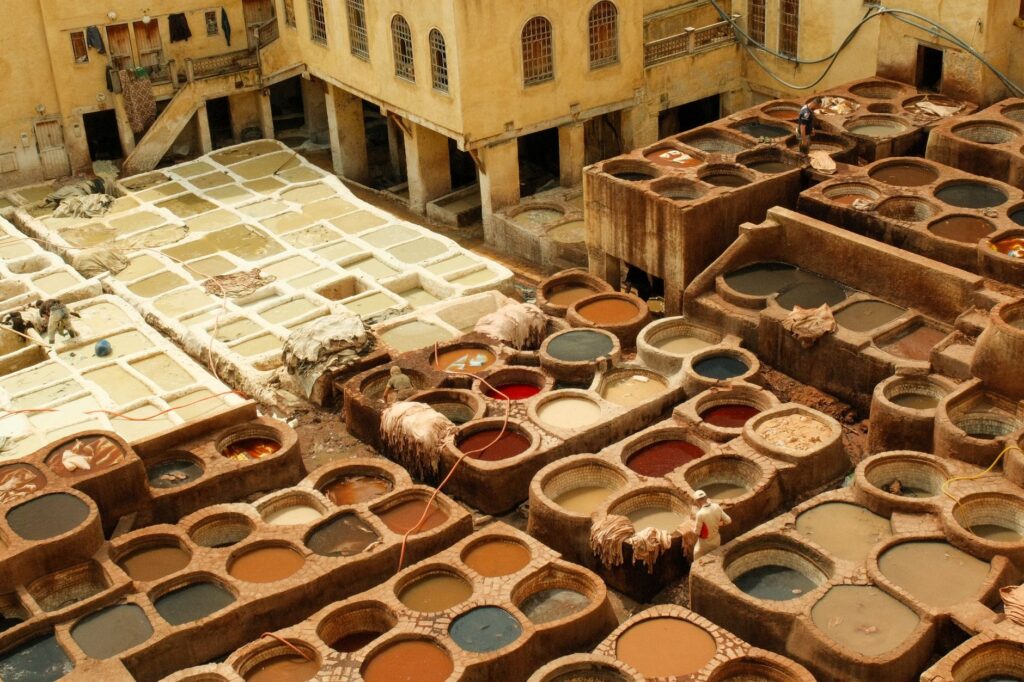
The Chouara tanneries, in Fez el-Bali, are one of the city’s most recognisable landscapes. Their operation is based on an artisanal process combining stone vats, lime, pigeon droppings, salt and water. Tanners work sheep, goat and cow hides in a cycle that can last weeks.
This is not a demonstration for tourists. The tanneries are productive units supplying leather goods, shoemaking and bookbinding workshops. The intense smell and the colours of vegetable dyes are part of an inherited technical system that the city maintains despite access difficulties, industrial competition and contemporary health requirements.
A trade that demands patience and endurance
Working in the vats requires physical strength and tolerance of harsh conditions. Artisans alternate stages of soaking, fleshing, tanning and dyeing. Each phase has its own rhythm and its own tool. The resulting leather is used for babouches, bags, belts and bindings sold in the medina itself and beyond.
Threads, looms and textiles in the heart of the medina
Fez has been a textile centre for centuries. Traditional looms produce cotton, wool and silk fabrics used in clothing, upholstery and decoration. The weaver’s trade requires setting up the warp, calculating patterns and maintaining thread tension for hours.
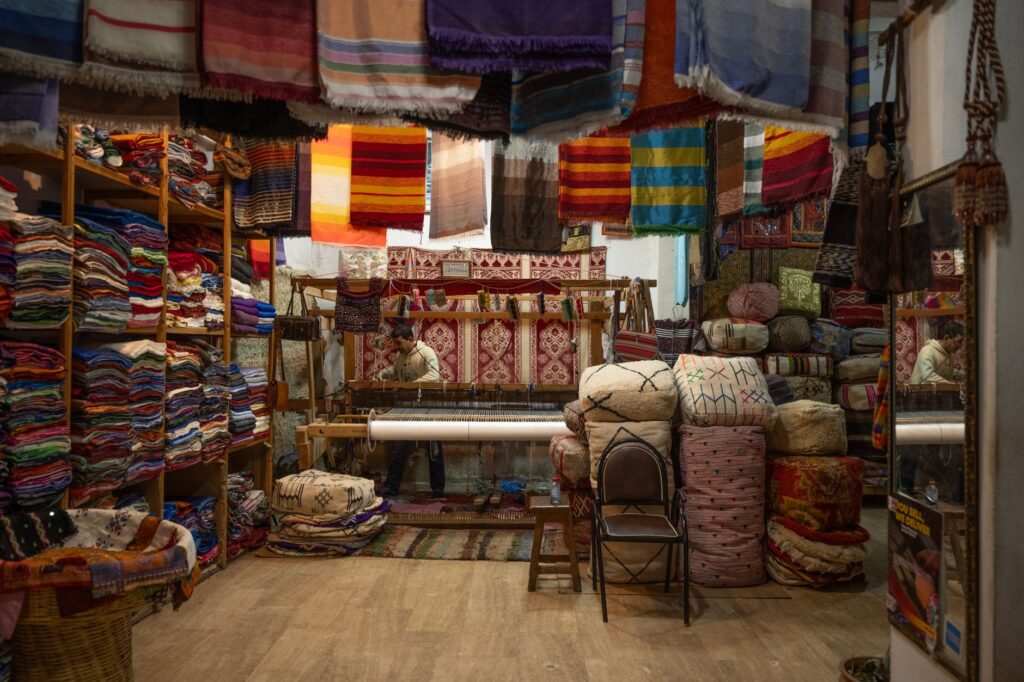
In specialised souks, such as the weavers’ souk, pieces using ancient techniques can still be found. Competition from industrial fabrics has reduced the number of workshops, but has not eliminated them. The UNESCO file explicitly mentions the survival of architectural and decorative knowledge as an advantage for maintaining the site’s values.
The survival of traditional architectural know-how, notably as regards architectural building and decoration trades, is a major advantage for the maintenance of the values of the property.
Wood, plaster and ceramic: the building trades
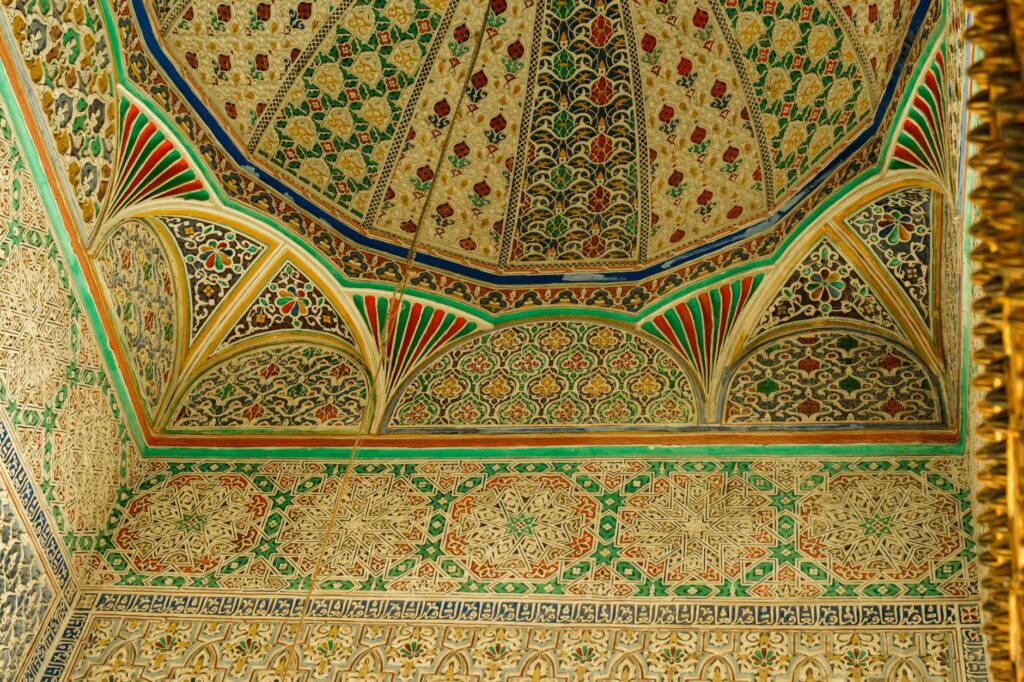
The architecture of Fez is characterised by techniques and decorations developed over more than ten centuries. Local artisans combine Andalusian, Oriental and African influences. Carved plaster, zellij tilework and cedar carpentry are part of that repertoire.
Restoring monuments such as the Bou Inania Madrasa or the Qarawiyyin Mosque requires specialists capable of reproducing geometric motifs with precision. These trades do not only embellish: they guarantee the structural integrity of buildings that have stood for centuries.
Zellij: pieces cut by hand
Zellij is a mosaic of glazed pieces cut one by one with hammer and chisel. Each fragment is fitted to form stars, polygons and braids. The process is slow and demands precise visual memory. Master tile cutters often work in family workshops, passing the trade to apprentices who start young.
Iron and copper: metals that order urban life
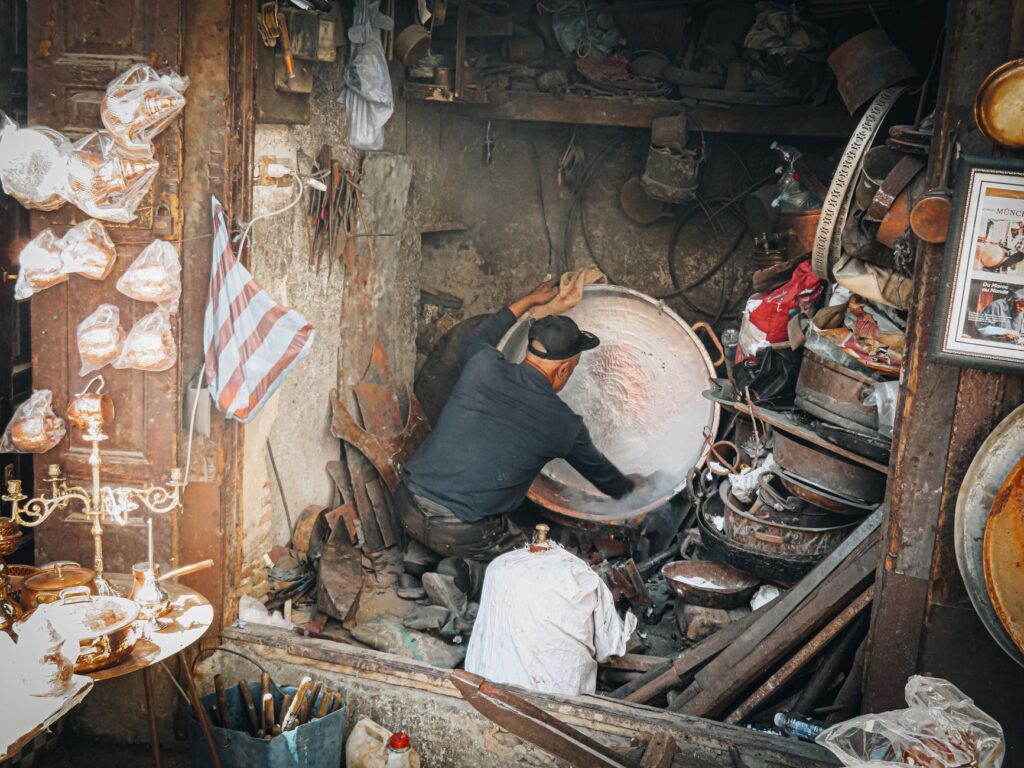
Blacksmiths in Fez produce grilles, nails, hinges, knockers and tools. Their work is present in doors, windows and screens throughout the medina. Copper, meanwhile, is worked into trays, teapots and lamps sold in the souks.
Traditional forging requires control of fire and hammer. Although some production has been mechanised, workshops that maintain manual techniques still find demand among those seeking durable, repairable pieces.
Fondouks: workshops, warehouses and lodging
Fondouks are historic buildings with a square plan, central courtyard, galleries and rooms. In the medina of Fez they served as inns for merchants and artisan workshops. Many remain in use, though adapted to new activities.
These spaces are part of the urban fabric described by UNESCO. Their conservation poses a challenge: they require maintenance, ventilation and uses compatible with their structure. Some have been rehabilitated; others await intervention.
A heritage that is inhabited
Unlike other historic ensembles turned into stages, the medina of Fez remains a place where people live, buy, pray, study and work. That condition is also its main challenge: population density and the deterioration of some buildings demand solutions that do not expel those who keep them alive.
The role of institutions and the transmission of knowledge
Morocco’s Ministry of Culture, according to the World Heritage file, oversees conservation projects. The Agency for the De-densification and Rehabilitation of the Medina of Fez handles interventions in threatened houses and notable monuments.
The transmission of trades does not depend only on public policy. It depends on families teaching their children, workshops accepting apprentices and a demand that values quality over mass production. Without that human chain, techniques are lost.
A visit with judgment: what to observe and how
The medina of Fez is not to be explored in haste. Its alleys do not follow a grid and maps are only indicative. For those who want to understand the trades, it pays to notice details: the hinges of a door, the wear on a threshold, the smell of a tannery, the sound of a hammer on copper.
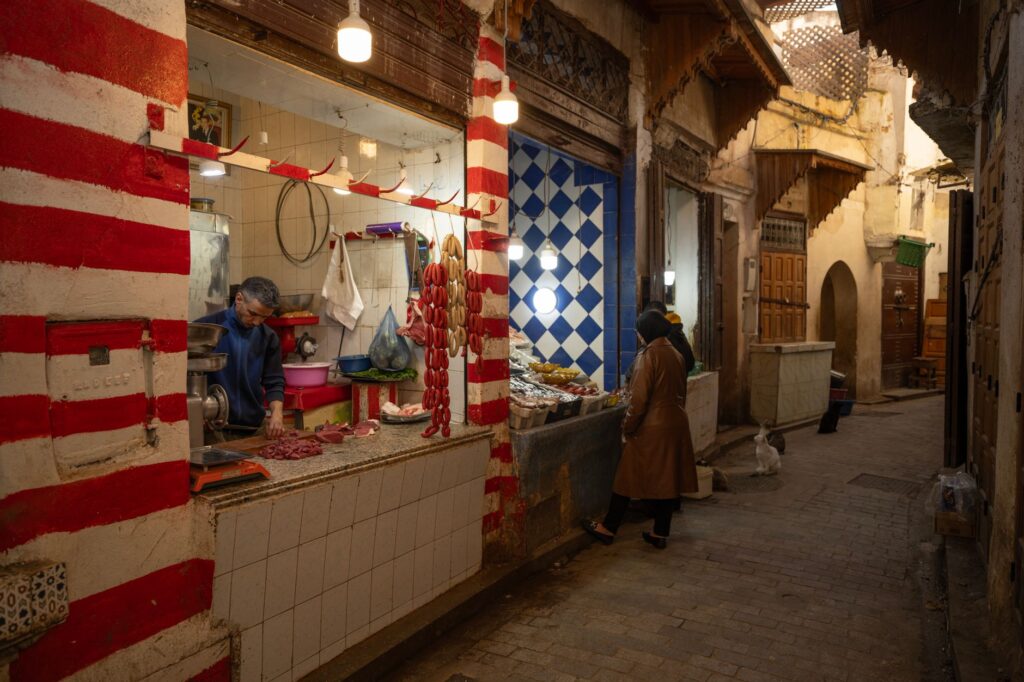
Respect for other people’s work is part of the experience. Workshops are not attractions: they are places of production. Observing without interrupting, asking permission and buying consciously are ways of recognising the value of what is seen.
Practical guide
Fez is located in northern Morocco. The medina, inscribed as a World Heritage site in 1981, comprises Fez el-Bali and Fez Jedid. Visitors should wear comfortable shoes, clothing covering arms and legs, and carry water. The terrain is uneven and distances can feel longer than they appear.
- The medina is an inhabited space: dress respectfully and ask permission before photographing people or workshops.
- Specialised souks organised by trade allow visitors to see production and buy directly.
- Tanneries are viewed from designated terraces; access to the vats is reserved for workers.
- Motor vehicles do not enter much of the medina; people walk or use hand carts.
- The best way to understand the trades is to hire accredited local guides or join craft-focused walking tours.
The medina of Fez does not offer a uniform experience. It offers a lesson in how a city can remain itself while changing. The trades that sustain it are not a spectacle: they are a form of knowledge renewed every day in small workshops, without spotlights or stages.