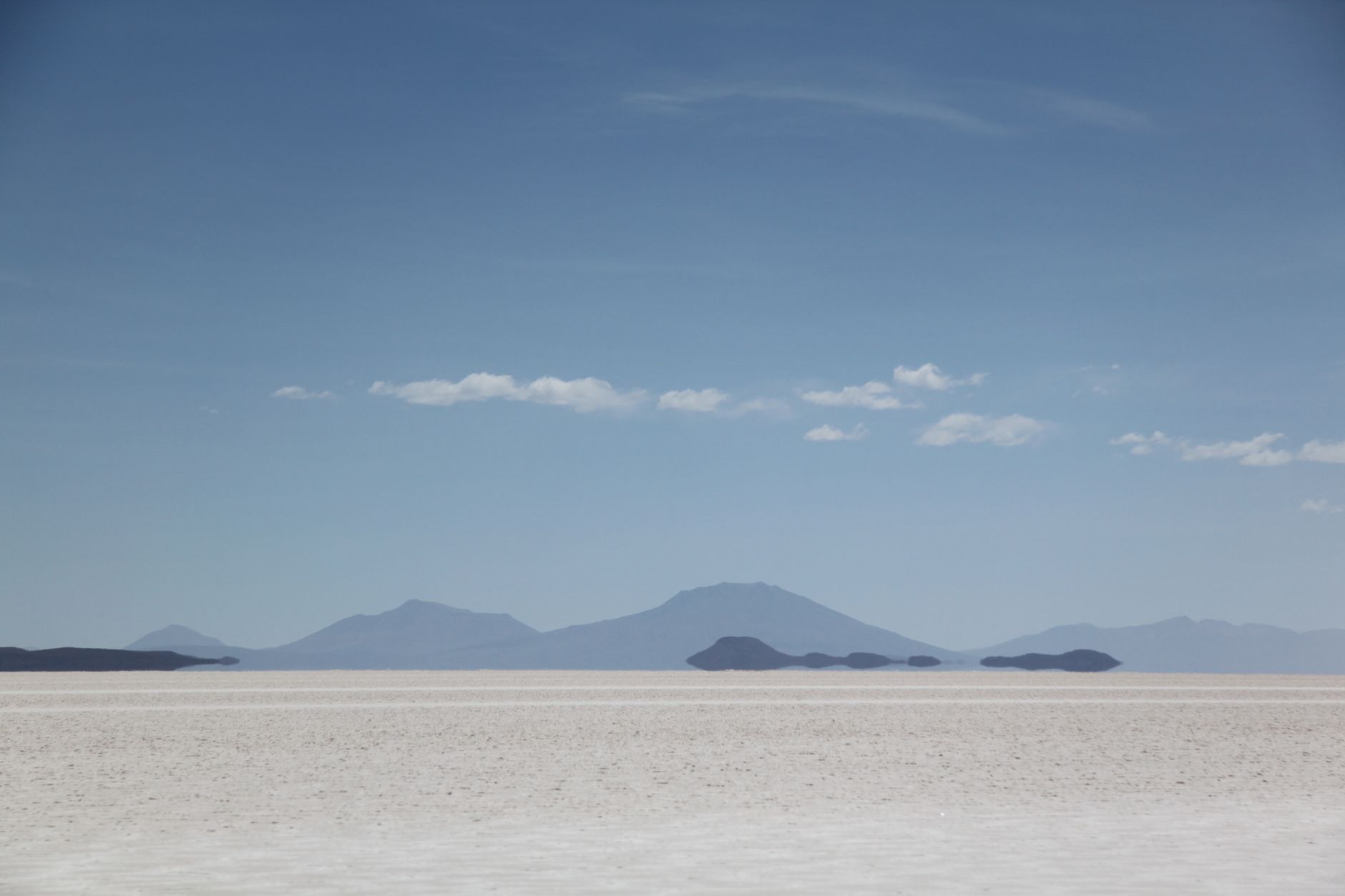

The first encounter with the Salar de Uyuni is not visual but auditory. Before the white horizon appears behind the hills of the Cordillera de los Frailes, the ear picks up a faint crunch, as if someone were walking on crushed glass. It is the salt crust cracking under the wheels of the four-wheel drives. Then comes the light: an infinite plain of 10,582 square kilometers that, in the dry season, returns the sun like a blinding mirror and, in the wet season, becomes a sheet of water where sky and earth merge.
This is the world’s largest salt flat, located at 3,656 meters above sea level in the Potosí Department of southwestern Bolivia. But reducing it to its geological wonder would be a mistake. The salt flat is, above all, an inhabited territory. This is demonstrated by the communities that have extracted salt for generations, the cooperatives that control production, the hotels built from salt blocks, and the hundreds of families that depend on tourism and mining to live in one of the planet’s most hostile environments.
A prehistoric sea turned into a pantry
Between 10,000 and 15,000 years ago, the Andean altiplano was occupied by Lake Minchín, a body of water that covered what are now the Uyuni and Coipasa salt flats. When the lake evaporated, it left behind a salt crust up to 11 layers thick and more than 120 meters deep in some points. That geological legacy is what sustains the region’s economy today.
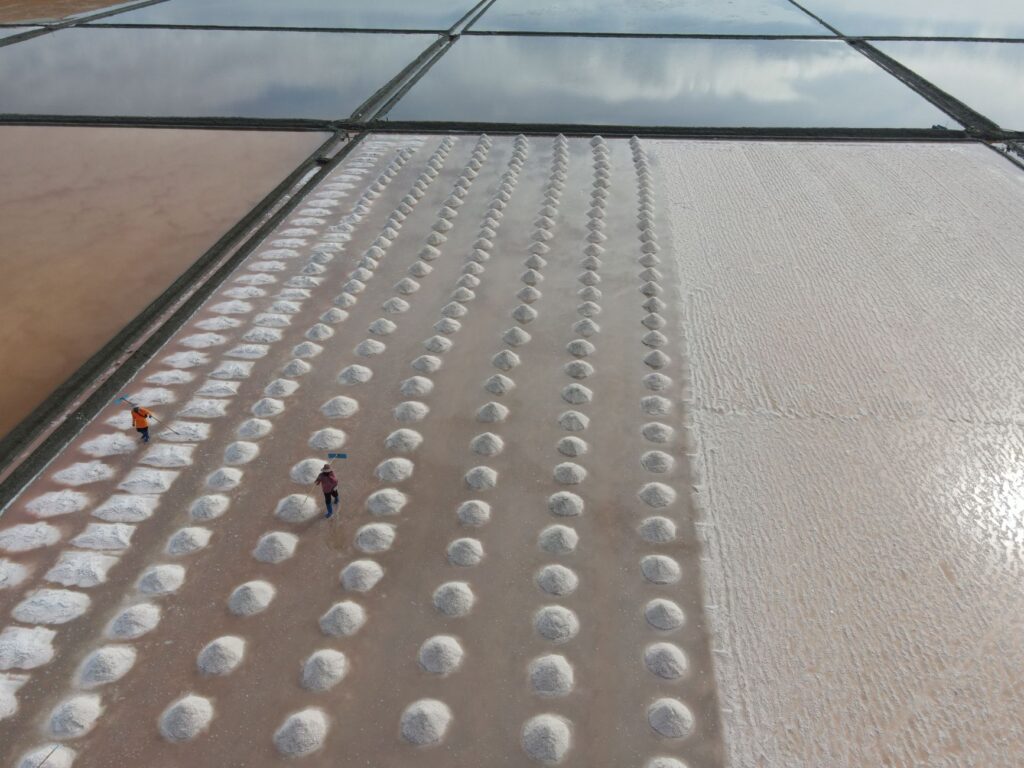
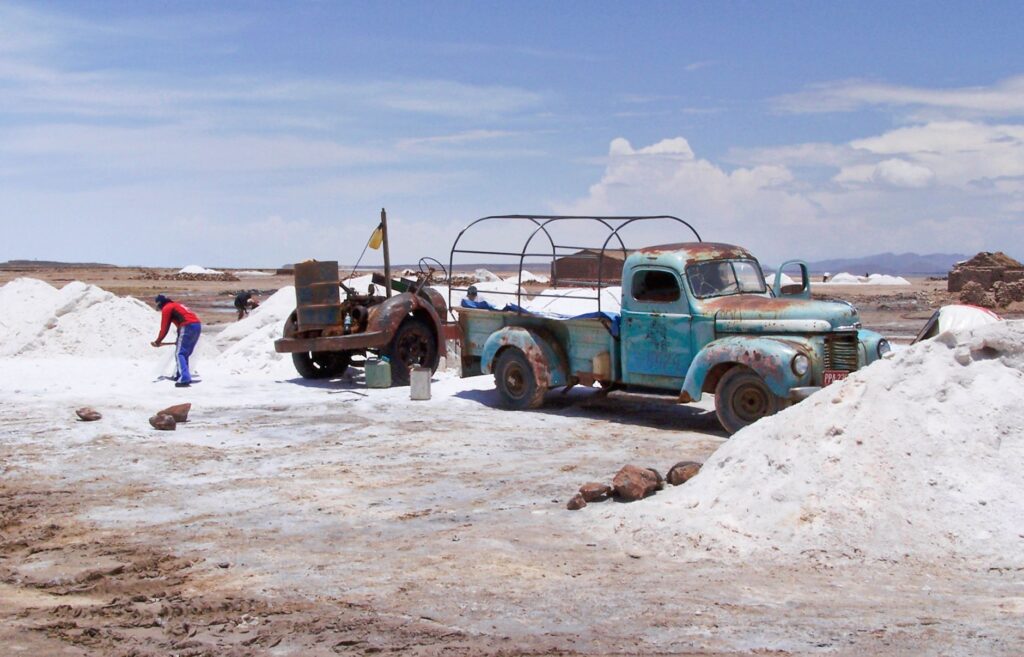
Salt extraction is an ancestral activity. Indigenous peoples, such as the Aymara and Quechua, practiced it long before the arrival of the Spanish. During the colonial era, Uyuni salt was used to preserve food and treat livestock. Today, production is organized into cooperatives that group dozens of families. In Colchani, 22 kilometers from the city of Uyuni, visitors can see how salt is piled into conical mounds and transported by truck to processing plants.
«Salt is not just a mineral. It is our history, our livelihood, and our identity. Without it, this place would be an empty desert,» explains a cooperative member from Colchani who prefers not to be identified.
The process is artisanal in much of the salt flat. Workers extract the salt with shovels and leave it to dry in the sun before moving it. In the plants, it is washed, iodized, and packaged for human consumption or destined for industry. Bolivia produces around 25,000 tons of salt per year, according to the National Institute of Statistics, although the figure varies with demand and weather conditions.
The tourism that transformed the landscape
If salt was the first economic engine, tourism became the second starting in the 1990s. Every year, more than 300,000 visitors arrive in Uyuni to tour the salt flat, according to estimates from the municipal government. Most do so in four-wheel drives hired in the city, with itineraries that include the train cemetery, the salt hotel, and the cactus islands.
The impact is ambivalent. On one hand, tourism has generated employment, improved road infrastructure, and put Uyuni on the global map. On the other, it has brought problems of waste management, pressure on water resources, and a growing economic dependence on a seasonal sector. During the high season, between May and October, the city of Uyuni goes from 15,000 to more than 30,000 floating inhabitants, straining basic services.
Local authorities and communities have begun discussing limits. Some tourism cooperatives propose daily visitor quotas, while others bet on diversifying the offer with flamingo-watching routes, night walks, and visits to indigenous communities. The underlying question is how to prevent the salt flat from becoming a theme park and keep it a living territory.
Lithium: the new altiplano gold rush
Beneath the salt crust, in the brines that extend through the subsoil, lies one of the world’s largest lithium reserves. Bolivia holds around 21 million tons of identified resources, according to the United States Geological Survey. The Bolivian government has promoted a state project to industrialize lithium since 2008, with the construction of pilot plants in the Salar de Uyuni.
Lithium exploitation is seen by some as an opportunity to diversify the economy and reduce dependence on salt and tourism. But it also raises concern among local communities, which fear the environmental impact of brine evaporation and competition for water in an extremely fragile ecosystem.
«We are not against development, but we want it done with respect. Water is scarce and the salt flat is not infinite,» says a community leader from the region.
So far, lithium production in Bolivia is limited compared to Chile and Argentina, which share the so-called lithium triangle. The Llipi plant, in the Salar de Uyuni, has struggled to reach projected production levels. The debate over the extractive model remains open.
Salt architecture: hotels that melt
One of the most photographed symbols of the salt flat is the salt hotel, built entirely from salt blocks extracted from the flat itself. The first was erected in 1993 and operated for years as tourist accommodation. Today, several hotels and refuges follow the same technique: walls, roofs, beds, and tables made of compacted salt.
Salt architecture is not just a tourist curiosity. It responds to the need to build in an environment where wood and stone are scarce and expensive to transport. Salt blocks are cut from the flat, left to dry, and joined with a mixture of salt and water. The result is a resistant, insulating, and above all available material.
However, maintenance is constant. Rain and humidity erode the walls, and each season hotels must repair or rebuild parts of their structures. It is a perfect metaphor for the relationship between humans and the salt flat: a permanent struggle against dissolution.
The inverted sky: when the salt flat becomes a mirror
During the rainy season, between December and March, a thin layer of water covers the salt flat and transforms it into the world’s largest mirror. The phenomenon attracts photographers and travelers seeking the perfect image: the sky reflected on the ground, clouds walking underfoot, the horizon vanished.
But the mirror also has practical consequences. Vehicles must take extreme precautions to avoid getting stuck in soft areas, and tours are reorganized according to conditions. For communities, the wet season is a period of lower tourist activity and greater dedication to salt extraction, which is done mainly in the dry season.
The contrast between the two seasons defines life on the salt flat. Drought imposes its rhythm of work and visits; rain brings the ephemeral beauty of the reflection and the forced pause.
Flamingos, cacti, and life in the desert
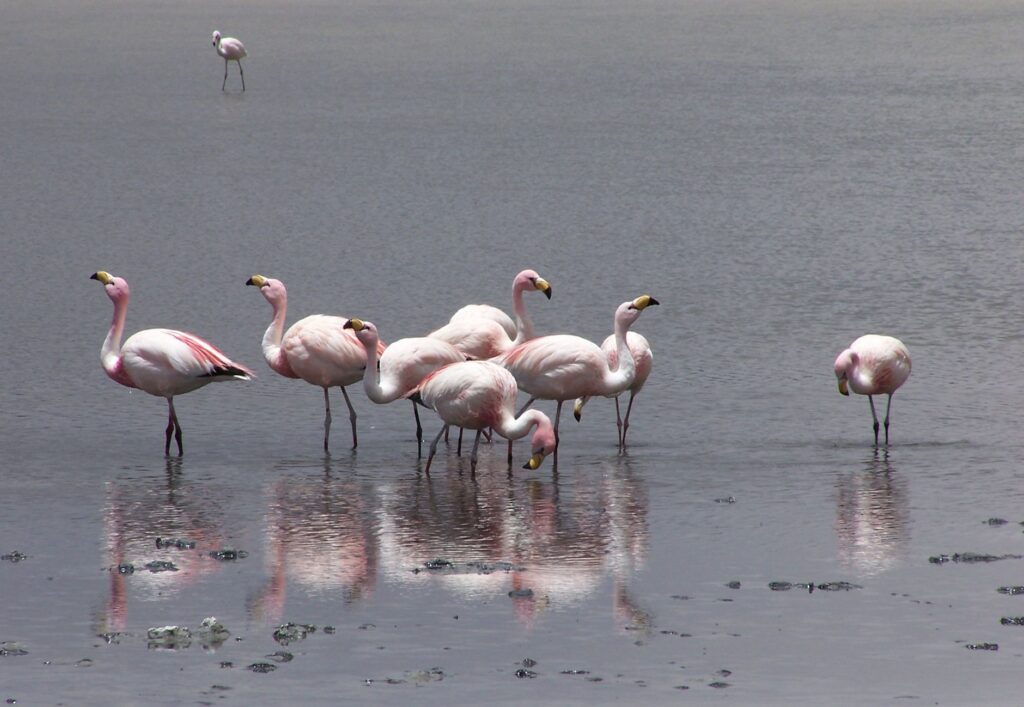
Although it may seem sterile, the salt flat and its surroundings harbor surprising biodiversity. In nearby lagoons, such as Colorada and Verde, three species of flamingos live: the Andean, James’s, and Chilean. They feed on algae and microorganisms that thrive in mineral-rich waters.
On Incahuasi Island, in the center of the salt flat, giant cacti grow up to 12 meters tall. The island is a rocky outcrop covered with cacti and petrified coral formations, a testimony to when the altiplano was underwater. Visitors can ascend a marked trail and contemplate the salt flat from above.
Wildlife also includes vizcachas, Andean foxes, and birds such as the Andean gull. Survival in this environment demands extreme adaptations: thick skins, nocturnal habits, and an astonishing ability to make use of every drop of water.
The community that sustains the salt flat
Beyond the tours and lithium plants, the Salar de Uyuni is a territory of organized communities. In Colchani, Uyuni, Llica, and Tahua, families share the tasks of extraction, transport, and sale. Many cooperatives have diversified their activities: some offer accommodation, others produce salt handicrafts, others manage restaurants.
Community organization is key to survival. Decisions about water use, waste management, and authorization of new tourism or mining projects are made in assemblies. There is not always consensus, but the system allows local voices to carry weight in a territory historically ignored by central policies.
The Salar de Uyuni is not just a landscape to contemplate. It is a place where geology, history, and daily life intertwine. The salt that is extracted, the lithium that is sought, the tourism that arrives, and the flamingos that nest are all part of the same system. Understanding it is understanding that the beauty of this white desert lies not only on its surface but in the people who inhabit and transform it every day.
Practical guide
Getting there: The city of Uyuni has an airport with flights from La Paz and Santa Cruz. It can also be reached by overnight bus from La Paz (approximately 10 hours) or from Sucre (8 hours). Tours to the salt flat depart from the city of Uyuni and from Colchani.
When to go: The dry season (May to October) offers clear skies and full access to the salt flat. The wet season (December to March) allows the mirror effect to be seen, but some roads become impassable. The shoulder season (April and November) combines good weather with fewer visitors.

What to bring: High-factor sunscreen, UV-filter sunglasses, a hat, warm clothing for the night (temperatures can drop below 0 °C), waterproof footwear, and water. The altitude (3,656 m) requires prior acclimatization; it is recommended to spend at least one day in Uyuni before starting the tour.
Where to sleep: Uyuni offers hotels and hostels for all budgets. On the salt flat, there are refuges and salt hotels, although many close during the rainy season. Communities also manage rural lodgings.
What to respect: Do not leave waste, do not extract salt or cacti, do not disturb the flamingos, and respect areas restricted by communities. The salt flat is a fragile ecosystem and an inhabited territory.
Budget: A one-day tour of the salt flat costs between 30 and 50 dollars per person, depending on the operator and the guide’s language. Three-day tours that include the Colorada and Verde lagoons cost between 100 and 150 dollars. Prices vary by season and negotiation.
At the end of the day, when the sun sets and the salt flat is tinged with orange and violet, the vehicles return to Uyuni. The cooperative members go back to their homes, the flamingos take refuge in the lagoons, and silence settles over the white crust. Tomorrow, everything will start again. The salt will still be there, waiting.