Navigating the celestial mirror of the high Andes
At nearly four thousand meters above sea level, the border between Peru and Bolivia dissolves into a liquid expanse that defies the senses. Lake Titicaca is far more than a geographical landmark; it is the navel of the Andean world, a cobalt-blue basin where sky and earth merge into a single distant horizon. Traversing its shores demands a deliberate pause, an adjustment of heart rate, and an attentive gaze toward a landscape that has witnessed the rise and fall of ancient empires without losing its imposing serenity.
In this feature, we delve into the sacred waters that cradle Inca myths and the enduring customs of peoples who have mastered the extreme harshness of high-altitude climates. From the Capachica Peninsula to the Island of the Sun, the journey offers a profound immersion into South America’s deep memory, where modern urgency pauses before traditional handlooms, reed boats, and morning songs greeting the dawn.
Geography of extremes: The highest navigable basin on Earth
The geography of Titicaca is defined by its altitude and vast scale. Covering over eight thousand square kilometers, this inland sea divides into two sectors: the larger lake, Chucuito, and the smaller basin, Huiñaymarka, linked by the narrow Tiquina Strait. The snow-capped peaks of the Real mountain range act as a perpetual backdrop, casting shifting shadows across the lake’s surface as daylight progresses.
The highland climate is a decisive factor in daily life. Days are intensely luminous, featuring relentless ultraviolet radiation due to the thin atmosphere, while nights plunge temperatures below freezing. This thermal amplitude has shaped a specialized flora and fauna, notably totora reeds —essential for housing, transport, and nourishment— and the Titicaca flightless grebe, a critically endangered endemic bird surviving in isolated reed beds.
The floating architecture of the Uros: Ingenuity against adversity
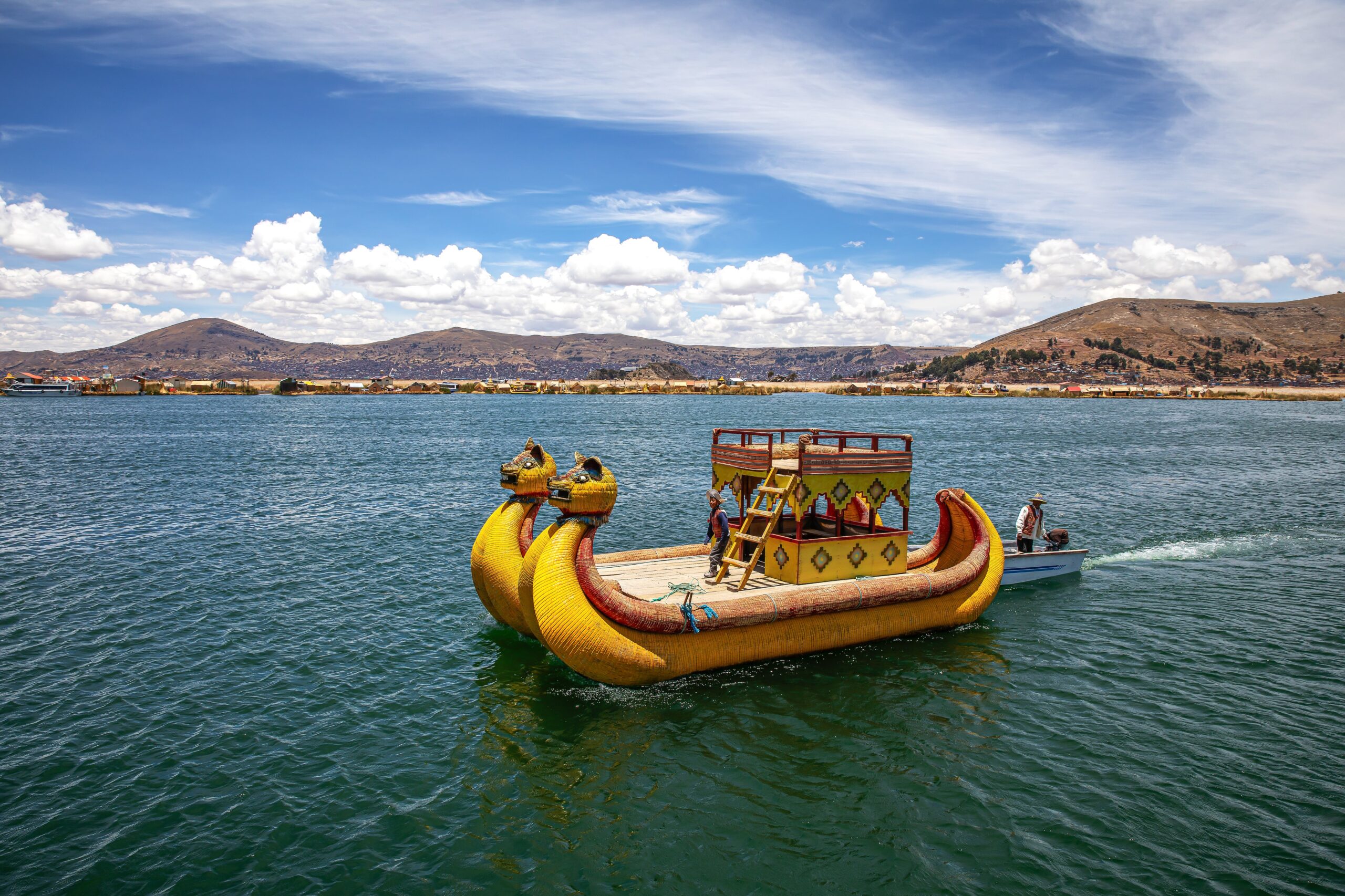
Just a few kilometers off the bay of Puno in Peruvian territory lies one of the planet’s most unique human settlements: the floating islands of the Uros. Historically compelled to flee the expansion of the Incas and Collas, this community found ultimate refuge on the water. Their construction technique involves layering dense roots of totora reeds, locally known as khili, and weaving sturdy mats that form the firm yet flexible floor of their homes.
Living upon the water requires constant maintenance. Every week, families must add fresh layers of reeds to compensate for the decay of the lower base, while eucalyptus stakes driven into the lake bed prevent the islands from drifting away. This floating architecture is no static tourist attraction, but a dynamic dwelling system showcasing remarkable human adaptability within seemingly uninhabitable environments.
The cultural pulse of Taquile and Amantaní: Weaving identity
Further out into the lake, the islands of Taquile and Amantaní reveal a cultural richness recognized by UNESCO as Intangible Cultural Heritage of Humanity. On Taquile, the role of the weaver is a matter of profound social gravity. Here, men craft fine ear-flapped caps and intricate chullos that denote marital status and community rank, utilizing a weaving technique so dense that water can be held within the garment without spilling.
The lake does not merely separate shores; it unites communities under an ancestral code of deep respect for Pachamama and sacred waters.
Social organization on these islands relies on collective principles where land and labor are shared. Motorized vehicles and large hotel infrastructures are absent; travelers arriving here are welcomed through community-based rural tourism, lodging with local families who share their meals, myths, and worldview. It is an exchange where the visitor ceases to be a passive spectator, becoming temporarily part of the communal machinery.
Highland flavors: The ancient pantry of the altiplano
Gastronomy around Titicaca faithfully reflects the resources of the lake environment and the high-altitude valleys. The star aquatic catches are pejerrey and trout, introduced in the early twentieth century but fully integrated into the local diet. They are frequently served fried, accompanied by native potatoes in varied shapes and textures, or in hot soups designed to combat the biting afternoon chill.
On land, agriculture relies on ancient staples such as quinoa, kañiwa, and an immense variety of tubers subjected to natural dehydration yielding chuño or tunta. This ancestral method preserves potatoes for years, ensuring food security against frequent highland frosts. Local markets in Puno and Copacabana offer a sensory explosion blending medicinal herbs, dried meats, and traditional stew aromas.
Stone memories: Copacabana and imperial imprints
Crossing the border into Bolivian territory, the landscape culminates in Copacabana, the principal pilgrimage center on the lake’s shores. The imposing white colonial-Moorish basilica guards the Dark Virgin, a statue venerated by locals and transport workers alike, who come to bless their vehicles with flowers, beer, and syncretic rituals blending Catholicism with Andean cosmology.
Close to the sanctuary, Mount Calvario offers a demanding hike that rewards travelers with unmatched panoramic views of the peninsula and surrounding islands. Along the slopes, pre-Inca agricultural terraces remind visitors that these hillsides were intensively farmed to sustain dense populations, demonstrating technical mastery that continues to astonish modern scholars.
The sacred route to the Islands of the Sun and Moon
The spiritual climax of the Titicaca journey lies on the mythical Island of the Sun, regarded in Inca mythology as the birthplace of the Sun god and empire founders Manco Cápac and Mama Ocllo. Disembarking at its docks initiates an ascent up the Yumani stairway, a stone path leading to the Fountain of the Three Waters, a sacred spring carved into rock symbolizing youth, happiness, and eternal life.
Across the island, steep paths meander through terraced farm fields and archaeological ruins such as the Pilko Kaina temple, a labyrinthine palace with trapezoidal niches that served as a temporary residence for Cusco sovereigns. Nearby, the smaller Island of the Moon houses the Iñakuyu temple, a seclusion center for the Sun Virgins, where polished stone architecture dialogues with the absolute silence of the lake and the vast Andean sky.
Practical guide
How to get there: The main access from the Peruvian side is via the city of Puno, connected by bus and train from Arequipa and Cusco. On the Bolivian side, the usual starting point is La Paz, traveling by bus to Copacabana and crossing the Tiquina Strait by motorboat.
Best time to visit: The dry season, spanning from May to October, offers clear skies and sunny days, though with freezing nights. Rainfall concentrates between November and April, turning the landscape vibrant green but occasionally complicating navigation routes.
Accommodation: Puno and Copacabana feature varied hotel options. On the islands of Taquile, Amantaní, and Sun Island, community-run rural tourism homestays provide the most authentic lodging.
Health recommendations: Given altitudes exceeding 3,800 meters, proper acclimatization during the first two days is essential, alongside avoiding heavy meals, maintaining hydration, and drinking coca-leaf infusions to prevent altitude sickness.
The eternal heartbeat of the high-altitude waters
At dusk, when the sun dips behind the mountain range and bathes Titicaca in golden and violet hues, the lake reclaims its most intimate, mysterious dimension. Boats return slowly to harbors, children gather final reeds from the shore, and the silence of the Puna envelops travelers in profound stillness. This is no destination for rushed itineraries or fleeting postcards; it is a territory demanding time, respect, and the humble willingness to listen to the heartbeat of a sea in the clouds that jealously guards the oldest secrets of the Andes.
Source in EN: El Viajero in EL PAÍS (https://elpais.com/elviajero/viajes/2026-09-21/vivir-el-titicaca-un-viaje-al-alma-de-los-andes.html)