
Origins and Deployment of the Trans-Indochinese Railway
The construction of the Trans-Indochinese Railway, popularly known as the Reunification Express, represents one of the most complex civil engineering milestones undertaken in Southeast Asia during the French colonial era. Conceived in the late 19th century under the administration of Paul Doumer, the project aimed to unify the various protectorates of French Indochina through a continuous meter-gauge track connecting major rice and coal production centers with strategic coastal ports. Works spanned decades, confronting a capricious topography, impenetrable jungles, and extreme climatic conditions marked by seasonal monsoons.
The original layout responded not only to extractive interests and military control but also established the first major logistical network capable of vertebrating a territory over one thousand seven hundred kilometers long. French engineers and thousands of local laborers mobilized under strict labor regimes had to pierce mountains, erect hundreds of metal bridges, and design embankments capable of withstanding annual floods from the torrential rivers of the country’s central and northern regions. This foundational infrastructure laid the groundwork for modern Vietnamese railway connectivity, adapting over the decades to the geopolitical upheavals that shook the region throughout the 20th century.
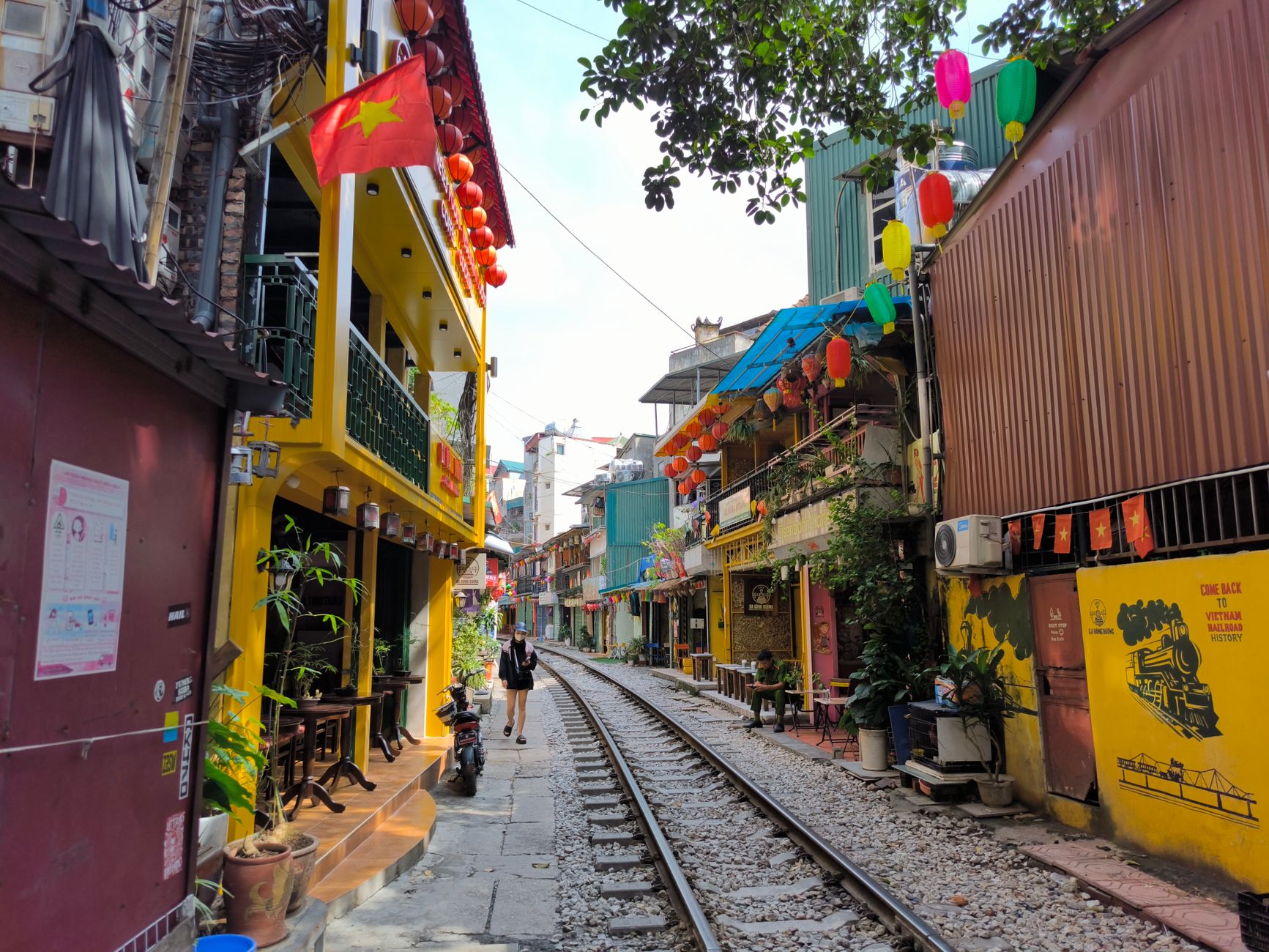
Today, the line survives not merely as an archaeological testament to railway engineering, but operates as a vital corridor for medium and long-distance passenger transport, as well as cabotage freight traffic. Although limited in speed compared to modern high-speed networks proliferating elsewhere in East Asia, the meter-gauge system maintains undeniable economic relevance by connecting peripheral industrial nodes with the deep-water ports of Haiphong and Saigon.
Vertical Geography and Topographic Challenges
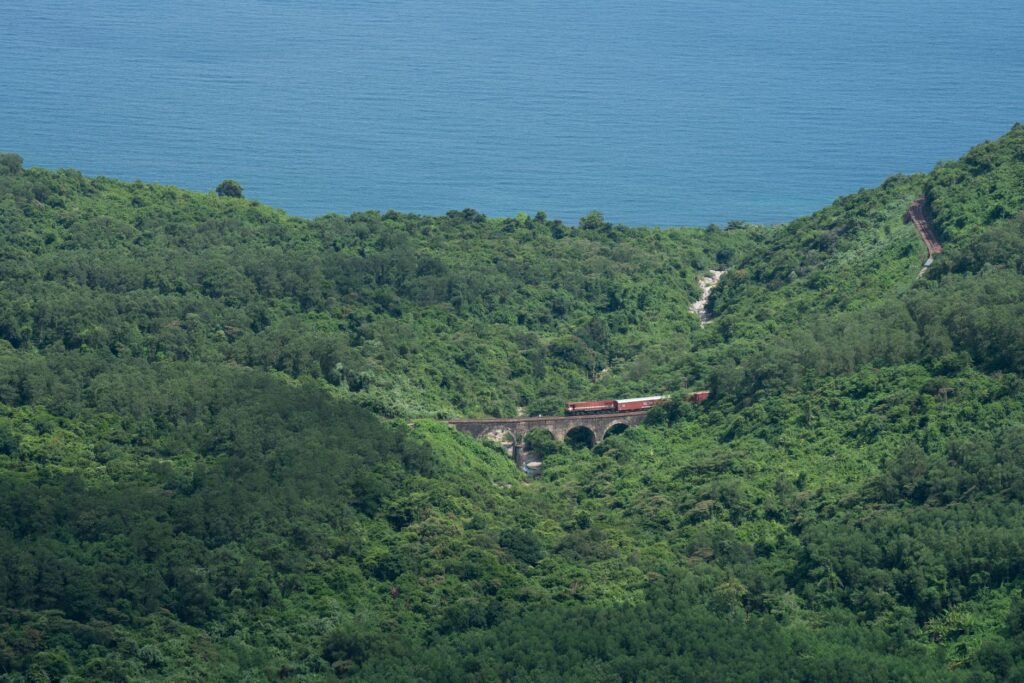
The railway trace winds along Vietnam’s eastern coast, offering a radical landscape transition ranging from river deltas to rugged marine cliffs. The most emblematic section from a technical standpoint is situated at the Hai Van Pass, the natural border separating Thua Thien Hue province and the municipality of Da Nang. In this sector, historically known as the pass of clouds, the track climbs steep slopes via loops and tunnels excavated into living rock, defying constant landslides and marine corrosion.
Overcoming this topographical obstacle required innovative technical solutions for its time, including the installation of masonry buttresses and complex drainage systems designed to channel seasonal torrential rainfall. Engineers had to calculate curvature radii with absolute precision to allow heavy steam locomotives to haul loads without compromising convoy stability on the narrow track. This mountain section continues to require intensive maintenance by conservation crews from the state-owned enterprise Vietnam Railways.
Further north, the route enters the karst formations of Ninh Binh province and the alluvial valleys of the Red River, where the instability of clay soils demands continuous monitoring of the subgrade. Each station and siding along this vertical geography functions as a millimeter gear within a system where punctuality depends equally on the machinist’s skill and the rigorous reading of local meteorological bulletins.
Infrastructure, Rolling Stock, and Contemporary Logistics
The rolling stock operating along the Trans-Indochinese Railway has undergone gradual modernization, combining foreign-built diesel locomotives with passenger cars adapted to the demands of international tourism and domestic transit. Although the infrastructure falls short of the electrification and double-track standards found in Europe or Japan, logistical management has improved notably thanks to the implementation of digitized signaling systems in the centralized command posts of Hanoi and Da Nang.

The coexistence of express passenger trains and freight convoys requires meticulous scheduling of single-track passes. Since much of the route lacks continuous double tracks, trains must wait in specific sidings to allow priority units to pass. This operational model, inherited from past railway practices, demands exceptional human coordination between stationmasters stationed in remote settlements and central traffic controllers.
In addition to passenger transit, the line plays a crucial logistical role in Vietnam’s industrial supply chain, moving containers, raw materials, and agricultural products from inland provinces to intermodal terminals connected with maritime ports. This multimodal integration reduces pressure on National Highway 1A, a road corridor saturated by heavy truck freight.
Station Architecture and Urban Heritage
The main stations along the Trans-Indochinese line constitute architectural pieces of great historical value, blending the formal language of the French Third Republic with vernacular elements of traditional Vietnamese construction. Hanoi’s station building, with its exposed brick facade and gabled roofs, maintains the operational prestige of major colonial rail hubs, while Da Nang’s terminal stands out for its harmonious integration with the modern urban fabric of the central coast.
Across more than seventeen hundred kilometers of track, dozens of secondary stations preserve their original structure of hardwoods and terracotta tiles, functioning as spontaneous community centers where local residents commercialize fresh produce as trains pass. These brief stops offer a glimpse into the daily lives of rural communities that have grown under the rhythm of the railway, untouched by the vertigo of large industrial metropolises.
The railway is not merely a transport line; it forms the guiding thread of national collective memory and a physical archive of industrial architecture in Southeast Asia.
Preserving this architectural heritage faces significant challenges due to urban expansion and the need to expand logistical facilities in urban centers. However, growing institutional awareness emphasizes the urgency of protecting these historic stations as cultural and tourist assets.
Onboard Experience and Life in Motion
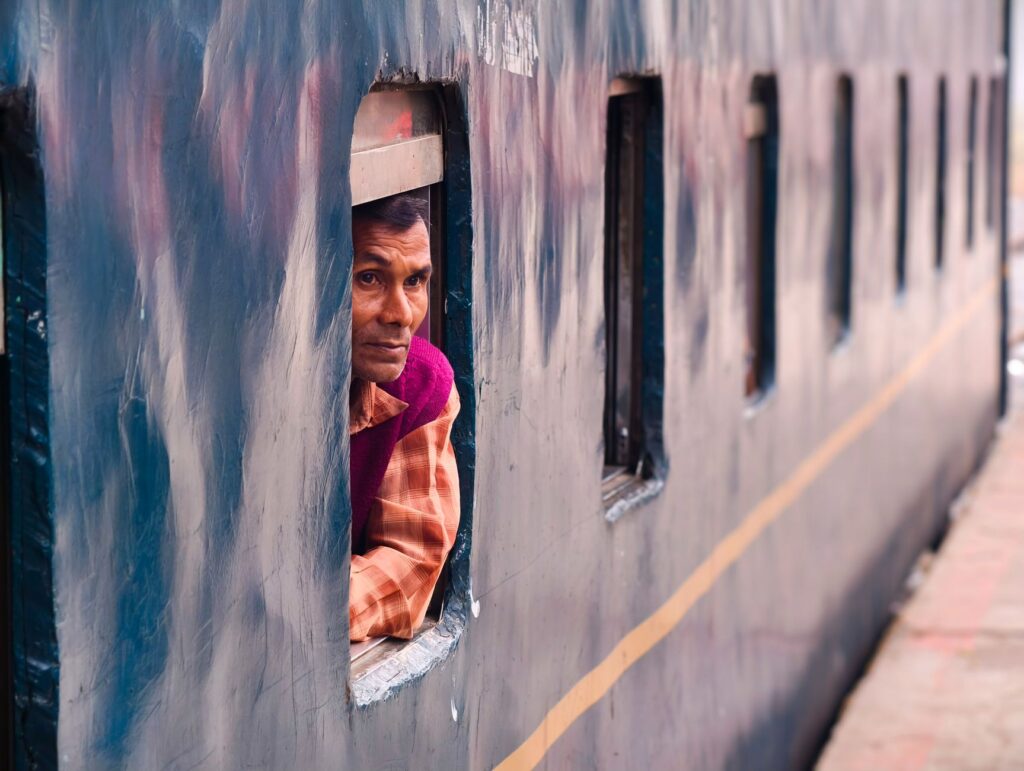
Traveling end-to-end on the Trans-Indochinese Railway requires embracing a temporality alien to commercial aviation standards. Complete journeys exceed thirty hours, turning the railcar into a micro-cosmos where local families, merchants, students, and international travelers coexist in search of a leisurely perspective of the Vietnamese territory. Sleeper compartments, equipped with basic yet functional amenities, encourage spontaneous social interaction among passengers from highly diverse socioeconomic backgrounds.

The onboard catering service, managed by small local entrepreneurs boarding at intermediate stations, offers an authentic sample of regional cuisine, ranging from central hot noodles to northern spiced broths. This constant mobility generates a circular economy around the track, where small local producers depend directly on train schedules to commercialize agricultural and artisanal goods.
Observing the landscape through large windows reveals Vietnam’s socioeconomic transformation: traditional rice fields cultivated using ancestral methods now alternate with modern industrial parks, expanding residential zones, and major highway infrastructures crossing the country from north to south.
Safety, Maintenance, and Future Challenges
Operational safety on the Trans-Indochinese Railway is conditioned by the infrastructure’s vulnerability to extreme weather events, especially typhoons and floods battering the coastal strip during the monsoon season. Vietnam Railways civil engineering teams operate under strict emergency protocols to swiftly repair track sections damaged by river overflows or hillside landslides in mountainous zones.
Medium-term modernization plans contemplate the comprehensive renovation of existing infrastructure, including replacing wooden sleepers with prestressed concrete, upgrading telecommunication systems, and rectifying tight curves to moderately increase the commercial speed of convoys. Nonetheless, budget constraints and the technical complexity of intervening in a historic layout require prioritizing investments in high-traffic density sections.

The debate concerning the potential construction of a new standard-gauge high-speed line remains open in the country’s governmental and academic circles. While financial viability and execution timelines for such a megaproject are discussed, the Trans-Indochinese Railway continues to guarantee territorial cohesion and basic logistical supply across Vietnam.
Practical guide
- Route planning: Tickets should be purchased in advance through the official Vietnam Railways platform or authorized agencies, especially during Tet (Lunar New Year) festivities.
- Service classes: Options include soft/hard seats and air-conditioned sleeper cabins (4-berth Soft Sleeper or 6-berth Hard Sleeper), the latter being ideal for long overnight journeys.
- Luggage and safety: Keep personal documentation close at hand and monitor valuables, utilizing storage spaces beneath lower berths.
- Onboard dining: While light meals are served onboard, travelers are advised to bring their own provisions and bottled water for journeys exceeding twelve hours.
- Intermodal connections: Major stations connect with urban bus networks and official taxis; agreeing on fares or using mobile ride-hailing apps in large cities is recommended.
Epilogue on Rails and Horizons
At dusk, as the silhouette of the Truong Son mountains merges with the copper hue of the tropical sky, the convoy moves forward with the steady clatter of metal joints over the meter-gauge track. In that moment of pause, the traveler understands that the true value of this centennial infrastructure lies not only in its logistical efficiency, but in its capacity to reveal the human scale of the territory.
The railway remains a suspended bridge between colonial memory and 21st-century dynamism, inviting us to read the landscape at the exact speed of thought.
Amid secondary stations wrapped in mist and flashes of urban lights announcing arrival at major economic hubs, the Trans-Indochinese continues writing its history on wood and steel ties, reminding us that train travel is, above all, an exercise in attention and respect for the distance covered.