


At the western edge of New Guinea, where the Pacific Ocean meets the Indian, emerges a labyrinth of limestone and jungle that defies the conventions of modern geography. Raja Ampat, or the Four Kings, is not merely an elite diving destination; it is the final stronghold of a marine biodiversity that seems to belong to another geological era. Navigating these waters demands a profound understanding of planetary rhythms, where tides dictate access to secret lagoons and the currents of the straits determine the viability of every passage.
The experience of traversing this archipelago aboard a traditional Pinisi schooner offers a unique perspective on the relationship between humanity and the sea. These wooden vessels, built according to ancestral techniques declared a World Heritage Site, become floating laboratories from which to observe an ecosystem housing over 75% of the world’s known coral species. The journey is an immersion into the logistical complexity of one of Southeast Asia’s most remote regions, where aesthetic beauty intertwines with the technical rigor of oceanic navigation.
The Heart of the Coral Triangle: Geography of a Sanctuary
Raja Ampat spans approximately 40,000 square kilometers of sea and land, comprising over 1,500 minor islands surrounding the four main ones: Waigeo, Misool, Salawati, and Batanta. This region is the core of the Coral Triangle, an area of critical importance for the health of global oceans. The archipelago’s geological configuration, characterized by karst formations rising vertically from turquoise waters, creates a network of protected channels and bays that serve as natural nurseries for thousands of species.
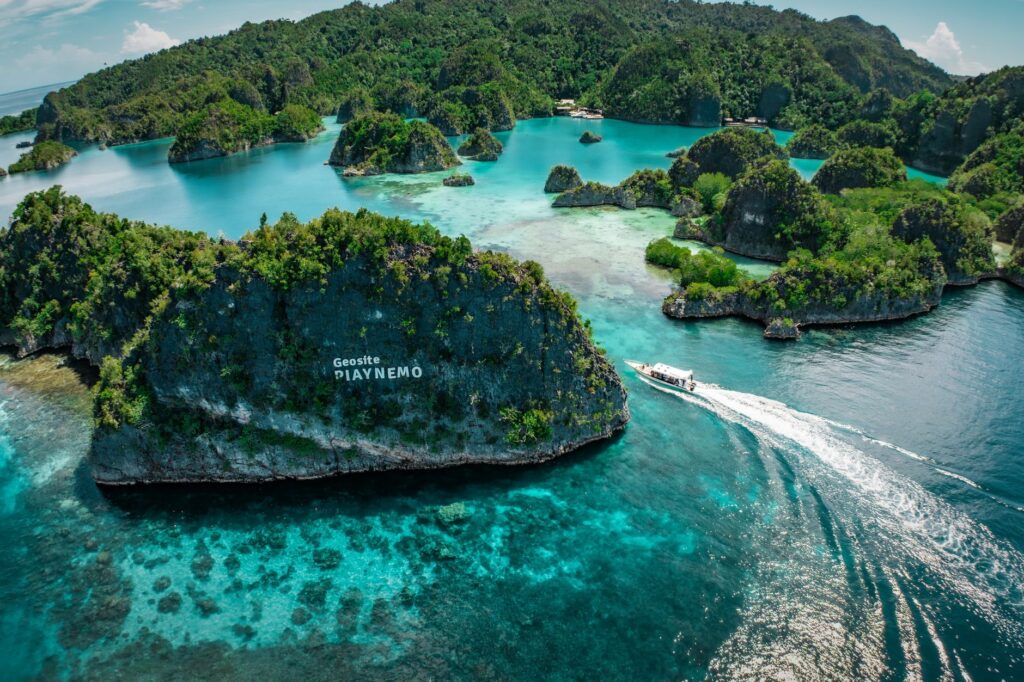
From an oceanographic standpoint, the area is a meeting point for massive water bodies. The Indonesian Throughflow, an oceanic current transporting water from the Pacific to the Indian Ocean, passes through these straits laden with nutrients. This technical feature explains the exuberance of marine life but also imposes severe challenges on navigation. Captains must precisely calculate time windows to cross areas like the Dampier Strait, where currents can reach speeds exceeding the capacity of conventional engines on heavy-displacement vessels.
The Architecture of Wind: Sailing a Traditional Pinisi Schooner
The choice of vessel is no minor detail in Raja Ampat. The Pinisi, a two-masted schooner originating from the Bugis ethnic group of Sulawesi, represents the perfect symbiosis between tradition and functionality. Built without written blueprints using ironwood (Eusideroxylon zwageri) and teak, these ships possess stability and a draft that makes them ideal for exploring Indonesian archipelagos. Their design allows for stable navigation even when sea conditions become erratic due to monsoonal shifts.
Aboard a modern Pinisi, logistics becomes an art form. Managing resources such as fresh water and fuel is critical, given that refueling infrastructure is virtually non-existent outside the port city of Sorong. The vessel’s autonomy defines the expedition’s reach. Desalination systems and waste management are essential technological components that allow these wooden giants to operate sustainably in such a fragile environment.
“Sailing Raja Ampat is not merely a geographic relocation; it is a return to the ocean’s primal state, where the rhythm is set by the water rather than the clock.”
Mapping the Currents: Technical Challenges in the Straits
The Dampier Strait, separating Waigeo from Batanta, is perhaps the most technical navigation area in the entire archipelago. Here, water is forced through a relatively narrow channel, creating whirlpools and upwellings that attract large pelagics like manta rays and sharks, but also test the mettle of any navigator. Route planning must consider the Sorong tide tables, adjusted for the local variations of each island.

Night navigation in these waters is restricted by the presence of coral reefs that rise abruptly from depths of 50 meters to the surface. The use of high-definition radar and forward-looking sonar is indispensable, although visual watch remains the most reliable tool in lagoon areas. The helmsman’s skill in reading the color of the water—from the cobalt blue of the depths to the emerald green of the sandbanks—is what ensures the safety of the traverse.
The Labyrinth of Misool: Realm of Limestone and Silence
While northern Raja Ampat is famous for its biodiversity, the south, dominated by the island of Misool, stands out for its geological spectacularity. Here, limestone islands have been sculpted by erosion over millennia, creating a landscape of spires and sea caves. Navigating Misool is an exercise in precision; entering lagoons like Love Lagoon or exploring the Tomolol caves requires the use of shallow-draft auxiliary tenders.
In Misool, environmental protection is extreme. Much of the area is managed by conservation concessions that have successfully eradicated dynamite and cyanide fishing. For the navigator, this means that anchoring zones are strictly regulated to avoid coral damage. The use of permanent mooring buoys is mandatory in many spots, requiring prior logistical planning to secure a safe and legal overnight anchorage.
Expedition Logistics: Supply in Isolation
Conducting a 10 to 14-day traverse through Raja Ampat requires a meticulous supply chain. Sorong, in the West Papua province, acts as the only real logistical hub. Before setting sail, schooners must load fresh provisions, mechanical spares, and, most importantly, emergency medical supplies. In an environment where the nearest hospital with a hyperbaric chamber may be days of sailing away, safety is the absolute priority.
Communication during the traverse is limited. While some areas near major villages have basic mobile phone coverage, most of the archipelago remains in a digital shadow zone. Professional expeditions rely on satellite phones and GPS tracking systems to maintain contact with the mainland. This forced disconnection adds a layer of authenticity to the adventure, compelling participants to focus entirely on the natural surroundings.
Encounters at the Edge of the World: Papuan Maritime Culture
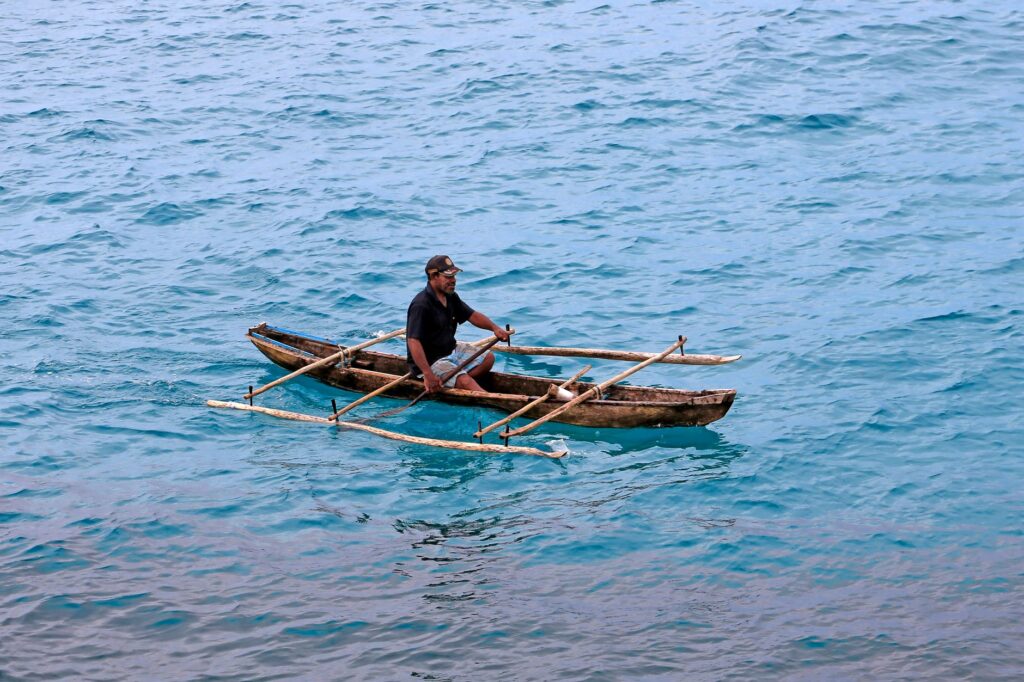
Despite its uninhabited appearance, Raja Ampat is home to communities that have lived in harmony with the sea for generations. The villages of Arborek, Sawinggrai, and Yenbuba are examples of how Papuan culture has adapted to insularity. Their inhabitants are the guardians of these reefs, and many of the protected areas result from community management agreements known as Sasi, a traditional practice that prohibits the extraction of certain resources during specific periods to allow for regeneration.

Interacting with these communities requires a protocol of respect and reciprocity. Village visits must be coordinated and usually involve paying fees that directly benefit the local economy. Observing the construction of traditional canoes or participating in a welcoming ceremony allows one to understand that Raja Ampat is not just a giant aquarium, but a living territory with a complex and profound social history.
Sustainability and the Reef’s Future
The surge in tourism over the last decade has tested Raja Ampat’s resilience. Managing environmental impact is the greatest challenge the archipelago faces. The entry permit system (PIN conservation fee) is a fiscal tool that funds patrols against illegal fishing and environmental education programs. However, rising sea temperatures due to climate change remain a latent threat that no permit can fully stop.
Expedition schooners are adopting zero-waste policies, eliminating single-use plastics and using biodegradable cleaning products. Visitor education is fundamental: not touching coral, using reef-friendly sunscreens, and maintaining a respectful distance from marine wildlife are non-negotiable rules. The future of Raja Ampat depends on our ability to be invisible observers in an ecosystem that does not belong to us.
“The true frontier is not on the map, but in our ability to protect what still remains intact.”
Practical guide
To undertake a traverse through Raja Ampat, planning should begin at least six months in advance. The main entry point is Domine Eduard Osok Airport (SOQ) in Sorong. There are daily connections from Jakarta, Makassar, or Manado operated by Indonesian domestic airlines. It is essential to check baggage allowances, as internal flights are often restrictive regarding weight.

The best window for sailing is during the northwest monsoon, from October to April, when waters are calmest and underwater visibility is at its peak. Between June and September, the southeast monsoon can bring strong winds and rough seas, especially in the Misool area, leading many vessels to cease operations or relocate to other regions of Indonesia.
- Documentation: A passport with at least six months of validity is required. Most nationalities can obtain a Visa on Arrival (VoA) at international airports.
- Conservation Permit: It is mandatory to purchase the Raja Ampat Marine Park entry card. The cost is around one million Indonesian Rupiah (approx. 65 USD) and is valid for one year.
- Health: Raja Ampat is a malaria-risk zone. It is recommended to consult a travel medicine center regarding appropriate prophylaxis and the use of potent repellents.
- Currency: The Indonesian Rupiah (IDR). There are ATMs in Sorong, but once in the archipelago, cash is the only form of payment in the villages.
- Gear: In addition to diving or snorkeling gear, it is essential to bring lightweight, quick-drying clothing, footwear for walking on sharp rocks, and high-spectrum sun protection.
The Echo of Ancestral Waters
As evening falls over the archipelago, when the sun hides behind the pinnacles of Wayag, silence takes over the landscape. Only the gentle splashing of water against the schooner’s wooden hull breaks the stillness. At this moment, one realizes that Raja Ampat is not a place to be conquered, but to be contemplated with humility. The vastness of the ocean and the fragility of the life it holds remind us of our position in the natural order.
The final photograph of a journey to these reaches should not just be an image of a colorful reef or a perfect sunset, but the memory of a recovered connection with the planet’s essence. Upon leaving these waters, the traveler takes not only memories but the responsibility to give a voice to a sanctuary that, despite its invincible appearance, depends on global awareness to continue existing. Raja Ampat is, ultimately, the mirror of what the world once was and what we can still save.


