
As the iconic red convoy of the Rhaetian Railway (RhB) winds through the slopes of the Albula Valley, travelers experience a strange distortion of physical reality. It is not just the altitude, which will soon exceed two thousand meters, but the audacity of an infrastructure that seems to ignore the laws of gravity. In this region of the Swiss Alps, the train does not merely move forward; it rises above itself through spiral tunnels and stone viaducts that form perfect loops, allowing the engine to gain height without resorting to rack-and-pinion technology—an engineering milestone that earned it UNESCO World Heritage status in 2008.
This report explores the backbone of the Grisons, a railway network that is much more than a luxury tourist attraction. It is, in essence, the umbilical cord that keeps the isolated communities of the Engadin connected with the Poschiavo Valley and the Italian Valtellina. Through a technical and human analysis, we discover how this «iron pulse» has shaped the identity of a territory where winter lasts six months and rail transport is the only guarantee of survival and cultural cohesion against Europe’s most hostile geography.
The Paradox of Adhesion: Engineering Against Verticality
The construction of the Albula line, inaugurated in 1903, and the subsequent Bernina line, completed in 1910, represented an unprecedented technical challenge for the time. Unlike other high-mountain railways that use a third toothed rail for traction on steep slopes, the Rhaetian Railway bet on pure adhesion traction. This means the steel wheels must bite the rail relying solely on the weight of the locomotive and friction, even on gradients reaching 7%—an astronomical figure for a conventional train.
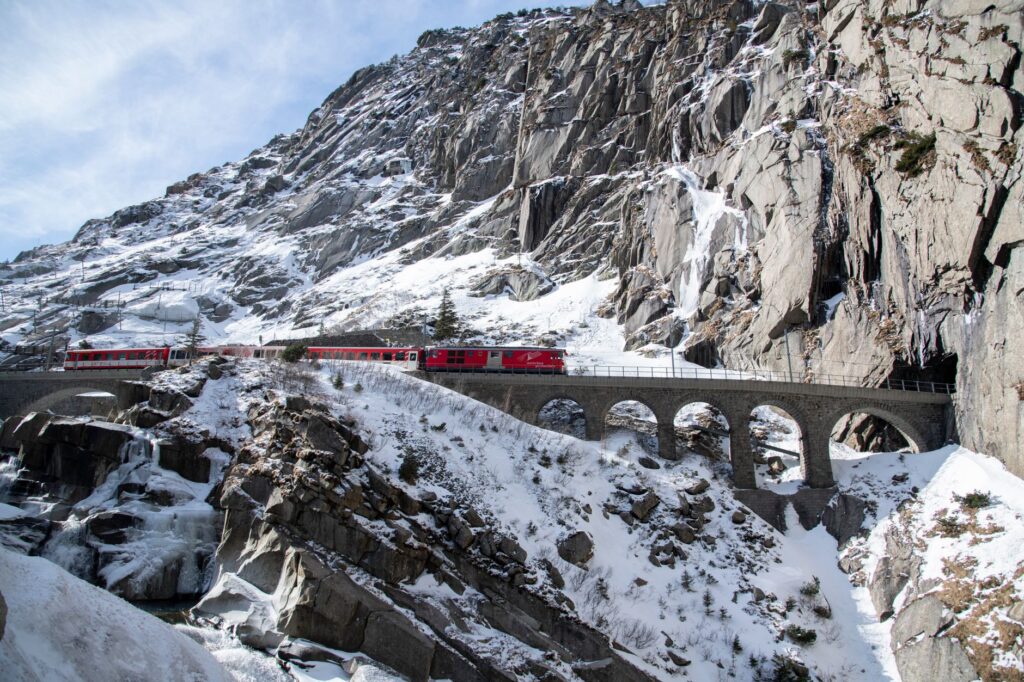
To enable a multi-carriage convoy to ascend from 429 meters in Tirano to 2,253 meters at Ospizio Bernina, engineers designed a layout based on circular geometry. The Brusio Viaduct is the most eloquent example: an open-air helical structure that allows the train to complete a full 360-degree turn over itself to gain height in a confined space. This solution not only solved a logistical problem but created one of the world’s most beautiful industrial aesthetics, where local stone blends with the landscape of conifers and granite.
The Albula Tunnel and the Secret of the Spirals
Between the stations of Bergün and Preda, the line performs an exercise in geological contortionism. In just a few kilometers of linear distance, the train must overcome a height difference of 416 meters. The solution was the creation of three spiral tunnels and two helical tunnels. Passengers lose their orientation as the train enters and exits the mountain, crossing the Albula River repeatedly, always at a higher level than before. «It is a mechanical dance over the abyss,» comment the maintenance engineers who inspect the tracks every night.
The Human Factor: Guardians of the Red Line
Behind Swiss precision lies an army of professionals operating in extreme conditions. During the months of January and February, snow accumulation at the Bernina Pass can exceed six meters. Here, rotary snowplows—some of them historic steam-powered gems still kept operational for emergencies—are responsible for clearing the way. Connectivity is not an option; it is a public service obligation that the RhB fulfills with a punctuality that defies blizzards.
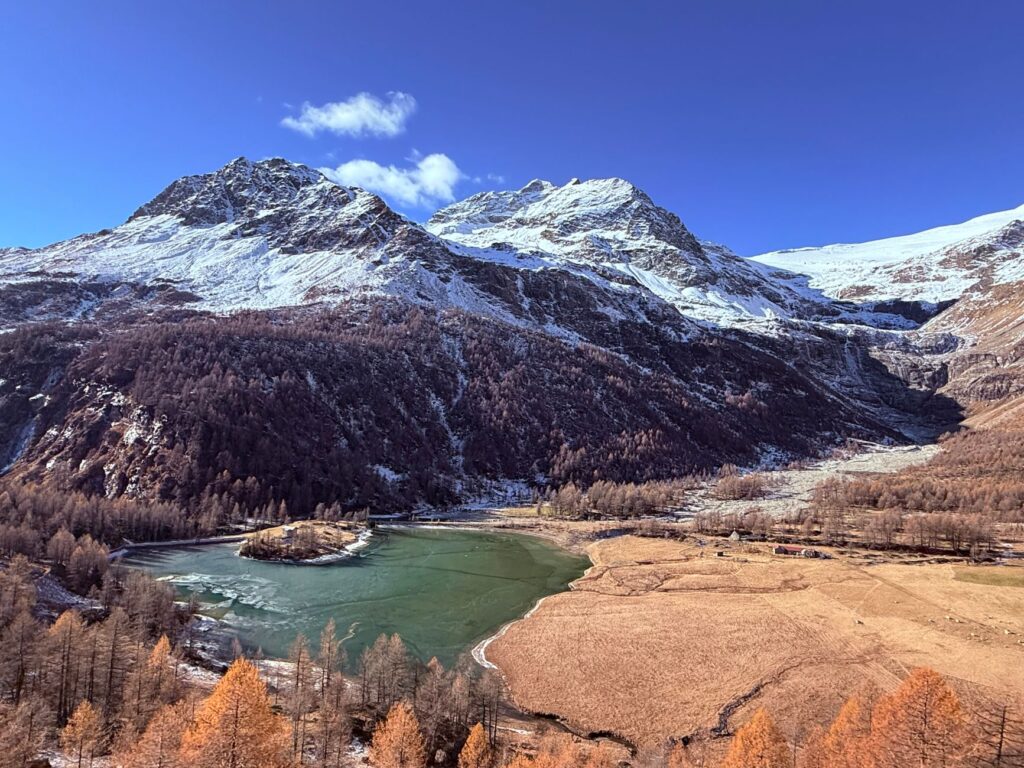
Station masters in remote spots like Alp Grüm, accessible only by train or on foot, represent a way of life that resists total automation. These posts do not just manage rail traffic; they act as meteorological observers and rescue points for mountaineers. Their presence ensures that, despite the cutting-edge technology in the driver’s cabs, the human factor remains the ultimate guarantor of safety in the mountains.
The Rhaetian Railway is not just a work of engineering; it is a constant dialogue between human ambition and the immutability of the Alps.
The relationship of local residents with the train is one of deep interdependence. In towns like Samedan or Pontresina, the train schedule dictates the rhythm of the school day, the supply of fresh goods, and access to specialized medical services in Chur, the canton’s capital. For a resident of the Grisons, the sound of the train whistle is as natural as the murmur of a melting stream.
Stone Architecture: The Landwasser Viaduct
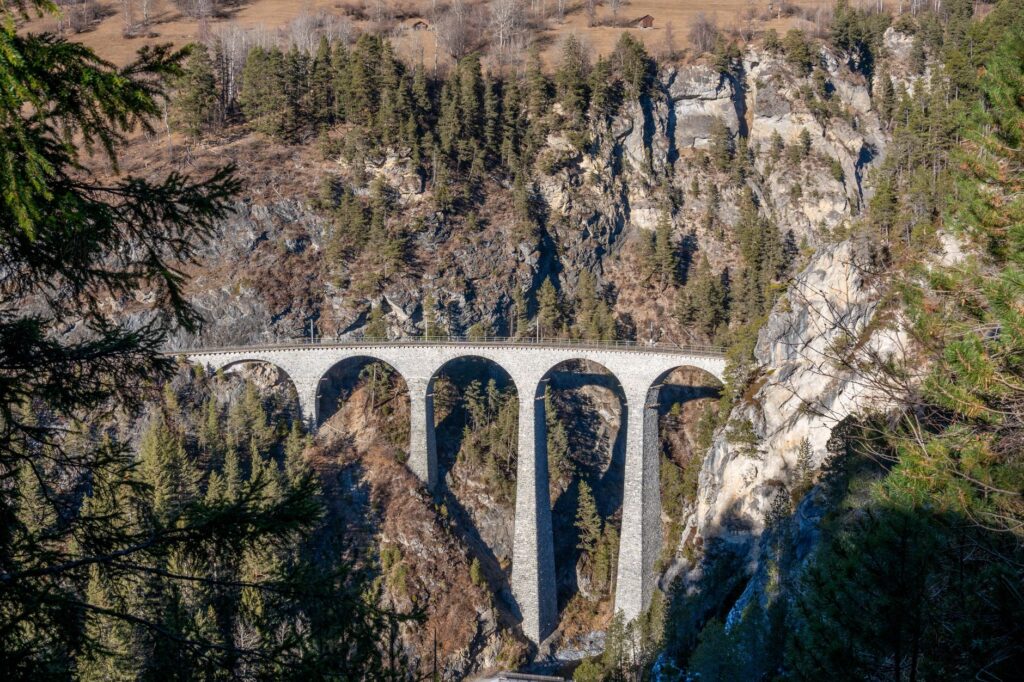
If there is an image that defines the audacity of this line, it is the Landwasser Viaduct. Standing 65 meters high and 136 meters long, this structure of six limestone arches leads directly into a tunnel carved into a vertical rock wall. The most surprising aspect of its construction is that it was carried out without conventional scaffolding, using iron towers and cable cranes to place each ashlar in its exact spot.
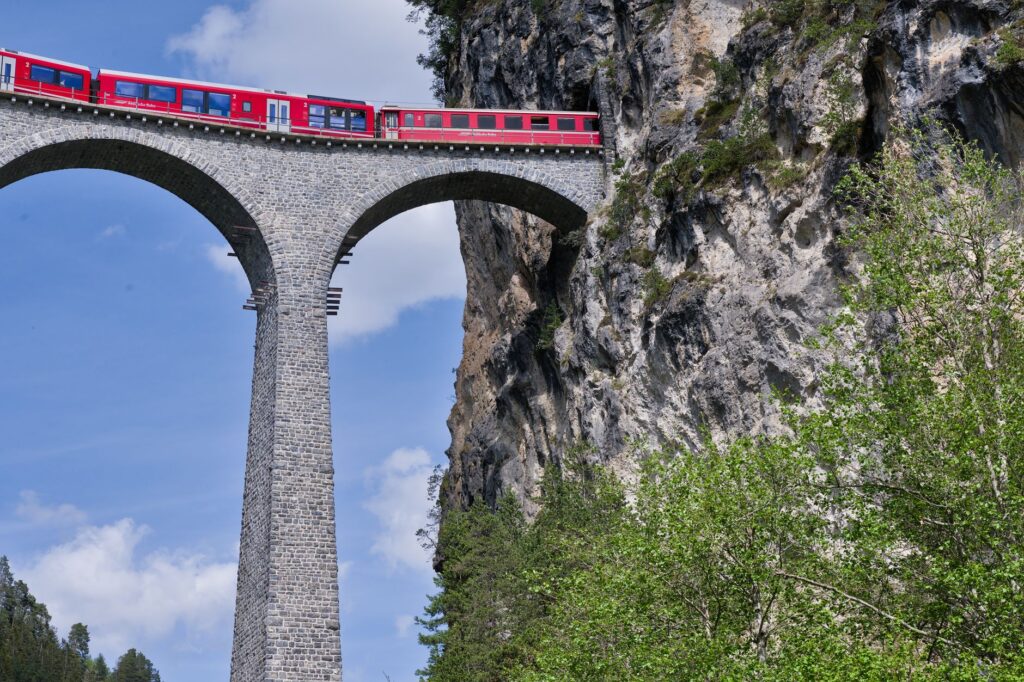
The choice of local stone instead of steel was not merely aesthetic. The region’s granite and limestone offer superior thermal resistance to the extreme temperature fluctuations of the high mountains. Furthermore, the visual integration is perfect; from a distance, the viaduct looks like a natural extension of the cliffs that support it. It is the culmination of a construction philosophy that sought harmony with the environment long before sustainability was a marketing concept.
Ospizio Bernina: The Watershed of Waters and Tongues
The high point of the journey, both physically and symbolically, is the Ospizio Bernina station. Located on the shores of Lago Bianco, this stop marks the continental watershed. To the north, waters flow toward the Danube and the Black Sea; to the south, they seek the Po River and the Adriatic. But the division is not only hydrological; it is also cultural and linguistic.
- The German and Romansh North: In the Engadin, order and the architecture of massive houses with sgraffito decorations define the landscape.
- The Italian South: Descending toward Poschiavo, the air becomes softer, slate roofs give way to clay tiles, and the language shifts from German to Italian in just a few kilometers of vertical descent.
- The Climatic Transition: It is possible to leave Sankt Moritz under a snowstorm and arrive in Tirano, an hour and a half later, surrounded by vineyards and palm trees.
This ability to unite such disparate worlds in a journey of a few hours is what gives the Rhaetian Railway its unique character. It is not a train that crosses a country; it is a train that connects human and biological ecosystems that would otherwise live with their backs to each other due to the impassable barrier of four-thousand-meter peaks like Piz Bernina.
Practical guide
To experience the essence of the Rhaetian Railway, it is essential to distinguish between the Bernina Express (the panoramic train with mandatory reservation) and the regional trains. The latter use the same tracks, allow for hopping on and off at intermediate stations at no extra cost, and most importantly, have windows that can be lowered—essential for photographers looking to avoid reflections from the panoramic glass.
The full journey between Chur (Switzerland) and Tirano (Italy) takes approximately four hours. A technical stop at Alp Grüm is highly recommended to enjoy the views of the Palü Glacier, as well as another in Poschiavo to explore its historic center with Lombard influence. For engineering enthusiasts, the railway museum in Bergün offers a detailed look at the original blueprints and the historic machinery that made the line’s construction possible.

Crossing the Bernina in winter is to witness the spectacle of a glass world where the only trace of civilization is a double line of steel.
In terms of logistics, the Swiss Travel Pass covers the entire journey, although supplements for the panoramic cars must be paid separately. It is vital to check schedules during the winter season, as although the service is constant, daylight hours are limited, and the Bernina Pass section is particularly spectacular during sunset, when the snow reflects the pink tones of the Alpenglow.
The Echo of Steel in the Alpine Silence
At the end of the journey, when the train stops in the basilica square of Tirano, the traveler feels they have crossed much more than a national border. The final descent from the Bernina Pass to the floor of the Valtellina valley is a lesson in geographical humility. The train, which recently dominated the peaks, now runs through the streets of Italian villages, sharing space with cars and pedestrians, integrating into daily life with the naturalness of one who knows their mission has been accomplished.
The true magic of this railway network lies in its persistence. In a world that seeks maximum speed and the longest tunnel to avoid the mountain, the Rhaetian Railway continues to choose the hard way: the surface, the curve, the direct contact with rock and ice. It is a reminder that the journey is not the time it takes to arrive, but the profound understanding of the territory one crosses. Strong The iron pulse continues to beat, tireless, between the white of the glacier and the green of the southern valleys.