In the heart of the Arabian Peninsula, the Al Hajar mountain range rises like a wall of limestone and schist, dividing the coastal strip of the Gulf of Oman from the infinite sands of the interior basins. In this territory of vertical abysses and seasonal riverbeds known as wadis, human mobility does not conform to the conventional patterns of continuous asphalt. Transportation in these latitudes is an exercise in amphibious adaptation between stone and water, where the connectivity of entire villages depends on low-scale engineering executed with the highest degree of tactical precision.
The arteries connecting settlements such as Wadi Bani Awf or Wadi Tiwi are not mere secondary roads, but scars sculpted by sudden flash floods and maintained through the expertise of local builders. Understanding how inhabitants move and what fleets sustain life in these gorges requires delving into a logistical ecosystem where four-wheel-drive vehicles with low-range gearing act as the true communicating vessels of the Omani plateau.
The Vertical Geography of Al Hajar and the Genesis of Wadi Routes
The topography of Al Hajar is the decisive factor conditioning any movement across northern Oman. With peaks exceeding three thousand meters in Jebel Akhdar, the terrain is characterized by steep slopes and gorges so narrow that sunlight barely grazes the bottom for more than a few hours a day. The wadis act as the only passable valleys, combining stretches of loose gravel beds with rocks polished by the ancient passage of ephemeral streams.
Historically, travel was conducted on the backs of camels or via stone-paved pack trails that still wind along vertical cliffs today. Nowadays, the road network has evolved into compacted dirt tracks that demand a deep understanding of local geomorphology. Road engineers and local drivers share a single diagnostic consensus: the infrastructure does not dominate the territory, but rather negotiates with it permanently.
The Historical Evolution from Animal Traction to Off-Road Motorization
For centuries, the isolation of mountain villages was only broken by caravans of animals adapted to the escarpments. The transition toward motorization did not occur through major state highways, but through the gradual introduction of heavy-chassis, four-wheel-drive vehicles capable of wading streams and climbing living rock steps. This radical shift altered the demography of the wadis, enabling regular provisioning of fuel, food, and building materials.

The collective memory of the valleys preserves the names of early imported vehicle models from the mid-20th century—true icons of mechanical endurance that established the foundations of the sultanate’s current transport culture. Driving expertise in these terrains is never improvised; it is passed down through generations as ancestral knowledge comparable to locating water sources or mastering terraced farming techniques.
High-Traction Fleets and Four-Wheel-Drive Logistics
The automotive segment sustaining connectivity in Al Hajar consists almost entirely of large-displacement off-road vehicles with ladder-frame chassis. These machines are not aesthetic whims, but tools of economic survival. The ability to modulate tire pressure depending on whether one traverses rolled stones, fine sand, or wet rock is a technical competency determining the viability of any commercial or sanitary journey.
Mechanical workshops located in towns bordering the wadis function as logistical operations centers. There, fractured leaf springs are repaired, shock absorbers subjected to extreme fatigue are replaced, and fuel injection systems clogged by fine desert dust are cleaned. Without this subterranean and capillary maintenance network, transportation in the highlands would collapse within weeks.
The engine of an off-road vehicle in the wadis does not roar out of vanity; it is the mechanical heartbeat keeping mountain communities alive in the face of geographic isolation.
In addition to private vehicles, small transport cooperatives operate fleets of adapted pickup trucks for the mixed transport of passengers and heavy goods. These transporters act as the true mail carriers of the gorge, ensuring that fresh produce reaches villages perched on the upper steps of the mountain range.

Hydrological Challenges: The Impact of Flash Floods and Seasonal Rushes
The greatest risk to the wadi transport network stems from the meteorological phenomenon known locally as the *khareef* or from spring convective storms, which discharge massive volumes of water in a few hours over arid basins incapable of absorbing precipitation. When this occurs, dry riverbeds transform into violent brown torrents capable of dragging multi-ton boulders and entire vehicles.
Managing this risk demands early warning systems based on both traditional sky observation and institutional meteorological surveillance. Local drivers know the points of no return and the subtle signals emitted by the riverbed before a surge. Crossing a wadi during periods of high flow is penalized and discouraged, frequently isolating entire communities for days until waters recede and excavators clear passage over the gravel.
The Engineering of Submersible Fords and Track Maintenance
To mitigate constant erosion, transport authorities have implemented engineering solutions adapted to intermittent flow environments. Rather than building costly large-span bridges in canyons where floods destroy any rigid infrastructure, priority is given to reinforced concrete submersible fords. These crossings allow water to flow over the top without compromising the foundation of the road.
Maintaining these tracks is an unceasing labor. Following each rainy season, motor graders and water trucks swing into action to fill potholes, re-compact the roadbed, and clear rockfalls dropped from upper ledges. Investment in this continuous maintenance is the unavoidable price of keeping the canyons’ vital artery open.
Road Architecture and Human Adaptation in Slope Settlements
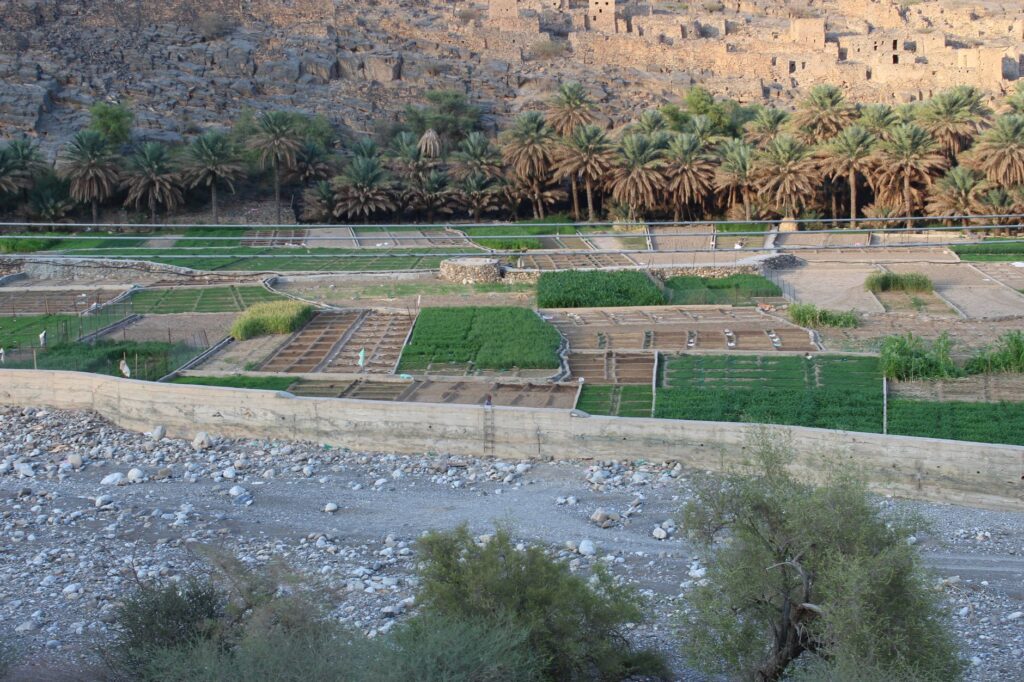
The interaction between roads and the traditional architecture of mountain villages reveals a perfect symbiosis. Villages like Misfat al Abriyeen are structured such that peripheral vehicular accesses respect ancient pedestrian paths and gravity-fed irrigation channels known as *falaj*. The arrival of the dirt track has not destroyed the historic urban fabric; instead, it couples with it via outer parking platforms that preserve the interior calm of the mud-brick and stone alleys.
This peaceful coexistence between modern mobility and vernacular heritage is the result of strict conservation regulations and the deep respect local communities hold for their built environment. New infrastructures are designed to minimize visual impact within a geological landscape dominated by ochre, grey, and toasted earth tones.

- Mandatory peripheral parking lots to prevent congestion in narrow alleys.
- Use of porous pavements on approach roads to facilitate water infiltration.
- Discreet signage integrated into natural stone without garish plastic elements.
- Community drinking water refill points linked to main transport routes.
Sustainability and the Delicate Balance of Adventure Tourism
Over the past decade, opening the wadis and Al Hajar plateaus to international adventure tourism has introduced an unprecedented pressure variable onto the transport system. The proliferation of rental vehicles driven by visitors unfamiliar with off-road driving has exponentially increased mechanical incidents, rescues in remote areas, and the degradation of gravel tracks.
Facing this scenario, Omani institutions have begun regulating access to particularly fragile canyons, requiring the use of authorized local transporters for the most complex stretches. This measure not only protects traveler safety but also redistributes the economic benefits of tourism among families operating high-traction vehicle fleets in the territory.
The Transition Toward Clean Energy in Mountain Mobility
Despite current reliance on large-displacement internal combustion engines, local engineers and regional planners are already exploring the viability of incorporating four-wheel-drive electric vehicles with high-capacity batteries adapted to extreme temperatures. Microgrid solar pilot projects in summit villages are beginning to supply the energy necessary to recharge light auxiliary logistics fleets.
This energy transition in such a hostile environment poses formidable challenges, but it is seen as an unavoidable step to reduce the carbon footprint and acoustic impact in natural sanctuaries where the silence of stone and wind constitutes one of primary intangible heritages.
The future of mobility in Al Hajar will depend on our ability to reconcile territory exploration with the absolute preservation of its geological silence.
Practical Guide
Planning a journey or observation route through the wadis and transport systems of Al Hajar requires logistical rigor, respect for local regulations, and precise understanding of meteorological and mechanical conditions.

When to Go and Climatic Seasonality
The optimal window for exploring the region spans from November to March, when daytime temperatures are moderate and the risk of violent storms diminishes significantly. Summer months (June to September) record extreme heat that subjects engines to critical thermal stress and discourages any unassisted incursions without advanced experience.
Mechanical and Driving Requirements
Using an authentic four-wheel-drive (4WD) vehicle with low-range gearing is mandatory. Standard passenger cars and urban SUVs are neither authorized nor equipped to transit gravel beds and the 20% inclines characterizing approaches to the main canyons.
Safety Rules and Wadi Etiquette
Camping on the bottom of wadis or parking vehicles in dry riverbeds is strictly prohibited, even under clear skies, due to the risk of sudden flash floods originating from storms in high summits. Carrying at least five liters of drinking water per person per day, satellite communication devices in areas without cellular coverage, and basic tools for tire changes on rocky terrain are indispensable.
Provisioning and Cultural Respect
Local communities value modesty in attire and photographic discretion. Fuel must always be topped off to maximum capacity in major towns like Nizwa or Rustaq before venturing into mountain circuits, as there are no service stations inside the gorges.
Twilight in the Al Hajar canyons descends with the relentless swiftness of arid latitudes, transforming limestone walls into a canvas of copper tones and violet shadows. Along the gravel tracks, the final off-road vehicle of the day crosses the dry riverbed, kicking up a trail of golden dust that slowly dissolves into the warm desert air. In this stronghold where stone dictates law and the engine serves as the sole bridge to the outside world, mobility remains a daily act of endurance, a silent pact between machine and geography that continues to write the living history of Oman.