
The geography of South American skies is on the verge of a subtle yet profound transformation. In a region where international travel has historically been conditioned by mandatory stopovers in political capitals, direct connectivity between economic hubs and heritage enclaves represents a paradigm shift. The announcement by Latam Airlines Perú regarding the launch of a non-stop route between São Paulo and Cusco, scheduled to begin on March 29, 2027, with four weekly frequencies, is not merely an addition to a commercial airline’s schedule. It is a strategic bridge designed to reconfigure mobility flows across the Southern Cone.
For decades, travelers departing from Brazil—the region’s largest tourism source market—who wished to delve into the heart of the Inca Empire had to endure a fragmented journey. The unavoidable transit through Jorge Chávez International Airport in Lima was the logistical toll imposed by traditional airport infrastructure. This new direct connection of four weekly frequencies eliminates that geographic friction, allowing the Brazilian visitor to land directly at the threshold of the Andes. For Cusco’s socioeconomic fabric, which depends vitally on the travel industry, this direct flight opens a direct corridor with São Paulo’s economic powerhouse.
The geopolitics of Andean skies and the Brazilian market
To grasp the scope of this new air route, one must analyze the behavior of the Brazilian traveler within the Latin American context. Brazil possesses a middle class with a high propensity for cultural and nature-based international tourism, but trips to high-altitude archaeological destinations used to compete with options within domestic Brazilian territory or the Caribbean. Bypassing the Lima layover reduces total travel time by approximately two to three hours, while also eliminating the operational stress of baggage transfers and immigration checks in a congested terminal.
Preliminary figures from the aviation sector suggest that potential demand for this corridor exceeds the initial capacity provided by the four weekly frequencies stipulated by Latam Airlines Perú for March 2027. São Paulo, through the Guarulhos hub, concentrates not only residents of the paulista metropolis but also seamless connections from southern and inland Brazil. By channeling this volume directly into Alejandro Velasco Astete International Airport, the airline optimizes its route network and diversifies the profile of visitors arriving in the Cusco department.

Airport infrastructure and high-altitude operational challenges
Landing in Cusco presents unique technical challenges that shape commercial aviation. Situated at over 3,300 meters above sea level, the Cusco aerodrome is surrounded by mountain ranges requiring highly trained flight crews and aircraft with specific performance capabilities to operate under low-air-density conditions. The arrival of direct international flights from a low-altitude metropolis like São Paulo raises operational questions regarding departure and arrival schedules, which have historically been conditioned by morning weather restrictions in the valley.
Likewise, ground reception infrastructure must adapt to a passenger flow that will arrive with international expectations yet without passing through the customs filter of the Peruvian capital. Local tourism and transport authorities have noted that this announcement increases the urgency to accelerate both the modernization of current facilities and the progress of complementary road and airport projects in the southern Andean region, ensuring that the surge in visitors does not overwhelm the fragile basic services of the historical city.
Socioeconomic impact on the local Cusco fabric
The arrival of Brazilian tourists via direct flights will have a direct impact on the region’s economy, while raising dilemmas regarding sustainability. Traditionally, the Brazilian traveler exhibits a high spending pattern on upscale hospitality and fine dining experiences, a segment that has flourished in the valley and the imperial city over the past decade. This traveler profile values cultural offerings and adventure tourism, which could mitigate the seasonal fluctuations characteristic of tourism activity in the Peruvian Andes.
However, local urban development experts warn of the risk of placing further pressure on saturated historical centers. Cusco’s historic core, recognized by UNESCO, has faced the ravages of real estate and tourism pressure for years. Facilitating the influx of visitors from Brazil must be accompanied by effective public policies for territorial dispersion, incentivizing alternative routes toward the South Valley, the path to Choquequirao, or communities in the traditional communal circuit, preventing economic benefits from concentrating exclusively in the central urban core.

Diversification of flows and the concept of binational tourism
One of the most intriguing aspects of this direct link is the consolidation of a concept of binational or intra-regional tourism in South America. Frequently, major tourism flows toward Peru have been fed by extra-regional markets from North America and Europe. By boosting exchange with the Brazilian giant, the Peruvian tourism sector reduces its dependence on the economic and political fluctuations of the northern hemisphere, integrating into a more resilient and dynamic South American market.
This phenomenon also fosters a reverse flow. The ease of flying non-stop from Cusco to São Paulo opens a window for Peruvian tour operators to design combined packages that include the Andean experience alongside the Brazilian Atlantic coast or business tourism in South America’s financial center. This commercial reciprocity strengthens diplomatic and cultural ties between two nations that, despite sharing an extensive Amazonian border and a common history, have historically maintained surprisingly rigid air connectivity barriers.
Colonial architecture superimposed on Inca foundations
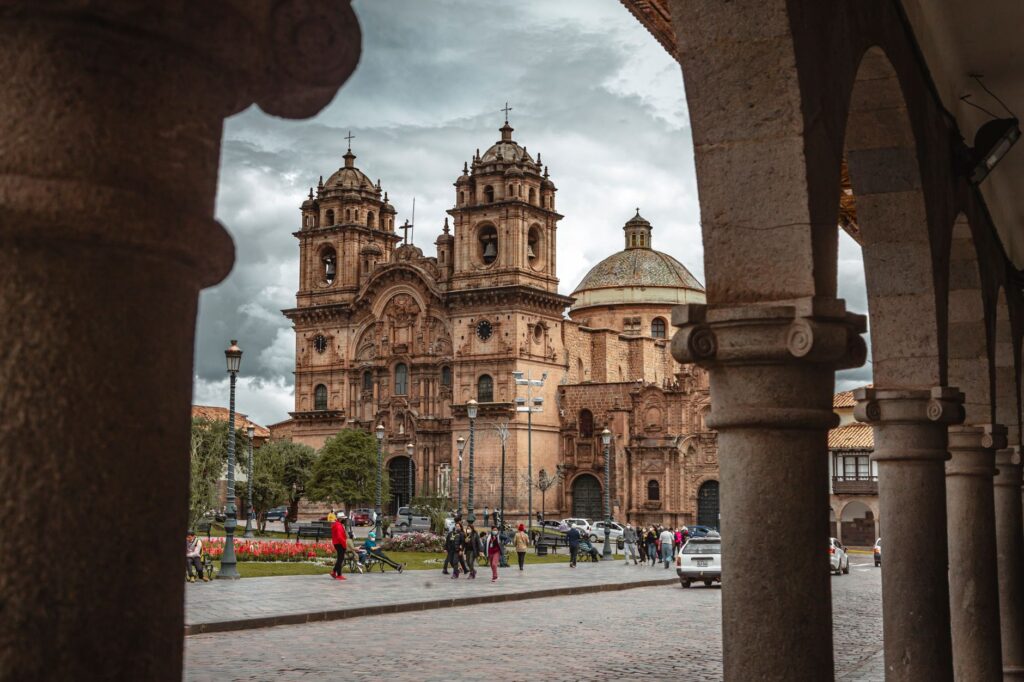
For the Brazilian traveler crossing the continent on the new 2027 flight, the first impression upon walking the streets of Cusco will be that of inhabiting an architectural palimpsest. The flawlessly fitted stone masses without mortar, visible in the walls of Hatun Rumiyoc street or at the base of the Coricancha temple, literally support the colonial arches, manor houses, and Catholic churches erected after the Spanish conquest. This physical superimposition is the tangible testimony of a radical cultural clash that gave rise to a unique mestizo identity on the continent.
Walking through the San Blas neighborhood or gazing at the Plaza de Armas at dusk requires understanding that every stone tells a dual story: that of the Inca imperial power and that of the urban reconfiguration imposed by the viceroyalty. The preservation of this monumental heritage demands a delicate balance between massive commercial openness and the physical protection of archaeological monuments, a challenge that local administration must manage with technical rigor and long-term vision in the face of anticipated visitor growth.
Cusco gastronomy as an ambassador of Andean biodiversity
Beyond stones and temples, Cusco’s appeal today rests on one of the most vibrant culinary revolutions on the planet. High Andean cuisine has ceased to be viewed as a repertoire of subsistence ingredients, transforming into high cuisine based on the recovery of high-altitude ecosystems, forgotten native tubers, ancestral corns, and pre-Hispanic fermentation techniques.
Fine dining restaurants and traditional markets like San Pedro offer foreign visitors a tasting map of Peruvian biodiversity. The arrival of Brazilian tourists—originating from an equally rich and diverse culinary culture—promises to further vitalize this sector, generating creative exchanges between Peruvian and Brazilian chefs who are already beginning to experiment with fusing Amazonian and Andean products within the gastronomic circuits of both nations.
Practical guide
How to get there: Starting March 29, 2027, Latam Airlines Perú will operate four direct weekly frequencies between Guarulhos International Airport in São Paulo (GRU) and Alejandro Velasco Astete International Airport in Cusco (CUZ). Booking well in advance is recommended due to high seasonal demand.

Entry formalities: Brazilian citizens may enter Peruvian territory carrying only their valid national identity document (RG) or passport, thanks to free-transit agreements in place within the Andean Community and Mercosur region.
Acclimatization and health: Cusco sits at 3,399 meters above sea level. It is essential to plan the first 24 hours with relative rest, constant hydration, and avoiding heavy meals to prevent altitude sickness (soroche).
Best time to visit: The dry season runs from May to September, offering clear skies ideal for trekking and archaeological visits. Transition months (April and October) feature lower tourist crowds.
Currency and payments: The official currency is the Peruvian sol (PEN). International credit cards are widely accepted in hotels and restaurants, but carrying cash in local currency is advised for small shops and artisan markets.

Urban transport: Cusco’s historical center is best explored on foot due to its steep, narrow colonial layout. For peripheral trips or heading to the airport, use authorized taxi services or mobile transport apps.
Heritage respect: Climbing, touching, or altering Inca walls and archaeological monuments is strictly prohibited. Always hire official guides accredited by the Ministry of Culture for visits to archaeological parks.
The arrival of the direct flight from São Paulo is not only good news for tourism logistics; it is a silent invitation to look at the continent with fresh eyes, recognizing that the Andes and the Atlantic are now a little closer to each other, waiting to be discovered with respect, curiosity, and historical memory.
Source in EN: Social media and regional journalistic coverage in Regiones travel tourism via Google News (https://news.google.com/rss/articles/CBMi6wFBVV95cUxNZTlkSHo5Tng2NlRjOVlvcjdzcDhlc1BEbC1HZlVkSUdjZE1MTE9EeVNCekwta3ZhUXVuUmdCVXhiNjNkLVE4ZkJUSnV5SUNYLWRabmR1Xy16SlctZzV5aDBGa3pBLXZWX3FDMWZ4SlRXWjRHSjNKYzBmWGZHcnJRTmNYUWxxeXFFeUFQSHdlMHhtc1M4bTlvNG1JeVcweW1ZUzMzWHAyVTNmTkFBWUVmSF9JdUk2YjBlM2I4X1RfZUdxLUNwSXM0VTRqVG1YQVRmbXNDcXhUQzQ0czUtSFFJUWZrNHdjZ0trc3ZF?oc=5)