Order at Thirty Thousand Feet: Anatomy of an Airborne Upheaval
A commercial flight to Miami became the setting for a security crisis where citizen intervention and duct tape averted a major tragedy, reopening the debate on discipline in contemporary skies.
At thirty thousand feet of altitude, space ceases to be a mere means of transport and becomes a temporary community suspended in the void. The laws governing the earth’s surface seem to blur amidst the constant hum of the engines and the artificial gloom of the cabin. However, this fragile order depends on an unspoken pact of coexistence that the vast majority of passengers automatically respect.
Last Thursday, that invisible pact fractured aboard an American Airlines flight. What began as individual discomfort quickly escalated into a direct threat to collective safety. In an environment where outside police assistance is physically impossible, the crew and travelers find themselves alone in the face of human unpredictability.
Technological dependence and the density of modern seating have transformed the flying experience. Accumulated tensions on the ground often find an unexpected trigger in the air, fueled by fatigue, stress, and occasionally, the excessive consumption of substances. The cabin thus becomes a pressure cooker where any spark can unleash a storm.
The Outbreak of Violence in Seat 24
It all began with shouting and obscenities. A passenger, whose identity was not immediately released by federal authorities, began uttering vulgarities without apparent reason, disrupting the tranquility of the cabin. Flight attendants and cabin crew responded with the professionalism dictated by their strict safety protocols, attempting to calm the situation through verbal de-escalation.
Airspace is not a lawless zone, but a territory where the captain’s authority extends as the ultimate safeguard of the common order.
Far from yielding to reason, the individual intensified his aggressive behavior. He escalated from words to physical acts, striking the aircraft’s furnishings and attempting to force open the emergency exit doors—an act of sheer recklessness that placed all occupants in catastrophic risk. At that critical moment, minutes stretched into hours for the eyewitnesses.
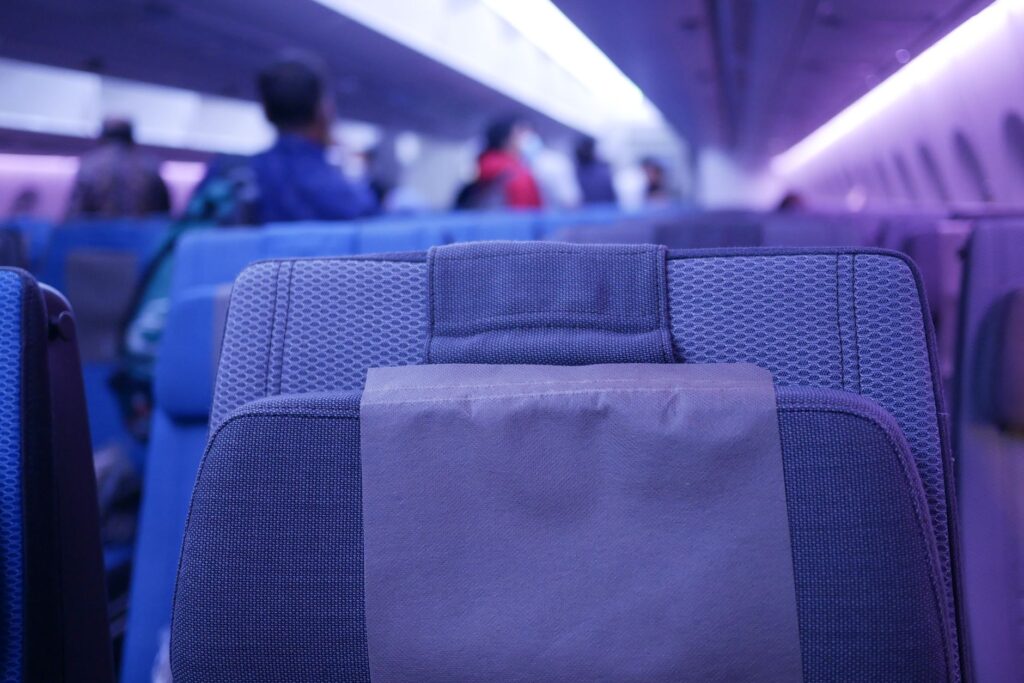
The cabin crew, trained to deal with unruly passengers, found themselves overwhelmed by the attacker’s unbridled fury. Standard physical restraint often requires superior force which, in narrow aisles crowded with carry-on luggage, is extremely complex to apply without exposing bystanders to serious injury.
The Citizen Response in the Sky
Faced with the imminence of a greater disaster, the institutional theory of safety gave way to the spontaneous practice of civil solidarity. Two passengers, whose identities were likewise withheld for privacy and ongoing investigation reasons, decided to leave the passivity of their seats to intervene directly in the conflict.
The intervention was not without risk. Subduing a rampaging man in a confined space requires a precise blend of determination, strength, and technique to prevent the situation from resulting in collateral damage. The two volunteers managed to immobilize the assailant against the floor of the central aisle, locking his limbs while the rest of the cabin watched with a mixture of astonishment and relief.
This episode highlights a recurring phenomenon in modern civil aviation: the growing necessity to rely on citizen collaboration when crew resources prove insufficient. The figure of the cooperative passenger has become an unwritten tactical piece within current emergency protocols.
The Extreme Resort of Duct Tape
Once the initial physical threat was neutralized, the problem persisted: how to keep a violent individual immobilized for the remaining hours of flight until landing? Standardized plastic zip ties are not always available in sufficient quantities or their placement requires time that was simply unavailable.
It was then that resort was made to a method as rudimentary as it was effective: industrial duct tape. Traditionally used for emergency repairs on the ground, the tape became the definitive deterrent to secure the wrists and ankles of the agitated passenger, firmly fixing him to his seat.
Although the image of a passenger bound with duct tape may seem out of place in twenty-first-century commercial aviation, crisis manuals and the accumulated experience of airlines support its use as an exceptional measure of last resort. The absolute priority in the air is the physical safety of the majority against the actions of an uncontrolled individual.
Landing and the Intervention of the Law
The flight continued its route under palpable tension, with the problematic passenger firmly secured and closely guarded by the crew and volunteers. Communications between the flight deck and ground air traffic controllers proceeded rapidly to coordinate priority landing and the immediate presence of law enforcement.
Upon arrival at the destination airport, police cruisers and federal agents awaited on the tarmac. As soon as the aircraft doors opened, officers boarded to take control of the situation, unbind the individual, and proceed with his formal arrest on charges of interfering with the flight crew and in-flight assault.
Federal authorities later confirmed that the passenger was transferred directly to a detention facility and subsequently to a medical installation to evaluate his mental state. The preliminary investigation initially ruled out terrorist motivations, pointing instead toward a critical episode of acute behavioral disruption.
The Debate on Discipline and In-Flight Alcohol
The incident immediately reignited debate within the corridors of aviation safety agencies and the boardrooms of major airlines. The sustained increase in incidents involving violent passengers in recent years has led experts to question commercial policies that encourage alcohol consumption before and during flights.
Statistics from regulatory bodies show a notable increase in reports of misconduct, ranging from insults to staff to direct physical attacks. Many airlines have tightened their internal regulations and advocated for the creation of internationally shared unruly passenger ban lists, though legal implementation continues to encounter bureaucratic hurdles.
Global freedom of movement demands a renewed commitment to civility and personal responsibility aboard aircraft.
Flight attendant unions have long demanded stronger legal protections, harsher penalties for offenders, and an increased police presence at airports and boarding gates. Aviation safety, they argue, cannot rest exclusively on the goodwill of flight attendants and the sporadic bravery of travelers.
Practical guide
Useful information based on confirmed facts regarding safety protocols and passenger rights during critical onboard situations.
Fact identification: The event took place on an American Airlines flight bound for Miami, officially reported by competent authorities.
Action protocol: The crew is trained in verbal de-escalation and physical restraint, resorting to citizens only in situations of extreme risk.
Use of exceptional measures: The use of duct tape is permitted as a last-resort resource to prevent harm to crew and passengers.
Legal consequences: Interfering with the crew of a commercial flight constitutes a serious federal crime carrying prison sentences and severe fines.
Reporting channels: Reports and logs of aviation incidents are managed directly by the federal aviation agencies of the respective country.
Source attribution: Data regarding this incident stems from police and security reports published by The New York Times.
The Emotional Echo of Silence After the Storm
When the plane doors finally opened and agents led away the troubled passenger, the entire cabin exhaled a collective sigh that seemed to contain hours of accumulated tension. The silence that followed was not an awkward vacuum, but a comforting truce, the realization that normalcy had reclaimed its rightful place. In the glances of the passengers who shared an aisle and a scare remained the steadfast certainty that human vulnerability at high altitudes can only be countered through the firmness of collective empathy and civic courage.