Tectonic Origins and the Stone Architecture
Yosemite National Park, situated along the western flank of California’s Sierra Nevada range, is far more than a scenic geographic accident; it is a stony archive of Earth’s deep history. Approximately ten million years ago, the region began experiencing massive tectonic uplift coupled with a westward tilt, triggering unprecedented erosive processes. Nevertheless, the true architect of Yosemite’s current physiography was ice. During the glacial epochs of the Pleistocene, colossal tongues of ice descended from the summits, widening and deepening ancient riverbeds into U-shaped valleys characterized by vertical walls and flat floors.
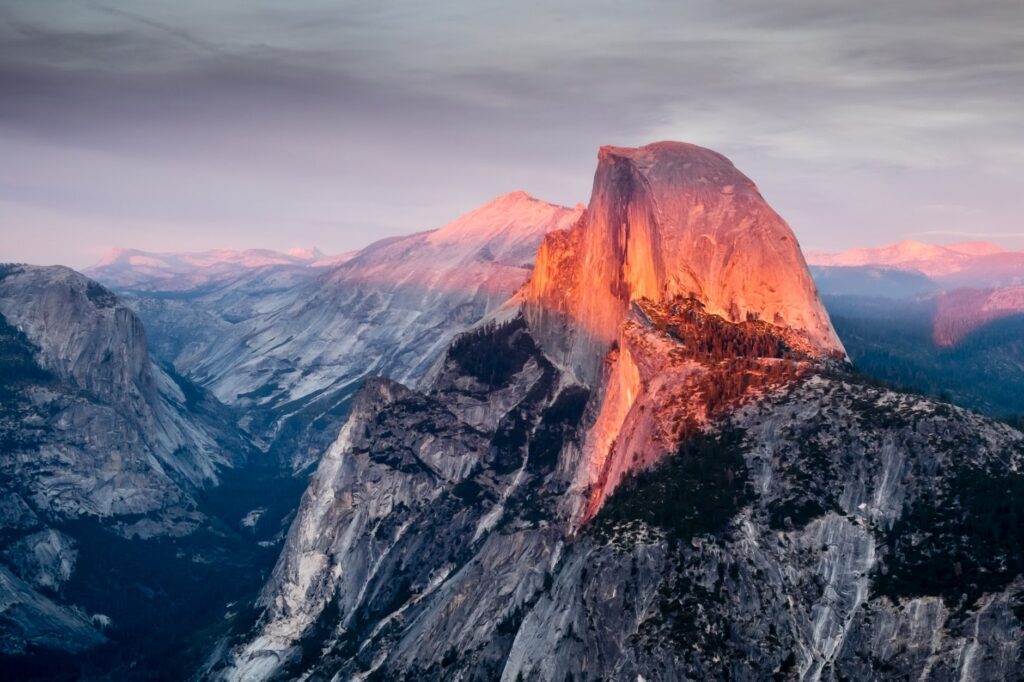
Beneath the visible surface of monumental domes and unbreakable monoliths lies a vast batholithic complex. Yosemite’s granite formed between 80 and 100 million years ago, when molten magma slowly solidified deep beneath the Earth’s crust. This gradual cooling allowed large, stable mineral crystals to grow, endowing the rock with exceptional resistance against the elements. When tectonic uplift and subsequent glacial ablation stripped away the upper sedimentary layers, these plutonic masses were exposed to weathering, giving rise to such singular structures as Half Dome and El Capitán.
The geomorphological analysis of these cliffs reveals a complex system of joints or natural fractures. Far from being homogeneous, the granitic walls respond to internal mechanical stresses and lithostatic unloading pressure. Meltwater infiltrates these microscopic fissures during freeze-thaw cycles, causing the mechanical fragmentation of the rock over millennia. This phenomenon, known as ice-wedge weathering, continues to sculpt the landscape in real time, reminding scientists and visitors alike that the apparent immutability of stone is actually a transitory phase within a continuous dynamic cycle.
High-Altitude Hydrology and Iconic Waterfalls
Yosemite’s water wealth constitutes the ecological engine that sustains a remarkably diverse biodiversity in a high alpine environment. The region’s hydrological cycle depends critically on winter snow accumulation on the upper plateaus, situated above two thousand five hundred meters of altitude. During spring, the gradual melt feeds an intricate network of streams, rivers, and waterfalls that define the visual and auditory identity of the valley. Waterfalls such as Yosemite Falls—one of North America’s tallest drops at 739 meters broken into three main tiers—experience drastic seasonal variations ranging from torrential flows in May to near-complete summer drought.

This hydrological regime not only sculpts the relief via fluvial abrasion, but also sustains fragile riparian ecosystems in the valley floor’s alluvial plains. Gallery forests, dominated by quaking aspens, white firs, and majestic ponderosa pines, rely on seasonal groundwater saturation to survive Mediterranean summers characterized by prolonged aridity. The park’s contemporary management closely monitors hydrometric indicators, given that alterations in global precipitation patterns threaten to destabilize the water balance accumulated over centuries in high-mountain basins.
Likewise, the watershed of the Merced and Tuolumne rivers acts as a vital resource for millions of residents in California’s Central Valley. The historical infrastructure of dams and reservoirs built throughout the twentieth century sparked profound debates over preservation versus utilitarian exploitation, an ethical conflict that marked the birth of modern wilderness legislation in the United States. Today, the ecological restoration of riverbanks seeks to reverse the impacts of past channelization, allowing rivers to reclaim their natural meandering course and original ecological functions.
The Challenge of Sustainability and Anthropogenic Pressure
With more than four million annual visitors concentrated largely within the scarce eighteen square kilometers of Yosemite Valley, the park faces a fundamental paradox: the conservation of natural resources against the massive demand for recreational access. This high visitor density generates significant strain on local infrastructure, from chronic vehicular congestion in summer months to waste accumulation and soil compaction on heavily traveled trails. National Park Service authorities have recurrently implemented reservation systems and vehicular access restrictions to mitigate direct environmental impacts on sensitive habitats.
Wildlife management represents another critical front in park conservation. Emblematic species such as the American black bear have historically altered their behavior patterns due to the anthropogenic availability of food. Environmental education programs aimed at visitors, coupled with the mandatory use of bear-proof canisters in camping zones, have drastically reduced habituation incidents. However, the fragmentation of peripheral ecological corridors due to urban and forestry development outside park boundaries continues to threaten the long-term genetic viability of animal populations.
blockquote>The true measure of management in Yosemite does not lie in how many people manage to gaze upon its summits each year, but in how many future generations will be able to do so without the landscape losing its original ecological integrity.
Climate change adds an additional layer of complexity to long-term planning. Sustained temperature increases have caused the winter snowpack to shrink and melt prematurely, altering the biological cycles of endemic flora and fauna. Furthermore, prolonged drought weakens the natural resilience of forests against devastating pests, such as the bark beetle, and exponentially multiplies the virulence of high-intensity wildfires. Mitigating these risks demands a paradigmatic shift toward active forest restoration and the application of prescribed burns that mimic natural fire cycles.
Biodiversity Across Altitudinal Gradients
Yosemite’s abrupt topography generates an extraordinary diversity of microclimates and life zones ranging from low-altitude chaparral to tree-less alpine tundra. This marked altitudinal gradation enables more than two hundred bird species, eighty mammal species, and some fifteen thousand vascular plant species to coexist within a relatively compact geographic space. In the lower slopes, dominated by black oaks and sclerophyllous scrub, wildlife includes elusive predators like the bobcat and the gray fox, perfectly adapted to warm, dry summers.

As altitude increases, the landscape gives way to dense coniferous forests where imposing specimens thrive. Among them, the giant sequoia (Sequoiadendron giganteum) stands out, with ancient specimens in groves like Mariposa Grove exceeding two thousand years of existence. These botanical colossi possess fascinating evolutionary adaptations, such as a fibrous, tannin-rich bark that protects them against recurring wildfires and fungal pathogens. Studying the regeneration dynamics of these groves offers invaluable insight into ecological resilience amid extreme climatic disturbances.
Above the tree line, on granitic plateaus lashed by gale-force winds, plant life adopts dwarf and prostrate forms to minimize moisture loss and withstand freezing winter temperatures. Here, highly specialized botanical species complete their reproductive cycles in brief summer weeks. High-mountain fauna, represented by the yellow-bellied marmot and bighorn sheep, has developed complex physiological strategies to endure long periods of hibernation and resource scarcity, consolidating a fragile biological balance that requires constant scientific monitoring.
The Legacy of Conservation and Environmental Activism
Yosemite’s history is inextricably linked to the birth of the modern global conservation movement. In the mid-nineteenth century, detailed descriptions by naturalists and romantic painters began drawing public attention to the valley’s aesthetic singularity. The figure of John Muir was instrumental; through his passionate writings and co-founding of the Sierra Club in 1892, he mobilized public opinion and the U.S. Congress to legally protect the territory from timber speculation and intensive grazing.

The formal establishment of the park by federal law in 1890, followed by the transfer of valley lands previously managed by the state of California to federal control in 1906, laid the institutional foundations for creating the U.S. National Park Service. This pioneering legal framework enshrined the principle that certain natural spaces possess intrinsic value superior to immediate economic exploitation—an ethical premise later replicated across dozens of sovereign jurisdictions worldwide.
blockquote>Protecting a monumental landscape does not mean freezing it in time under a glass case, but rather understanding the ecological processes that sustain it and ensuring that future societies can experience its wonder without altering it irreversibly.
Nevertheless, the history of conservation in Yosemite also carries institutional shadows that contemporary historiography examines with critical rigor. The park’s creation entailed the forced displacement of Indigenous Ahwahneechee communities, who had inhabited and managed the valley through controlled burning for millennia. In recent years, the Park Service has initiated a necessary process of historical reconciliation and active collaboration with native tribes, integrating their traditional ecological knowledge into modern forest management and cultural heritage restoration plans.
Practical guide
Planning a rigorous visit to Yosemite National Park requires understanding its seasonality and access logistics. The best time to view waterfalls at their peak flow spans from May to June, coinciding with the alpine snowmelt peak. However, September and October offer a more leisurely experience, with stable temperatures, fewer visitors, and the chromatic appeal of seasonal shifts in riparian forests.

To reach the park, San Francisco International Airport or Sacramento International Airport act as primary air transport hubs, from where renting a vehicle is necessary to cover the three-hundred-kilometer distance to the western park gates. It is mandatory to check current peak-hour vehicle reservation systems in advance, as well as opening restrictions on high-mountain passes like Tioga Pass, whose viability depends entirely on winter snow accumulation and typically extends from late May through November.
- Accommodation: Book up to a year in advance at historic lodges within the valley, such as Yosemite Valley Lodge or the iconic The Ahwahnee, or opt for authorized campgrounds like Upper Pines and Lower Pines.
- Gear: Trekking boots with ankle support are indispensable due to the steep slope and polished granitic surfaces of demanding trails like the Mist Trail or the final ascent to Half Dome.
- Mountain Safety: Always carry drinking water, filtration systems, physical topographic maps, and approved bear spray if planning overnight stays in remote or high-altitude zones.
- Environmental Regulations: Strictly respect the ban on feeding wildlife and utilize specific metal lockers to store food and scented products.
The Emotional Perspective of Silent Summits
Beyond demographic figures, visitor statistics, or complex environmental management equations, Yosemite endures in collective memory as a space for interior transformation. When the oblique evening light strikes the vertical face of El Capitán, dyeing the rock in intense ochres and deep reds, human scale is redefined against the vastness of geological time. This monumental silence, interrupted only by the distant whisper of wind through firs and the muffled roar of waterfalls, acts as an eloquent reminder of our fragility and shared responsibility in safeguarding the planet’s last truly wild strongholds.