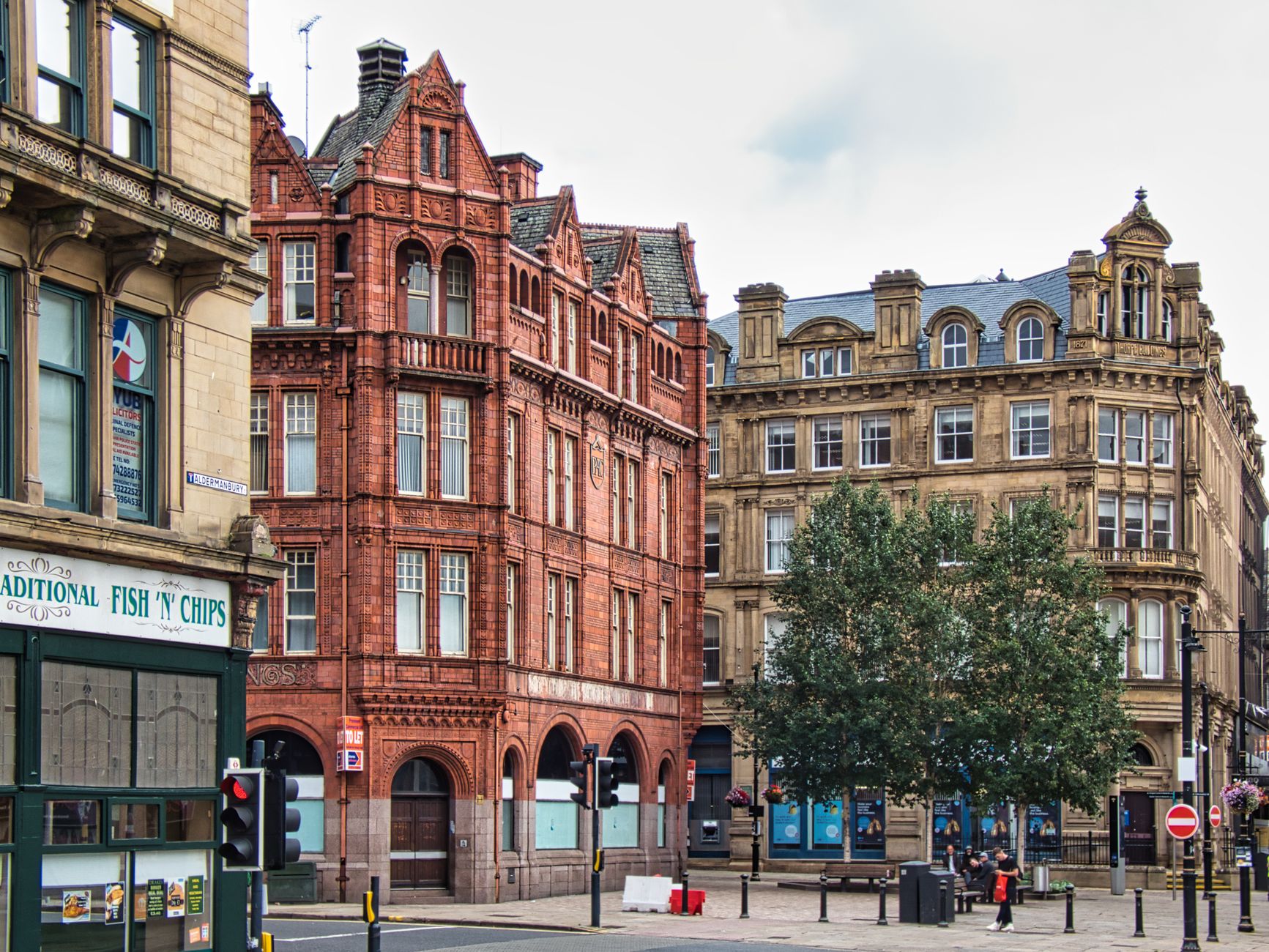

Bradford cannot be explained without wool. In the heart of West Yorkshire, in northern England, this United Kingdom city grew to the rhythm of looms and of the warehouses that stored and sorted the fiber arriving from the ports. Its historic center preserves an unusual architectural ensemble: civic buildings, wool exchanges, churches and mills that share the same sandstone, the same monumental scale and a common memory of prosperity and conflict.
Today Bradford is far more than an industrial remnant. It is a diverse city with an intense cultural life and a complex relationship with its own past. This report proposes a reading of the place through its built heritage, its cultural spaces and the decisions a visitor can make to know it without reducing it to a postcard.
A city you read in its stone
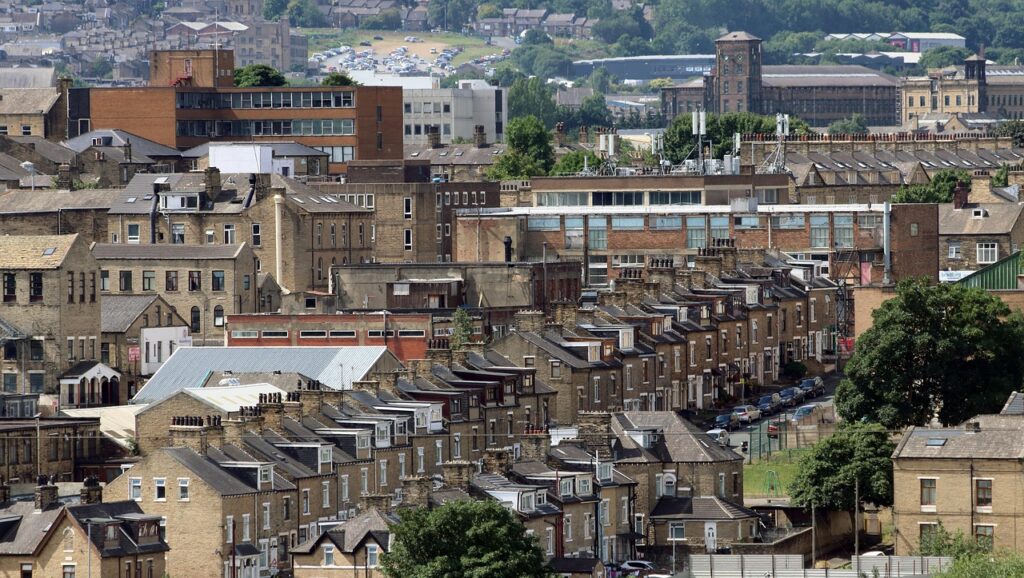
Central Bradford is organized around a handful of buildings that concentrate much of its history. Cartwright Hall, Bradford City Hall and the Little Germany ensemble are pieces of the same story: that of a commercial bourgeoisie that invested in architecture to assert its position. Little Germany, in particular, gathers former warehouses and offices of German wool merchants, with ornate facades that now house offices, studios and creative spaces.
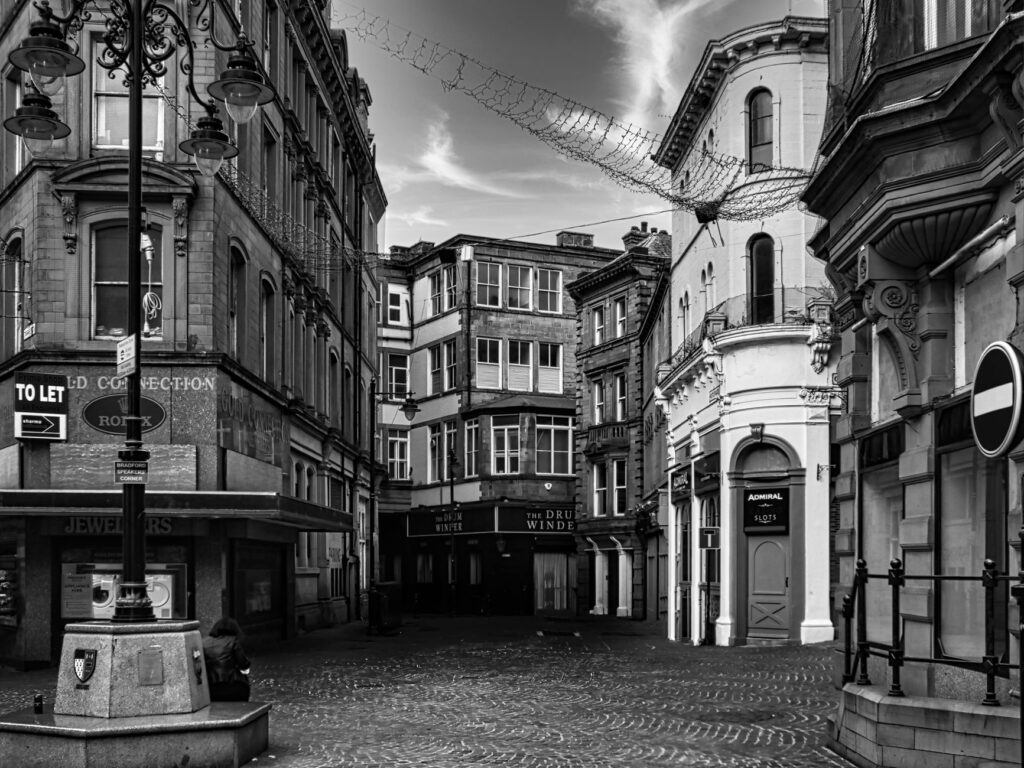
Walking those streets requires looking up. Pediments, cornices and reliefs tell more than many commemorative plaques. It is a heritage that cannot be visited in a single building; it is experienced as an ensemble.
The local sandstone, known for its warm tone and porous texture, gives cohesion to that landscape. It is not a minor detail: the choice of material responded both to the availability of nearby quarries and to a will for permanence. The buildings had to last, and they had to look solid in the eyes of competitors and clients. That logic explains why the center preserves a chromatic homogeneity that other industrial cities lost with twentieth-century reconstructions.
The textile legacy and its conversions
The textile industry left Bradford with a stock of mills and workshops that, after the decline of the twentieth century, have gradually adapted to new uses. Some became cultural spaces, others housing or premises for small businesses. That conversion was not always easy: it involved decisions about what to preserve, what to transform and what to demolish.
The result is a hybrid urban landscape, where a brick chimney can sit alongside a contemporary art center. For the visitor, that mix is an opportunity: it allows the city to be understood as a process, not as a closed museum.
It is worth distinguishing between the great monumental buildings and the smaller mills, often invisible on tourist itineraries. The latter best show the real scale of textile work: large spaces, high ceilings and extensive windows, designed to take advantage of natural light. Many remain standing because they found a residential or commercial use, and their everyday presence recalls that the city was not built only for civic pride, but to produce.
Bradford’s heritage is not contemplated from a display case: it is walked, crossed and inhabited in buildings that changed function without entirely erasing their origin.
Museums and spaces that explain the city
The National Science and Media Museum occupies a central place in local cultural life. Its collections on photography, film and media connect with an industrial tradition of technical innovation. A few minutes away, the Bradford Industrial Museum preserves textile machinery and allows visitors to see up close how a loom worked, a trade that defined generations of workers.
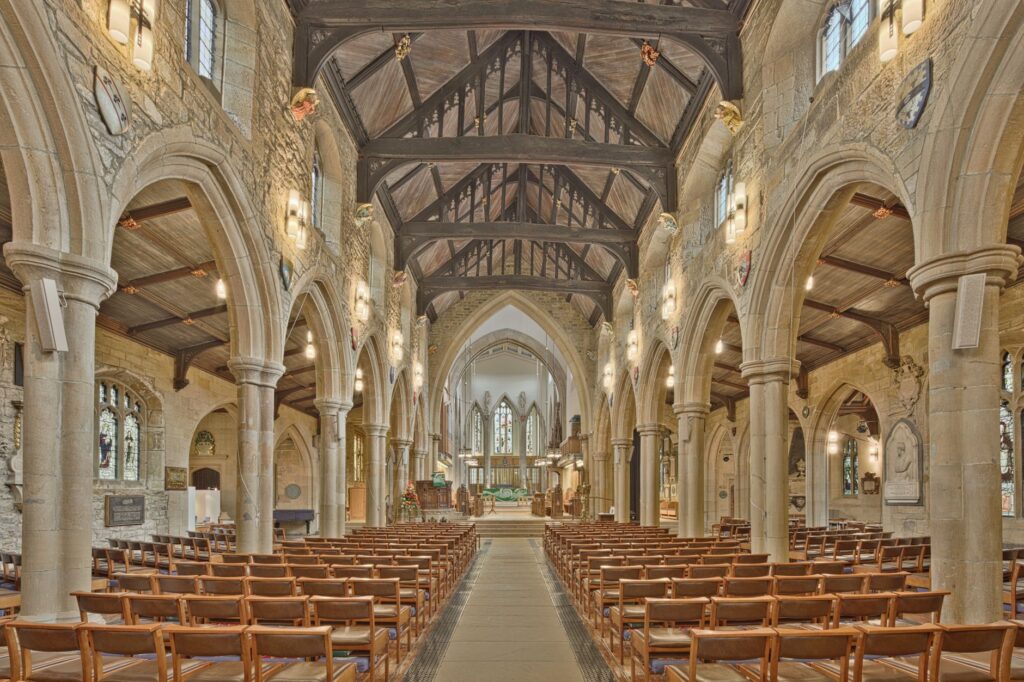
Bradford Cathedral, medieval in origin and transformed over the centuries, offers another register: that of a religious institution that has accompanied the city’s life through its hardest stages. Its interior, sober and luminous, invites a pause away from the bustle of the center.
These spaces do not compete with one another; they complement each other. The science and media museum speaks of innovation and of how the world is told through images; the industrial museum speaks of bodies and work; the cathedral speaks of continuity and ritual. Visiting them on the same day allows a fairly complete idea of the layers that make up local identity.
Neighborhoods, communities and everyday life
Beyond the center, Bradford is organized into neighborhoods with marked identities. Areas such as Manningham or Great Horton concentrate an intense commercial and associative life, with markets, mosques, temples and shops that reflect the diversity of the population. That diversity is part of the city’s contemporary heritage, although it does not always appear in traditional guidebooks.
Walking these neighborhoods requires respect and curiosity. They are not stages for the visitor but places where people live and work. The best way to approach them is through markets, food outlets and community spaces that open their doors to the public.
It is also worth remembering that the history of immigration in Bradford is part of its intangible heritage. Successive arrivals of communities, linked in part to labor demand and to later migratory processes, have transformed the social and commercial landscape. That history is not always musealized, but it can be read in shop windows, in the languages heard on the street and in the variety of temples and places of worship.
Food as a gateway
Food is one of the best ways to understand Bradford. The local curry tradition, with a well-established scene of restaurants and takeaways, coexists with traditional pubs and a growing offer of cafés and bakeries. That gastronomic coexistence says much about a city accustomed to mixing influences.
For the traveler, tasting that diversity is also a way to support local economies and to meet those who sustain the everyday life of the place. A practical recommendation: look for places with a regular neighborhood clientele, ask about the dishes of the day and avoid concentrating all meals in the areas most frequented by visitors.
A heritage that demands responsible decisions
Bradford faces the challenge common to many European industrial cities: how to preserve its heritage without turning it into a backdrop for tourists. There is no single answer. It involves keeping buildings in use, supporting local cultural institutions and preventing tourist pressure from displacing residents.
The visitor has a role, however modest. Choosing local businesses, respecting the opening hours of community spaces and avoiding treating neighborhoods as attractions are small gestures that contribute to a more balanced form of tourism.
To this is added a question of expectations. Bradford is not a city of monumental postcards or a theme park of the Industrial Revolution. Those who arrive looking only for great landmarks may leave with an incomplete impression. Those who accept walking it with time will find an uneven urban fabric, with very cared-for areas and others awaiting investment, and that very inequality is part of what must be understood.
Bradford’s industrial memory is not preserved only in buildings: it stays alive when communities continue to use those spaces to work, learn and gather.
Practical guide
To plan a visit to Bradford, some basic criteria are worth keeping in mind. The center is easy to explore on foot, although peripheral neighborhoods require public transport. The climate of northern England is changeable, so waterproof clothing and comfortable shoes are advisable in any season.
- Allow time for the historic center and for at least one museum; the National Science and Media Museum and the Bradford Industrial Museum offer complementary perspectives.
- Check the opening hours of cultural spaces before visiting, as they may vary by season.
- Spend a morning or afternoon in a neighborhood outside the main circuit, with a respectful attitude and without intruding on private spaces.
- Use public transport to move between areas and reduce car use in the center.
- Support local shops and restaurants, especially in markets and neighborhoods.
- Carry a spare battery or check coverage if you plan to use your phone as a guide, and download maps before setting out to avoid depending on the connection.
When to go and how to get around
Spring and summer usually offer more hours of daylight and a denser cultural agenda, although the weather is not predictable. Autumn and winter allow a quieter visit, with fewer visitors in the museums. Bradford has a railway station and road connections with other cities in northern England, making it easy to include in a broader tour of the region.
Getting around the center on foot is simple if points of interest are grouped by proximity. For the neighborhoods, it is advisable to check routes and frequencies in advance, as services may be reduced at weekends or at night. If traveling by car, it is preferable to leave the vehicle in park-and-ride facilities and combine with public transport.
A city in transformation
Bradford is not a city frozen in time. Its industrial heritage is the base on which a new identity is being built, marked by diversity, culture and the search for a place in the contemporary economy. Walking it attentively allows that transformation to be seen in progress, with its achievements and its tensions.
That transformation is also expressed in the debate over what deserves to be preserved. Not all industrial buildings can be rehabilitated, and decisions about their future affect the life of the neighborhoods. Observing those processes, without turning them into a spectacle, helps to understand that heritage is a continuous negotiation between memory, use and viability.
For the traveler willing to look beyond the headlines, Bradford offers something valuable: the chance to understand how a city negotiates with its memory without renouncing its future. That is, perhaps, the most useful lesson a visitor can take away.