The Decline and Rebirth of an Era on Rails
For decades, overnight rail transport in Europe appeared doomed to obsolescence. The liberalization of airspace, the proliferation of low-cost airlines, and the initial allure of daytime high-speed rail relegated sleeping cars to the background. Several state-owned companies drastically reduced their networks, eliminating historic routes that for generations had connected capitals and peripheral regions while passengers slept. However, the current climate urgency, combined with cumulative fatigue over cumbersome airport security procedures, has prompted a Copernican shift in the continent’s mobility policies.
Today, the night train is perceived not merely as a nostalgic or romantic alternative, but as a cornerstone and strategic piece within the European Union’s cross-border transport system. Community institutions and various national railway operators have begun coordinating efforts to revitalize this sector, driven by the need to decarbonize medium and long-distance transport. On average, rail emits an insignificant fraction of the greenhouse gases generated by commercial aviation on equivalent routes.
This paradigm shift responds not only to environmental guidelines, but to a structural transformation in how we understand efficient displacement. Sleeping in motion allows travelers to optimize their time, eliminating the need for costly hotel stays and transforming transit hours into a period of effective rest. Existing infrastructure, although requiring substantial investments in modernization and maintenance, offers a well-established capillary network that crosses geographical and administrative borders with a lower territorial impact than constructing new exclusive high-speed lines.
Infrastructure Investment: The Technical Challenge of the Cross-Border Network
Revitalizing overnight rail transport is not simply a matter of adding new carriages to existing tracks; it entails overcoming a complex web of technical, logistical, and regulatory challenges. One of the main historical obstacles has been the fragmentation of European railway systems. Different track gauges, disparate signaling systems (such as the still-incomplete deployment of the European Rail Traffic Management System, ERTMS), and tensions in catenary electrical grids often force costly locomotive changes or cause convoys to halt at borders for hours.
Furthermore, the prioritization of daytime high-speed trains and freight traffic during nighttime slots—traditionally used for infrastructure maintenance work—generates significant bottlenecks. Night train operators must negotiate competitive timetables on saturated tracks, which frequently results in accumulated delays over journeys exceeding one thousand kilometers.
In response to this landscape, national infrastructure managers are increasing budgetary allocations for border crossing renovations and technical harmonization. Investment focuses on the digitization of command posts, the improvement of automatic coupling hooks, and the updating of rolling stock maintenance workshops. Without these structural interventions, any expansion of night train offerings would inevitably collide with the physical and operational limits of a network designed for the past century.
The true success of the nocturnal rail renaissance will not depend solely on passenger enthusiasm, but on the technical capacity of States to integrate fragmented national networks into a truly cohesive single transport market.
Operator Strategy: Fleet Renewal and Modern Comfort
For years, traveling on a European night train meant facing aging compartments, deficient sanitary facilities, and an absolute lack of digital connectivity. This image has begun to fade thanks to ambitious rolling stock acquisition programs by major sector players, led by the Austrian company ÖBB with its modern Nightjet trains, followed by joint initiatives among operators in Germany, France, and Switzerland.
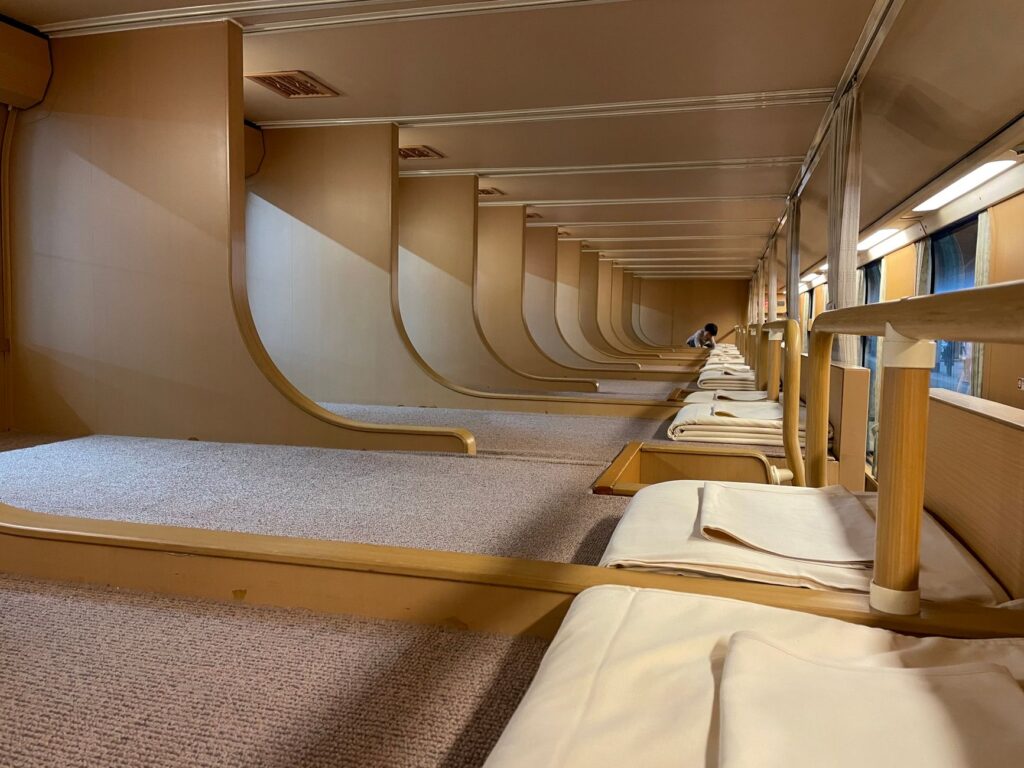
The new generation of night trains introduces innovative concepts in interior design, adapting to contemporary travelers’ demands for comfort, privacy, and security. Alongside traditional sleeping compartments and couchettes, individual capsule spaces (known as mini cabins) have gained popularity, offering optimized private space for solo travelers without the need to book an entire cabin.
Likewise, carriage soundproofing, independent compartment climate control, and the integration of USB charging ports and onboard Wi-Fi have been substantially improved. These technological enhancements not only raise the standard of comfort, but redefine the service’s value proposition: the journey ceases to be an uncomfortable formality and becomes an integrated, productive travel experience or a period of absolute rest.
The Human Experience Onboard: Community and a Leisurely Pace
Beyond engineering and logistics, the night train retains a unique human dimension that radically differentiates it from any other mass transport mode. Unlike the sterile anonymity of an airport terminal or the rigidity of an airline seat, a night train carriage fosters a particular form of conviviality and socialization among passengers from highly diverse geographical and cultural backgrounds.
Narrow corridors and shared spaces act as spontaneous meeting points where conversations transcending linguistic and national barriers take root. This leisurely pace allows travelers to internalize geographical transitions: going to sleep in a bustling metropolis and waking up at dawn to view alpine valleys, river plains, or Mediterranean coasts offers a visceral understanding of the territory that air transport, with its instantaneous jump between isolated points, systematically destroys.
Onboard staff play a fundamental role in this experience. Train managers and cabin attendants act as guardians of a demanding railway tradition, ensuring safety, punctuality, and passenger well-being during unsociable hours. Their professional dedication guarantees that, despite technical unforeseen events along the route, the passenger experience maintains a personalized and human standard of care.
Cross-Border Connectivity: Key Corridors and Routes
The current map of night trains in Europe is undergoing a radical reconfiguration. Corridors that had disappeared or drastically reduced frequencies are regaining prominence thanks to bilateral agreements and public subsidies conditioned on territorial cohesion. Vienna has indisputably established itself as the nerve center of this network, directly connecting with cities such as Berlin, Hamburg, Zurich, Rome, Brussels, and Paris.
Meanwhile, the Franco-German axis has recovered essential connections, demonstrating that political cooperation between states is an indispensable requirement to make multi-border lines economically viable. However, significant geographical asymmetries persist. While Central Europe boasts a notably high density of routes, the southern and eastern peripheries of the continent face greater operational difficulties stemming from both lower availability of modern rolling stock and lesser integration of national rail networks with trans-European corridors.
The development of these corridors requires long-term planning that transcends national electoral cycles. Train interoperability—the capacity to circulate under different safety regulations and electrical voltages—is the ultimate testing ground to measure the European Union’s real commitment to creating a single, efficient railway area.
Economic Challenges and the Dilemma of Public Subsidies
One of the most complex debates surrounding the resurrection of the night train revolves around its economic viability and the role of state intervention. Operating night trains is inherently costly: it requires highly specialized rolling stock, permanent crew throughout the night, high infrastructure usage fees, and higher maintenance costs than daytime trains due to the wear accumulated over long distances.
In a market where air transport continues to enjoy historical tax exemptions—such as the absence of taxes on aviation kerosene and the application of reduced or zero VAT rates on international flights—night train tickets often compete under inferior economic conditions. To correct this market distortion, various governments and supranational bodies are implementing direct financial support formulas, exemptions from rail track access fees, and public service obligation (PSO) models that guarantee the economic sustainability of strategic routes.
However, critics point out that subsidies must be managed rigorously to avoid market distortions and ensure that private and public operators compete on a level playing field. The medium-term goal is for technological innovation, economies of scale derived from massive fleet renewals, and consolidated demand to allow nocturnal services to achieve sustainable financial equilibrium without permanent reliance on public aid.
Ensuring that the night train remains accessible to all budgets is not just a matter of social equity, but the fundamental key for sustainable mobility to effectively replace highly polluting transport.
Planning and Future: Toward an Integrated Booking System
Beyond tracks and trains, the user experience in European rail transport has historically suffered from a severe problem of commercial fragmentation. Unlike the airline industry, where global platforms allow travelers to compare and purchase combined tickets from multiple airlines with a single click, purchasing a complex rail journey crossing several European countries can become a cumbersome and frustrating task.
The lack of a truly unified European booking system forces passengers to navigate multiple websites of different national operators, dealing with disparate cancellation policies, non-standardized fares, and scarce protection against delays in international connections. Conscious of this commercial barrier, the European Commission and various sector stakeholders are promoting initiatives to standardize sales channels and guarantee more robust passenger rights in case of missed cross-border links.
The future of overnight rail travel will depend largely on this digital simplification. If the purchasing process becomes as intuitive and transparent as an airline booking, it is highly likely that a new cohort of travelers will embrace rail not only as an ideological option, but as their preferred transportation mode for continental medium-distance journeys.
Practical Information for the Nocturnal Traveler
Planning an overnight train journey in today’s Europe requires keeping several specific logistical considerations in mind to ensure a smooth and satisfying experience:
- Advance Booking: Places in private compartments and couchettes, especially during peak season or weekends, usually sell out weeks in advance. It is recommended to purchase tickets as soon as the respective operator’s sales period opens (generally 60 to 90 days prior).
- Accommodation Types: Evaluate available options according to personal needs. Deluxe cabins feature private bathrooms and showers; standard couchettes are ideal for families or groups; and the new individual capsules offer maximum privacy for solo travelers at competitive prices.
- Documentation and Border Controls: Although most routes take place within the Schengen area, some lines cross external borders (such as connections with the Balkans or Eastern Europe), making a valid passport mandatory and requiring verification of specific visa requirements.
- Luggage: Unlike strict airline weight and size restrictions, trains allow greater flexibility, but it is the passenger’s responsibility to manage their own luggage through narrow corridors and place it in designated spaces within compartments.
- Connectivity and Autonomy: Although new fleets feature power outlets and Wi-Fi, it is advisable to download entertainment content in advance and carry an external battery, as data signals can be intermittent in remote rural areas or nighttime mountain passes.
Conclusion: The Destination Lies in the Journey
The renaissance of the night train in Europe transcends the mere recovery of a tourism or transport offering. It represents a profound cultural shift in how contemporary society values the time, space, and environmental impact of its displacement. By transforming transit into an experience of rest and contemplation, the night train proves that efficiency does not have to conflict with sustainability or human scale.
As cross-border infrastructure modernizes, fleets are renewed, and booking channels are unified, the horizon of European transport is increasingly traced upon rails. The future of continental mobility is no longer measured exclusively by the relentless speed with which a destination is reached, but by the quality, safety, and coherence of the path traveled during the night.