An Archipelago Sculpted by Ice and Time
Between the coasts of Sweden and Finland, emerging from the cold and often crystal-clear waters of the Baltic Sea, lies an archipelago that defies the simple notion of continuous territory. Åland is not a single landmass, but an intricate mosaic composed of more than six thousand islands and islets, of which barely a hundred are permanently inhabited. This fragmented landscape, patiently sculpted by the retreat of glaciers during the last ice age, has conditioned the existence of its inhabitants from the very beginning. Here, geography is not a mere backdrop, but the principal actor dictating the rhythm of life, communications, and the local economy.
The history of these islands is deeply intertwined with the surrounding water. For centuries, the sailors, fishermen, and merchants who traversed the Gulf of Bothnia depended on the whims of the weather and their own vessels to maintain contact with the outside world. Today, although modernity has radically transformed living standards, the essence of this relative isolation persists. Connectivity is not understood in Åland as a luxury or a disposable convenience, but as a fundamental right and a vital public service that requires meticulous logistical engineering and constant investment by local and national authorities.
The Floating Backbone: The Ferry System
To understand how the daily machinery of Åland functions, one must look toward the water. Asphalt roads and bridges connecting the main islands, such as Fasta Åland, to some of their closest neighbors are only part of the solution. The true heart of mobility in the archipelago lies in its complex network of public ferries, known locally as skärgårdsfärjor. These ships, frequently painted in a distinctive red or white tone, operate as authentic floating streets, transporting not only foot passengers, but also private cars, freight trucks, and emergency vehicles.
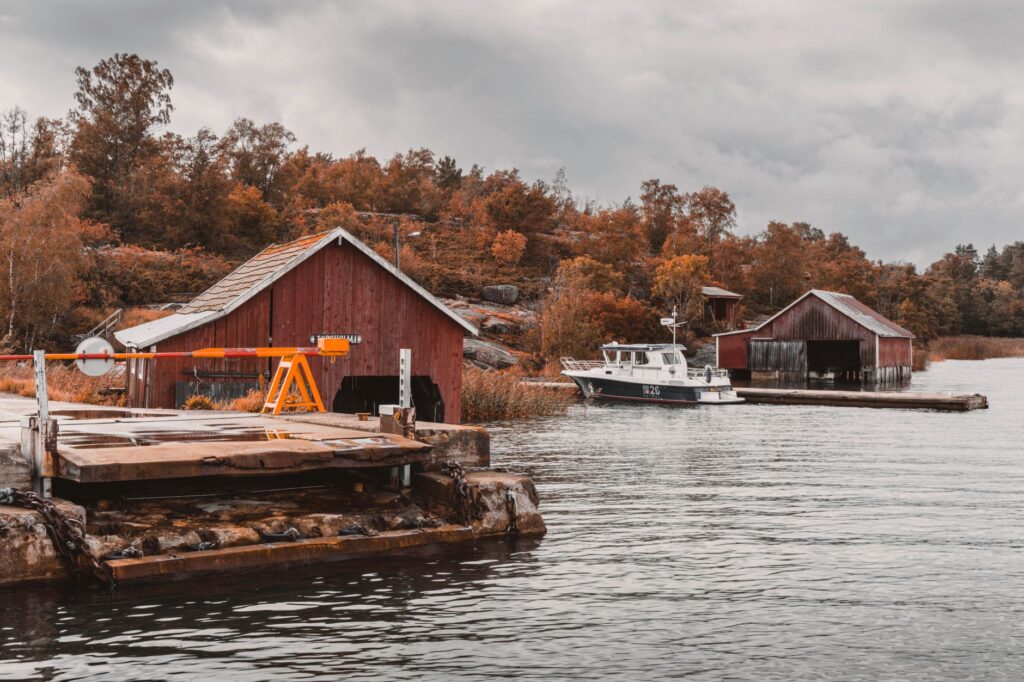
The management of this fleet responds to rigorous planning. Routes are divided into main lines connecting with the European mainland and local circuits meandering among the outer islands. Unlike commercial ferry services oriented purely toward mass tourism, Åland’s routes operate under strict public service obligations. This means that a resident of a remote island like Brändö or Kumlinge is guaranteed that the vessel will arrive even during the harshest winter months, when sea ice begins to form along the shores and crews must carve a path using reinforced hulls.
The transportation infrastructure in Åland does not measure its success by the speed of its journeys, but by the unwavering reliability with which it unites its communities during the most adverse days.
The technical challenges faced by the operators of these ferries are considerable. Meteorological tides, gale-force winds from the north, and dense fog that frequently descends over the Baltic during autumn demand remarkable skill from the captains. Moreover, the ecological transition has reached this fleet: in recent years, the autonomous government has promoted the modernization of vessels toward hybrid and electric propulsion systems, drastically reducing carbon emissions in a natural environment that residents protect with an almost religious fervor.
Road Engineering Across the Stone Labyrinth
When the ferries deposit travelers on solid ground, a terrestrial infrastructure network unfolds, surprising visitors with its high quality in such a dispersed territory. Åland’s roads wind through pine forests, cultivated meadows, and rocky coasts, connecting villages where time seems to flow at another cadence. The construction and maintenance of this road network pose a permanent civil engineering challenge, especially due to the geological nature of the terrain, composed of Precambrian rock and unstable glacial deposits.

To overcome the countless straits and channels fragmenting the territory, the administration has developed a system of bridges and causeways over the decades that is a source of local pride. Civil engineering works like the Prästösund Bridge demonstrate how civil architecture can integrate sensitively into a protected landscape. Each structure must support not only vehicular traffic, but also harsh winter weather conditions, where the use of salt and the constant freeze-thaw cycle test the durability of asphalt and structural materials.
However, investment in roads does not seek to encourage runaway traffic. In fact, Åland’s mobility policy prioritizes road safety and coexistence with vulnerable users. It is common to find bicycle lanes parallel to the main roads, fostering an active transport model that attracts both locals and visitors interested in exploring the archipelago at a leisurely pace. The bicycle is not merely a recreational resource here, but a real and efficient alternative for commuting between neighboring towns during the summer months.
Autonomy, Culture, and the Human Factor
To speak of connectivity in Åland is, inevitably, to speak of its unique political and cultural status. Although they belong to Finland, the islands enjoy broad legislative autonomy, a historical demilitarization status, and Swedish as their sole official language. This singular identity is reflected in the way communities manage their transport resources. Decisions on which routes to maintain, which schedules to prioritize, or how to subsidize tickets for residents are made locally in the regional parliament, known as the Lagtinget, ensuring that the real needs of the population prevail over pure economic efficiency.

The demographics of the archipelago present particular challenges. While the regional capital, Mariehamn, concentrates most of the population and functions as the hub for services and commerce, the outer islands experience a gradual process of demographic aging. In this context, maintaining robust connectivity is not just a logistical matter, but a fundamental tool to curb rural depopulation. Ensuring that a young person can study in Mariehamn and return to their home island or that a doctor can quickly reach an emergency in an isolated islet depends directly on the efficiency of this multimodal transport network.
Local culture is deeply marked by this coexistence with the sea. Traditions of shipbuilding, artisanal fishing, and sailing remain alive in the collective memory and daily practice of many residents. Far from being a community cut off from the modern world, Åland has successfully capitalized on its strategic position in the Baltic, becoming a meeting point for international navigation and a benchmark in the sustainable management of insular territories.
Digital Connectivity and Decarbonization
In the twenty-first century, physical mobility is no longer the sole indicator of connectivity. For a dispersed archipelago like Åland, digital infrastructure has become the invisible circulatory system allowing local businesses to compete in the global market and citizens to access essential services without physically traveling to the mainland. The deployment of high-speed fiber-optic networks across virtually all inhabited islands has radically transformed the local economy, facilitating telework and the emergence of small tech and creative enterprises.

Simultaneously, the transport sector is immersed in a profound green transformation. The regional government has set the ambitious goal of achieving emission neutrality in its public ferry network within the coming decade. This entails not only the electrification of smaller vessels, but also the exploration of alternative fuels such as biogas and green hydrogen for longer routes. Electric vehicle charging stations are multiplying along roads and at ferry terminals, anticipating a vehicle fleet rapidly evolving toward zero-emission mobility.
The true innovation in Åland does not lie in the blind adoption of technology, but in its ability to place technology at the service of preserving its fragile ecological balance.
This commitment to sustainability also extends to tourism. Authorities actively promote the concept of slow travel, inviting visitors to leave their cars at home or in the main parking lots and explore the archipelago using a combination of public ferries, bicycles, and hikes. This model not only reduces the environmental footprint, but also noticeably improves the quality of the travel experience, allowing for a more genuine contact with nature and local communities.
Practical guide
How to get there: The main access route to Åland is via large-scale ferries operated by companies such as Viking Line and Tallink Silja, connecting Mariehamn with Stockholm, Turku, and Helsinki. It is also possible to fly to Mariehamn Airport (MHQ) from the Finnish and Swedish mainlands.

Getting around the archipelago: To explore the outer islands, the local ferry network (Ålandstrafiken) is indispensable. It is recommended to check timetables in advance and reserve space for vehicles, especially during the summer months. Many local routes are free for foot passengers.
Silence and Horizon: The Atlantic Refuge
When the sun begins to sink over the horizon of the Baltic Sea, dyeing the waters a coppery hue and casting long shadows over the red granite cliffs, Åland reveals its true emotional dimension. In this corner of the north, where the bustle of the European continent seems to vanish completely, stillness is not an emptiness, but a tangible presence. Gulls glide silently over the calm waves, and the only sound accompanying the traveler is the steady whisper of the wind through the pines and the soft lapping of water against the wooden dock.
Inhabiting or visiting this archipelago demands a special attunement to the rhythms of nature. Here, delays caused by unexpected fog or a sudden shift in wind are not perceived as annoying inconveniences, but as reminders that human beings remain subject to forces much greater than their own will. It is in this acceptance that the profound peace emanating from these islands resides, an enduring reminder that true disconnection is, in reality, a reunion with the essential.