The Landscape Sculpted by Ice and Time
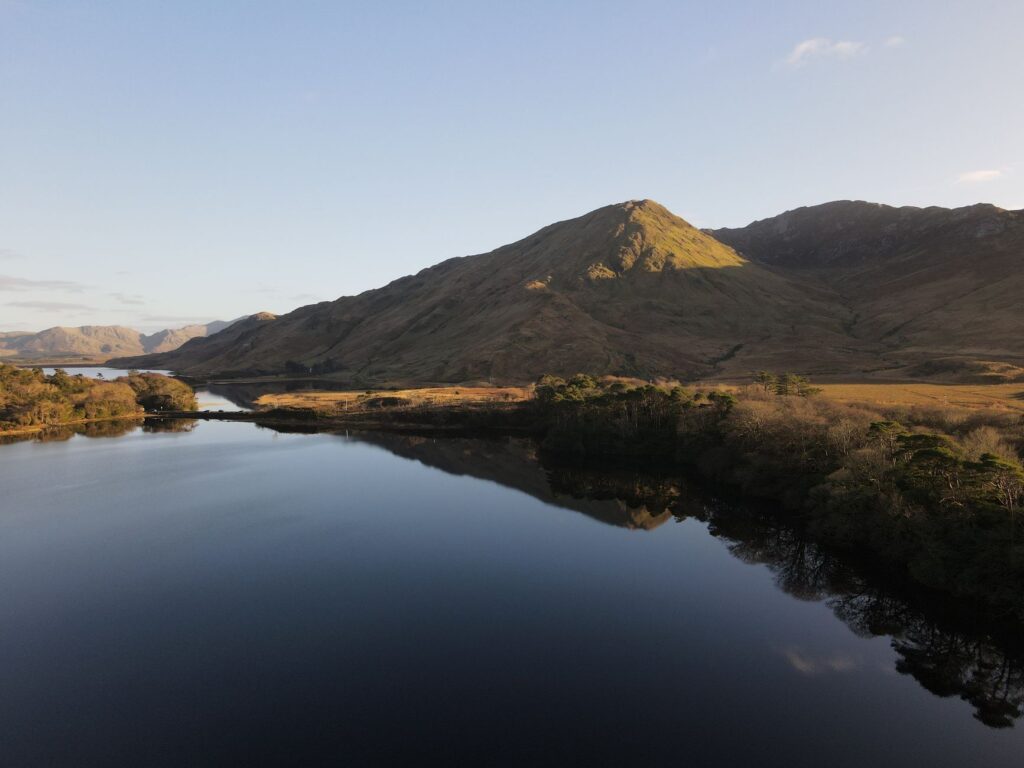
The territory of Connemara, situated on Ireland’s rugged western edge, is defined by a landscape where stone and water maintain an unbroken dialogue. Unlike the island’s typical coastal contours, the Killary fjord — locally known as Killary Harbour — penetrates fourteen kilometers inland, wedged tightly between the imposing summits of Mweelrea and Ben Gorm. This marine inlet, carved by glaciers during the Pleistocene epoch, represents a unique geographical feature along the Irish Atlantic seaboard. Here, the tide rises and falls with a force that for centuries has dictated the rhythm of human life, demanding constant adaptation from those inhabiting its shores.
The formation of this fjord stems from a complex geomorphological process in which ice erosion exposed ancient quartzite and schist rock formations. These vertical walls, exceeding six hundred meters in elevation at certain points, act as a natural screen against prevailing westerly winds, generating a surprisingly sheltered microclimate. On the slopes, rainwater descends via countless streams and seasonal waterfalls, feeding the brackish waters of the estuary and creating a transitional ecosystem where deep-sea marine species coexist with migratory coastal birds.
The Vernacular Architecture of Dry-Stone Walls
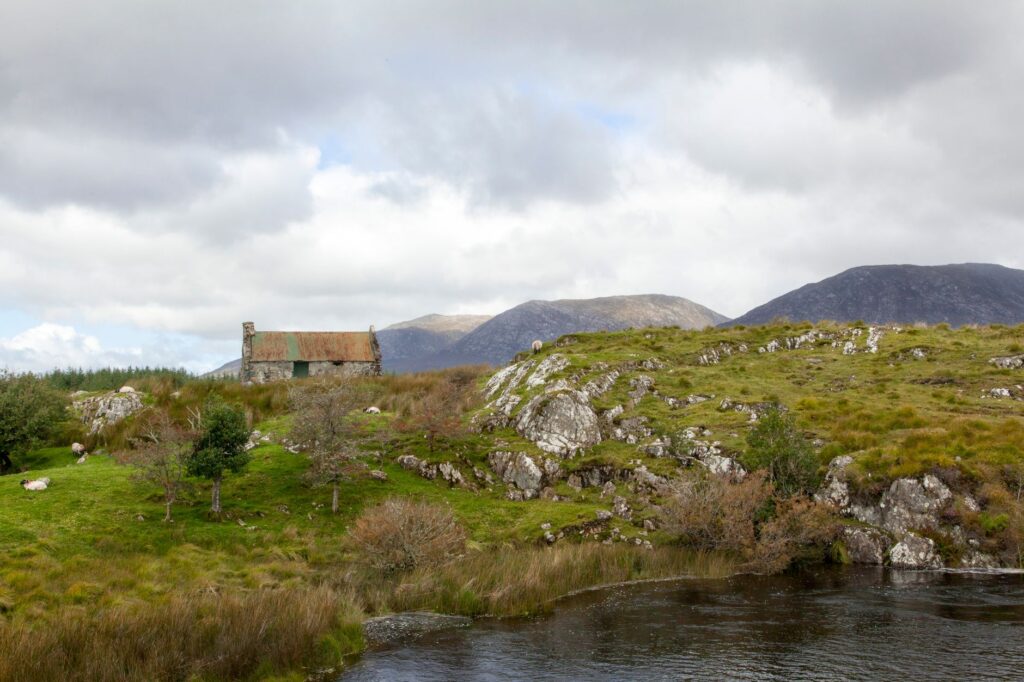
Exploring the surroundings of Connemara involves understanding the monumental effort required to colonize this rugged terrain agriculturally and pastorally. The surrounding fields are delineated by kilometers of dry-stone walls, erected without mortar by generations of farmers who had to clear the soil of boulders and granitic slabs before cultivation was possible. These structures are far from mere property boundaries; they function as a sophisticated natural drainage system and thermal shelter for sheep herds, the region’s historical economic backbone.
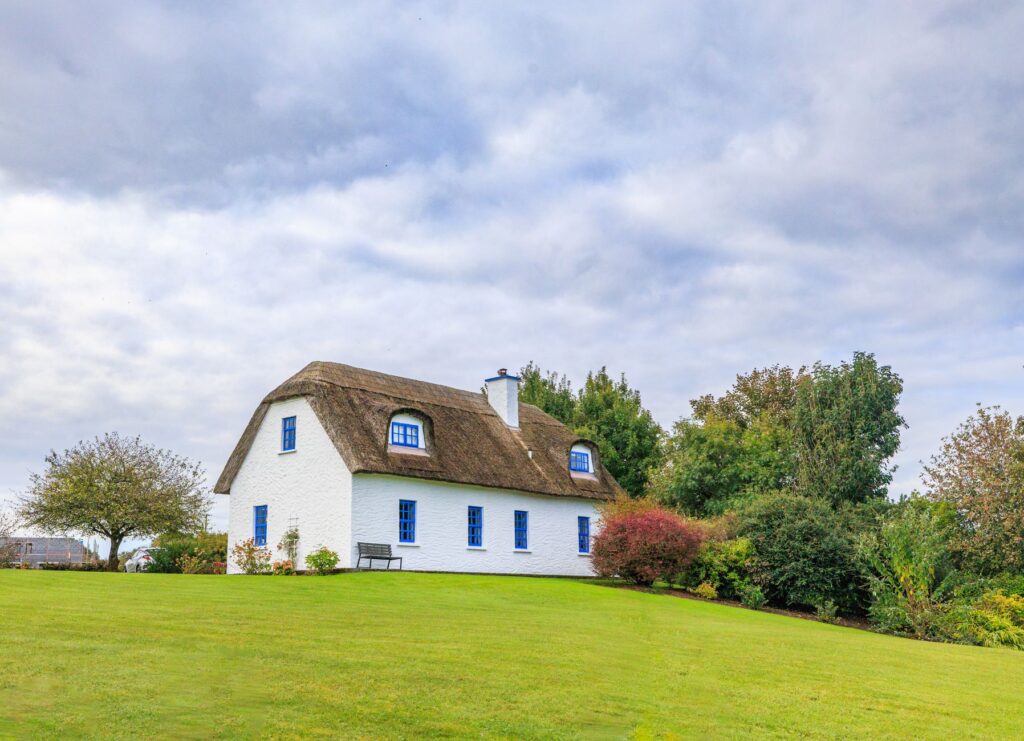
Traditional local dwellings, originally constructed with local stone and thatched or slated roofs, respond to a strict bioclimatic logic. Oriented with their backs to marine gales and featuring reduced window openings to minimize heat loss, these buildings reflect a poverty-born architecture elevated to mastery. Today, many of these structures have been restored with rigorous respect for their original volumes, utilizing traditional lime mortars and salvaged timber joinery that blend seamlessly into the heather and peat landscape.
Inshore Navigation and Maritime Heritage
The fjord’s waters have historically served as an essential communication route in a region where land transport remained practically non-existent until well into the nineteenth century. Inshore navigation, traditionally conducted in wooden craft known as *curraghs* — lightweight lath structures sheathed in tarred canvas — enabled the transport of goods, livestock, and people between scattered communities on both banks. This mode of transport demanded profound knowledge of tidal currents and local winds, lore transmitted orally from generation to generation.
The sea in Killary is not a dividing barrier, but rather the invisible waterway uniting communities separated by impassable precipices.
With the decline of traditional inshore fishing, Killary’s waters have found a new economic and ecological vocation through sustainable mussel farming. Mussels rafts dedicated to cultivating Atlantic and Galician varieties line the most sheltered zones of the fjord discreetly, taking advantage of nutrient-rich currents and the extreme purity of the waters. This low-intensity aquaculture model proves that respectful exploitation of the marine environment is entirely feasible, visually integrated into the landscape without disrupting native fauna corridors.
The Pulse of Settlements and Community Life
Population nuclei established around the fjord, such as Leenane, retain the structure of traditional Irish roadside villages, where daily life revolves around local commerce, the traditional pub, and the stone pier. In these spaces, unhurried conversation and the exchange of news regarding weather and sea conditions remain unaltered social rituals. The scarcity of flat land has kept urban growth virtually nonexistent, preserving the human scale and visual isolation that characterizes this corner of Connemara.
The local economy has successfully diversified toward low-intensity tourism prioritizing long-distance hiking, kayaking, and botanical observation over mass infrastructure. Ancient drovers’ roads, once used to transport peat harvested from interior valleys down to embarcation points, have been transformed into marked trails allowing travelers to venture into high-mountain moors with minimal environmental impact. This economic transition has successfully averted the rural depopulation affecting other peripheral regions across Europe.
The Botany of Moors and Atlantic Peatlands
Killary’s botanical environment is among the most singular in the British Isles, dominated by the vast expanse of the Atlantic blanket bog. This ecosystem, formed over millennia due to constant water saturation and cool summer temperatures, acts as an invaluable natural carbon sink. Among the cushions of *Sphagnum* moss grow botanical species of major biogeographical interest, such as the carnivorous round-leaved sundew (*Drosera rotundifolia*) and various wild orchid varieties adapted to acidic, nutrient-poor soils.

Managing these spaces requires a delicate balance between active conservation and traditional extensive grazing. Sheep herds, roaming freely across the slopes, perform an indispensable ecological function by preventing the excessive proliferation of woody scrub and maintaining herbaceous layer biodiversity. Local botanists and environmental authorities collaborate closely with farmers to establish grazing rotation periods in the most fragile zones, ensuring the preservation of a cultural landscape that is simultaneously an ecological sanctuary.
The Atlantic Light and the Landscape’s Chromatic Palette
One of the most captivating aspects of the Killary fjord is its constant luminous transformation. The convergence between the oceanic mass and mountain summits generates a dynamic meteorological regime where clear skies swiftly give way to dense rain showers and lingering mists. This atmospheric variability produces dramatic lighting effects, locally known as Connemara’s shifting moods, historically drawing landscape painters and photographers in search of a chromatic palette built upon the ochres of withered ferns, deep pasture greens, and metallic water greys.
Light in these latitudes does not merely illuminate the landscape; it sculpts it second by second with strokes of silver and shadow.
Far from being perceived as a drawback, this damp, unstable climate serves as the true artisan of the melancholy, poetic atmosphere defining the traveler’s experience. Low-lying clouds brushing the water’s surface and mirror-like reflections on completely calm days configure a setting of introspection and silence, where the sole perceptible sound is the whispering wind among reeds and the measured rhythm of Atlantic tides against the stone pier.
Practical guide
Getting there: The primary access to the Killary fjord is via road from Galway (approximately a 1 hour 15 minute drive north along the N59) or from Westport (30 minutes south). Renting a compact vehicle is strongly recommended due to the narrowness of the region’s secondary roads.
When to go: The months from May to September offer the longest daylight hours and moderate temperatures (between 14 °C and 20 °C). However, autumn months (October and November) provide an exceptional chromatic palette across the peatlands and greater tranquility along the trails.
Accommodation: Priority is given to traditional guesthouses (*B&Bs*) and small restored rural inns in Leenane and surrounding areas. Advance booking several months ahead is essential during the summer peak season.

Gastronomy: The star product is the Killary mussel, locally harvested and served in area pubs alongside homemade soda bread and fresh inshore seafood. Connemara lamb stews represent another unmissable local reference.
Route recommendations: The long-distance walking trail known as the *Killary Famine Trail* offers a unique historical and scenic perspective, tracing an old relief road constructed during the Great Famine. Waterproof mountain footwear and appropriate technical rain gear are required.
The Final Sanctuary at the Water’s Edge
As evening falls, when activity within the fjord halts entirely and the shadows of the Mweelrea mountains stretch across the mirror-like water surface, Killary reveals its most intimate dimension. Sitting on the threshold of a converted stone cottage, the traveler understands that the true wealth of this Atlantic outpost lies in its capacity to suspend time. Here, slowness is not a flaw but a conquest, an eloquent reminder that the planet’s most breathtaking landscapes still demand patience, respect, and attentive listening to the deep pulse of earth and sea.