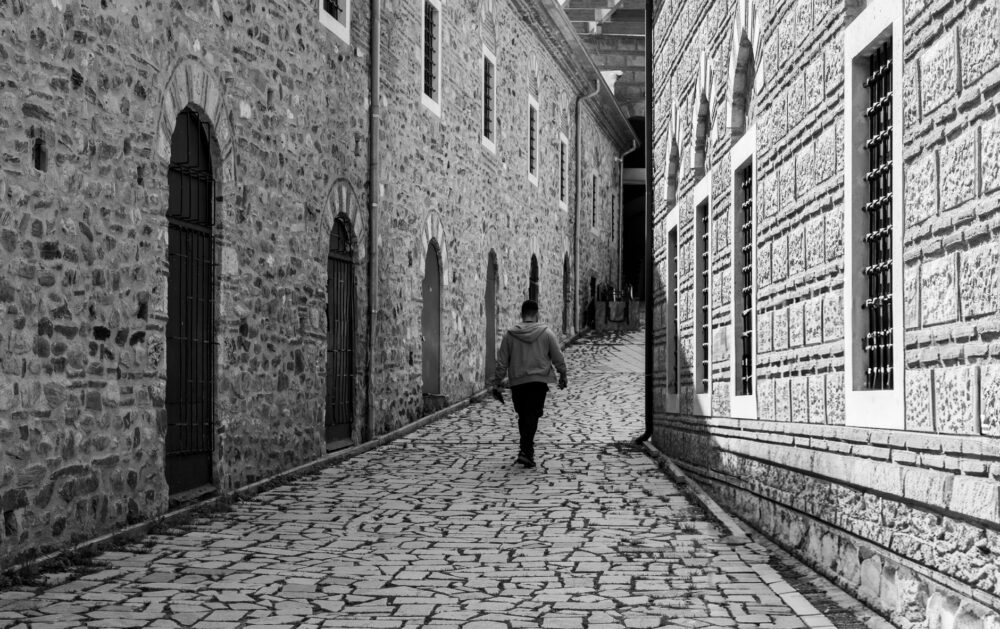
There is a question worth asking before setting out: at what scale do we want to measure the journey? Not the scale of places crossed off a list, but the scale of the person who walks, listens and remembers. In an age that rewards speed and accumulation, defending the human scale is not nostalgia but a deliberate choice, both editorial and personal: deciding what deserves our attention and what we leave out so that what remains can breathe.
A territory is not a backdrop
When we speak of territories, we speak of inhabited places. There is a real difference between visiting a landscape and understanding one: the first turns it into a background for a photograph; the second requires time, context and a certain humility. A territory does not begin when we arrive or end when we leave. It has a prior history, a daily life that does not pause, and rules that do not always match our own.
This is why we favour a simple idea of culture: one that recognises what was already there before our arrival. Culture is not an ornament of travel but its condition. Without it, movement becomes a series of stimuli with no thread. With it, even a small square becomes legible, and the traveller discovers that not everything has been designed for their consumption.
Hospitality is not demanded; it is thanked
There is a way of travelling that confuses service with entitlement. Hospitality, by contrast, is a gesture that is offered and that should be received with gratitude and without demand. It is not a product included in a booking; it is a form of treatment born of trust, and it may not occur at all. When it does, it transforms the journey: a shared table, a precise direction, a door opened without calculation.
A concrete responsibility follows: do not turn kindness into expectation. The traveller who gives thanks instead of making claims understands something essential about mobility: we are not the centre of the place we arrive in, but a passing presence that should behave as such.
Nature is not a stage set
Nature, too, demands a different scale. A forest, a coastline or a mountain is not a stage for the opportune photograph; it is a system with its own times that will not bend to our schedule. Learning to look at it without appropriating it is a form of respect and also of practical intelligence: whoever understands an ecosystem knows that their presence has limits and that not every access is a right.
Responsible mobility does not mean giving up travel; it means accepting that movement has consequences. That acceptance does not subtract pleasure; it orders it. It asks us to consider what we leave, what we carry and what we avoid, without turning the question into an endless moral examination.
Memory as light luggage
We return home with little material luggage and with a harder burden to measure: memory. Not idealised recollections, but what stays with us because it altered a previous idea. A smell, a way of greeting, a way of cooking that cannot be learned from a recipe book. Gastronomy, in this sense, is one of the most honest doors into a territory: it does not explain an entire culture, but it shows how daily life is organised.
Memory also teaches us not to exaggerate. Not every journey transforms us; some simply rest us, and that is fine. The human scale allows for small journeys, without epic, that nonetheless leave a discreet and lasting mark.
Looking without possessing
Perhaps the most useful lesson is this: to look without possessing. The traveller’s gaze should not turn the world into a collection. We can admire without appropriating, photograph without interrupting, explore without invading. That restraint does not impoverish the experience; it makes it more precise. It returns us to an old and sensible idea: travel is a form of learning, and learning requires acknowledging that we do not know.
A well-measured journey is not measured by what we reach, but by what we learn not to touch.
At Atlas Lume we defend that scale: the traveller who arrives with questions and leaves with more questions still; the one who understands culture as conversation and hospitality as a gift; the one who accepts that the world is not at their service. This is not a solemn stance but a practical way of caring for what matters: territories, the people who inhabit them, and the possibility of continuing to travel with meaning.