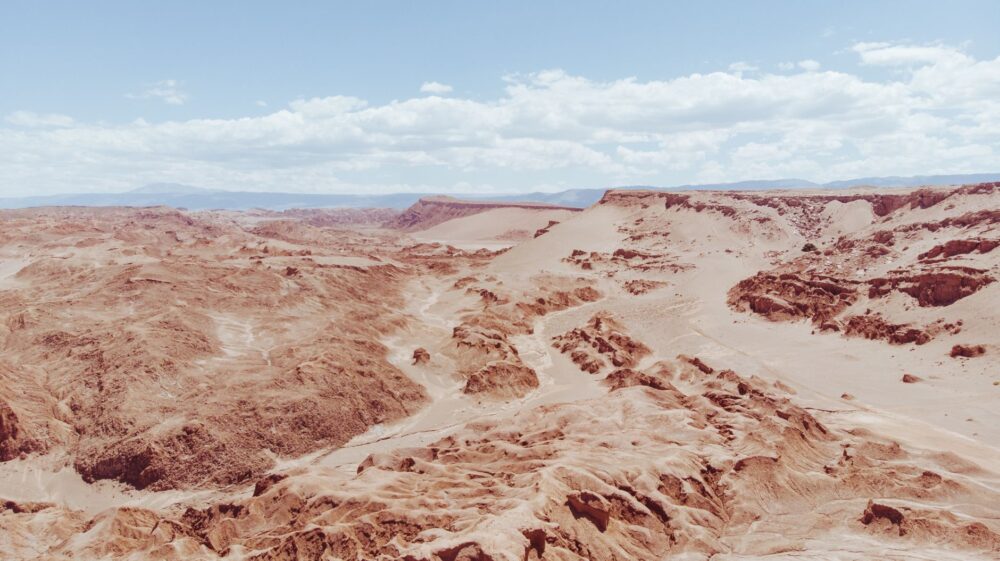
Neuquén province occupies the northwestern edge of Argentine Patagonia, a territory where the Andes collapse into arid plateaus and river valleys. That abrupt transition, running from snow-capped peaks to tussock-grass steppe within a few kilometres, produces a diversity of environments rarely found in South America. Here, high-mountain species, large raptors, and mammals adapted to harsh winters and dry summers all share the same landscape.
Watching wildlife in Neuquén is not a zoo visit or a motorised safari. It is an exercise in patience, in reading the land, and in accepting that the animal almost never appears when you expect it. The reward comes as distant silhouettes, tracks in the mud, or a slow glide along the edge of a rocky ridge.
A territory of three ecological tiers
Neuquén is organised in bands that succeed one another from west to east. The first is the high Andean mountain zone, with glacial lakes, lenga forests, and centuries-old araucaria trees. The second is the foothills and transverse valleys, where the climate grows drier and scrublands and shrub steppes appear. The third is the Patagonian plateau, a sea of tussock grass and sedimentary rock stretching to the border with Río Negro.
Each band has its own cast of species. In the high mountains, the Andean condor, the orange chinchillón, and rock-dwelling birds such as the Andean seedeater dominate. In the foothills and scrublands, the culpeo fox, the puma — hard to see but present — and a wide variety of songbirds appear. On the plateau, wildlife becomes more elusive and dispersed: guanacos, Patagonian rheas, maras, and grey foxes roam enormous expanses in search of water and fresh grass.
The Andean condor: the glider that depends on wind
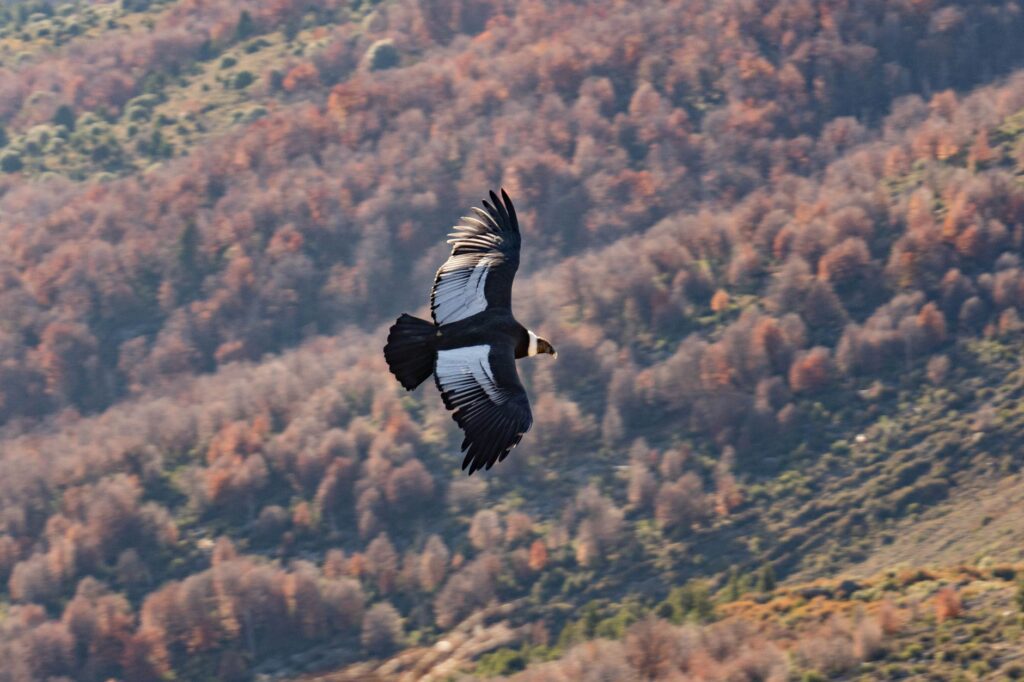
The Andean condor is perhaps the province’s most emblematic animal. With a wingspan that can exceed three metres, it needs thermal currents and slope winds to move. That is why it is easiest to see in sectors where the Andes generate strong updrafts, especially in mid-morning when the sun warms the rocky slopes.
It is not a bird that allows close observation. Sightings are usually at a distance, through binoculars, as the bird traces wide circles over a ridge. Specialists recommend against approaching roosts or nests and avoiding any loud noise that might alter its behaviour. The condor is sensitive to human disturbance and reproduces slowly: a pair raises, at best, one chick every two years.
Watching wildlife is not about collecting sightings: it is about accepting that the animal decides when to show itself and that our presence must go unnoticed.
Red deer: an introduced presence that shapes the ecosystem
Red deer are not native to South America. They were introduced to Argentine Patagonia in the early twentieth century for hunting and have since spread through forests and steppes in Neuquén and neighbouring provinces. Today they are a common presence in many environments, and their management sparks debate among conservationists, landowners, and authorities.
During the southern autumn, males emit their characteristic roar, a deep sound heard kilometres away in wooded valleys. The phenomenon attracts observers and photographers, but it also demands clear regulations to avoid disturbance during the rut. Ethical observation means staying on permitted roads, not chasing animals, and respecting areas where population studies are underway.
An open debate on management and conservation
The presence of red deer raises complex questions. On one hand, they compete with native herbivores and can alter forest regeneration. On the other, they generate economic activity in rural areas. Biologists working in the province insist on the need to monitor densities and to ground any decision in field data rather than perceptions.
Steppe and wetland birds: Neuquén’s other heritage
The Patagonian steppe is not an empty desert. It is an ecosystem with birdlife adapted to extreme conditions. On Neuquén’s plateaus, Patagonian rheas, tinamous, seedsnipes, and several raptor species can be observed. In wetlands and mallines — humid areas that act as water reservoirs — ducks, coots, herons, and Austral flamingos appear in season.
Mallines are especially important because they concentrate life in a dry landscape. Many are on private land or within provincial protected areas, and their conservation depends on both regulation and the goodwill of landowners. Some rural establishments have begun offering birdwatching as a complementary activity, creating incentives to care for these environments.
The quiet work of rangers and biologists
Behind every well-managed sighting is technical work that is rarely seen. Provincial rangers, biologists from national universities, and conservation organisations monitor populations, record data, and draft recommendations. Neuquén has natural protected areas that play a key role in conserving habitats and regulating public use.
That work includes condor censuses, monitoring red deer populations, controlling invasive species, and environmental education with local communities. It also means dealing with limited resources and the pressure of unregulated tourism. Ethical wildlife observation is not just an individual attitude: it is the result of a management system that needs funding and continuity.
Cultural landscape: the Mapuche imprint and extensive livestock farming
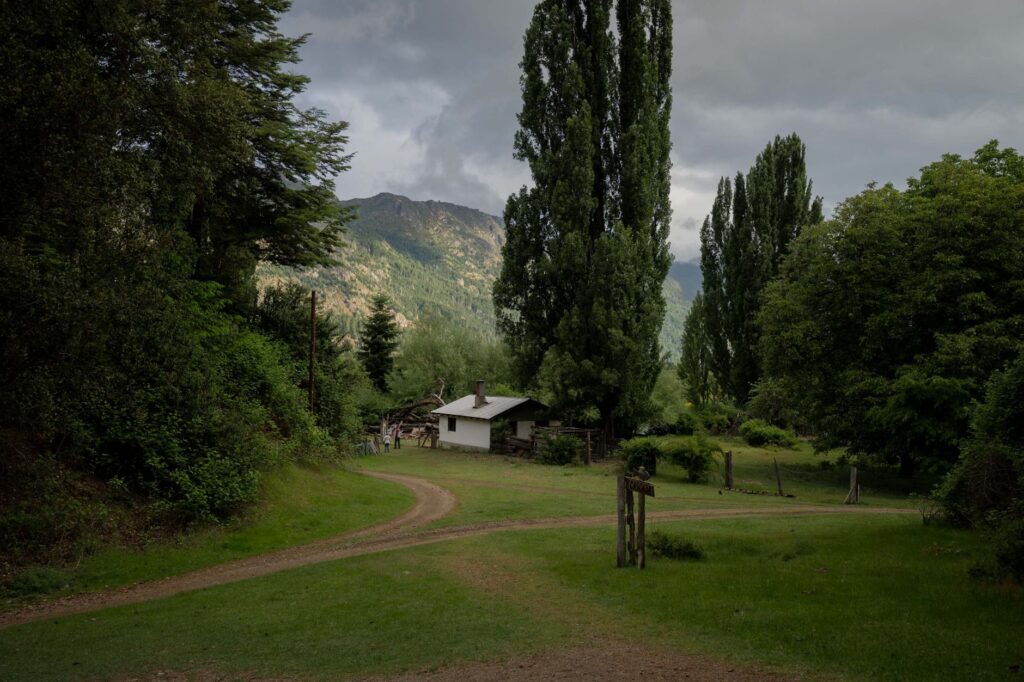
Neuquén’s territory has a deep human history. The Mapuche people have inhabited the region since long before the Argentine state took shape, and their relationship with wildlife and landscape is part of the cultural heritage. Local toponymy — Neyken or Neuquén appear in historical records and current names — reflects that presence.
Extensive livestock farming, especially sheep and goat herding, has shaped the landscape for more than a century. That activity coexists with wildlife and sometimes comes into conflict with it, for example when foxes or pumas prey on flocks. Coexistence programmes seek to reduce these conflicts through management techniques and compensation, though implementation is uneven.
How to watch wildlife without disturbing its home
The basic rule is simple: the animal comes first. That means keeping your distance, not feeding, not chasing, not playing sounds to attract birds, and not leaving permitted trails. In Neuquén, many species are sensitive to human presence and react with stress even at considerable distances.
- Use binoculars or a telephoto lens instead of getting closer.
- Avoid visiting roosts or nests during breeding season.
- Do not leave waste or food that might attract animals.
- Follow rangers’ instructions and signage.
- Hire local guides trained in ethical observation.
Wildlife watching in Neuquén requires planning. Distances are long, the weather changes quickly, and tourist services are limited outside urban centres. Visitors who arrive with realistic expectations — and patience — often take away memories more valuable than a photo: the memory of a distant glide or the sound of wind on an empty plateau.

Patagonian wildlife does not perform: it allows itself to be found. That difference separates the curious traveller from the predator of experiences.
Practical guide
When to go: Spring and autumn are the most comfortable seasons for wildlife watching, with moderate temperatures and greater bird activity. Winter is harsh in the high mountains, with snow and restricted access. Summer concentrates tourism and can compromise tranquillity in protected areas.
Getting around: Neuquén city serves as a logistical base, with an airport and road connections. To reach protected areas and rural zones, renting a vehicle or hiring local services is advisable. Distances between points of interest are long and fuel is not always available in remote areas.
What to bring: Layered warm clothing, sun protection, enough water, binoculars, and footwear suitable for uneven terrain. In summer, insect repellent. In winter, snow chains if driving mountain roads.
Where to get information: Provincial tourism offices and protected-area administrations offer updated information on access, permits, and recommendations. Licensed guides also know the right sites for undisturbed observation.

What to avoid: Do not feed animals, do not approach nests or young, do not use drones in protected areas without authorisation, and do not leave trails. Most incidents with wildlife stem from carelessness, not animal aggression.
A horizon that demands a long view
At dusk, when the Patagonian wind calms and low light traces the ridges, Neuquén shows its quietest face. A condor turning above a hill, a group of guanacos crossing a plain, a fresh track in the mud of a mallín. None of it is guaranteed. Wildlife does not answer to itineraries or office hours.
But that uncertainty is part of the place’s value. In a world where almost everything can be scheduled, the Neuquén steppe reminds us that nature still has its own rules. Watching it with respect is a way of recognising that we are not the only inhabitants of the landscape, and that the work of those who care for it deserves more attention than it usually receives.