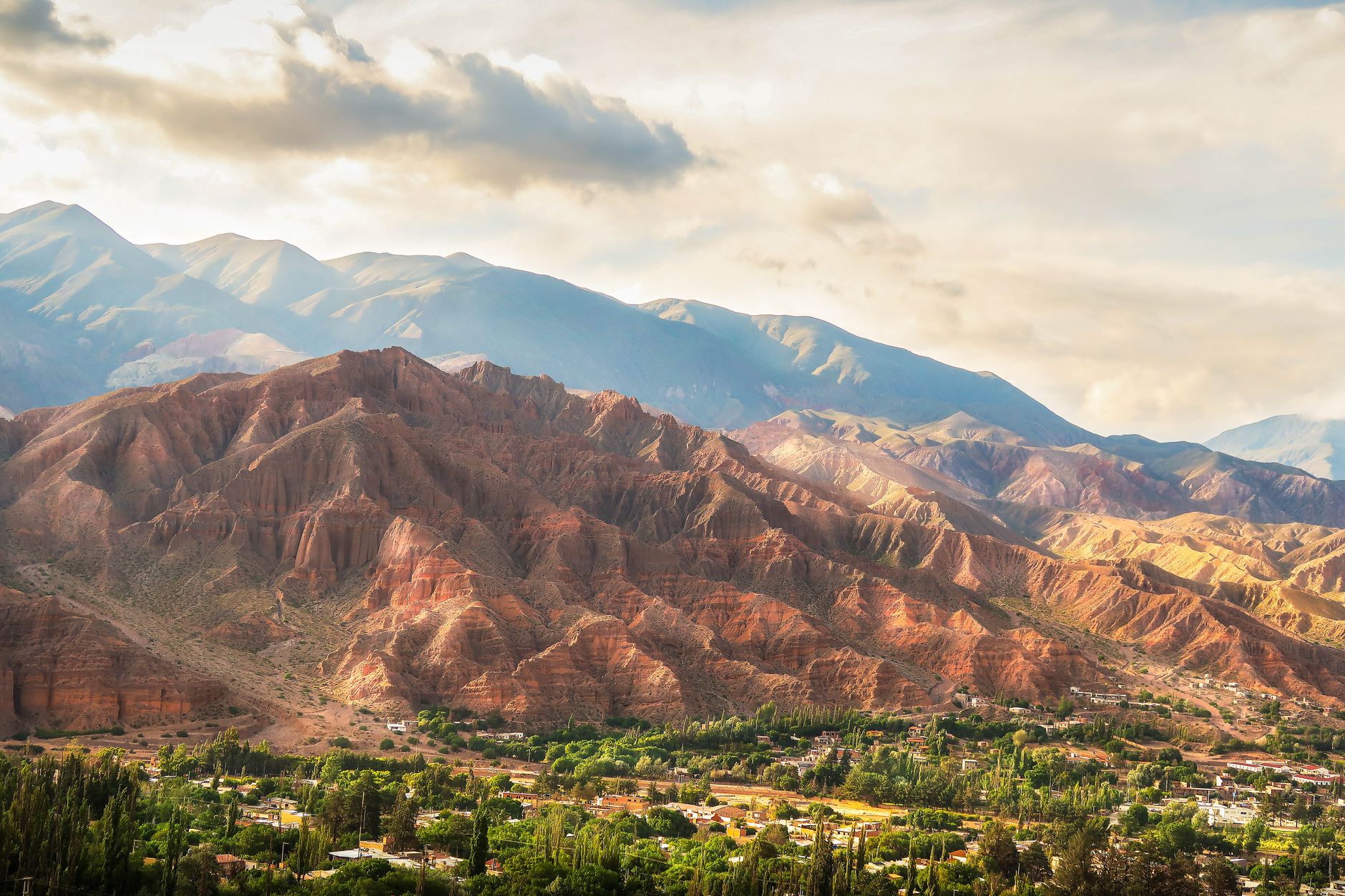

The Quebrada de Humahuaca stretches for 155 kilometres in the province of Jujuy, Argentina, following the course of the Río Grande. Inscribed as a UNESCO World Heritage Site in 2003, this region combines a dramatic natural setting with a history of human occupation spanning more than 10,000 years. It is not merely a geographical feature: it is a cultural landscape where present-day communities maintain agricultural, architectural, and festive traditions that converse with their pre-Hispanic and colonial past.
To travel through the quebrada is to enter a way of life that has integrated the ancient and the modern. From Purmamarca to Humahuaca, villages succeed one another among multicoloured hills, cultivation terraces, and historic chapels. The visitor who pauses to observe discovers that every adobe wall, every irrigation channel, and every community celebration tells a story of adaptation and resilience.
A natural corridor between the Puna and the valleys
The Quebrada de Humahuaca acts as a natural passage connecting the Andean high plateau with the lower lands to the south. Its geological formation, with coloured strata ranging from red to green, is the result of millions of years of erosion and tectonic movement. This corridor has been used since prehistoric times as an obligatory route for the exchange of goods, ideas, and people.
The Río Grande, which runs through the quebrada from north to south, is the axis that articulates life in the region. Along its course are distributed the main settlements: Humahuaca, Tilcara, Maimará, Purmamarca, and numerous rural communities. The availability of water has historically conditioned agriculture and social organization.
The quebrada is not just a landscape to contemplate: it is a territory where water, land, and community work define daily life.
Traces of ten thousand years of history
The archaeology of the Quebrada de Humahuaca reveals a sequence of occupations spanning from hunter-gatherer groups to the Inca Empire and Spanish colonization. Archaeological sites such as the Pucará de Tilcara or the Coctaca cultivation terraces testify to complex societies that knew how to make use of the environment’s resources.

The Coctaca agricultural terraces, more than 1,500 years old, are still in use today. This slope cultivation system allows soil and water conservation, and is an example of sustainable agricultural technology that has endured through the centuries. The continuity of these practices is a distinctive feature of the quebrada.
During the Inca period, the region was integrated into the Qhapaq Ñan, the road network that articulated the empire. Later, in colonial and republican times, the quebrada maintained its importance as a communication and trade route. The struggles for Argentine independence also left their mark on this territory.
Adobe villages and vernacular architecture
The architecture of the Quebrada de Humahuaca is one of its hallmarks. The villages are built with local materials: adobe, stone, cardón, and mud. The low houses, with earthen roofs and interior courtyards, adapt to the arid climate and frequent earthquakes. The narrow, cobbled streets preserve a layout that in many cases dates back to pre-Hispanic times.
The churches and chapels, some declared National Historical Monuments, are outstanding examples of colonial religious architecture. Temples such as those in Purmamarca or Humahuaca combine European elements with local techniques and materials, and house valuable sacred art.

In recent decades, tourism pressure and the introduction of modern materials have posed challenges for the conservation of this architecture. However, many communities have revalued the use of traditional techniques as a way to assert their identity.
Daily life in the communities
Beyond the tourist circuits, the Quebrada de Humahuaca is home to communities that maintain ways of life tied to the land. Family farming, high-altitude livestock raising, and handicrafts are central activities. The cultivation of corn, potatoes, quinoa, and broad beans is complemented by the raising of llamas, sheep, and goats.
Local fairs and markets, such as those in Humahuaca or Tilcara, are exchange spaces where regional products are sold and culinary traditions such as the preparation of tamales, empanadas, and humitas are kept alive. Textile handicrafts, with loom weaving, are another cultural expression transmitted from generation to generation.
Religious festivities and carnivals are key moments in community life. The Humahuaca Carnival, with its comparsas and rituals, is one of the most important celebrations in the region and attracts visitors from all over the country. These festivities combine Catholic and Andean elements, and are a sample of popular religiosity.
The communities of the quebrada are not spectators of their heritage: they are its active guardians, adapting and transmitting it every day.
Environmental and conservation challenges
The Quebrada de Humahuaca faces environmental and social challenges that threaten its integrity. Tourism pressure, disorderly urban growth, and lack of territorial planning are some of the most pressing problems. UNESCO has pointed out the need to strengthen public policies to protect the cultural landscape.

Climate change also impacts the region, with longer droughts and changes in rainfall cycles that affect agriculture. Communities have developed adaptation strategies, such as the recovery of traditional irrigation systems and crop diversification.
Site management involves provincial and municipal authorities and community organizations. The management plan seeks to balance heritage conservation with local development, promoting sustainable and participatory tourism.
What to see and how to get around the quebrada
The Quebrada de Humahuaca is mainly travelled along National Route 9, which links the towns of Purmamarca, Maimará, Tilcara, Huacalera, Uquía, and Humahuaca. The journey can be made by bus, car, or bicycle, although distances are considerable and the terrain is rugged.
Purmamarca is known for the Hill of Seven Colours and its handicraft fair. Tilcara is home to the Pucará, a reconstructed pre-Hispanic fortress, and an interesting archaeological museum. Humahuaca, the largest town in the quebrada, stands out for its cathedral and the monument to the Heroes of Independence.

For those seeking nature, there are trails of varying difficulty, such as the one leading to the Garganta del Diablo in Tilcara or the walks around Purmamarca. It is advisable to acclimatize to the altitude (the quebrada exceeds 2,000 metres) and carry water, sunscreen, and warm clothing.
Practical guide
Best time to visit: The dry season, from April to October, offers sunny days and cold nights. Summer (December to March) is rainier and hotter, but coincides with Carnival.
How to get there: The nearest airport is San Salvador de Jujuy, about 90 kilometres from Purmamarca. From there you can rent a car or take intercity buses. There are also services from Salta.
Accommodation: There are options for all budgets, from hostels and campsites to boutique hotels in Tilcara and Purmamarca. It is advisable to book in advance during high season.
What to bring: Warm clothing for the night, comfortable walking shoes, sunscreen, hat, and water. Do not forget personal documentation.

Tips: Respect local traditions, ask permission before photographing people, and do not leave waste on trails. Support the local economy by buying handicrafts and regional products.
A landscape that is inhabited
The Quebrada de Humahuaca is an example of how heritage can be a driver of development if managed with sustainability and community participation criteria. Its value lies not only in its monuments or geology, but in the ability of its inhabitants to keep alive a way of life in harmony with the environment.
At the end of the day, when the sun sets over the hills and the village lights come on, the quebrada reveals its true dimension: a territory where past and present intertwine, and where every visit is an opportunity to understand that there are landscapes that are not only contemplated but inhabited.