
On the skyline of Aarhus, Denmark’s second-largest city, color has long been a statement of intent. Perched atop the ARoS Art Museum, Olafur Eliasson’s famous circular walkway, Your rainbow panorama, has spent over a decade filtering the Danish sky through the vibrant hues of the optical spectrum. Yet beneath the very same museum grounds, a quiet, almost mystical revolution has taken shape. Opened in June, As Seen Below – The Dome, the latest creation by the legendary American artist James Turrell, stands as one of the most ambitious public art installations in Europe—a subterranean sanctuary designed to capture light and alter our perception of space.
This colossal structure is not merely a sculpture to be observed from a distance, but a living space where architecture and the cosmos engage in direct dialogue. Buried beneath the artificial hills and gardens surrounding the museum, Turrell’s dome acts as a physical conduit between the depths of the earth and the infinity of the Nordic sky. With this addition, ARoS solidifies its position as a global epicenter for light art, offering visitors an experience that challenges the limits of physics, psychology, and aesthetic contemplation in a setting where sleek Scandinavian design meets Californian avant-garde philosophy.
The Cultural Metamorphosis of Jutland
Aarhus has long stepped out of Copenhagen’s shadow to establish itself as a dynamic cultural laboratory. Located on the Jutland peninsula, this former Viking settlement has masterfully combined its rich historical heritage with daring contemporary architecture and a world-class culinary scene. The ARoS Art Museum, originally founded in 1859 and reimagined in 2004 in its current monumental building designed by Schmidt Hammer Lassen Architects, is the prime engine of this transformation. Its structure, inspired by Dante’s Divine Comedy, offers a physical journey ascending from the subterranean galleries (representing hell) to the celestial light of the rooftop.
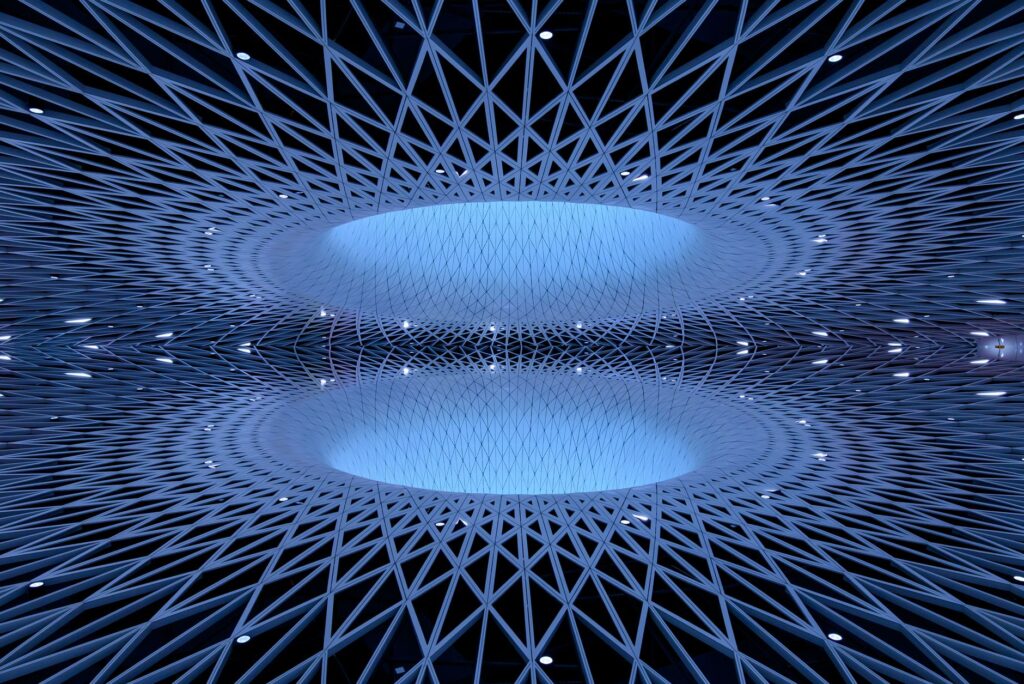
The integration of As Seen Below – The Dome adds an unexpected, profound dimension to this journey. Descending into the museum’s lower depths, visitors leave the urban rush behind to enter a space of quiet introspection that operates in perfect opposition to Eliasson’s rooftop rainbow. While the rooftop structure projects us outward toward the city, Turrell’s underground dome coaxes us inward, using the sky above as a mirror for the mind. This architectural duality makes ARoS unique in the international museum landscape, hosting the distinct visions of two of the world’s greatest masters of light and space along a single vertical axis.
The Phenomenology of Light According to James Turrell
To fully grasp the scale of this installation, one must delve into the artistic philosophy of James Turrell, a leading figure of the Light and Space movement that originated in Southern California during the 1960s. Unlike traditional painters who use canvas to represent light, Turrell utilizes light itself as a physical medium. «My work is not about light, it is light,» the artist has famously stated. His installations seek to eliminate the distance between the viewer and the medium, immersing the audience in fields of pure color where the eyes lose their three-dimensional reference points—a phenomenon known as the Ganzfeld effect.
«Light is not something that reveals things; it is the revelation itself, a physical substance we can feel with our skin and eyes if we only learn to be still.»
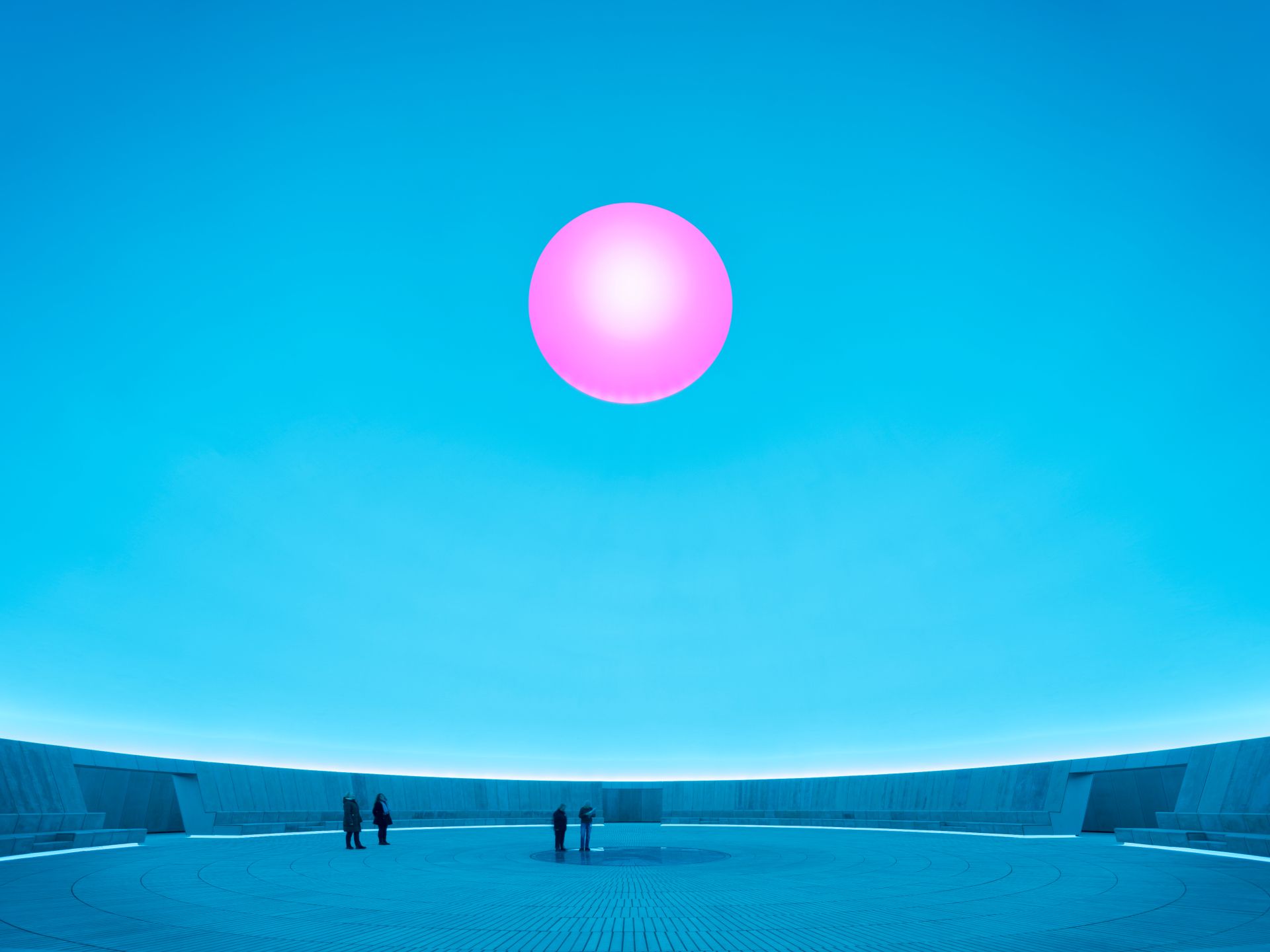
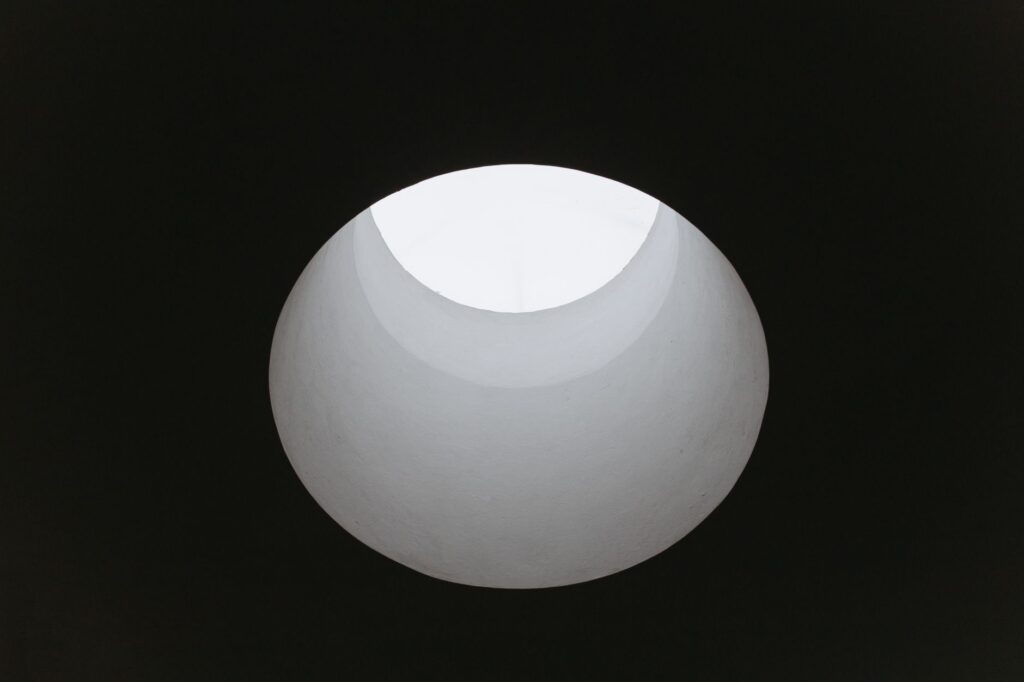
In Aarhus, Turrell pushes this premise to its limits through a design that fuses state-of-the-art engineering with ancient spatial sensitivity. Upon entering the dome, visitors must allow their eyes to adjust to a carefully calibrated twilight. As their pupils dilate, the true nature of the space is revealed: a perfect void where the walls seem to dissolve, and the sky, framed by a sharp central oculus, takes on a dense, almost solid quality. The ever-changing Jutland sky becomes a living canvas, shifting from deep indigo to soft slate gray, interacting continuously with the custom LED lighting systems concealed within the structure.
The Architecture of Invisibility: Engineering ‘As Seen Below’
Constructing the dome was an unprecedented engineering feat for both ARoS and the city of Aarhus. Integrated into the museum’s major expansion project, known as The Next Level—designed in collaboration with the renowned firm Schmidt Hammer Lassen—the structure rises 17 meters high and spans 40 meters in diameter. To achieve the absolute visual purity required by Turrell’s work, all technical infrastructure, from ventilation shafts to the complex wiring of the custom LED arrays, has been completely hidden from view.
The result is a masterclass in invisible architecture, where concrete and steel are subservient to immateriality. The dome’s interior walls are coated with a specialized plaster that absorbs and diffuses light uniformly, erasing any shadows or structural seams that might betray the true scale of the space. The overhead oculus, a perfect ellipse open to the elements, has no visible frame or glass. This creates a powerful optical illusion, making the sky feel as though it is suspended just inches above the viewer’s head, like a tactile membrane vibrating with the Danish wind and passing clouds.
A Subterranean Choreography of Color
The experience of entering As Seen Below – The Dome shifts dramatically depending on the time of day and weather conditions. On clear mornings, direct sunlight pierces the space, casting a sharp beam of light that moves slowly across the stone floor, marking the passage of time like a contemporary sundial. However, the installation reaches its peak dramatic intensity during twilight. Turrell has programmed a specific light sequence for the sunset hours—a chromatic dialogue designed to contrast with the natural shifts of the Nordic evening sky.
As the sun dips below the horizon, the LED system floods the interior walls with hues ranging from deep magenta to warm amber. This injection of artificial color alters how the human eye perceives the natural sky framed by the oculus; a sky that would normally appear dark gray is transformed, by contrast, into a brilliant emerald green or an electric, otherworldly blue. Visitors, resting on the perimeter stone benches, watch this silent choreography unfold—a hypnotic experience that suspends the modern rush of urban life.
A Silent Dialogue with Olafur Eliasson
It is impossible to discuss Turrell’s dome without drawing a connection to the artwork that has defined the visual identity of Aarhus for over a decade: Olafur Eliasson’s Your rainbow panorama. Located at the very top of the museum, this circular glass walkway invites movement, action, and active observation of the urban landscape through a constantly shifting spectrum of colored glass. It is an extroverted piece, celebrating the museum’s physical connection to the geography of Aarhus, its harbor, and its surrounding forests.
«Beneath the soil of Aarhus, the Nordic sky ceases to be a distant backdrop and becomes a tangible, living element that quietens the mind.»
In contrast, Turrell’s As Seen Below is a work of absolute introversion. There are no views of the city here, no external visual references. The viewer is isolated from the outside world, enclosed in a chamber that evokes both ancient Roman pantheons and the astronomical observatories of lost civilizations. While Eliasson reveals the city through color, Turrell strips the city away to reveal light in its purest state. Together, these two monumental works offer visitors to ARoS a complete conceptual journey through the mechanics of human perception.
Discovering Aarhus: Jutland’s Vibrant Cultural Capital
A visit to James Turrell’s dome serves as the perfect gateway to a city that has reinvented itself while maintaining its welcoming, human scale. Just a short walk from ARoS lies the Latin Quarter (Latinskvarteret), the oldest district in Aarhus, characterized by narrow cobblestone streets, 18th-century half-timbered houses, and thriving specialty coffee shops. Here, life moves at a relaxed pace, inviting visitors to wander through local design boutiques and independent bookshops in a quintessential atmosphere of Danish hygge.
For architecture enthusiasts, the city offers a striking contrast between the historic charm of Den Gamle By (an open-air museum chronicling Danish town life through the centuries) and the bold modernism of the new harbor district, Aarhus Ø. In this waterfront development, the iconic Isbjerget (The Iceberg) residential complex stands out with its sharp white and blue peaks mimicking floating glaciers. The city’s culinary scene is also enjoying a golden age, with Michelin-starred restaurants reinterpreting classic Nordic cuisine using fresh ingredients from Jutland’s fertile agricultural hinterland.
Practical guide
Getting There and Around
Aarhus has its own airport (AAR), located approximately 40 minutes from the city center, offering connections to major European transit hubs. Alternatively, flying into Billund Airport (BLL) or Copenhagen Airport (CPH) and taking the comfortable Danish State Railways (DSB) train is a highly scenic and sustainable option. The train journey through the Jutland countryside brings you directly to Aarhus Central Station (Aarhus H), which is an easy ten-minute walk from the ARoS Museum.
ARoS Museum Hours and Admission
ARoS is open from Tuesday to Sunday, with extended hours until 9:00 PM from Tuesday to Friday. These late-night hours are ideal for experiencing James Turrell’s installation during the crucial twilight transition. It is highly recommended to purchase tickets online in advance through the museum’s official website, particularly during the peak summer season. Admission grants access to all temporary exhibitions, the subterranean dome, and the rooftop rainbow panorama.
Tips for Visiting ‘As Seen Below’
- Time Your Visit with Sunset: Check the local sunset time in Aarhus on the day of your visit and enter the dome at least thirty minutes prior to witness the full, dramatic light transition.
- Dress Warmly: Because the dome is open to the sky, the temperature inside matches the outdoor climate. Be sure to dress in layers, especially during the cool autumn and winter months.
- Observe Silence: The dome is designed as a space for quiet contemplation. Visitors are kindly asked to speak in whispers and keep mobile screens dimmed to avoid disrupting the visual adaptation of others.
- Take Your Time: Do not rush the experience. Plan to spend at least 40 minutes sitting on the stone benches to allow your eyes to fully adjust to the subtle shifts in color and light intensity.
Source: Condé Nast Traveler España