Nashville tests an acoustic pause around Dolly Parton’s literary retreat
In the capital of country music, the new Songteller Hotel invites travelers to inhabit the creative process of its most famous creator through handwritten scores, solid wood, and silence.
Nashville’s main avenue roars under the weight of beer delivery trucks and the metallic echo of electric guitars spitting out cover songs from every licensed basement downtown. Yet, a few blocks away from the ruckus of Lower Broadway, the city’s heart rate drops several degrees until it reaches an almost monastic cadence. It is here that Dolly Parton’s persona is reinterpreted far from sequins and television sets, transformed into a conceptual and lyrical architectural framework that prioritizes the blank page over neon lights.
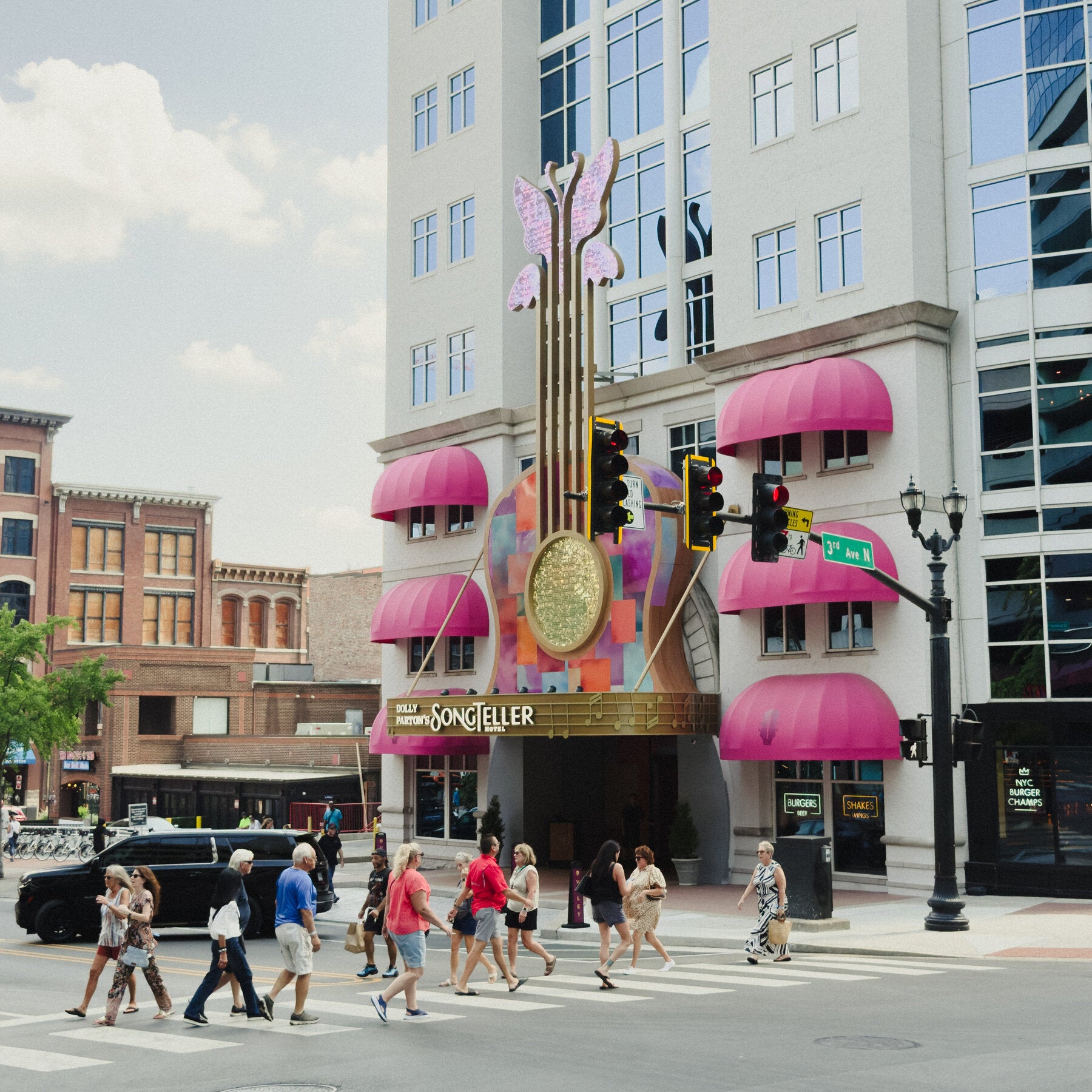
The newly opened Songteller Hotel does not attempt to replicate the theme park many expected in the heart of Tennessee. The artist’s physical absence from the ribbon-cutting ceremony—a fact that sparked a wave of local press speculation regarding her health and creative oversight—is offset by an overwhelming conceptual presence. Every single space within the building has been conceived to pay tribute not to the pop diva, but to the craftswoman of words, that rare figure capable of condensing the hardship and beauty of Appalachia into a three-minute melody.
The industry’s sharpest critics wondered whether a global star’s persona could anchor a hospitality project without her constant presence in the lobby cutting ribbons or signing autographs. The answer, as one discovers upon pushing through the massive oak revolving doors, lies in the very nature of the songwriter’s catalog. The hallway walls do not display promotional tour posters, but rather facsimiles of school notebooks where the lyrics to ‘Jolene’ or ‘I Will Always Love You’ were corrected in ballpoint pen and crossed out with the fury of someone searching for the ultimate rhyme.
Architecture of silence and noble woods
The interior design deliberately shuns the baroque excess that usually characterizes shrines dedicated to roots music in North America. The architectural firms commissioned for the project opted for a sober chromatic palette dominated by earth tones, tanned leather, and reclaimed old-growth pine from historical barns in Sevier County. There are no giant screens looping music videos; instead, guests encounter museum-grade display cases protecting acoustic string instruments from the 1950s and logbooks signed by veteran session musicians.
This commitment to visual restraint stems directly from strict guidelines issued by the artist’s inner circle: the space must invite introspection and writing. The guest rooms feature solid wood writing desks positioned toward double-glazed windows that completely shut out the commotion of the southern metropolis. Resting on every nightstand is a cloth-bound journal filled with acid-free paper, intended to capture the impromptu thoughts of travelers suffering from the creative insomnia typical of songwriters.
The spatial layout also fosters fortuitous yet quiet encounters among independent creators. On the ground floor, a library of rare scores and popular songbooks replaces the traditional boisterous cocktail bar. Here, patrons can thumb through original bluegrass charts while sipping herbal infusions gathered from the smoky mountains, accompanied by no other soundtrack than the occasional creak of floorboards and the distant murmur of polite conversation.
True luxury in Nashville no longer means listening to the loudest music, but rather finding a corner where the noise of the world stops long enough to hear your own voice.
Appalachian cuisine through a contemporary lens
The hotel’s culinary offering, overseen by a team of chefs hailing from small rural enclaves in Tennessee, rejects the stereotypes of fast southern cooking to embrace a modern reinterpretation of the mountain pantry. The stoves in the main dining room operate under a strict farm-to-table philosophy, reviving nearly forgotten recipes of wild berry preserves, cornbread made from traditional stone-milled grains, and meats slow-smoked over American hickory wood.
Sitting down at a table in this dining room is an exercise in historical and anthropological memory. Each dish arrives accompanied by a brief explanatory note detailing the family origin of the recipe, connecting the culinary experience to the childhood memories that Parton frequently recounts in her memoirs. Rough, comforting flavors are thus resurrected, designed to warm the spirit after a long walk through the characteristic autumn drizzle of the Cumberland Valley.
The dining room service maintains a remarkable discretion, avoiding the effusive and prefabricated demeanor so common in the local tourism sector. The waitstaff understands the historical background of each dish and can recount with precision how certain ingredients related to the subsistence economy of mining families during the Great Depression, adding a layer of cultural depth that significantly enriches the stay.
The pulse of an industry in deep transformation
The opening of this hotel refuge coincides with a moment of profound urban and cultural transformation in Nashville. Historically crowned as the undisputed capital of traditional country music, the city is witnessing an influx of real estate capital and new residents arriving from both coasts of the United States. This accelerated growth generates inevitable tensions between the preservation of indigenous musical heritage and the commercial commodification of its living myths.
Against this backdrop, Dolly Parton’s establishment functions as a raft of aesthetic resistance. By shifting the focus away from mass spectacle toward the artisanal craft of songwriting, the initiative poses an uncomfortable question for local developers: can a city retain its artistic soul when its main streets have turned into theme parks for bachelor parties? The answer offered by the hotel is not verbal, but spatial, inviting every visitor to reflect on the true value of authenticity in times of rapid consumption.
Tourism analysts are watching this commercial experiment with curiosity. If it succeeds in establishing itself without the physical presence of its primary marketing draw, it will open the door to a new model of cultural patronage where intellectual property and emotional atmosphere weigh heavier than the traditional ribbon-cutting ceremony.
Sentimental geography from Sevier County to the big city
To understand the visual and conceptual genesis of the hotel, it is necessary to draw an imaginary line connecting the misty peaks of the Smoky Mountains with the grid asphalt of Nashville. The project curators spent months traveling the dusty rural roads where the artist grew up, salvaging textures, scents, and materials that have since been integrated with millimeter precision into the design of common areas and private guest rooms.
This geographic transfer does not seek folkloric mimicry, but rather subtle evocation. Thick wool rugs imitate geometric patterns hand-woven by women of the mountain clans, while indirect lighting simulates the amber tone cast by the sunset over beech and oak forests. The result is a sensory map that allows the traveler to transition mentally from wild nature to urban refuge without ever leaving the comfort of a reading armchair.
Architectural heritage experts particularly praise how the contemporary structure of the building has been integrated into the surrounding historic fabric, respecting the heights and facade lines prevalent in the historic district. There are no formal strivings or grandiloquent gestures on the exterior; the true audacity of the project is jealously hidden within, reserved for those who cross the threshold seeking something more than just a bed for the night.
Building a sanctuary dedicated to the written word in a city surrendered to noise is an act of commercial daring and, at the same time, a love letter to the dark corners where songs are born.
Practical guide
Getting there: Nashville International Airport (BNA) is located about a 15-minute taxi or rental car ride from the city center. Several municipal bus lines also connect the terminal with the vicinity of the historic district, though direct access to the hotel is easily accomplished on foot from the main stops.
Accommodation: The Songteller Hotel operates with variable rates depending on the season. Booking several months in advance is essential due to high demand driven by international interest surrounding the project. Rates include full access to the score library and a mountain-inspired breakfast.
When to go: The autumn months (September through November) offer moderate temperatures and lower tourist congestion compared to the spring and summer peaks, allowing visitors to enjoy common areas with greater tranquility and silence.
Cultural recommendations: Complementing your stay with a leisurely visit to the National Museum of African American Music and a walking tour of the historic Music Row studios is strongly advised, while always maintaining respect for local noise ordinances in adjacent residential areas.
The final chord in the twilight shadow
When afternoon fades over the Tennessee urban skyline and neon lights begin to flicker in the distance, the hotel library acquires an emotional density that is difficult to explain through hotel occupancy statistics or financial balance sheets. At that precise moment, sitting by the window overlooking the exposed-brick interior courtyard, one understands the true purpose of this literary retreat. It is not about supplanting the absent artist with cardboard cutouts or mass-produced souvenirs, but rather about enabling a physical space where her songwriting legacy continues to breathe through the hands and voices of those who still believe in the healing power of a well-crafted melody performed with absolute sincerity.
ATLAS LUME · BEFORE YOU GO
A story that continues at the destination
DocumentsCheck visas, health requirements and document validity with official sources.
BookingsConfirm the final price, taxes and conditions directly with the provider.
Responsible travelRespect local communities, heritage and ecosystems.