Introduction to the Atlantic Sanctuary
At the western edge of the tropical Atlantic, where warm equatorial waters caress the volcanic outcroppings of insular Pernambuco, beats one of the most fragile and thoroughly studied marine ecosystems in the Southern Hemisphere. The Fernando de Noronha archipelago, designated a UNESCO Natural World Heritage Site, is much more than a retreat for summer leisure; it is a living laboratory of oceanographic interactions where deep currents, mineral nutrients, and marine biodiversity of immeasurable scientific value converge. Among the species that choose these submarine platforms for feeding and transit, the spotted eagle ray (Aetobatus narinari) stands out—a cartilaginous glider whose populations face global challenges driven by incidental overfishing and the alteration of ancestral migratory routes.
Understanding the dynamics of this species requires looking beyond the tourist surface of paradisiacal beaches. Marine biologists operating within the Fernando de Noronha Marine National Park have spent decades monitoring the movement patterns of these animals through acoustic telemetry and underwater visual censuses. The presence of the eagle ray in the sheltered bays of the archipelago responds to a precise combination of temperature, availability of benthic mollusks, and natural protection against oceanic predators such as hammerhead and tiger sharks. This report examines the biological reality of this marine vertebrate and unravels the ecological balances sustaining its existence in one of the most closely watched oceanographic enclaves on the planet.
Insular Geodynamics and Volcanic Origins
The submarine architecture supporting life in Fernando de Noronha is the result of a violent geological history that began millions of years ago. The archipelago emerges as the visible summit of an ancient underwater volcanic ridge, its peaks rising abruptly from the Atlantic abyssal plain to depths exceeding four thousand meters. This rugged topography generates a unique oceanographic phenomenon: when equatorial currents collide with submerged basaltic walls, a vertical ascent of deep waters rich in nitrates, phosphates, and other essential mineral nutrients occurs.

This upwelling process stimulates the proliferation of phytoplankton, the foundation upon which the entire local marine food web is constructed. Marine currents not only transport nourishment but also act as conveyor belts for pelagic and benthic species dependent on water thermal stability. The white-sand bays and volcanic rock channels offer low-energy zones where eagle rays can rest and feed without the constant physical exertion demanded by the open currents of the deep ocean.
Biology and Morphology of Aetobatus narinari
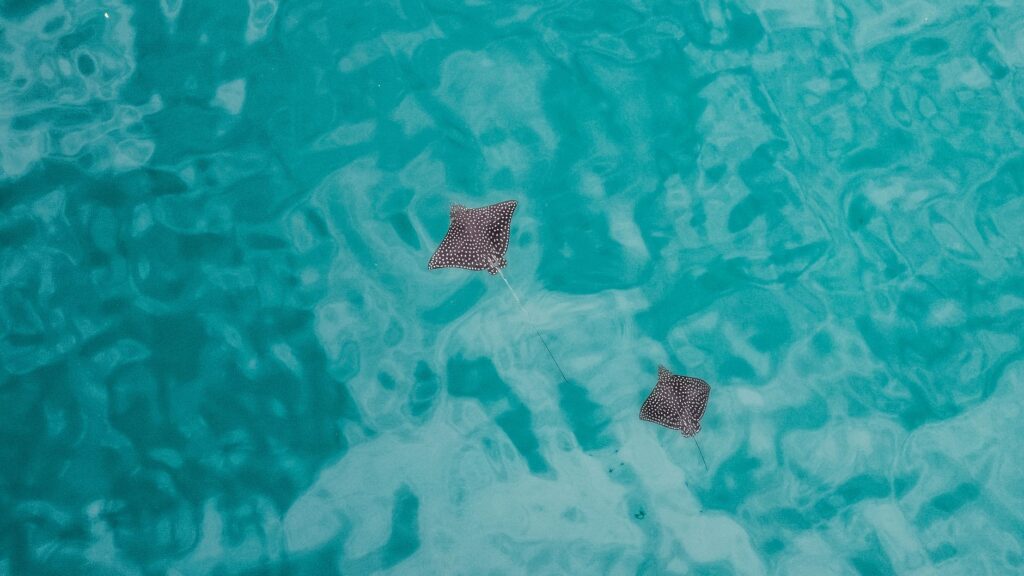
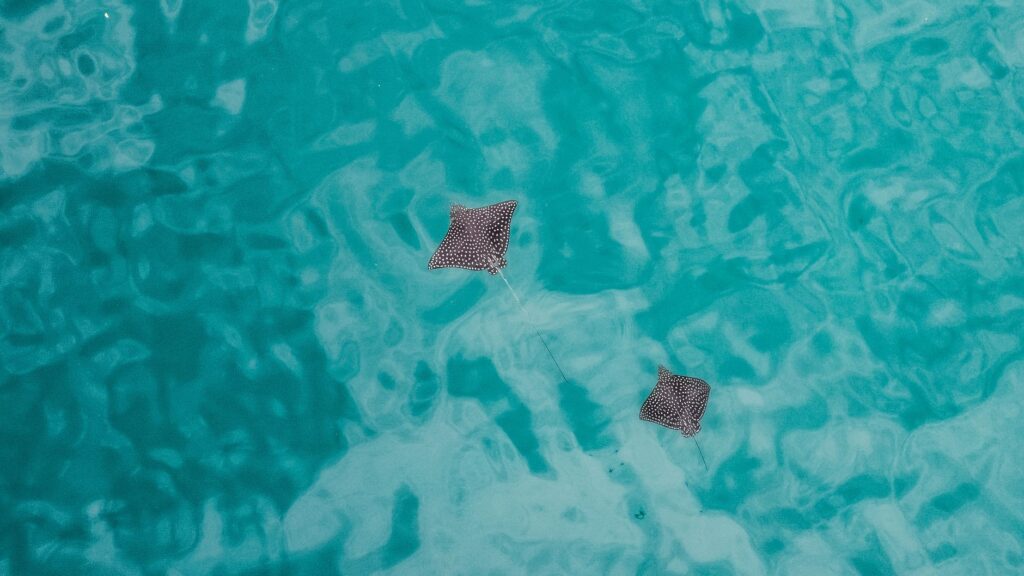
The spotted eagle ray is an evolutionary masterpiece adapted to the pelagic and reef environment. Unlike bottom-dwelling rays, which spend most of their time half-buried in sediment, Aetobatus narinari possesses a streamlined body with wide, angular pectoral wings that act like airfoils, allowing it to literally ‘fly’ through the water column with unmistakable elegance. Its dorsum, sporting a dark bluish-green hue, is spangled with numerous white or bluish spots acting as disruptive camouflage against predators observing from above.
Its masticatory apparatus is another biomechanical marvel. Equipped with flattened, highly calcified dental plates, the eagle ray feeds primarily on bivalve mollusks, gastropods, crabs, and marine worms inhabiting the surrounding sandy bottoms. It uses its specialized duckbill-like snout to stir up sediment and unearth its prey, crushing their shells with immense force before discarding calcified fragments. This trophic behavior plays a key regulatory role in the health of benthic communities across the insular platform.
Migratory Behavior and Acoustic Telemetry
One of the most active fields of research in Fernando de Noronha is tracking the movement patterns of the eagle ray. Through the surgical implantation of acoustic tags in scientifically captured and immediately released specimens, researchers from the marine conservation project have mapped detailed seasonal migration routes. It has been discovered that while some individuals are permanent residents patrolling the same areas year-round, others use the archipelago as a vital staging post along migratory corridors stretching across northeastern Brazil.
Protecting the migratory routes of the spotted eagle ray demands cross-border cooperation and strict control over industrial fishing gear operating beyond national park boundaries.
Acoustic signals recorded by a network of submerged receivers reveal that these animals exhibit strong site fidelity, favoring zones with mixed sand and coral patches where visibility is optimal and water temperatures range between 26 and 28 degrees Celsius. These data demonstrate that any acoustic or physical disturbance in these critical areas can destabilize reproductive and feeding cycles across entire populations.
Anthropogenic Impact and Tourism Pressures
Despite its status as a protected area, Fernando de Noronha is not immune to the pressures of human development and mass tourism. The steady increase in annual visitors generates intense demand on local infrastructure, waste management, and recreational boat traffic in sheltered bays. Underwater noise generated by outboard motors and dive vessels alters the communication and orientation patterns of marine fauna, directly impacting sensitive species such as resident rays and sharks.

Likewise, incidental fishing in buffer zones peripheral to the park represents a constant threat. Although capturing eagle rays is prohibited by Brazilian legislation, lost ghost nets drifting offshore and unregulated fishing pressure along transit routes outside the jurisdictional waters of the archipelago continue to deplete adult populations, which exhibit very low reproductive rates and small litters of only three to five pups per gestation.
Conservation Strategies and Citizen Science
Faced with these threats, scientific and conservation responses in Fernando de Noronha have intensified through advanced technologies and public participation programs. Citizen science plays an increasingly significant role: recreational divers and underwater photographers visiting the archipelago actively collaborate by uploading their images to global facial recognition databases based on the unique dorsal spot patterns of each individual. This non-invasive method allows biologists to identify specific specimens over years without resorting to stressful captures.
Concurrently, environmental authorities have implemented strict access restrictions in certain bays during critical breeding and nursery seasons, limiting commercial navigation and establishing reduced-speed nautical corridors. These measures aim to balance the economic viability of sustainable tourism with the strict preservation of essential habitats supporting the archipelago’s marine biodiversity.
Practical guide
Planning a responsible observation trip to Fernando de Noronha requires understanding local regulations and the environmental conditions of the tropical Atlantic.
Best time to visit: The period between August and November offers optimal underwater visibility and calmer seas, ideal for observing marine fauna via snorkeling or scuba diving.
Access permits: Every visitor must pay a daily environmental preservation fee (TPA) established by the state government of Pernambuco, in addition to securing advance entry to the Marine National Park to access principal beaches.
Responsible diving and snorkeling: Touching, chasing, or feeding any marine species is strictly prohibited. Maintain a safe distance of at least five meters and avoid using sunscreens containing oxybenzone, which harms corals.
Authorized operators: Hire exclusively certified nautical services and dive centers complying with the sustainability protocols of the Chico Mendes Institute for Biodiversity Conservation (ICMBio).
The Final Pulse of the Deep Ocean
As dusk falls, when the last rays of sunlight pierce the translucent surface of Baía dos Golfinhos, the Fernando de Noronha archipelago recovers a primordial stillness. It is in this twilight moment that the unhurried silhouette of the eagle ray glides over golden sand, reminding us of the fragility of the balances sustaining life at the edges of the sea. The survival of this majestic marine glider does not depend on chance, but on scientific rigor, strict adherence to conservation regulations, and humanity’s capacity to understand that the wealth of the oceans is the mirror of our own future on Earth.