Introduction to the Sahelian Corridor
The territory stretching between the shrub savannas of Senegal and the vast arid expanses of Mali has historically been shaped by an unforgiving geography. In this region of millennial transits, where camel caravans set the pace for centuries, steel and steam introduced a radical transformation at the dawn of the twentieth century. The Dakar-Niger Railway is not merely a transport infrastructure; it is an umbilical cord traversing political and climatic boundaries to unite subsistence economies with major urban centers. Understanding its current operation requires delving into a framework where nineteenth-century engineering collides head-on with the logistical challenges of the twenty-first century.
For decades, this railway line has suffered the blows of institutional neglect, economic fluctuations, and regional instability. Yet, its strategic relevance has never diminished. While the corridor’s highways suffer severe damage during the rainy season or are hampered by complex border checkpoints, the railway remains the sole mass alternative for heavy freight transport and low-income passengers. This report examines the current pulse of a railway line that refuses to disappear, unraveling the technical, social, and economic complexities that define its daily operations.

Colonial Genesis and Sahelian Topography
The conception of the original route responded to a logic of extraction and territorial control by the French colonial administration. Connecting the Atlantic port of Dakar with the banks of the Niger River in Koulikoro required overcoming rocky escarpments, crossing seasonal riverbeds, and laying tracks over clay soils subject to severe thermal expansion. The engineers of the era faced an endemic scarcity of potable water, malaria epidemics, and a titanic material logistics that relied entirely on river navigation and human labor.
The result was a single-track metric gauge snaking through lateritic plateaus and sandy depressions. The topography features no alpine gradients, but poses a far more insidious challenge: wind erosion and the constant encroachment of dunes. Across entire sections, desert winds bury the rails within weeks, demanding permanent maintenance crews operating with limited resources. This ceaseless struggle against nature defines the operational character of the railway, where every kilometer traversed is a victory over the geological instability of the Sahel.
Rolling Stock Infrastructure and Mechanical Challenges
Keeping a fleet of diesel-electric locomotives operational in an environment characterized by extreme temperatures and abrasive dust is a feat of local mechanical engineering. Central workshops, located in strategic nodes such as Thiès and Kayes, function as living museums of railway technology, where turners and fitters hand-manufacture spare parts no longer commercially available internationally. This artisan adaptability is the true engine preventing the total paralysis of the network.

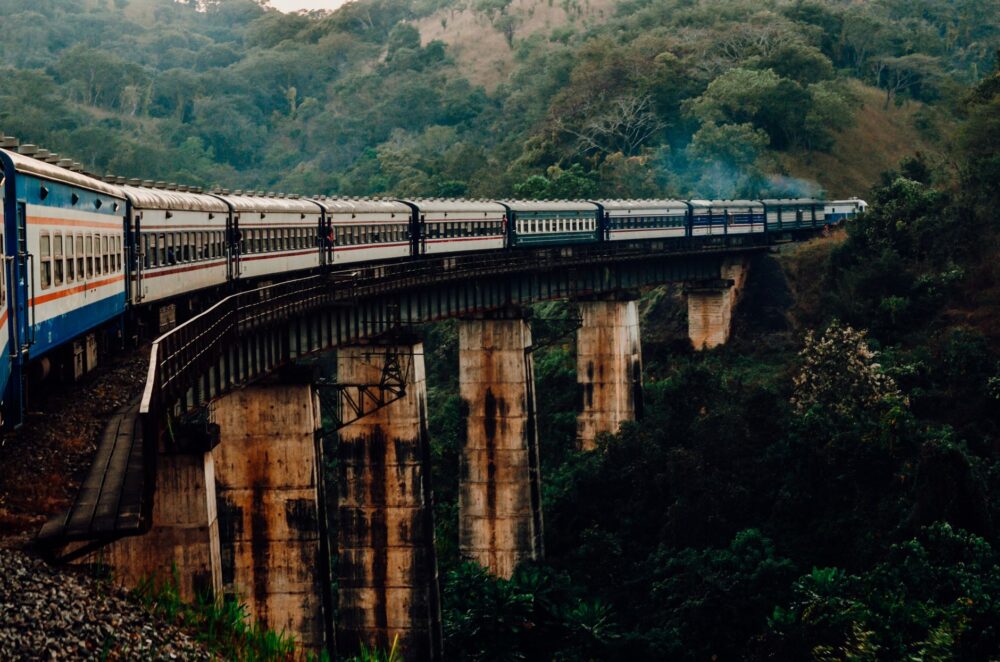
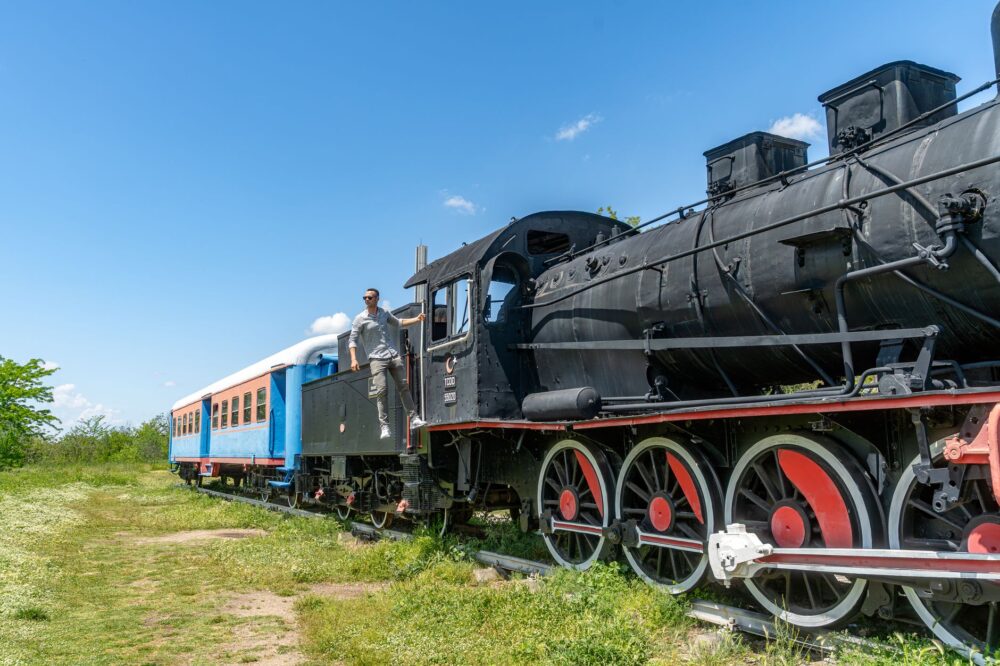
The traction units, mostly veteran Western-built locomotives adapted to African loading gauges, haul mixed compositions of freight cars and passenger coaches. The latter reflect the sociology of Sahelian travel: entire families, merchants with bales of textiles, and students share space during journeys that can stretch for days due to speed restrictions imposed by the deficient state of the track bed. Air conditioning is virtually nonexistent, replaced by natural ventilation rushing through barred windows.
The Economy of the Track: Cross-Border Trade and Supply
For millions of inhabitants devoid of access to paved roads, the train represents the only viable commercial lifeline. Basic goods such as sugar, cement, petroleum derivatives, and fertilizers travel inland, while peanuts, cotton, and horticultural products descend toward coastal markets. This bidirectional circulation sustains entire local communities that would otherwise remain isolated during the months when dirt tracks become impassable due to mud.

The economic impact of the railway is most clearly manifested at intermediate stations. As the convoy stops, platforms instantly transform into bustling open-air markets trading hot food, fresh water, and handicrafts. This platform economy is vital for rural subsistence.
The train is not merely a freight transport medium; it is an itinerant market injecting liquidity and connecting forgotten villages with the commercial pulse of capitals.
However, schedule irregularities and frequent service interruptions force merchants to diversify risks, combining rail transport with cargo trucks when circumstances permit.
The Human Factor: Drivers, Trackmen, and Travelers
Behind every transported ton and cleared kilometer of track lies the human effort of workers who inherited their trade from fathers and grandfathers. Locomotive drivers operate under extreme conditions, interpreting visual signals and track conditions without modern digital assistance systems. Their intuitive knowledge of the terrain—knowing precisely where the track has softened following a night storm—is a critical asset in preventing catastrophic derailments.

Meanwhile, trackmen patrol assigned segments on foot or using rudimentary velocipedes, tightening bolts, replacing rotted wooden ties, and clearing accumulated sand. Their silent labor forms the front line of infrastructure defense. Alongside them, passengers endure delays and discomforts with a stoicism rooted in local culture. Train travel fosters a unique community solidarity; compartments transform into spaces for political debate, cultural exchange, and mutual aid against the hardships of the journey.
Modernization Projects and Geopolitical Tensions
In recent years, the urgency to revitalize the corridor has attracted the attention of international investors and regional governments. Agreements have been signed for the comprehensive renovation of the track, the acquisition of new rolling stock, and the implementation of modern signaling systems. Nonetheless, executing these projects frequently encounters bureaucratic hurdles, financial constraints, and, above all, a complex security situation in certain zones of the Malian border.
The transition toward a competitive railway model demands not only capital injections but a profound restructuring of operational governance. Local authorities constantly debate between partial privatization via international concessions and direct state control to guarantee public service in deficit-ridden regions. The long-term viability of the line will depend on its capacity to integrate into major regional logistical corridors, connecting Atlantic ports with the continental heart of West Africa without losing its socializing function.

Practical guide
Planning a trip or logistical analysis around the Dakar-Niger Railway requires understanding its current nature as an infrastructure undergoing intermittent reconstruction.
- Operational status: Passenger service operates irregularly and is subject to last-minute cancellations due to maintenance work or technical incidents. It is recommended to verify convoy status directly at major stations in Dakar or Bamako before initiating any travel.
- Climatology and seasonality: The best time to document or traverse the line spans the dry season months (November to February), when temperatures are more moderate and the risk of interruptions due to torrential rains is zero. During the rainy season (June to October), numerous sections suffer flooding or ballast softening.
- Logistics and security: Securing official permits from national railway companies (such as Société Nationale des Chemins de Fer des Sénégal or equivalent operators) is essential for accessing workshops, classification yards, and restricted track zones. The presence of local authorities and experienced guides is mandatory in border regions.
- Provisions: Conditions aboard passenger trains are basic. Carrying sufficient bottled water, dry food rations, a first-aid kit, and adequate protection against dust and the abrasive Sahelian sun is vital.
- Photographic and recording equipment: Fine desert dust and constant track vibrations demand waterproof casings, protective lens filters, and additional spare batteries, as there is no onboard electrical supply to recharge devices.
Visual Epilogue in the Savannah
As the sun begins to dip over the Sahelian horizon, dyeing the sky in deep ochre and violet tones, the silhouette of the locomotive emerges through the dust haze kicked up by the harmattan wind. In that moment, the railway transcends its status as a simple iron machine to become a visual metaphor for human resilience. The headlights cut through the impending darkness, briefly illuminating solitary acacias and the patient faces of those waiting at rural sidings. It is the steady heartbeat of an artery that, despite historical and geographical adversities, continues pumping life, commerce, and hope through the unbreakable heart of West Africa.