
Origins and Geography of an Ancestral Craft
The province of Cuenca shelters between its river gorges and willow-lined banks an artisanal tradition whose survival today is an exercise in cultural resistance. In the valleys where water marks the rhythm of agricultural life, wicker basketry has never been a mere decorative pastime, but rather a structural response to the storage, harvesting, and transportation needs of the rural world. The willow plantations, popularly known as mimbres, thrive with exceptional vigor in the humid soils near the Júcar and Huécar rivers, where the microclimate favors the growth of flexible, resistant, and long rods. This raw material, cultivated with care and harvested during the winter months when the plant enters vegetative rest, constitutes the skeleton upon which a secular community identity rests.
The transformation process of raw wicker into a utility or artistic object requires deep knowledge of the natural environment and unyielding patience. Following harvesting, the rods must undergo a boiling process in large cauldrons to soften the bark and facilitate subsequent peeling, a task that traditionally brought families together around the fire at dusk. This debarking ritual, performed with the help of a biting iron or manually through stem friction, reveals a clear, uniform wood that ranges from ivory white to toasted brown depending on whether the boiling process includes the skin. The Cuenca geography, marked by rugged terrain and notable demographic dispersion, has historically acted as a protective barrier preventing the premature replacement of these manual techniques by plastic or corrugated cardboard.
Stepping into the traditional workshops of the region means crossing an invisible border where time seems governed by different cycles. Here, the production rhythm is not set by assembly line algorithms, but by the physical endurance of hands and the natural elasticity of plant fiber. Master basket makers, guardians of unwritten knowledge, pass down the secrets of intuitive geometry from generation to generation. Every curve, every crossing of rods, and every finishing touch responds to a structural logic perfected over centuries of trial and error, an intangible heritage that today fights to find its place in the circuits of contemporary design and conscious consumption.
The Alchemy of the Workshop: Tools and Manual Processes
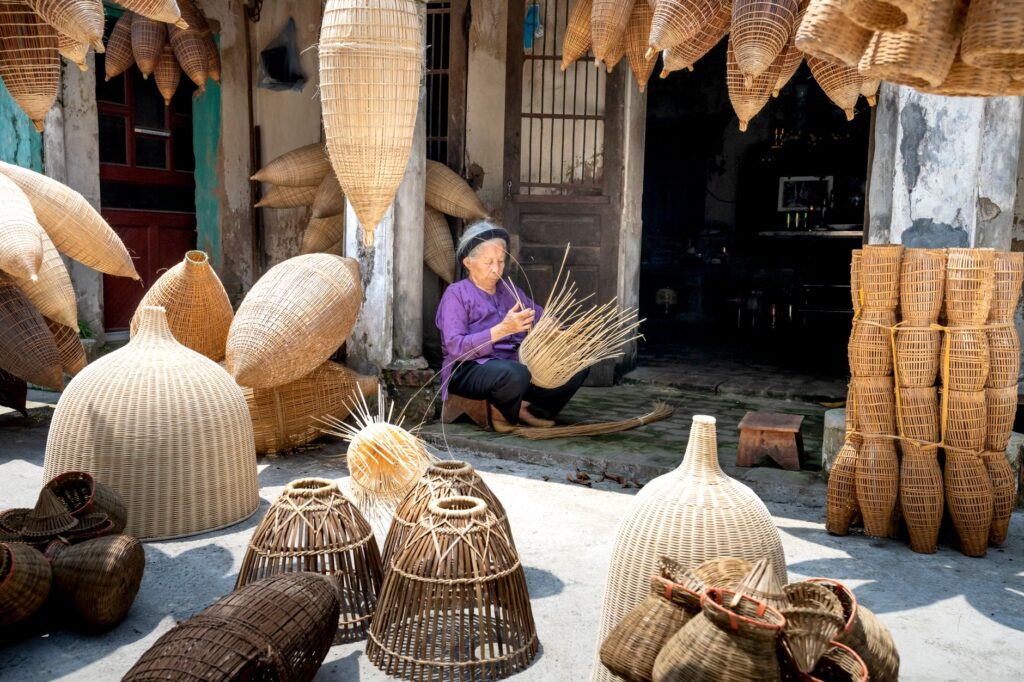
Inside a basketry workshop, the inventory of tools is as sober as it is eloquent. There is no heavy machinery or complex automated systems; the tooling consists of short, sharp-bladed knives, hardwood awls, iron or wooden mallets to compact the weave, and molds or forms that guarantee the symmetry of volumetric pieces. The workbench is, par excellence, the artisan’s lap, where the rod is bent, pressed, and secured through tension generated by the weave itself. The basket maker’s ergonomics are sculpted by years of repetitive postures, a silent physical effort that leaves its mark on hand musculature and the millimetric precision of the fingers.
The initial phase of any piece is the creation of the base, the structural core that will determine the stability and load capacity of the basket. Through the crossing technique, several bundles of rods are intertwined to form a symmetrical star secured with concentric passes of finer wicker, known as guiding or tracking strands. From this two-dimensional plane, the uprights are raised vertically to define the walls of the piece. It is at this moment that the artisan’s skill becomes most apparent: maintaining constant, homogeneous tension across the entire perimeter is what prevents the basket from warping or acquiring a wobbling silhouette. The alternation of techniques, such as the cord, the wale, or the checkerboard weave, provides both mechanical solidity and a rich repertoire of visual textures.
The true measure of a basket maker is not found in the speed with which they raise a piece, but in the ability to listen to the tension of the rod before it decides to snap in their hands.

The finishing touch represents the crowning glory of this artisanal process. The protruding ends of the uprights are not cut flush, but are meticulously bent and inserted into the surrounding weave to form a reinforced upper border, known as the rim or closing braid. This finish not only fulfills an aesthetic function but prevents fraying and provides the mouth of the basket with the rigidity necessary to withstand constant handling. Occasionally, single-piece handles are incorporated, curved via heat and deeply embedded in the base structure, or natural vegetable oil protective treatments are applied to waterproof the fiber without altering its breathable capacity.
Innovation and Contemporary Design in the Mountains
Facing the risk of obsolescence, today’s workshops in Cuenca have successfully articulated a fruitful dialogue between tradition and the demands of author design. New generations of creators, many trained in artistic disciplines yet drawn to the purity of wicker, have settled in the region to work side by side with veteran masters. This symbiosis has given rise to a formal renewal that transcends traditional agricultural utilitarianism. Today, the workshops produce not only classic shopping baskets, log holders, and grape-harvesting hods, but also sculptural lamps, divider screens, indoor furniture, and wall coverings that redefine wicker’s role in contemporary interior architecture.
This transition has not been without tension. Incorporating new aesthetic styles sometimes requires modifying traditional proportions, experimenting with eco-friendly dyes based on walnut hulls or roots, and combining wicker with other noble materials like oak wood, vegetable-tanned leather, or low-temperature ceramics. Nevertheless, artisans insist that innovation lacks value if respect for the raw material is lost. Intimate knowledge of how wet wicker behaves compared to dry remains the inescapable filter validating any foray into avant-garde design. Experimentation thus becomes a bridge connecting the agrarian past with global markets of sustainable design.
Institutional recognition and the opening of digital marketing channels have allowed these workshops to deseasonalize production and reach an international audience that values traceability and authenticity. Specialized fairs and fair-trade craft platforms act as fundamental showcases to highlight work that requires weeks of dedication for a single piece. Despite these advances, the sector faces significant structural challenges, such as the lack of generational renewal and the scarcity of land dedicated to specialized willow cultivation, issues that threaten to break a knowledge transmission chain dating back to the Middle Ages.
Circular Economy, Sustainability, and the Future of Cultivation
Wicker basketry naturally represents the most demanding principles of the circular economy long before this concept was coined by modern economic theory. The life cycle of a Cuenca basket is a pristine model of sustainability: it originates from a renewable plant that purifies riverbeds and anchors soil, is worked without intensive electrical energy consumption or polluting emissions, and, at the end of its exceptionally long useful life, is a 100% biodegradable element that can return to the earth without leaving toxic traces. In a global context marked by climate urgency and the saturation of single-use plastic products, traditional basketry emerges as a consumption alternative that is deeply coherent and respectful of river ecosystems.
However, the survival of this productive ecosystem depends directly on the health of local willow plantations, known as mimbresas. In recent decades, the drastic reduction of cultivated surface area in the Cuenca valleys, driven by rural abandonment and an aging rural population, has forced some workshops to import raw material from other European or Asian regions, losing part of their local singularity. Recovering traditional river gardens and encouraging the planting of new salix strains is an urgent priority to guarantee the authenticity of regional crafts. Various local collectives and regional administrations are promoting riverbank recovery initiatives and specialized training courses to attract young talent to cultivation and basketry.
The degradation of traditional trades is not merely an economic loss, but a gradual dimming of our capacity to interpret and inhabit the territory in a sustainable way.
The sector’s future relies on consolidating a territorial quality brand certifying the local origin and entirely manual production process of the pieces. Today’s consumers increasingly demand transparency regarding the origin of acquired objects, demanding to know who stands behind each weave and under what labor conditions it was crafted. Cuenca basketry amply meets these requirements, offering a truthful narrative rooted in the landscape and free of commercial artifice. Opting for this craft is, ultimately, investing in the conservation of landscape biodiversity and the survival of an aesthetic sensibility that refuses to disappear beneath the steamroller of industrial standardization.
Practical guide
- How to get there: Cuenca is seamlessly connected by the AVE high-speed rail line from Madrid and Valencia, located less than an hour from both capitals. To tour the traditional workshops of the mountains and river valleys, renting a private vehicle at the station is the best option, taking the N-420 road and county routes toward the Júcar and Huécar canyons.
- Best time to visit: Autumn and spring months offer optimal weather conditions for exploring riverbanks and visiting workshops peacefully. Between November and February, visitors can witness the delicate process of harvesting and boiling wicker on traditional farms.
- Recommended workshop and store route: It is advisable to schedule appointments with local master artisans in towns like Cañizares, Priego, and Cuenca capital, where small studios combine direct sales of classic pieces with contemporary vegetable fiber design collections.
- Charming accommodation: The region features an excellent network of restored rural lodgings, former flour mills, and historic inns integrated into the river landscape, ideal for understanding the connection between vernacular architecture and the natural environment.
- Local gastronomy: Visiting the workshops complements naturally with mountain gastronomy, highlighting traditional dishes such as morteruelo, ajo arriero, and gazpachos manchegos, prepared with local products in traditional mountain taverns.
The quiet moments of willow: the art of enduring.
When evening light begins to slide down Cuenca’s limestone gorges, the workshops gather the calm pulse of the day. In these spaces where the scent of damp wood and boiled bark permeates every corner, time seems suspended within the hands of the artisans. Each braided rod is an act of faith in permanence, a tangible reminder that truly valuable things demand time, attention, and respect for nature’s rhythms. Against the vortex of the ephemeral, Cuenca’s wicker basketry stands as a silent monument to human patience, an intimate geography woven with plant thread where past and future embrace in every single knot.