
In the extreme altitudes where oxygen is scarce and the wind carves the granite ridges of the Himalayas, lives one of the most enigmatic and least understood felines on the planet. The snow leopard, known as the Ghost of the Mountains, is not merely an apex predator; it is the biological barometer for the health of Central Asia’s high-mountain ecosystems. In the Ladakh region of northern India, this animal has found one of its last and most solid refuges, defying the laws of survival in an environment where temperatures can plummet below minus forty degrees Celsius.
This report delves into Hemis National Park and the surrounding valleys to analyze the complex dynamics that allow the existence of Panthera uncia. Through an analysis of its evolutionary biology, the unique climatic conditions of the Himalayan rain shadow, and innovative conservation programs led by local communities, we discover how the balance between humans and predators is redefining the future of biodiversity at the roof of the world.
Biology of Adaptation: Evolutionary Design for Life’s Limits
The snow leopard is a masterpiece of adaptive evolution. Unlike its close relatives in tropical jungles, this feline has developed unique morphological characteristics to thrive in hypoxia and extreme cold. Its fur, dense and woolly, can reach up to twelve centimeters in thickness on the belly, providing almost perfect thermal insulation. The grayish coloration with blurred rosettes is not aesthetic but a disruptive camouflage that makes it practically invisible among the schist and limestone of the Ladakhi cliffs.
One of the most fascinating features is its exceptionally wide nasal cavity, which allows the freezing air to be warmed before it reaches the lungs, optimizing gas exchange at altitudes exceeding 4,000 meters. Additionally, its tail, which can measure as long as its body, serves a critical dual function: it acts as a precision balance beam during chases on 45-degree slopes and serves as a natural thermal blanket that the animal wraps around its body and face while resting.
Biomechanics of the Leap and the Hunt
The snow leopard’s limbs are short and powerful, with hind legs significantly longer than the front ones, enabling it to leap up to 15 meters in length. Its paws function as natural snowshoes, distributing weight over unstable surfaces. This biomechanical specialization is essential for hunting its primary prey in Ladakh: the bharal or blue sheep (Pseudois nayaur), an ungulate whose agility on vertical terrain is legendary.
«Survival in the Himalayas does not depend on brute force, but on thermodynamic efficiency and absolute mastery of gravity.»
The study of its diet reveals astonishing plasticity. Although the bharal constitutes the core of its diet, the snow leopard also preys on the Siberian ibex and, in times of scarcity, on marmots and woolly hares. This adaptability is what has allowed the species to persist in a landscape where biomass is sparse and seasonal.
High-Altitude Climatology: Ladakh’s Vertical Desert
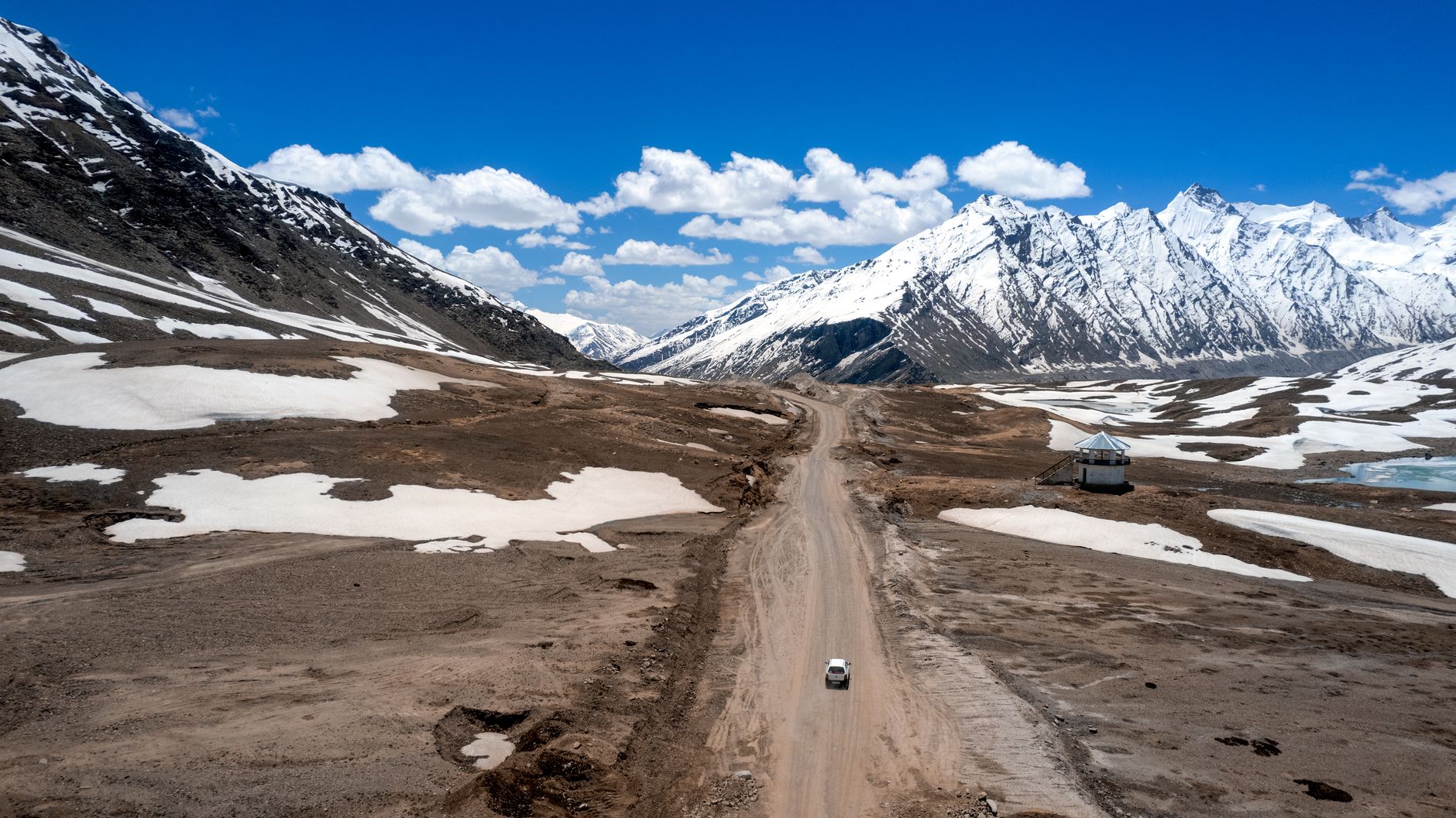
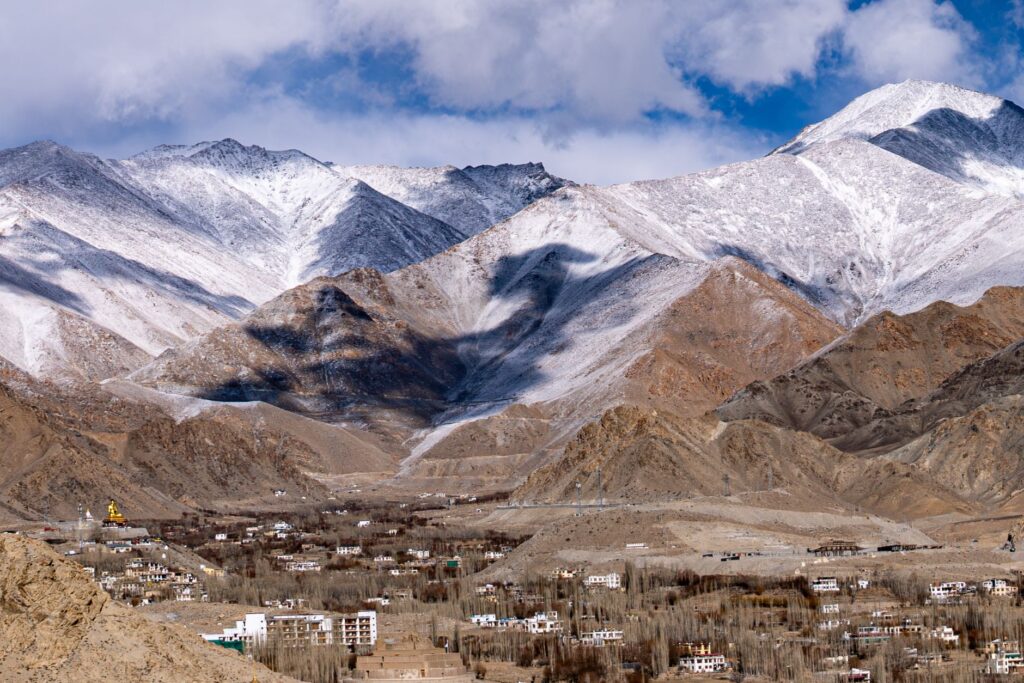
Ladakh is located in what geographers call a rain shadow. The towering peaks of the Himalayan range block the monsoon clouds rising from the Indian plains, creating a high-altitude desert characterized by extreme aridity. This climatic condition is fundamental to understanding the snow leopard’s ecosystem. Without the dense forest masses of other regions, the landscape is a raw exhibition of geology and ice.
Thermal variations in Ladakh are brutal. During winter, the preferred season for sightings as leopards descend into the valleys following their prey, the atmosphere is so dry that snow does not melt but instead sublimates. This dry, freezing air is what has shaped the feline’s physiology and determined the structure of the vegetation, composed mainly of thorny shrubs and slow-growing alpine grasses that sustain the herbivores.
Hydrology and the Cryosphere
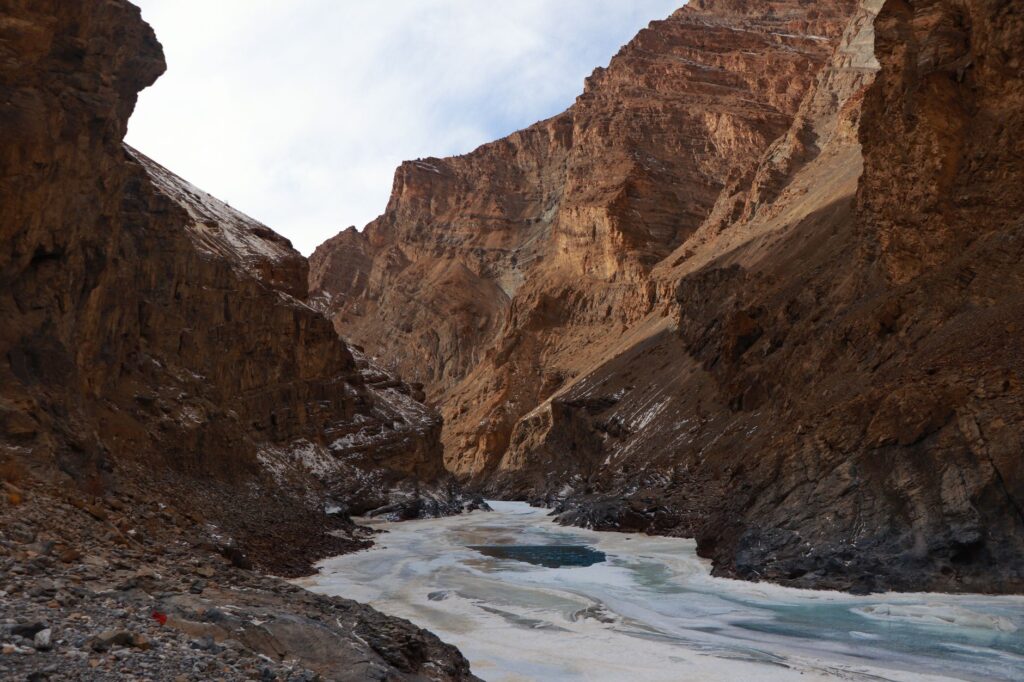
The water cycle in this refuge depends entirely on the cryosphere. Glaciers and seasonal snow deposits are the only sources of moisture. The retreat of these glaciers due to global climate change represents a silent but devastating threat. Altering the melt regime not only affects human communities that depend on traditional irrigation channels (zing) but also fragments the habitat of the leopard’s natural prey, forcing it to move into areas of greater conflict with humans.
Ecology of Coexistence: The Community Conservation Model
Historically, the snow leopard was seen as a threat to the livelihoods of Ladakhi herders. A single attack on a pen of sheep or pashmina goats could mean economic ruin for a family. However, in recent decades, a paradigm shift has occurred, driven by organizations like the Snow Leopard Conservancy and the local government. The focus has moved from punitive protection to incentive-based conservation.
The Himalayan Homestays program is the pillar of this success. By turning former hunters and herders into guides and hosts for nature tourism, the leopard has shifted from being an enemy to a vital economic asset. The income generated by travelers seeking to photograph the feline is reinvested in the community, funding the construction of predator-proof corrals that eliminate the need for retaliatory killings.
«The snow leopard is no longer the ghost that steals livestock, but the guardian that sustains the economy of our most remote valleys.»
Furthermore, community insurance systems have been implemented where villagers themselves manage funds to compensate for livestock losses immediately, reducing social friction and fostering a sense of local pride in the presence of the great cat.
Tracking and Science: Monitoring in Extreme Conditions
Studying the snow leopard in the wild is one of the greatest challenges of modern zoology. Due to its cryptic nature and the vastness of the terrain, direct visual censuses are insufficient. Science in Ladakh today relies on two fundamental tools: camera traps and genetic analysis of scat.
Camera traps, strategically placed at mountain passes and natural marking sites, allow individuals to be identified through the unique patterns of their rosettes, similar to a fingerprint. These data have revealed surprisingly high population densities in valleys like Rumbak and Ulley, confirming that Ladakh is a critical biological corridor connecting Central Asian populations.
Population Genetics
DNA analysis extracted from fecal samples has allowed researchers to understand the genetic diversity and dispersal patterns of the species. In such a fragmented environment, connectivity between valleys is vital to avoid inbreeding. Studies show that snow leopards are capable of traveling astonishing distances, crossing mountain passes over 5,500 meters to find mates, underlining the need to protect not only population cores but also ecological corridors.
The Role of Responsible Ecotourism in Preservation
The surge in international interest in the snow leopard has brought with it considerable ethical responsibility. Ecotourism in Ladakh must be strictly regulated to avoid stressing the animals and degrading the fragile grasslands. Sighting groups are small and led by local trackers who possess ancestral knowledge of the terrain.
This low-impact tourism not only provides funds for conservation but also acts as a platform for global environmental education. Visitors learn that the leopard’s survival is intrinsically linked to the preservation of Ladakhi Buddhist culture, which promotes compassion toward all sentient beings and has been the spiritual substrate that has prevented the species’ extinction in this region for centuries.
Practical guide
For those wishing to undertake an expedition to the snow leopard’s domain, it is imperative to understand that this is not a conventional pleasure trip, but a test of endurance and patience.

- Ideal Time: January, February, and March are the best months for sightings. This is when the intense cold pushes leopards and their prey (the bharal) to lower altitudes (3,500-4,000m).
- Access: The entry point is the city of Leh, connected by flight to New Delhi. Due to the altitude (3,500m), it is mandatory to undergo at least three days of total acclimatization before any physical activity.
- Equipment: It is essential to have a high-mountain layering system capable of withstanding -30°C. Expedition-grade sleeping bags and technical insulated footwear are must-haves.
- Key Locations: Hemis National Park and the Rumbak, Tarbung, and Husing valleys are the centers of activity. The Ulley Valley, west of Leh, offers an alternative with slightly more comfortable accommodations.
- Health: Prior consultation with a doctor regarding altitude sickness (AMS) and constant hydration are vital. The air in Ladakh is extremely dry, which accelerates dehydration.
- Traveler Ethics: Always follow the instructions of local trackers. Drones are not permitted, and strict silence must be maintained during sightings to avoid interfering with the animal’s natural behavior.
Finally, encounters with the snow leopard usually occur at a great distance through spotting scopes. Patience is the naturalist’s most important tool; waits can last for days under the freezing Himalayan sun, but the reward of seeing a gray shadow move with infinite grace among the cliffs is an experience that transforms one’s perception of wildlife.
The Last Breath of Winter in the Himalayas
As evening falls in the Rumbak Valley, when the shadows of the peaks lengthen and the blue of the sky turns to deep indigo, the silence becomes absolute. It is at this moment that the presence of the snow leopard is felt most intensely, even if it remains unseen. Its existence is a reminder that there are still places on Earth where the rhythm of life is dictated by seasons and geology, far from the immediacy of the modern world.
The conservation of this feline is not just a matter of biology; it is an act of respect toward the integrity of our planet. By protecting the snow leopard, we protect the glaciers that feed billions of people and preserve a symbol of nature’s resilience. As long as the Ghost of the Mountains continues to roam the ridges of Ladakh, there is hope for biodiversity in Earth’s most extreme ecosystems. Its golden gaze, occasionally captured by a lens or a pair of binoculars, connects us with a wild essence that we must not allow to be extinguished.