
Introduction to the Edge of the Continent
At the southernmost tip of the planet, where the Andes mountain range plunges precipitously into the cold waters of the Beagle Channel, rail transport has played a foundational role in human settlement, isolation, and survival. The Fuegian Southern Railway, popularly known as the Train at the End of the World, is not merely a contemporary tourist attraction; it represents the logical evolution of a narrow-gauge system originally conceived to supply the infamous prison at the end of the world in Ushuaia. Through this report, we examine how civil engineering had to adapt to a climatically harsh environment, dominated by impenetrable peat bogs, sub-Antarctic beech forests, and extreme weather conditions that defied the construction logic of the early twentieth century.
The history of this railway line is inextricably linked to the penal history of modern Argentina. Around 1902, national authorities decided to establish a maximum-security prison in the Territory of Tierra del Fuego, taking advantage of natural geographical isolation as an infallible method of confinement. To keep the penitentiary colony operational, which required large volumes of firewood for heating and construction materials, a precarious railway network was built, penetrating daily into the slopes of Mount Susana. Today, traveling along this route provides insight into the complex logistics that made it possible to inhabit one of the southernmost urban enclaves on the globe.
Penal Origins and Timber Logistics
The construction of the penitentiary railway system responded strictly to urban survival needs. Ushuaia was, at the beginning of the past century, a precarious settlement that depended entirely on supply ships arriving sporadically from Buenos Aires. During the long, dark winter months, fuel shortages posed a mortal threat to inhabitants and inmates alike. Prisoners, guarded by wardens amidst inclement weather, were forced to clear surrounding forests and load timber onto primitive carts pulled by oxen and horses.
However, animal traction proved insufficient as the penal population grew and forests near the prison became depleted. It was then that prison authorities projected the installation of a 500-millimeter gauge Decauville track, later replaced by a 600-millimeter gauge that allowed the use of steam locomotives. This technological shift marked a monumental logistical leap: British and German-built engines began plying river valleys, hauling tons of lenga and coihue logs toward workshops and carpentry yards inside the penitentiary.
Engineering Against Peat Bogs and Sub-Antarctic Climate
Designing and maintaining a railway line over Fuegian terrain means challenging the fundamental laws of traditional geotechnics. The ground surrounding Ushuaia is largely composed of peat bogs, accumulations of partially decomposed organic matter saturated with water that act as unstable sponges. Tracks could not be laid directly onto this muddy surface without suffering catastrophic subsidence. Engineers and prisoners alike executed complex drainage works, side ditches, and basalt-reinforced embankments to ensure platform stability.

Adding to soil difficulties was severe weather. Gale-force winds from the western quadrant, heavy snowfalls blocking mountain passes for months, and constant low temperatures demanded continuous maintenance of the superstructure. Wooden sleepers required special treatment to prevent premature rotting caused by permanent moisture, while steep gradients on mountain slopes required extraordinary mechanical effort from small locomotives tasked with overcoming altitude gains toward the Cañadón de la Toro.
The railway at the end of the world is not only a monument to narrow-gauge engineering, but the physical testimony of how forced labor and logistical necessity sculpted the human geography of southern Patagonia.
The Transition: From Historic Prison to Tourism Renaissance
With the final closure of the Ushuaia prison in 1947, decreed by President Juan Domingo Perón under a new humanitarian penitentiary vision, the railway lost its original purpose. Facilities were abandoned, tracks were gradually covered by moss and native vegetation, and rolling stock suffered progressive deterioration due to vandalism and weather. For decades, the old prisoner train seemed condemned to definitive oblivion, relegated to local history pages as a melancholic relic of difficult times.
Nevertheless, the boom of international tourism toward Argentine Patagonia in the late twentieth century prompted an ambitious heritage recovery project. Private investors, collaborating with industrial archaeology experts, rescued the original layout and promoted its meticulous reconstruction. Steam locomotives faithful to historical models were imported, and the section skirting the Pipo River was rehabilitated, allowing contemporary travelers to relive the sensory experience of penetrating American confines at the same leisurely pace as the ancient inmates.

Territorial Integration and Tierra del Fuego National Park
Today, the Fuegian Southern Railway operates within the boundaries of Tierra del Fuego National Park, forming a unique transport corridor connecting the End of the World Station with Macarena Station and National Park Station. This territorial integration has radically transformed how visitors experience the protected landscape. Instead of accessing natural enclaves via noisy motor vehicles, the train offers a silent perspective respectful of the surrounding ecosystem.
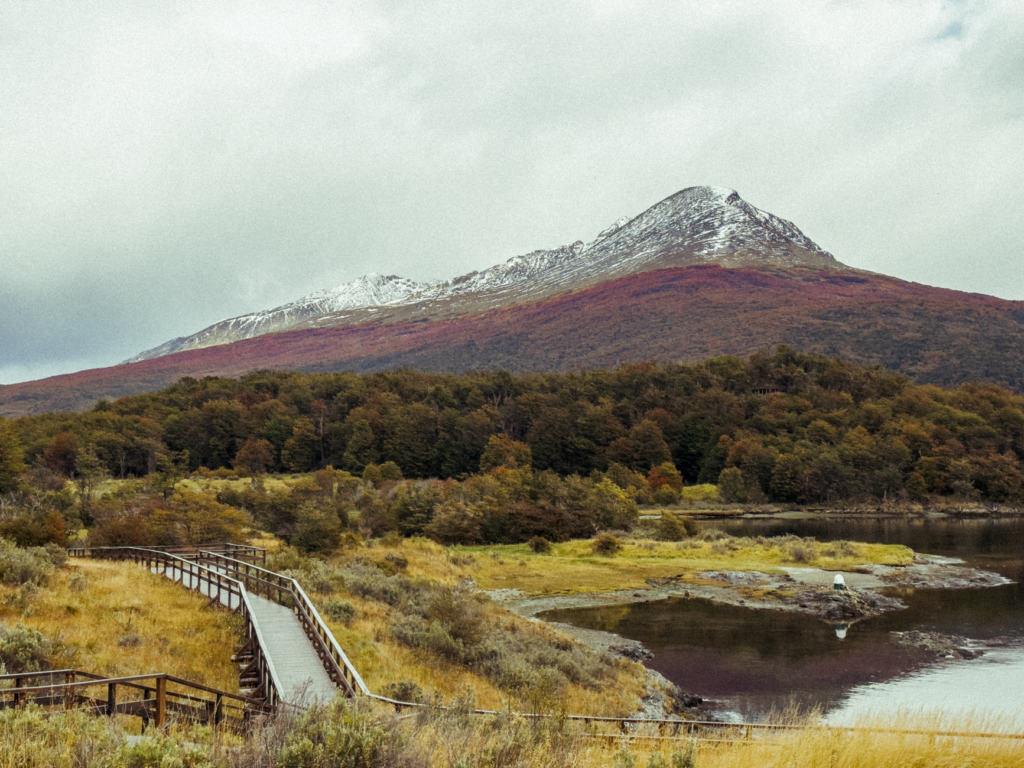
The railway track runs parallel to the Pipo River, crossing restored metal bridges that allow observation of summer meltwater fluvial dynamics. Passengers can closely view characteristic «flag trees,» specimens of lenga deformed by the relentless force of southern winds, as well as glacial geological formations. This model of tourist mobility demonstrates that it is possible to valorize historical infrastructure without compromising the environmental fragility of South America’s most prized natural reserves.

The Onboard Experience: Rolling Architecture and Travel Rituals
Boarding the fine wood carriages of the Fuegian Southern Railway is an exercise in introspective travel. Car interiors, equipped with traditional stove heating and wide panoramic windows, invite quiet contemplation of the landscape. The onboard guide recounts the living conditions of former prisoners with historical precision, demystifying popular legends and providing documentary rigor on daily realities within the southernmost prison on the planet.
The rhythmic sound of steam escaping locomotive pistons sets the pace of a journey that seems to suspend time. Strategic stops, such as the one at Macarena Waterfall, allow travelers to briefly disembark to breathe crisp air imbued with aromas of moss and damp wood, while observing remnants of Yámana indigenous camps that inhabited the region millennia before European explorer arrivals and subsequent founding of the penal colony.
Preserving railway memory in such extreme latitudes demands ongoing conservation engineering efforts and deep respect for the fragile balance of sub-Antarctic forests.
Contemporary Challenges and Operational Sustainability
In the twenty-first century, managing historic railway infrastructure within such a delicate ecological setting presents considerable operational challenges. Energy transition and carbon footprint reduction are absolute priorities for current operators. Although main locomotives continue operating on steam—representing the primary heritage attraction—strict protocols have been implemented for certified biomass use in combustion, minimizing impact on local forest resources.

Likewise, erosion caused by constant visitor growth requires ongoing maintenance work on embankments and track drainage systems. Modern civil engineers must combine traditional construction techniques with satellite monitoring technologies to detect movements in peat soils before compromising circulation safety. Thus, the Fuegian Southern Railway projects itself into the future as an international benchmark for sustainable rail tourism and heritage conservation.
Practical guide
- How to get there: Ushuaia features daily flight connections from Buenos Aires via Malvinas Argentinas International Airport. The Fuegian Southern Railway’s Main Station is located 8 kilometers west of the city, accessible via tourist bus services or taxi.
- When to visit: The high operating season runs from November through April, coinciding with the southern spring and summer, when weather conditions are more favorable and daylight hours extend significantly.
- Ticketing and reservations: It is strictly advisable to purchase tickets in advance through official channels, especially between December and February, due to high international demand and limited capacity in historical carriages.
- Service classes: The train offers various travel categories, including standard tourist class and premium services featuring onboard Patagonian gastronomy, specialized multilingual guides, and preferential seating.
- Recommended gear: Dressing in layers (the onion system) is advised, utilizing waterproof and windproof outerwear, comfortable trekking footwear, and sunscreen, as weather conditions in Tierra del Fuego can change drastically within minutes.
Emotional Epilogue at the End of the World
When the locomotive’s whistle echoes for the last time at the terminal station, bidding farewell to the afternoon over the Pipo River valley, there remains the certainty that this train is much more than a mechanical attraction. It is the silent triumph of human tenacity against the desolate and beautiful immensity of deep Patagonia. Under a sky where clouds move swiftly driven by polar winds, steel rails continue to shine like a luminous scar upon the damp earth, reminding every traveler that even in the most remote confines of civilization, the desire to connect distant worlds never truly fades away.