
Imperial Origins and the Boldness of Alpine Alignment
The construction of the Semmering Railway in the mid-19th century stands as one of the most monumental milestones in European transportation history. Conceived under the mandate of the Austrian Empire, this project sought not only to connect the imperial capital, Vienna, with the strategic ports of the Adriatic Sea, but also to prove the technical supremacy of civil engineering against one of the continent’s most formidable natural barriers. The Semmering Alpine range imposed extreme grades, steep elevation changes, and severe weather conditions that forced contemporary engineers to completely rethink the limits of steam traction and railway track design.
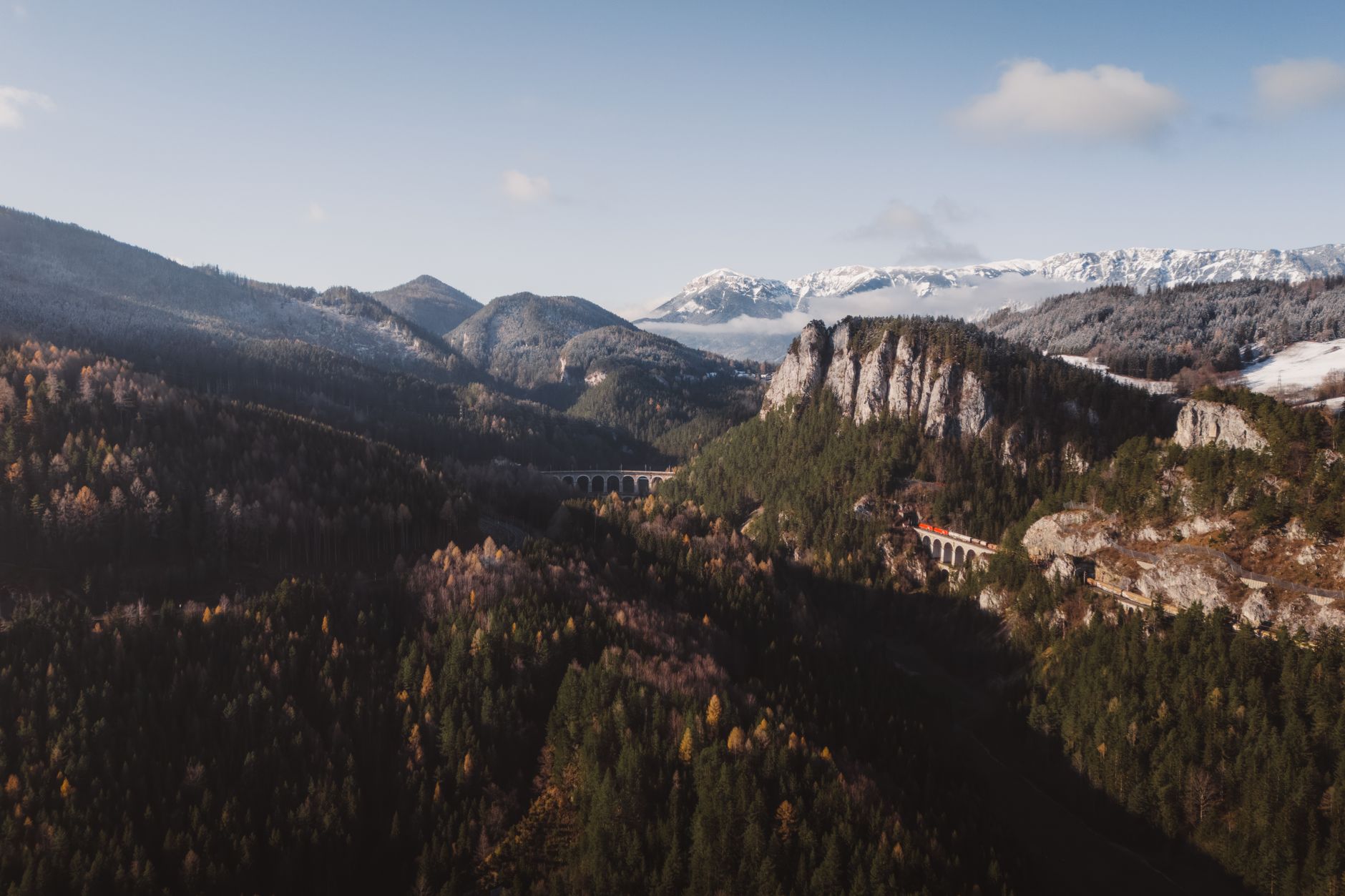
Under the visionary leadership of engineer Carl Ritter von Ghega, the project defied the skepticism of the contemporary scientific community. Instead of opting for traditional solutions that would have required unacceptable gradients for available locomotives, Von Ghega designed a winding route that harnessed the mountain slopes through stone viaducts, hand-excavated tunnels, and tight-radius curves that seemed to defy the laws of physics. This approach not only solved a monumental logistical problem but also integrated the infrastructure into the alpine landscape in a way that continues to astonish architects and travelers alike.
The execution of the works mobilized thousands of workers from various corners of the empire, facing epidemics, landslides, and harsh high-mountain winters. The rudimentary tools of the era, relying on early dynamite, artisanal stonemasonry, and human and animal labor, confer an epic dimension upon every meter of track. When it officially opened in 1854, the Semmering demonstrated that mountainous geography was no longer an insurmountable obstacle for continental trade and mobility, laying the groundwork for modern alpine tourism and Central European connectivity.
The Architecture of Viaducts and Mastery in Stone
One of the most striking aspects of the Semmering Railway lies in its architectural language. The engineers did not merely lay rails across the earth; they built civil engineering monuments that integrate gracefully into the valley. Multi-tiered masonry viaducts, such as the famous Kalte Rinne viaduct and the Jägergraben bridge, bear witness to an era where industrial functionality and classical aesthetics went hand in hand. These curved bridges, elevated over deep chasms, allowed engineers to bridge river gorges and canyons with astounding mathematical precision.
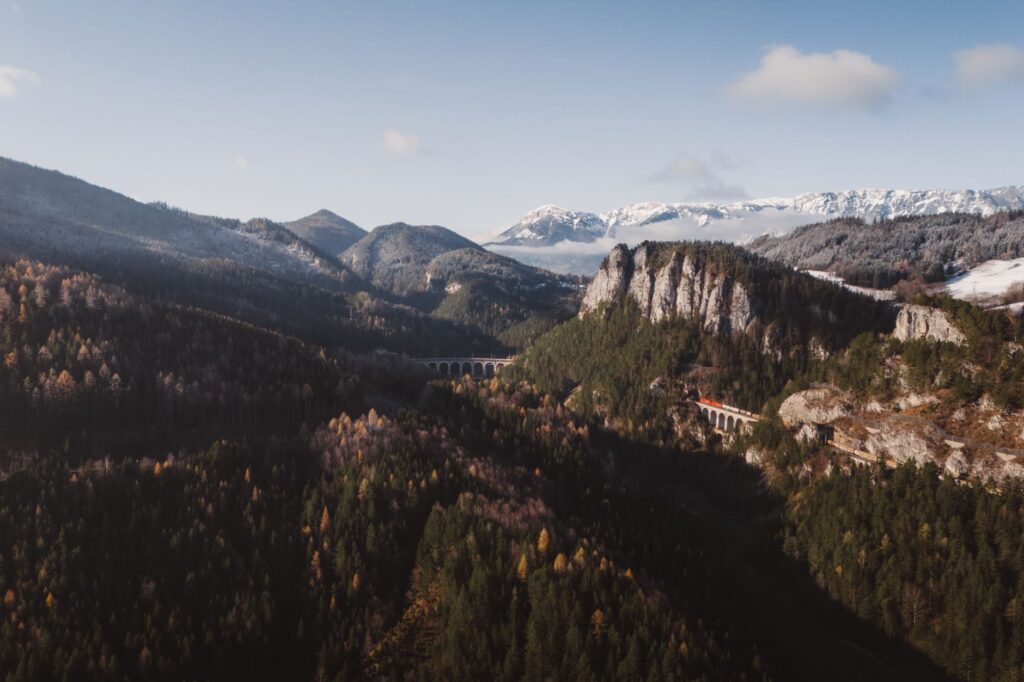
The choice of local stone for the construction of tunnels and bridges ensured not only structural durability against freeze-thaw cycles but also visual blending with the limestone cliffs of the Alps. Each arch was calculated to withstand the enormous dynamic stresses generated by the passage of heavy convoys, anticipating the demands of 20th-century rail transport. This construction solidity has allowed the infrastructure to remain operational and in excellent preservation condition a century and a half after its commissioning.
The Semmering is not merely a communication route; it is a manifesto of stone and iron that redefined our capacity to inhabit and connect the alpine territory.
In addition to the viaducts, the route features sixteen main viaducts and over twenty minor bridges, complemented by fifteen tunnels bored into the living rock. The summit tunnel, situated over 890 meters above sea level, involved a titanic effort of manual drilling and precarious ventilation. The complexity of these structures demanded constant maintenance from their earliest years, giving birth to a school of mountain railway engineering whose techniques were later exported to similar projects in the Andes, the Himalayas, and the Rocky Mountains of North America.
Technical Evolution: From Steam Traction to Electrification
The performance of the Semmering Railway has been inextricably linked to the evolution of traction technology. In its early decades, steam locomotives had to operate at the limit of their capabilities, consuming massive amounts of coal and water as they climbed continuous ramps reaching a slope of up to 25 per thousand. Local workshops developed specific designs for articulated locomotives and advanced braking systems to control descents and prevent catastrophic accidents on the route’s sharp curves.
At the turn of the 20th century, with the rise of electrification in Central Europe, the corridor underwent a radical transformation. The introduction of catenary systems and electric locomotives eliminated problems associated with smoke and corrosion inside tunnels, while significantly increasing the line’s commercial speed and freight capacity. This modernization allowed Semmering to maintain its strategic relevance against the emerging competition of automotive transport and high-capacity highways built in subsequent decades.
Today, the line forms an essential part of the Baltic-Adriatic rail corridor and the Trans-European Transport Network. Although modern pendulum trains and high-speed units have replaced historical relics in regular passenger services, the infrastructure retains its original layout. Contemporary engineers continue applying laser auscultation and structural reinforcement techniques to protect slopes from geological risks, proving that 19th-century design remains a living work perfectly adapted to the 21st century.
World Heritage and the Alpine Cultural Landscape
In 1998, UNESCO recognized the exceptional nature of the Semmering Railway by inscribing it on the World Heritage list. This accolade not only distinguished the technical prowess of the work but also the harmonious integration between transport infrastructure and the surrounding cultural landscape. The arrival of the railway radically transformed the valley, turning quiet alpine villages into exclusive rest stations and summer retreats for the Viennese aristocracy and bourgeoisie, who sought mountain fresh air and traditional spas.
The slopes of the Semmering quickly filled with stately villas of historicist and alpine architectural style, designed by prestigious architects who replicated urban elegance in the heart of nature. This phenomenon generated a pioneering model of tourism development driven by the railway, where the train journey was an inescapable part of the vacation experience. Passengers enjoyed spectacular views of coniferous forests and snow-capped peaks from panoramic carriages, consolidating an aesthetic narrative that permeated literature, painting, and photography of the era.
Heritage protection has posed a complex challenge for Austrian authorities, who must balance the modernization demands of contemporary rail traffic with the strict preservation of original historic elements. Centenary stations, switchman houses, and dry-stone retaining walls are the subject of careful restoration plans. This commitment ensures that current visitors can experience precisely the same sense of wonder felt by passengers on the first imperial train in the 19th century.
Contemporary Logistics and Trans-Alpine Connectivity
In the context of current European transport, the Semmering corridor plays a fundamental logistical role for the transit of freight and passengers between the north and south of the continent. Despite the construction of modern variants such as the Semmering Base Tunnel—a megaproject under development to alleviate historical gradients—the traditional route continues to operate as an indispensable link for regional traffic and as a top-tier tourist alternative that relieves congestion on major highway arteries.
Traffic management on this mountain line requires millimeter-level coordination between freight operators and passenger services. Rail control centers monitor adverse weather conditions in real time, especially during harsh alpine winters, when snow and ice pose a constant challenge to wheel adhesion on rails. Safety protocols include specialized snowplow trains and automated early-warning systems against rockfalls on forested slopes.
This capacity for technological adaptation demonstrates that historical infrastructures can coexist and complement the high-efficiency logistics networks of the 21st century. The maintenance of the line responds not merely to criteria of heritage nostalgia, but to a transport diversification strategy that guarantees the resilience of Central European supply chains against any eventualities on high-capacity routes.
Practical guide
Planning a trip to the Semmering Railway requires understanding transport options and the best times of year to enjoy both the landscape and the historical infrastructure. Essential recommendations for organizing the visit with rigor and autonomy are detailed below.
How to get there: The ideal starting point is Vienna (Vienna-Schwechat Airport or Central Station). From there, direct regional trains operated by Österreichische Bundesbahnen (ÖBB) connect to Gloggnitz in approximately one hour, marking the formal start of the historic line.
When to travel: Although the line operates year-round, advanced spring (May and June) and autumn (September and October) offer optimal conditions for hiking and photography thanks to the chromatic contrast of alpine forests. Winter brings exceptional snowy landscape appeal, though it requires caution due to potential timetable variations.
Ticketing and fares: It is recommended to purchase the regional single ticket or use combined transport passes for the Lower Austria and Styria regions. Seat reservations are not required on regional trains, but it is advisable to check updated schedules on the official ÖBB application before starting the journey.
Accommodation and gastronomy: The towns of Semmering, Mürzzuschlag, and Gloggnitz feature traditional hotel offerings including former mansions converted into boutique hotels. Local gastronomy combines traditional Austrian culinary tradition with Styrian influences, highlighting game dishes and alpine pastries in traditional taverns near the stations.
Emotional Epilogue on the Threshold of the Alps
As the sun begins to descend behind the summits of the Semmering and the last golden rays illuminate the secular stone arches of the Kalte Rinne viaduct, the mountain reclaims the profound silence that prevailed before human arrival. In that twilight moment, contemplating the silent passage of the final night train winding its way southward evokes a strange melancholy—a tangible reminder that great feats of human engineering serve not only to shorten geographical distances, but to weave an enduring bond between ephemeral human ingenuity and the stony eternity of nature.