
Geological Origins in the Heart of Alava
The Salt Valley of Gesaltza Añana, located in the province of Alava, is not a conventional natural landscape, but rather a colossal thermodynamic infrastructure carved over millennia by the Earth’s own geology. Unlike coastal marine salt pans, this inland gorge owes its existence to a gigantic diapir of Triassic salts formed more than two hundred million years ago. Layers of rock salt and clays, compressed by the tectonic forces of the Alpine movement, slowly rose toward the surface through geological faults, creating an inexhaustible underground deposit.
Four brine springs emerge naturally in the upper part of the valley, locally known as the salt eyes. The liquid welling up from these depths is up to ten times saltier than Atlantic seawater, a concentration so high that it saturates the flow almost as soon as it contacts the air. For centuries, local communities understood that this geological phenomenon represented an irreplaceable source of wealth for food preservation, sparking a human occupation that has transformed the landscape into a masterpiece of vernacular engineering.
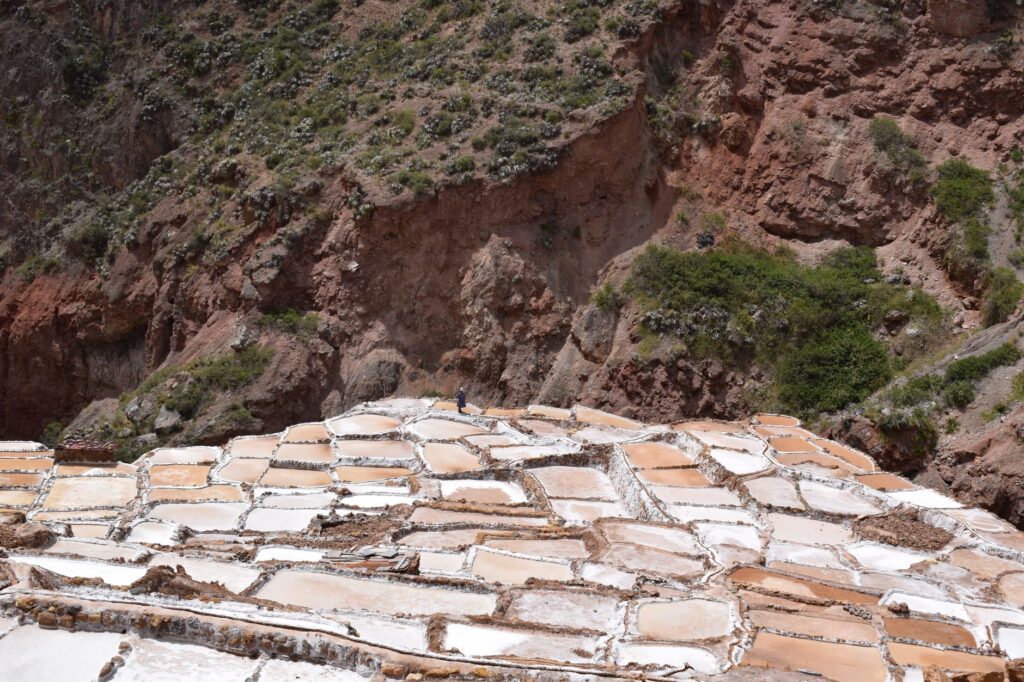
The arrival of the Romans marked the primary industrialization of the enclave, but it was during the Middle Ages that the valley acquired its current morphological configuration. The hillsides were entirely covered with thousands of terraced evaporation pans made of wood and stone, forming a gravity-fed distribution canal system that feeds the crystallization beds. This layout not only optimizes solar exposure, but also harnesses the canyon’s orientation to generate constant air currents that accelerate sodium chloride crystallization without requiring fossil fuels.
Ribature Carpentry Applied to the Earth
The most fascinating element of Añana’s traditional architecture is the massive use of Scots pine and oak timber to support the platforms where the water evaporates. Far from being an ephemeral material, the brine acts as a natural preservative that impregnates the wood’s fibers, preventing premature decay and giving the complex a characteristic grayish tone and a mineralized texture that defies the passage of centuries. Local carpenters perfected techniques inherited from naval construction to erect stilt structures capable of supporting tons of wet weight.
The canal system, initially carved from hollowed-out tree trunks and later replaced by tongue-and-groove wooden channels, forms a labyrinthine network descending from the springs to the lowest beds. Each plank is assembled without iron nails, employing mortise-and-tenon joints to prevent the electrochemical corrosion that salt would otherwise provoke. This artisanal mastery turns the valley into a living museum of historical carpentry, where every beam and sluice gate fulfills a rigorous and precisely measured hydraulic function.
The comprehensive restoration undertaken in recent decades has required the revival of nearly extinct crafts. Modern carpenters work with the same hand tools and geometric proportions as their ancestors, selecting timber pieces based on their forest orientation and flexural strength. This conservation effort does not seek a museological aestheticization, but rather the restoration of the system’s original hydrodynamic functionality, allowing brine to flow through historical channels exactly as it did in the 16th century.
The Thermodynamic Cycle of Sun and Wind
The salt production process in Añana is a flawless exercise in applied thermodynamics and passive environmental energy use. Brine is distributed from regulatory reservoirs to the pans, which are flat, clay-sealed surfaces where the liquid sits in a layer just a few centimeters thick. Two fundamental meteorological variables intervene here: direct solar radiation and the channeled wind regime characteristic of this geographical hollow.
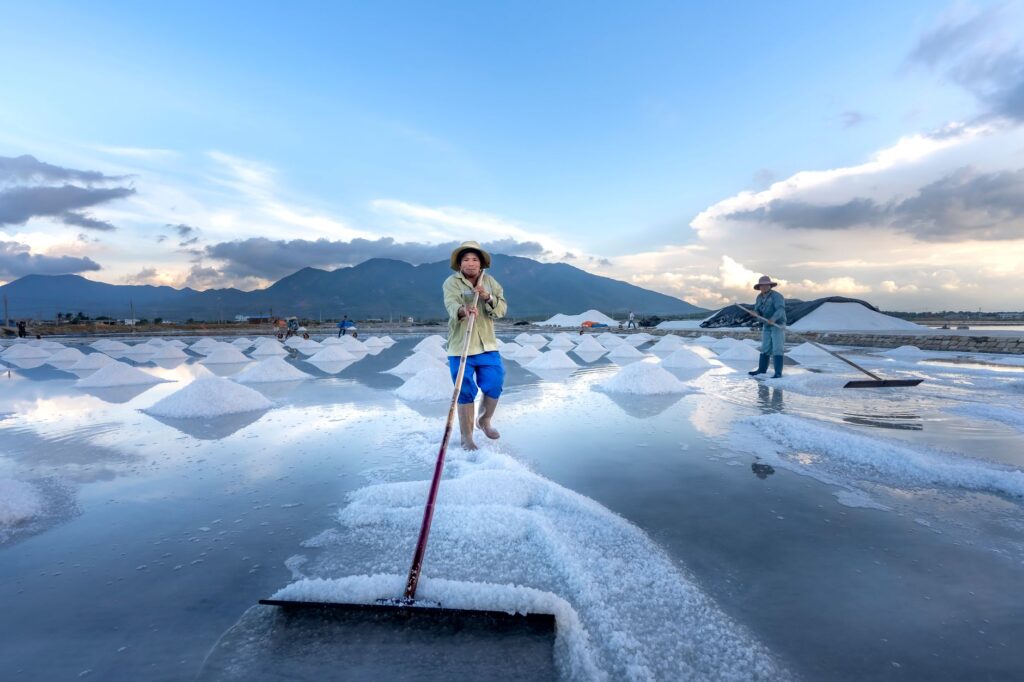
Evaporation occurs in a controlled manner under the supervision of salt workers, who regulate the flow using small wooden gates called ristreles. Water moves from one bed to another, gradually increasing its salt concentration until density reaches the precipitation point. At that precise moment, crystals begin to deposit at the bottom of the platform, acquiring different purities and crystalline shapes depending on the speed of the process and the zone of the valley where they are cultivated.

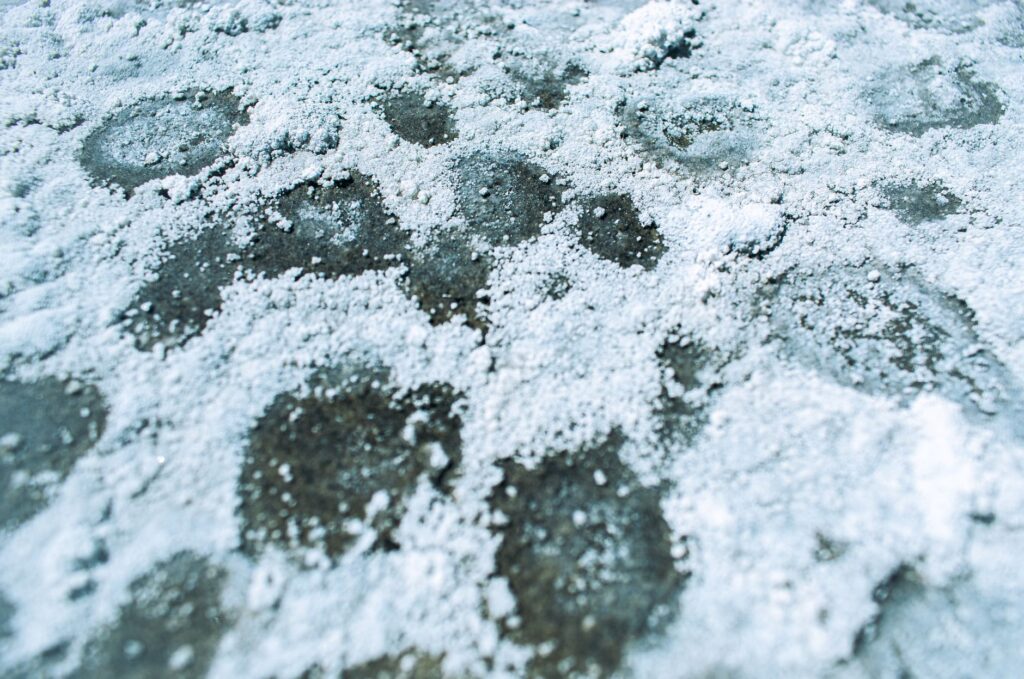
Among the most prized varieties is salt blossom, a delicate crystalline film floating on the water’s surface before precipitation, harvested manually with fine-mesh sieve tools. This product, valued by international haute cuisine, requires very specific atmospheric conditions of calm and dry heat. The result is a pure, unrefined condiment that encapsulates the trace elements and minerals of the Alavese subsoil, differing radically from industrial sea salt or terrestrial mining extraction.
Salt is not merely a condiment; it is the invisible thread weaving the architectural memory and ecological balance of a valley sculpted by water and time.
Halophilic Biodiversity and Ecological Equilibrium
Far from being a sterile environment due to extremely high salt concentration, the Salt Valley harbors a unique ecosystem composed of highly specialized plant and animal species. Halophilic plants, capable of thriving in soils with lethal sodium concentrations for the vast majority of conventional flora, carpet the margins of the channels and the slopes of the terraces. Species such as glasswort or various chenopod varieties display extraordinary physiological adaptations to filter excess salt and survive in this extreme microclimate.
Fauna has also found an invaluable biological refuge in this artificial landscape. Amphibians, aquatic macroinvertebrates, and numerous migratory birds use the ponds and channels as resting and feeding zones. The presence of these biological communities acts as an infallible indicator of the valley’s environmental health, demonstrating that sustainable human intervention, maintained over centuries, can enrich biodiversity rather than destroy it.
Scientific institutions work closely with the site’s managers to monitor water quality and the stability of clay slopes. This continuous tracking helps understand how salt production cycles interact with the hydrological basin’s natural cycles. Valley preservation thus relies on a rigorous scientific approach that balances heritage recovery with the strict protection of unique habitats and endemic species.
Wellness and Geothermal Energy in Saline Springs
Over the past decade, the use of the Salt Valley has transcended mere gastronomic production to delve into wellness and hydrotherapy based on the mineral-medicinal properties of its waters. The brine, rich in chloride, sodium, calcium, magnesium, and sulfates, possesses historically recognized dermatological and relaxing properties. The old spas that flourished in the area in the late nineteenth century have given way to new, environment-friendly facilities where visitors can experience flotation baths and open-air thermal circuits.
The recovery of these therapies is supported by balneological studies analyzing the skin absorption capacity of minerals present in hypersaline water. Extreme buoyancy, similar to that of the Dead Sea, drastically reduces pressure on the osteoarticular system, inducing a deep state of relaxation that complements the landscape’s sensory experience. These wellness spaces have been integrated into the lower part of the complex, utilizing renewable energies and geothermal recovery systems to heat the water without altering the valley’s thermal balance.
This therapeutic facet adds a regenerative dimension to the journey, allowing visitors to physically connect with the raw material that shaped local culture. Immersion in the saline springs closes the circle between architectural heritage, industrial ethnography, and healthcare, turning the stay into a holistic experience that transcends traditional contemplative tourism.
Subterranean Architecture and Capture Galleries
Beneath the visible surface of the evaporation pans and wooden walkways lies an unfamiliar labyrinth of underground galleries, inspection shafts, and hidden piping that constitutes the true circulatory system of the Salt Valley. These infrastructures, excavated directly into the clayey rock, capture and regulate spring flow before it reaches the surface, protecting the resource from external pollution and guaranteeing a constant supply during the hot summer months of peak evaporation.

Exploring these galleries reveals historical shoring techniques with secular timber and dry-stone masonry walls supporting the hydrostatic pressures of the terrain. Modern engineers employ laser scanning technology and pressure sensors to monitor the status of these invisible structures, preventing any risk of collapse in such a dynamic and complex geological substrate. This subterranean heritage testifies to the technical audacity of generations of master builders who mastered the subsoil with no tools beyond empirical observation.
Controlled access to certain sections of these galleries allows visitors to comprehend the sheer scale of human effort invested in taming the salt diapir. Specialized guided tours descend into the mountain’s bowels, where the constant sound of underground water and dim light create an atmosphere of monastic recollection. This duality between the blinding light of the upper pans and the damp gloom of the underground conduits defines the enclave’s overall architectural experience.
Practical guide
How to get there: The Salt Valley is located in the town of Gesaltza Añana, about 30 kilometers west of Vitoria-Gasteiz. Private vehicle access is primarily via the AP-68 highway or the N-124 national road, followed by the A-2622 local road. Vehicles are not permitted inside the historical valley center; a public parking lot is available at the main entrance. For public transport users, regular bus lines connect Vitoria-Gasteiz with Miranda de Ebro, stopping in nearby towns, though advance planning is recommended due to low regional service frequencies.
When to go: The salt production season runs from spring through early autumn (May to October), with summer months being the optimal period to observe the complete crystallization process and artisanal harvest. During spring, spring flow reaches its peak after winter rains, while autumn offers an exceptional chromatic palette in surrounding forests and greater tranquility for walking the walkways without tourist crowds.
Reservas y accesibilidad: Due to the structural fragility of the wooden walkways and the need to preserve architectural heritage, access to the interior of the Salt Valley is exclusively via guided tours organized by the managing foundation. Advance booking through their official website is essential. Part of the route is adapted for visitors with reduced mobility, though some areas with narrow walkways and steep inclines require firm footwear and basic physical fitness.
Accommodation and gastronomy: Hotel offerings within the valley itself are sparse, featuring small rural houses restored with bioclimatic criteria in surrounding villages of the Cuadrilla de Añana. For a wider range of hotel services, Vitoria-Gasteiz or Miranda de Ebro are less than a half-hour drive away. Local gastronomy revolves around Alavese agricultural products, highlighting pulses, free-range meats, and artisanal Añana salt enhancing traditional stews and vegetable preserves.
Mineral Epilogue: The Eternal Murmur of the Pans
When the sun sets over the mountain ridges and the last golden reflections fade across the surface of the pans, the Salt Valley reclaims its primordial silence. The hurried footsteps of visitors and the murmur of salt workers’ tools are gone, leaving only the steady, rhythmic dripping of brine along its centuried channels. This sound, unaltered for centuries, is the geological heartbeat of a territory that turned a natural difficulty into a collective work of art.
The experience of walking these suspended walkways leaves an indelible mark on the traveler, reminding them that true sustainability is not a modern invention, but the result of a prolonged, respectful dialogue between human intelligence and the earth’s limits. Añana stands as a beacon of heritage resilience, proving that conserving the past is the most effective tool to project a future where economy and ecology walk hand in hand.