
The fascination with capturing the world from above has accompanied the contemporary traveler for the past decade. From bulky professional setups to ultra-compact devices that fit in the palm of a hand, the evolution of unmanned flight technology has been marked by a constant tension: the pursuit of the perfect shot versus the growing regulatory and logistical complexity of transporting such gear in a backpack. In this landscape of technological saturation, where technical specifications often eclipse the true creative vocation of travel, a proposal emerges that aims to shake the foundations of portable audiovisual industry.
The launch of the Antigravity A1 in late 2025 does not merely represent another iteration within the crowded market of recreational and semi-professional quadcopters. Its structural and conceptual approach seeks to challenge the traditional architecture of drones with fixed front cameras, introducing a 360-degree capture system that eliminates framing anxiety mid-flight. For travelers traversing secondary roads, remote trails, or bustling metropolises, this device poses a fundamental question: how does our relationship with the landscape change when we stop piloting a camera and instead become directors of a complete visual sphere?
The End of Traditional Framing in Travel
For years, the main obstacle for travel videographers has not been sensor quality or wind stability, but the rigidity of the field of view. A conventional drone demands millimeter-level planning for every trajectory. The pilot must calculate camera movement, travel speed, and gimbal orientation simultaneously—a process that often distracts the traveler from the immersive experience of the place they are visiting. The introduction of 360-degree technology into a stable flight platform shifts the burden of aesthetic decision-making from the flight moment to the post-production editing process.
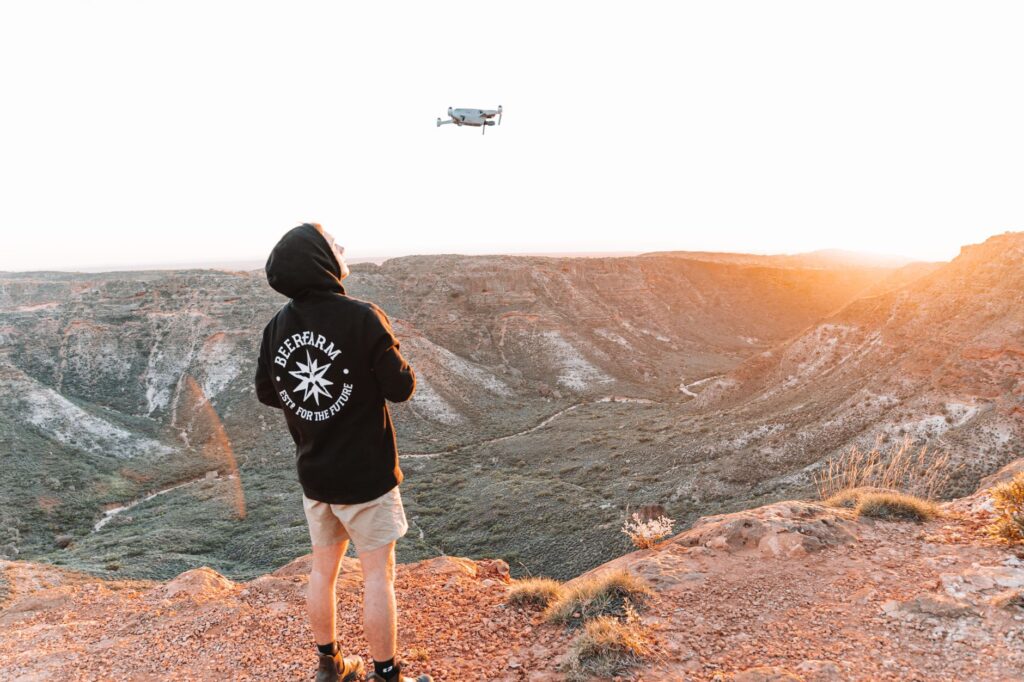
Creative freedom brought by this technology lies in the ability to fly without obsessively staring at the control screen to ensure the horizon is level or the subject remains in the rule of thirds. By recording the entire environment simultaneously, the Antigravity A1 allows the operator to focus on navigation safety and the direct contemplation of the landscape. This dissociation between piloting and photographic composition drastically reduces the learning curve for travelers who wish to incorporate high-angle shots and complex panoramas into their visual stories without accumulating hundreds of hours of practice in flight simulators.
Engineering and Portability: The Road Warrior’s Dilemma
Adventure travelers know the weight of every single gram in their luggage. Airline baggage restrictions, combined with limited space in camper vans and trekking backpacks, demand an uncompromising selection of electronic gear. Historically, adding a high-performance drone meant sacrificing vital space for lenses, spare batteries, and charging stations. Manufacturers have attempted to mitigate this issue through foldable designs, but the vulnerability of traditional three-axis mechanical gimbals still required rigid, bulky cases.
The design of the Antigravity A1 addresses this structural challenge by eliminating traditional mechanical gimbals, relying instead on integrated digital stabilization and protected dual spherical lenses. This space optimization not only lightens the traveler’s load but significantly decreases the risk of mechanical damage during transport under adverse conditions. Fewer moving parts mean greater resistance against dust on dirt roads, humidity in tropical forests, and low temperatures in mountain ranges—crucial factors for those who demand durability from their working tools.
The true value of a travel device is not measured by its laboratory datasheet, but by its ability to seamlessly integrate into the explorer’s routine without compromising safety or journey spontaneity.
Global Regulation and the Impact of Autonomous Flight
Navigating the complex web of international aviation regulations has become the greatest headache for creators on the road. Airspace restrictions, bans on flying over urban areas without specific authorizations, and legal variations between countries turn every border crossing into a bureaucratic hurdle. While no hardware can exempt travelers from complying with local civil aviation laws, the operational simplification of autonomous systems helps minimize incidents resulting from pilot errors in sensitive environments.
Furthermore, the lower visual aggressiveness of compact and quiet designs contributes to better social acceptance in local communities that often view the invasive buzzing of traditional drones with suspicion. Technological discretion fosters a more respectful coexistence with the human and natural environment, allowing the documentation of cultural realities without the aggressive interruption caused by larger equipment. However, experts remind us that possessing more advanced gear does not exempt users from the ethical responsibility of respecting privacy and environmental conservation rules.
Moving Visual Narratives: Beyond the Postcard
The mass consumption of travel content on social media has saturated the collective imagination with predictable aesthetics: high-angle sunsets over tropical beaches, frontal shots of winding roads, and low-level sweeps over forests. This visual homogenization poses an urgent challenge for contemporary storytellers seeking tools capable of restoring authenticity and depth to travel chronicles. The ability to reframe 360 material in post-production opens the door to camera movements impossible to execute manually, such as fluid transitions from a ground-level macro perspective to a high-altitude orbital panorama in a single continuous clip.

This narrative versatility allows for the construction of more dynamic visual stories that rely less on static shot structures. The viewer is no longer a passive recipient of a single perspective dictated by the camera operator, but experiences a three-dimensional immersion that more faithfully reflects the overwhelming breadth of natural spaces. The richness of detail is recovered when the angle no longer limits the capacity for wonder, allowing us to discover tangential elements that enrich the geographic and cultural context of the narrated story.
Energy Challenges and Autonomy in Remote Terrains
One of the greatest operational inconveniences faced by photographers on long-term expeditions is energy management. Far from the electrical grid, recharging drone, camera, and laptop batteries becomes complex logistics requiring portable solar panels, inverters, and strict planning of charging cycles. The aerodynamic efficiency and electrical consumption of dual-lens systems and 360-video processing demand a rigorous analysis of real flight battery life versus manufacturers’ commercial promises.

Field tests conducted in high-mountain regions and coastal zones with strong air currents show that thermal management and motor strain to maintain stability in adverse weather remain the limiting factors. Route planning must always include an energy safety margin higher than what is estimated in controlled environments. Experienced travelers agree that true autonomy lies not only in battery capacity, but in the wisdom of knowing when atmospheric conditions advise against takeoff, prioritizing equipment integrity and personal safety.
Flight Ethics and Sustainability in Fragile Destinations
Democratized access to aerial technology has increased pressure on fragile ecosystems and local communities that until recently remained sheltered from mass tourism. Rotor noise and the intrusive presence of flying cameras alter wildlife behavior, especially during nesting seasons or in high-mountain habitats. Therefore, the arrival of more sophisticated tools must be accompanied by deep reflection on the ethics of visual documentation and the environmental impact of the tech-enabled traveler.
International sustainable tourism associations insist on the need to establish specific codes of conduct for operating drones in protected natural areas. Environmental responsibility involves not only shutting off motors in the presence of sensitive animals, but also avoiding the publication of exact coordinates that could encourage overcrowding in pristine enclaves. The technical advancement of the Antigravity A1 and similar devices should serve to redefine our relationship with the environment through respect and restraint, using aerial perspective to raise awareness about the planet’s fragility rather than merely accumulating digital views.

Practical guide
Planning a trip with aerial capture equipment requires logistical rigor and updated regulatory knowledge. Below are the essential recommendations to successfully integrate this technology into your next route.
- Prior Regulatory Verification: Always consult the official civil aviation platforms of the destination country to understand geographical restrictions, no-fly zones, and aircraft registration requirements.
- Off-Grid Power Management: Incorporate a portable solar charging system of at least 100W and lightweight power stations to ensure operativity in remote areas.
- Protection Against Elements: Use airtight transport cases and specific cleaning kits for spherical lenses to prevent the degradation of optical material by dust, sand, or saline moisture.
- Third-Party Liability Insurance: Purchase an international policy specifically covering unmanned aircraft piloting against third-party damage or equipment loss.
- Respect for Wildlife and Local Culture: Maintain a prudent distance from native fauna and avoid flying over human settlements without the explicit consent of local communities.
The most advanced technology loses its meaning if it becomes a barrier between the traveler and the authenticity of the territory they traverse.
The horizon of travel videography is shifting toward a more organic integration between the environment and the digital tool. The Antigravity A1 symbolizes a paradigm shift that invites us to rethink how we observe, record, and share the world’s landscapes. In the end, what truly matters is neither sensor resolution nor the complexity of editing software, but the traveler’s ability to preserve a sense of wonder before the immensity of the landscape, using technology not as an end in itself, but as a silent bridge toward a deeper and more respectful understanding of our planet.
Source in English: Nomadic Matt’s Travel Site (https://www.nomadicmatt.com/travel-blogs/antigravity-drone-review/)