The Invisible Vulnerability of Aviation Giants
The contemporary traveler typically assumes air punctuality to be an immutable physical law, a seamless mechanism where aircraft take off and land with Swiss-watch precision. However, the operational reality of major connection hubs in the United States periodically demonstrates just how fragile this house of cards truly is. Recently, a critical incident shook the national aviation system: 2,919 delays and 118 cancellations simultaneously paralyzed multiple primary hubs, leaving tens of stranded passengers in crowded terminals. This phenomenon is neither an isolated accident nor a whimsical consequence of adverse weather, but rather the most visible symptom of a systemic congestion that has been brewing deep within modern air transport for years.
Analyzing this collapse requires looking beyond the departures board flashing red warning lights. The American aeronautical network operates under a principle of extreme optimization, where every boarding gate, slot time, and air traffic controller operates at the absolute edge of theoretical capacity. When a single link in this microscopic chain falters—whether due to an unexpected storm on the East Coast, a minor IT glitch, or chronic staffing shortages—the domino effect spreads at breakneck speed from coast to coast. What begins as a morning delay in Chicago can translate, just hours later, into the cancellation of an international flight in Los Angeles.
The Human Factor and the Overwhelmed Control Tower
Behind every radar screen and radio instruction lies an increasingly scarce resource subjected to unsustainable pressure: the air traffic controller. Federal administrations have struggled for years with a chronic deficit of qualified professionals, a situation worsened by mass retirements and training programs failing to absorb current commercial traffic demand. Working in a high-density control tower involves managing hundreds of tons of metal in hyper-congested airspace, where the margin for error is literally zero. When accumulated fatigue intersects with obsolete technological infrastructure, operational risk spikes exponentially.
Added to this complex labor landscape is airline management, forced to compete fiercely in a deregulated market. Commercial incentives frequently prioritize maximum fleet rotation over operational resilience. Aircraft spend minimal time on the ground to maximize profitability, meaning any morning disruption destroys the time cushion needed to return to normalcy. On this board, the passenger becomes the adjustment variable in a system prioritizing financial accounting over public service predictability.
Aging Infrastructure Facing the Supersonic Era
It is paradoxically ironic that the superpower leading the space and digital eras relies for many of its trunk airports on civil infrastructure designed in the mid-20th century. Although targeted, million-dollar investments have modernized select terminals, the core of the navigation system—including ground radars, analog communication systems, and approach protocols—suffers from concerning obsolescence. The transition toward the NextGen system, designed to modernize air traffic control via GPS, progresses at an exasperating pace due to budgetary and bureaucratic disputes.
This technological gap generates insurmountable geographical bottlenecks. Key airports such as Chicago’s O’Hare, Atlanta’s Hartsfield-Jackson, or Newark Liberty operate in physical spaces that can barely expand due to surrounding urban growth. The only path to absorbing more traffic is squeezing technology and procedures, but when these fail, the collapse achieves titanic dimensions, affecting not only the local economy but global supply chains relying on the bellies of commercial airliners for urgent cargo.
The Regulatory Labyrinth and Passenger Rights
Facing recurring episodes of operational instability, the legal framework protecting consumers in the United States shows notable deficiencies compared to stricter international regulations, such as the European CE 261 rule. Compensation for prolonged delays or cancellations is not always automatically guaranteed, forcing travelers to navigate bureaucratic labyrinths and discretionary airline customer service policies. Mastering contract of carriage clauses has become a survival skill for frequent flyers, who too frequently discover that terms and conditions protect the operator far more than the consumer.

Consumer advocacy associations and various federal legislators have repeatedly attempted to tighten penalties for carriers scheduling flights statistically incapable of operating reliably, a practice known as schedule padding. However, the aviation lobby argues that penalizing airlines for external factors—such as weather conditions or public infrastructure deficiencies—would destabilize the sector’s economy. While this political tug-of-war continues in Washington corridors, terminal reality remains marked by uncertainty and collective frustration.
Corporate Strategies and the Illusion of Normalcy
To grasp the magnitude of recent air traffic jams, one must examine the corporate strategies of the nation’s leading airlines. Following the turbulent years of the global health crisis, passenger demand experienced an explosive rebound known as revenge travel. Companies responded by quickly reactivating fleets and routes, yet without adequate structural backing in terms of preventive maintenance and reserve crews. The shortage of ground staff and secondary crews turns any minor setback into a major crisis, as no available personnel exist to relieve workers who have exceeded their legal shift limits.
This risk management approach built on calculated scarcity creates an extremely fragile corporate ecosystem. Airlines operate with tight operating margins and depend on everything running like clockwork. When the machinery stops, recovery costs—including hotels, re-routings, and reputational compensations—quickly erode quarterly profits, perpetuating a cycle where underinvestment in long-term resilience becomes the greatest threat to the sector’s financial viability.
Collateral Impact on the Economy and Global Logistics
The collapse of the American aviation network extends far beyond the inconvenience of stranded tourists or executives missing meetings. Commercial aviation is the backbone of contemporary trade and the executive mobility of an economic superpower. The simultaneous disruption of major hubs triggers multi-million-dollar losses across sectors as diverse as tourism, hospitality, international consulting, and advanced manufacturing. Supply chains for electronic and pharmaceutical components, relying on express cargo in passenger aircraft, suffer critical delays paralyzing entire assembly lines hundreds of miles away.
Likewise, the international reputation of the U.S. transport system suffers in the eyes of foreign investors and visitors. The perception that the country’s infrastructure is undergoing operational decline impacts the overall competitiveness of the economy. Logistics experts agree that without a massive injection of public capital and a radical reform of airspace management, these chaos episodes will become seasonal norms rather than exceptions, threatening the fluidity of 21st-century commerce.
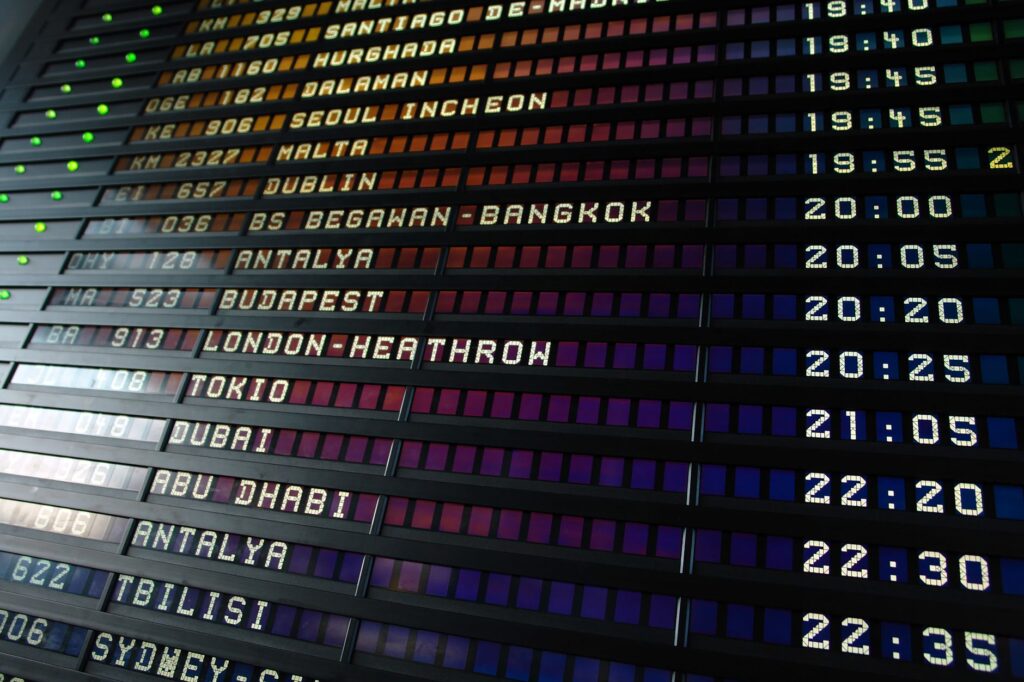
In modern aviation, punctuality is not an aesthetic luxury, but the most precise indicator of a nation’s economic structural health.
Practical guide
Navigating an air transport network in a state of congestion requires rigorous tactical planning and a deep understanding of one’s rights and available technological tools.
- Real-time monitoring: Use independent flight tracking applications like FlightAware or Flightradar24 instead of relying solely on airline notifications, which often lag in updating flight statuses.
- Prioritize direct flights: Whenever your itinerary allows, choose non-stop routes. Each added connection triples the probability of missing a connection due to cascading delays.
- Schedule flexibility: Book flights corresponding to the earliest morning departure window. These services are statistically the most punctual, as aircraft and crews are already stationed at the departure airport overnight.
- Know your regulatory rights: Thoroughly review the airline’s policies and the U.S. Department of Transportation (DOT) guidelines regarding mandatory cash refunds when a flight is canceled or the itinerary is substantially modified.
- Strategic hand luggage: Travel exclusively with carry-on luggage whenever possible. Avoiding checked bags eliminates the risk of your luggage getting trapped in the operational limbo of a collapsed hub.
- Specific travel insurance: Purchase policies explicitly covering travel disruptions, unexpected lodging expenses, and missed connections caused by air traffic congestion.
Toward a New Mobility Paradigm
The definitive overcoming of these recurring crises will not stem from operational band-aids or appeals to user patience, but from a profound transformation of the transport model. The integration of artificial intelligence systems for dynamic air traffic management, the decentralization of hubs by empowering regional airports, and stricter regulation on slot hoarding are indispensable steps on the national agenda. Rethinking future mobility means understanding that speed and efficiency must not be built upon the precarization of workers or the extreme vulnerability of critical infrastructure. Only through resolute investment and long-term vision will it be possible to restore serenity to the skies and ensure that flying remains, in proper measure, a safe, predictable, and deeply human experience.