

The Everyday Vulnerability Facing Global Unpredictability
We inhabit an era where global mobility and adventure travel continually lead us into remote, breathtaking yet inherently unpredictable corners of the earth. From the volcanic trails of the East African Rift to coastal regions exposed to extreme weather phenomena, the contemporary traveler faces risks that transcend simple logistical inconvenience. In these scenarios, the boundary between a challenging anecdote and a humanitarian tragedy narrows down to minutes, or even seconds. Traditional rescue infrastructure—frequently overburdened, geographically constrained, or devastated by the catastrophic event itself—rarely arrives immediately. This is where the technology we carry in our pockets ceases to be a mere entertainment hub and transforms into an invisible lifeline.
For years, the conversation surrounding travel safety has centered on costly medical insurance, physical first-aid kits, and outdated paper maps. However, the true silent revolution has taken place inside our mobile devices. Both Apple and Google have quietly integrated powerful emergency kits into iOS and Android that operate without complex configurations, often escaping the notice of the average user until the exact moment a crisis erupts. Understanding these functions before embarking on a journey through vulnerable regions is no longer an advanced technical option, but a fundamental civic and personal responsibility.
The Invisible Architecture of Mobile Survival
When a natural disaster strikes—whether an earthquake, flash flood, or wildfire—the first casualty is usually conventional telecommunications infrastructure. Cellular towers collapse under the weight of network congestion or suffer direct physical damage, leaving millions isolated. To counter this critical vulnerability, software engineers have developed decentralized communication protocols that harness short-range radiofrequency technologies and low-earth-orbit satellite connectivity. These tools allow devices to communicate with one another or dispatch emergency distress data bursts when public networks have completely ceased to exist.

The most effective emergency technology is neither the loudest nor the most complex, but the one that operates autonomously when the user is under extreme stress and disorientation.
The core of this architecture lies in the deep integration between operating systems and device accelerometers. Modern algorithms are capable of detecting movement patterns consistent with violent impacts, significant falls from heights, or the abrupt decelerations typical of vehicular accidents or structural collapses. Upon identifying these patterns, the device initiates a verification protocol through vibrations and sharp acoustic alerts. If the user fails to respond to cancel the signal, the device assumes an incapacitation situation and automatically triggers preconfigured distress channels.
Critical Access: Configuring the Device Before Departure
The gravest mistake made by modern travelers is assuming that emergency functions come optimized out of the box. In reality, most default factory privacy and power-saving protocols can severely limit the effectiveness of these tools at the worst possible moment. For instance, allowing precise location sharing to occur only while an application is actively open is an excellent power-preservation measure under normal circumstances, but it can prove fatal if a user becomes unconscious following a disaster and rescue services attempt to triangulate their exact position.
Preparation begins in the tranquility of home, meticulously reviewing security menus in iOS and Android. It is imperative to register essential medical information and emergency contacts so they remain accessible directly from the lock screen, allowing any bystander or paramedic to read blood types, severe allergies, or chronic conditions without needing to unlock the phone. Likewise, local and regional government emergency alerts must be enabled to ensure the device receives official immediate evacuation warnings before traditional mobile data lines become completely overwhelmed.

Satellite Communication and Mesh Networks in Isolated Terrain
For adventurous spirits exploring remote areas of Africa or any isolated geography where cellular coverage is a mirage, the recent inclusion of direct satellite connectivity in consumer smartphones marks a historic turning point. Renting costly standalone satellite communication devices is no longer strictly necessary; the ordinary phone used for daily photography now features antennas capable of pointing toward low-earth-orbit constellations to transmit compressed text messages and precise GPS coordinates to rescue coordination centers.
In addition to satellite routing, mesh networking protocols allow nearby phones to form ad-hoc networks utilizing low-energy Bluetooth and Wi-Fi Direct. If a group of travelers becomes trapped in a zone without coverage, a single device managing to register a faint signal can relay distress information across the phones of other group members until an outward-facing connection point is found. This decentralized digital relay capacity completely redefines survival strategies during group expeditions and humanitarian missions across the African continent.
Power Protocols and Energy Survival
A sophisticated emergency tool is entirely useless if the device battery dies at the culminating moment. In crisis situations, anxiety frequently drives users to constantly turn the screen on and off, check social media, or make nonessential calls, accelerating the depletion of the lithium-ion battery. For this reason, understanding and immediately activating extreme power-saving modes is a survival skill just as vital as knowing how to start a campfire or purify water.
- Disable all nonessential connections, keeping only GPS and active emergency services running.
- Reduce screen brightness to the absolute minimum and set the screen lock timeout to the shortest possible values.
- Avoid using video cameras and high-intensity flashlights unless strictly necessary for visual signaling to rescue teams.
- Keep the device close to the body in extremely cold climates to prevent temporary degradation of battery capacity caused by low temperatures.
The Human Factor and Information Fatigue in Emergencies
Mobile technology in crisis situations does not merely manage technical data; it also interacts directly with the fragile human psyche. During a natural disaster or civil unrest event, information overload and constant notifications of tragic alerts can plunge the user into panic paralysis or cognitive fatigue. Modern operating systems have begun incorporating intelligent filters that silence unnecessary media noise and prioritize only direct messages from family members and official civil safety guidelines.
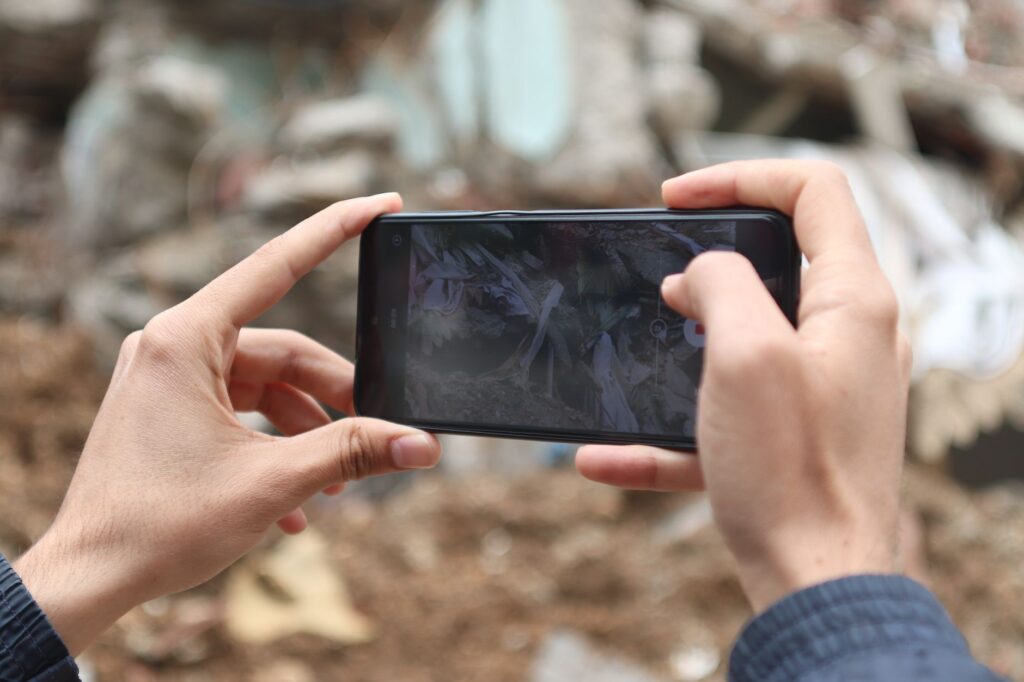
True technological mastery in a crisis lies in knowing how to disconnect from the tide of digital chaos to concentrate exclusively on vital channels of survival and evacuation.
It is vital to mentally train family members and travel companions on how to interact with the phone during an emergency. Touchscreens may fail if wet from rain or covered in dust and debris, meaning that knowing physical shortcuts—such as side-button combinations to trigger silent distress calls—ensures the action executes reflexively, even when hands tremble from adrenaline or cold.
Practical guide
The following operational framework outlines the essential steps required to optimize the emergency capabilities of any mobile device before embarking on travel to high-vulnerability regions or remote areas.
Device Security Audit
Perform a thorough review of location permissions, ensuring that critical applications have permanent access while all others remain restricted to conserve battery power and protect privacy.

Lock Screen Medical Data Setup
Complete the emergency profile with precise data regarding medical conditions, current medications, allergies, and direct contact numbers for family members who speak your language.
Local Disaster Alerts Activation
Verify within system notification settings that extreme emergency government alerts and public safety notices are permanently enabled.
Quick-Call Function Testing
Memorize and practice the physical button sequence necessary to trigger an emergency call without looking at the screen, simulating low-visibility scenarios.

Survival Battery Management
Identify the exact location of the extreme power mode in your quick settings menu so it can be activated in under three seconds during a prolonged blackout.
The Digital Haven in the Storm
When the dust finally settles after a catastrophe and nature reveals its most implacable face, the silence enveloping the landscape is often deafening. In that moment of profound vulnerability, where uncertainty threatens to overwhelm the human spirit, the small rectangle of glass and metal in our hand acquires an almost sacred significance. It is not a cold piece of engineering destined for consumption or the ephemeral record of digital vanity, but an invisible bridge reaching toward hope, community, and rescue. Preparing this device with awareness and respect is, ultimately, an act of deep appreciation for one’s own life and the lives of those walking alongside us.
Source in EN: Based on the technical reportage by The New York Times titled Get to Know Your Phone’s Built-In Emergency Kit.