
Crossing Australia from east to west is not merely a journey; it is an exercise in understanding planetary scale. The Indian Pacific, the rail service connecting the waters of the Pacific in Sydney with the Indian Ocean in Perth, represents one of the 20th century’s greatest feats of logistical engineering. Spanning 4,352 kilometers, this line does not just traverse three states and cross three time zones; it defies one of the most hostile and desolate environments on Earth: the Nullarbor Plain. This report analyzes the infrastructure that allows a convoy nearly a kilometer long to maintain the connectivity of an entire continent, operating as a vital land bridge for trade and passenger transport.
The very existence of this track is a testament to political will and technical expertise. Before its unification, rail transport in Australia was a chaos of varying gauges that forced passengers and freight into constant transfers. Today, the Indian Pacific is the symbol of standardization and efficiency, a corridor that allows industrial supplies and high-end tourism to flow uninterrupted through the Red Centre. The logistics of maintaining a rail operation in a desert where temperatures can exceed 50 degrees Celsius requires planning that borders on the military, where every drop of water and every liter of fuel must be managed with absolute precision.
The Dream of Federation: Uniting Two Oceans by Rail
The genesis of the Indian Pacific is intrinsically linked to the birth of Australia as a nation. In the late 19th century, Western Australia set an non-negotiable condition for joining the Federation: the construction of a transcontinental railway line connecting it with the eastern states. Until then, Perth was more isolated from Sydney than from Singapore, relying exclusively on slow and dangerous sea routes. The promise materialized in the Trans-Australian Railway Act of 1911, beginning a constructive epic that would last five years under extreme conditions.
Engineers of the era faced a territory lacking surface water sources. To feed the original steam locomotives, a network of artesian wells had to be dug and massive dams built—a water infrastructure that still defines the landscape of remote stations today. Construction advanced from Kalgoorlie in the west and Port Augusta in the east, meeting in the middle of the desert in 1917. However, it wasn’t until 1970 that full gauge unification (1,435 mm) was completed, allowing the first Indian Pacific to make the full journey without passengers having to change trains.
«The Indian Pacific is not just a line on a map; it is the umbilical cord that transformed an archipelago of isolated colonies into a cohesive continental nation.»
Conquering the Nullarbor: The World’s Longest Straight Track
The most iconic challenge of this route is the Nullarbor Plain, a name derived from the Latin nullus arbor (no trees). It is the world’s largest exposure of limestone, a prehistoric seabed covering 200,000 square kilometers. Here, railway engineering reached a milestone of geometric purity: the longest straight stretch of track on the planet, spanning 478 kilometers without a single curve. Maintaining track alignment in a terrain that expands and contracts with extreme thermal fluctuations requires constant ballast bed maintenance and the use of high-strength welded rails.

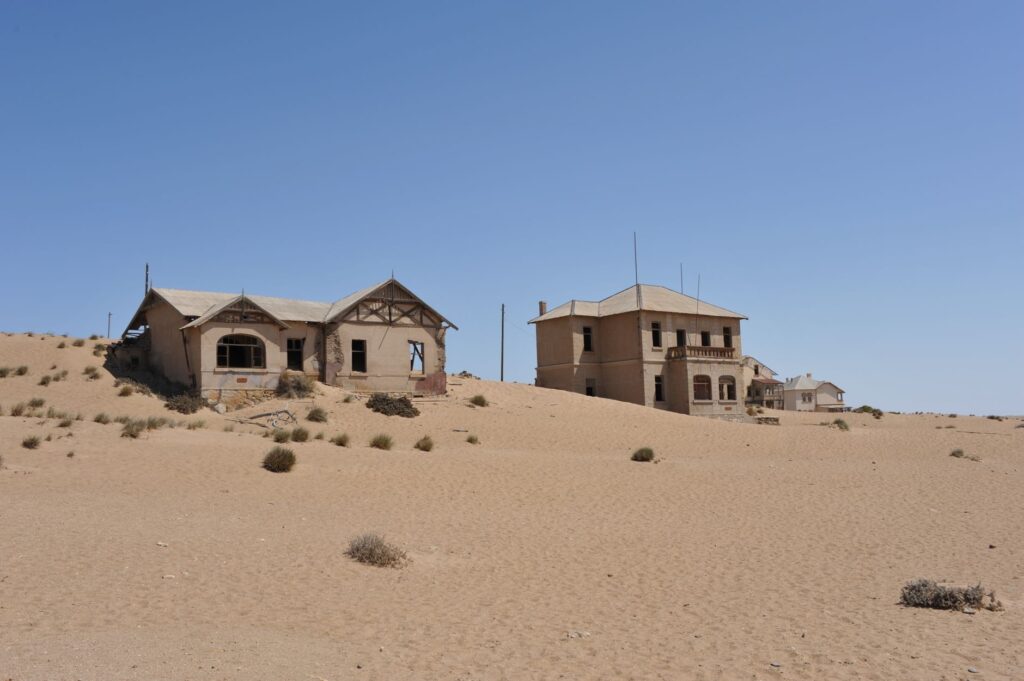
Maintenance logistics on the Nullarbor are a challenge of human geography. Small settlements like Cook, once thriving rail hubs with schools and hospitals, have been reduced to technical service stations. Today, Cook is a ghost town with a permanent population counted on one hand, whose sole function is to replenish the train’s water and serve as a crew change point. The survival of this node is critical; without the ability to refuel in the heart of the desert, the transcontinental crossing would be technically unfeasible for the heavy freight convoys that share the track with the passenger service.
Engineering for Endurance: Rolling Stock and Traction
Moving a train that can weigh up to 3,000 tons (in its freight configuration) across varying gradients and extreme climates requires phenomenal tractive power. The Indian Pacific typically utilizes NR class locomotives, diesel-electric workhorses designed specifically for Australian conditions. These machines are equipped with reinforced air filtration systems to prevent fine desert dust from penetrating engines and redundant cooling systems to withstand the radiant heat from the tracks.
The design of the carriages is also a piece of engineering in its own right. The S-series cars, originally built in stainless steel by Comeng, have undergone multiple refurbishments to integrate pneumatic suspension systems that absorb irregularities from a track crossing geologically unstable ground. Onboard energy management is another key factor: industrial generators located in specific power vans supply electricity for high-end air conditioning, kitchens, and water desalination systems, creating a bubble of civilization in the middle of absolute nothingness.

Intermodal Nodes and Synergy with Maritime Transport
While the Indian Pacific is famous for its passenger service, its true importance to the Australian economy lies in its role as a freight corridor. The line connects the country’s major ports, creating an intermodal network that allows containers arriving at the Port of Fremantle (Perth) to reach eastern coast markets in less than three days. This system drastically reduces reliance on road transport, which is more expensive and has a significantly higher carbon footprint over such long distances.
At the Sydney and Perth terminals, the integration of high-speed gantry cranes and automated inventory management systems allows the exchange between ship and train to be almost instantaneous. This logistical efficiency is what keeps Australia’s mining and agricultural industries competitive, allowing products like wheat from the western plains or iron from the interior to reach global markets with optimized transport costs. The railway acts as an economic multiplier, transforming hostile geography into a logistical advantage.
«The true feat is not just the speed of the journey, but the capacity to sustain a constant flow of supplies across an absolute geographical vacuum.»
Life on the Iron Frontier: The Human Element and Safety
Operating the Indian Pacific requires a highly specialized human team living in a constant cycle of rotation. Drivers and onboard staff must be prepared to manage emergencies in places where the nearest medical assistance may be hundreds of kilometers away. Railway safety relies on satellite communication systems and real-time monitoring that tracks the train’s position and track status, detecting potential heat-induced buckling before the convoy reaches the critical point.
The human factor also extends to the Indigenous communities that have inhabited these lands for millennia. Track management includes protocols for respecting sacred sites and collaborating with traditional owners to ensure infrastructure does not interfere with cultural routes. This social sensitivity is an integral part of modern logistics in Australia, where respect for the land is as crucial as the integrity of the rails.
Ecological Impact and the Future of Green Traction
In a world seeking decarbonization, the Indian Pacific faces the challenge of its reliance on fossil fuels. Although rail is inherently more efficient than trucking or aviation, the vast distances and lack of electrical infrastructure in the desert make the transition difficult. However, trials are already underway with hybrid locomotives and the use of biofuels derived from local crops. The goal is to turn this corridor into an example of large-scale sustainable transport.
In addition to traction, onboard waste management is a model of circular economy. Since the train cannot discharge waste in the desert, it features compaction and greywater treatment systems that are emptied and processed at major terminals. The commitment to the environment is not just ethical, but operational: any spill in the fragile Nullarbor ecosystem would have devastating legal and environmental consequences.
Practical Guide
- Trip Planning: The full journey takes 4 days and 3 nights. It is essential to book at least six months in advance, especially for Platinum and Gold cabins, which often sell out quickly due to high international demand.
- Best Time to Travel: From April to October. During these months, desert temperatures are more moderate, avoiding the extreme summer heat that can cause operational delays due to track expansion.
- Luggage Logistics: Cabin space is limited. It is recommended to check in heavy luggage and carry only a small bag with essentials for the three days on board.
- Connectivity: Mobile coverage is non-existent across much of the Nullarbor. The train offers basic communication services, but one should travel with the mindset of near-total digital disconnection.
- Technical Stops and Excursions: The train stops in Broken Hill, Adelaide, Cook, and Kalgoorlie. Each offers a different perspective on the logistics and history of the Australian outback.
As evening falls over the Nullarbor Plain, when the sun tints the oxidized earth purple and the tracks seem to merge with the horizon, the true essence of the Indian Pacific is understood. It is not just a steel machine moving through space; it is a triumph of human ingenuity over nature’s indifference. In the silence of the desert, the rhythmic clatter of the train sounds like the heartbeat of a continent that, thanks to these rails, has finally managed to find itself.