


Introduction to Vietnam’s Railway Artery
The territory of Vietnam extends across more than sixteen hundred kilometers of eastern coastline on the Indochinese peninsula, outlining an S-shaped silhouette that has historically posed formidable challenges for territorial connectivity and national cohesion. Within this geographical context of central constriction, land transport infrastructure has traditionally served as the backbone of the country’s economic and demographic development. The Trans-Indochinese Railway, locally known as the Reunification Express, represents the most ambitious civil engineering project executed during the French colonial era in Southeast Asia and the logistical lifeline that survived decades of warfare to physically unify a fragmented nation. The railway route linking the capital Hanoi with Ho Chi Minh City—formerly Saigon—is not merely a passenger and freight transport medium; it is a three-dimensional historical document sculpted in steel, stone, and concrete that traverses the sharpest contrasts of Vietnamese geography.
From the perspective of international railway engineering, the uniqueness of this line lies in its exact one-meter meter gauge, a standard adopted in the late nineteenth century by the colonial administration to reduce construction costs and negotiate with greater flexibility the tight turning radii demanded by the rugged topography of the terrain. Along its route, the track penetrates alluvial river valleys, scales mountain passes lashed by tropical monsoons, and skirts limestone cliffs where the waves of the South China Sea crash directly against the railway embankments. This report examines with technical, historical, and human rigor the inner workings of current railway operations, the state of its century-old infrastructure, and the logistical challenges facing one of the most fascinating and complex rail routes on the Asian continent.

Colonial Origins and the Challenge of Uniting the Coastal Strip
The genesis of the Trans-Indochinese Railway dates back to the late nineteenth century, when the Governor-General of French Indochina, Paul Doumer, conceived a master infrastructure plan intended to extract the colony’s natural resources—rubber, coal, and rice—and project French military power rapidly along the narrow coastal strip. Construction works began in a fragmented manner in the 1880s, but it was not until 1936 that the final missing section was completed, allowing a railway convoy for the first time in history to complete the entire journey between Hanoi and Saigon. This milestone required mobilizing tens of thousands of local workers under extreme hardship, facing tropical diseases, swampy terrain, and endemic resistance from local populations.
French engineers had to design extraordinary technical solutions to overcome insurmountable natural barriers by constructing numerous tunnels excavated in living rock and lattice metal bridges crossing turbulent rivers subject to severe seasonal floods. The railway route was conceived as a strategic corridor, but its topographic alignment was constrained by the narrow width of Vietnamese territory in its central zone, where the Truong Son mountain range—the Annamite Range—approaches the coastline dangerously close. This proximity forced engineers to route the line wedged between mountain buttresses and the coast, exposing it permanently to marine erosion and the instability of clay slopes during torrential rainy seasons.
The Orographic Engineering of the Hai Van Pass and Coastal Viaducts
One of the most critical and technically remarkable sections of the Trans-Indochinese line is located at the Hai Van Pass, the formidable mountain barrier separating Thua Thien Hue province and the city of Da Nang. In this sector, historically known as the Pass of the Clouds, the railway ascends in a serpentine fashion through steep gradients and spiral tunnels that challenge the adhesion limits of traditional diesel locomotives. Overcoming this geographical obstacle required excavating multiple short tunnels and stabilizing unstable slopes using complex cyclopean masonry retaining walls that still support the onslaught of monsoon storms today.

The Reunification railway is not merely a transport corridor; it is a monument of metric precision sculpted among cliffs where nineteenth-century engineering permanently defies the fury of the South China Sea.
Further south, the track descends toward the coastal plains of the central region, where engineers had to erect long viaducts across estuaries and marshes. These metal structures, many of them repaired and rebuilt on multiple occasions following the bombings suffered during the Vietnam War, currently require constant structural maintenance due to the aggressive saline corrosion of the marine environment. Technical bridge inspections and the replacement of tropical timber sleepers with prestressed concrete constitute priority tasks for the state-owned enterprise Vietnam Railways, aimed at raising safety coefficients and allowing higher axle loads on freight trains.
Post-War Reconstruction and the Resilience of the Meter-Gauge System
The impact of the Vietnam War on railway infrastructure was devastating. Between 1965 and 1972, systematic bombing virtually destroyed all major bridges, stations, maintenance workshops, and rolling stock, dividing the network into numerous disconnected segments. However, the repair capacity and resilience of Vietnamese sappers and workers became a subject of logistical study: as soon as a bridge was destroyed by foreign aviation, specialized brigades proceeded to rebuild it provisionally using timber structures or prefabricated steel sections in a matter of hours.

Following the fall of Saigon in April 1975 and the definitive reunification of the country, the central government prioritized the comprehensive rehabilitation of the line as a tangible symbol of national unity. In record time of just over a year, mobilizing voluntary labor and limited technical resources, full train traffic resumed across the 1,726 kilometers of track. Nevertheless, subsequent economic isolation and chronic underinvestment prevented the technological modernization of the alignment, freezing the system in mid-twentieth-century standards and turning the Trans-Indochinese line into a predominantly artisanal infrastructure in its conservation tasks.
Contemporary Logistics, Freight Challenges, and Intermodal Competition
In the twenty-first century, the Trans-Indochinese Railway faces severe structural contradictions derived from its own nineteenth-century design. While the Hanoi government promotes ambitious plans to build a new high-speed rail line with standard international gauge—dedicated exclusively to passengers and capable of speeds exceeding three hundred kilometers per hour—the current meter-gauge line continues to play an irreplaceable role in heavy freight transport and economical medium- and long-distance passenger travel.
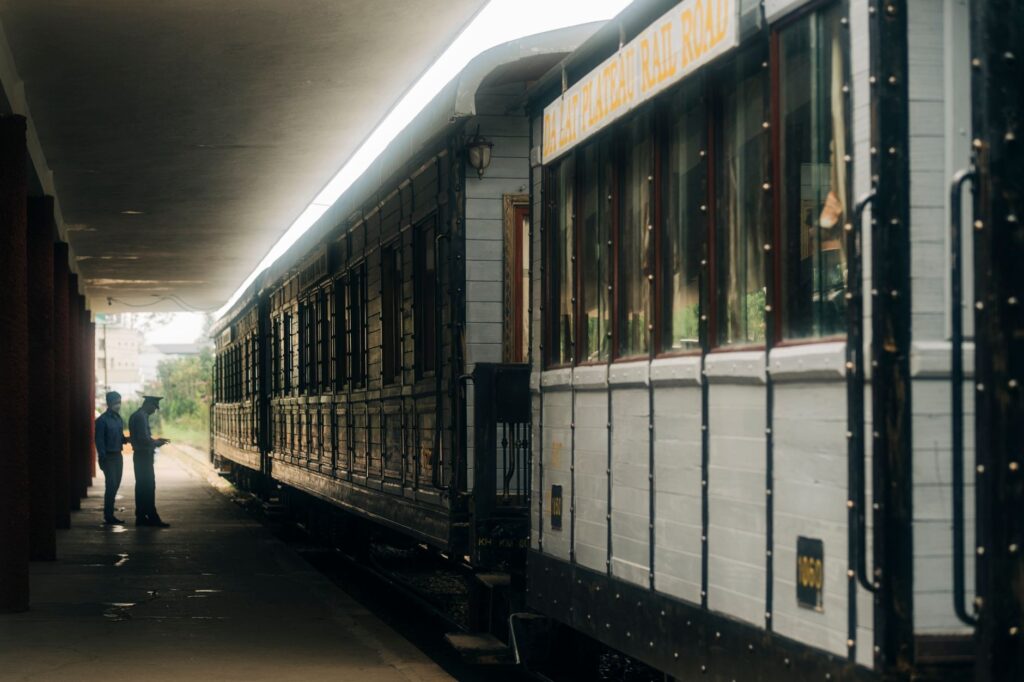
The average commercial speed of freight trains on the Trans-Indochinese route hovers around just fifty kilometers per hour, penalized by limited turning radii, unmanaged level crossings without automatic gates, and the obsolescence of the locomotive fleet. Despite these operational constraints, the railway offers an unbeatable comparative advantage over the chronic congestion and high accident rate of National Highway 1A. Logistics companies use container trains to connect southern ports with northern industrial hubs, optimizing operating costs and reducing the carbon footprint compared to mass road transport by truck.
The Human Experience Onboard: The Leisurely Rhythm of the Transcontinental Journey
For the contemporary traveler, traversing the Trans-Indochinese line constitutes an anthropological and sensorial immersion into Vietnam’s daily life. Unlike the hyper-modern rail networks of Japan or China, the journey on the Reunification Express unfolds at a speed that allows observers to witness the gradual transition from the agrarian landscapes of the Red River Delta to the bustling urban outskirts of the Mekong Delta. Sleeper cars, classified into four-berth compartments with wood paneling or open soft sleeper bunks, act as social microcosms where entire families, local merchants, and international travelers share endless hours of transit.
Stops at intermediate stations, brief yet intense, reveal the economic vitality of local communities dependent on the train’s passage. Street vendors crowd near windows offering regional culinary specialties such as steaming banh bao, fresh bamboo shoots, and Vietnamese drip coffee with ice and condensed milk. This constant flow of human interaction transforms the rail journey into a space of coexistence where the regional boundaries of a unified yet geographically diverse country blur to the monotonous rhythm of clicking rail joints.

Traveling on the Trans-Indochinese line is equivalent to deciphering Vietnam’s living memory through the windows of a train that withstands the passage of time with the patience of veterans.
Practical guide
Planning a journey along the Trans-Indochinese Railway requires understanding the operational particulars of the Vietnamese rail network and anticipating the logistical limitations of the system.
- Tickets and reservations: Tickets for major trains, such as the SE1 through SE8 express convoys, can be purchased via the official Vietnam Railways website or through authorized local agencies. Booking at least two weeks in advance is recommended, especially during national holidays such as Tet (Lunar New Year).
- Service classes: For long-distance journeys, soft sleeper berths in four-bed compartments (Soft Sleeper) are the most suitable option. Hard seat classes should be avoided for journeys exceeding four hours due to ergonomic discomfort.
- Major stations: The main hubs of the network are Hanoi Station (Ga Ha Noi) and Saigon Station in Ho Chi Minh City (Ga Sai Gon), both equipped with basic cloakroom facilities, ticket counters, and waiting areas.
- Luggage and security: Although onboard crime rates are low, keeping valuables under direct supervision and securing large suitcases in the spaces designated beneath lower bunks is strongly advised.
- Catering: Trains feature a basic dining car with simple hot dishes, but stocking up on bottled water and fresh provisions before initiating long journeys between major cities is recommended.
Visual Epilogue: Sunset Over the Delta Paddy Fields
When the railway convoy leaves the final mountain buttresses of the central cordillera and enters the alluvial expanse of the south, dusk light dyes the flooded rice fields a deep amber tone reflected in mirror-like waters where farmers still work hunched beneath conical hats. In that moment of visual silence, the metallic clatter of the train seems to merge with the millenary heartbeat of a land that has transformed endurance into its primary hallmark. The silhouettes of palm trees cut against a blazing horizon, and the dim lights of the carriages begin to flicker, casting warm glows on century-old ballast. The Trans-Indochinese line continues its inexorable march southward, tirelessly fulfilling its historical mandate to keep united, rail by rail, the complex and vibrant soul of Vietnam.


