
At the geographic and historical heart of Puebla de los Ángeles, the morning air retains the dense scent of damp feldspar, diluted cobalt oxide, and the holm oak wood that has fueled the kilns for centuries. Unlike other pottery centers around the world that have sacrificed the slowness of their processes in favor of industrial mass production, this Mexican valley maintains an unbroken liturgy. Here, clay is not simply a material resource; it is a living archive that stores the aesthetic tensions between pre-Hispanic earthenware, the Moorish technique inherited from Talavera de la Reina, and the contemporary reinterpretation that today redefines the landscape of international design.
The revitalization process experienced by the Pueblan workshops does not stem from commercial nostalgia, but from a profound need for material auditing. Traditional workshops, collectively recognized by international heritage protection regulations, face the challenge of keeping original chemical formulas alive while engaging in dialogue with architects and industrial designers. This confluence generates a fascinating creative tension where the millennial geometry of plates, jars, and tiles is deliberately fractured to make way for new volumetric forms, rough textures, and glazes stripped of traditional industrial sheen, opting instead for matte finishes with a profound organic tactile quality.
The Geography of Clay: Geology and Raw Material Selection
The birth of an authentic Talavera piece begins kilometers away from the kilns, in the clay deposits of the Pueblan region. Master potters personally select two types of earth: black clay, which provides plasticity and structural strength, and white clay, responsible for the fineness of the ceramic body. This mineral marriage requires a mathematical balance that only accumulated experience over generations can calibrate with precision. Any deviation in the percentage of silica or alumina causes the piece to collapse during high-temperature firings.
Once extracted, the clay undergoes a long purification cycle known as maturation. In the workshop courtyards, the earth is submerged in large settling pools where water separates organic impurities and coarse particles. This natural filtering process can extend for weeks. Observing the water evaporate slowly under the Puebla sun is to witness the beginning of an alchemical transformation where raw matter becomes a malleable canvas, ready to receive the artisan’s imprint before any design intervention.
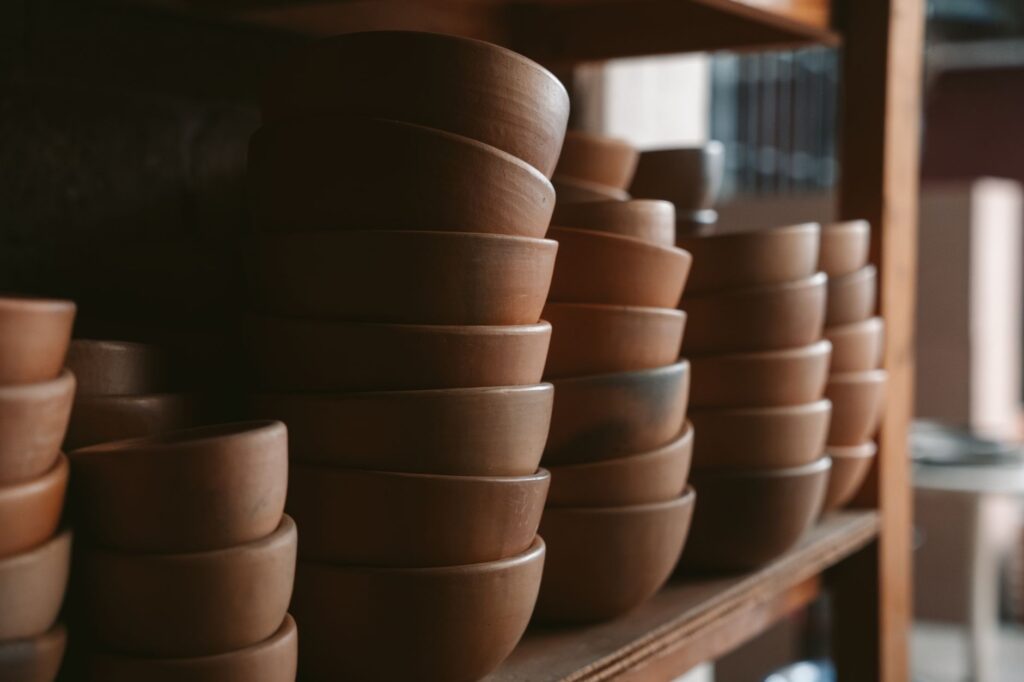
The purity of the materials is not an aesthetic caprice, but an indispensable technical requirement to pass the rigorous regulations of designation of origin. The mineral pigments used for decoration—cobalt blue, manganese oxide black, copper green, antimony yellow, and iron oxide red—must be natural and pre-calcined. If synthetic colorants were used, the piece would lose the unique chromatic vibration that characterizes this ceramics, an optical phenomenon produced by the way stanniferous glazes refract natural light over the white surface.
The Gesture of the Wheel and the Discipline of the Mold
Inside the workshop, the rhythmic sound of the potter’s wheel sets the pace of the working days. The throwers, with hands hardened by decades of contact with clay slip, raise symmetrical pieces with an economy of movement bordering on choreography. Each vase, jar, or platter is born from a single mass centered with centrifugal force. There are neither printed rules nor digital compasses in this phase; the height and thickness of the walls are measured exclusively with the tactile sensitivity of fingertips, capable of detecting millimeter variations in clay density.
However, the formal complexity of contemporary Talavera has forced the hybridization of the manual wheel with the use of high-absorption plaster molds. This technique, far from dehumanizing the process, allows for the reproduction of complex geometries conceived by contemporary designers seeking to break away from traditional rotational symmetry. Asymmetrical blocks, modular pieces for wall cladding, and sculptural volumes are gestated in these molds, where the plaster draws moisture out of the ceramic paste uniformly, consolidating a perfectly smooth exterior skin before manual demolding.
blockquote>Clay does not obey the haste of modern man; it demands a resting period as rigorous as its own firing. Forcing the drying process is destroying the memory of the material.
After demolding, the raw pieces must go through a critical phase known as air-drying. This slow drying process, carried out in rooms protected from drafts and direct sunlight, prevents the appearance of micro-fissures that would cause the ceramics to shatter inside the kiln. Artisans walk along the wooden shelves tapping the pieces with their knuckles, a millenary acoustic diagnosis: a dull sound indicates internal moisture, while a clearer, more resonant tone confirms that the object is ready for the first bisque firing.
The Alchemy of Stanniferous Glaze and the White Secret
The most notable distinguishing feature of authentic Talavera is its vitreous finish, a white and opaque glaze historically known as stanniferous glaze. This dense layer, composed of a precise mixture of silica, fluxes, and tin oxide, is applied directly over the bisque-fired piece without prior glazing of the bisqued body. The porous surface absorbs the liquid instantly, turning the act of glazing into an irreversible trial by fire: once the brush or hand touches the piece, any miscalculation in pressure or the amount of deposited glaze will be permanently etched after passing through the kiln for over ten hours at temperatures exceeding one thousand degrees.
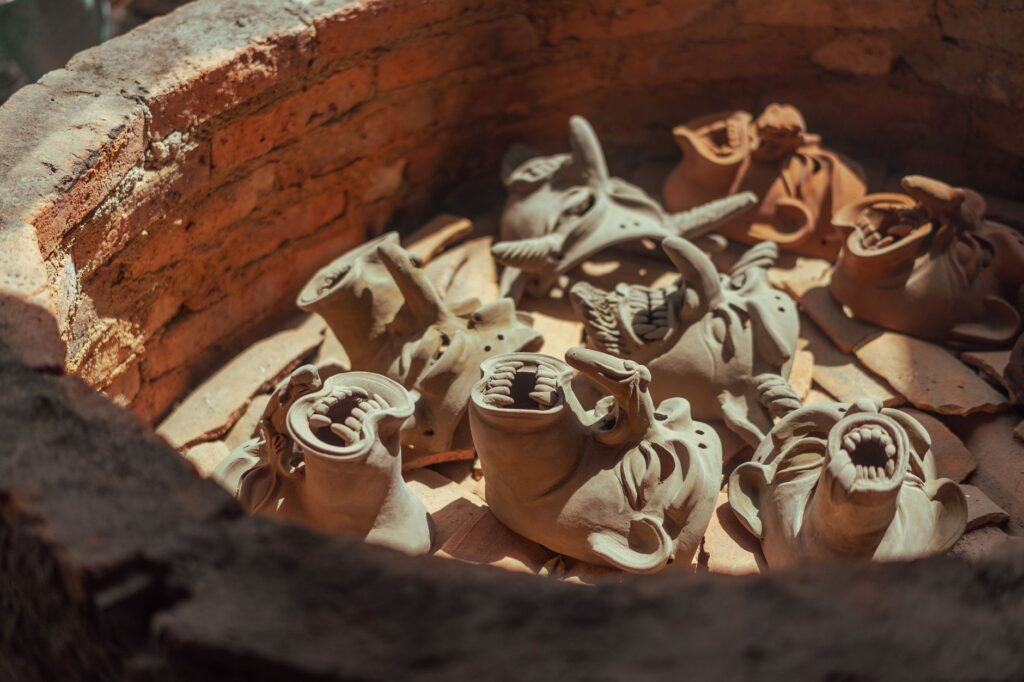
The formulation of the white glaze has been zealously guarded by traditional workshops, transmitted from masters to apprentices like a family treasure. Today, laboratories integrated into design studios analyze these traditional recipes through spectrometry to understand the physicochemical interaction between tin and metallic oxides. Far from seeking industrial uniformity, the current goal is to rescue the subtle roughness and minor optical imperfections—known in the craft as fire borders—that prove the artisanal nature of each surface.
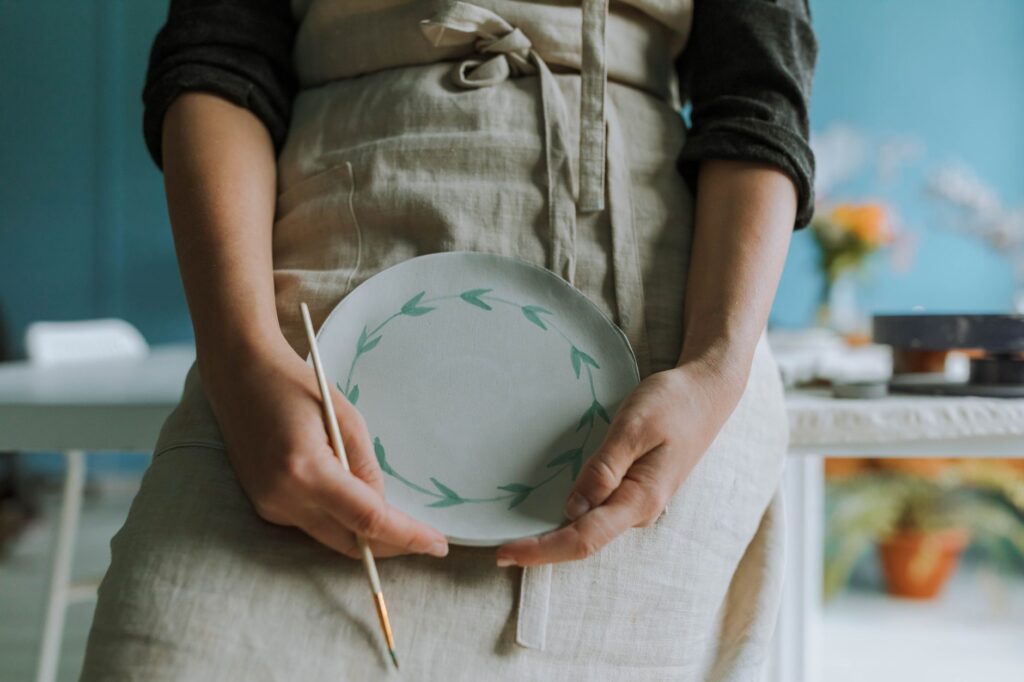
On this white base, still in a porous and powdery state, painters execute freehand decoration. There is no room for erasers or hesitation. The marten hair brush, loaded with pigment diluted in water, glides firm strokes that immediately merge with the raw glaze. The required skill is monumental: the painter must calculate how the pigment will expand slightly upon absorption, anticipating the final result that only the kiln will reveal after reaching temperatures above one thousand degrees.
The Dialogue with the Avant-Garde: Architecture and Industrial Design
In recent years, Puebla’s pottery ecosystem has ceased to be an exclusive preserve of traditional tableware to become a laboratory for architectural experimentation. Internationally renowned contemporary designers have established temporary residencies in local workshops to develop ceramic lattices, facade clenching, and urban furniture that reinterpret colonial tradition under brutalist and minimalist prisms. This synergy demonstrates that artisanal heritage is not an untouchable museum piece, but a dynamic platform for material innovation.
Collaboration projects usually begin with a radical exchange of knowledge. Architects contribute insights on spatial modulation, structural resistance, and large-scale thermal behavior, while master ceramists master the unpredictable behavior of fire and clay shrinkage. The result of this encounter is collections of large-format tiles where hand-sculpted relief plays with sunlight on the facades of public buildings and private residences, generating living facades that breathe and change hue throughout the day.
blockquote>True contemporary design in craftsmanship does not consist of inventing forms from scratch, but of listening to what the material has been trying to tell us for centuries through its limitations.
This crossroad has also transformed the design of everyday objects. Anthropomorphic vases, pendant lamps that filter light through clay lattices, and refined tea sets demonstrate that Talavera can inhabit cosmopolitan spaces without losing its vernacular identity. Specialized criticism has celebrated this evolution as an exemplary model of cultural sustainability, where the local economy is strengthened through the valuation of handmade work and the explicit rejection of planned obsolescence.
The Rhythm of Fire: High-Temperature Kilns and the Liturgy of Firing
The culmination of the entire process lies in the final firing, a ritual that tests the patience and accumulated knowledge of master kiln operators. Traditionally fueled by holm oak wood, many workshops have incorporated state-of-the-art gas kilns to ensure millimeter control of temperature curves, although the most purist workshops preserve at least one traditional structure for special pieces. The atmosphere inside the cooking chamber is a highly volatile environment where oxygen reduction can radically transform glaze colors.
Lighting the kiln is an event that gathers the entire workshop. The pieces are meticulously arranged on refractory shelves, separated by small clay supports to prevent them from adhering to each other during glaze fusion. Every cubic centimeter of the kiln must be utilized with geometric efficiency. Once the door is sealed with bricks and refractory mud, the thermal ascent begins. During the first few hours, heat must increase with extreme slowness to expel any residual trace of chemical moisture; a sudden temperature increase would turn the works into unusable fragments.
Upon reaching the maturation point—surpassing eleven hundred degrees Celsius—the interior of the kiln becomes an incandescent space where minerals reach their melting point and the glaze vitrifies completely. Cooling is another critical phase requiring entire days of waiting. Opening the kiln prematurely is a fatal error causing unwanted glaze crazing due to thermal shock. The moment of opening is always an act of suspense: the instant when light illuminates the freshly fired pieces and reveals whether the alchemy of fire has respected the promise of the original design.

Practical guide
How to get there: Puebla de los Ángeles is located approximately two hours by road from Mexico City. It is accessible via frequent buses from the TAPO Terminal or by private vehicle via Highway 150D.
When to visit: Spring (March to May) and autumn (October to November) offer optimal weather conditions to explore historic workshops without heavy summer rains.
Recommended workshop route: It is advisable to schedule guided tours in advance in the Barrio de la Luz and certified workshops in the metropolitan area, where the wheel-throwing and hand-painting process can be observed directly.
Authenticity regulations: Legitimate Talavera must feature designation of origin stamps engraved on the base, the artisan’s signature, and the registration number of the workshop authorized by the Regulatory Council.
Suggested accommodation: Puebla’s historic center houses boutique hotels located in restored viceregal mansions preserving central courtyards decorated with original 18th-century tiles.

Piece conservation: Contemporary high-temperature ceramic works are food-safe, although manual washing with soft sponges is recommended to preserve the integrity of stanniferous glazes.
Contextual readings: To delve deeper into the history of Pueblan pottery, consulting the archives of the Amparo Museum and specialized publications by the Institute of Aesthetic Research is recommended.
Epilogue in the Workshop: The Incalculable Footprint of Time
As evening falls in the pottery neighborhood, the bustle of industrial machinery gives way to a reverent silence. Deep within the workshop, a young apprentice painstakingly cleans the workbench, sweeping the feldspar dust that accumulates like fine white snow on the stone floor. On the wooden shelves, dozens of pieces fresh from the last firing cycle rest in twilight, faintly reflecting the last rays of sun filtering through the high windows. No piece is identical to another; in every imperfect curve and every stroke of cobalt blue beats the undeniable evidence of the human hand.
This persistence of the artisanal against the dictatorship of machine perfection constitutes the true legacy of Pueblan workshops. In a fast-paced world that consumes and discards objects with astonishing lightness, contemporary Talavera ceramics reminds us that the real value of an object lies in the time invested in its creation, the risk assumed before the fire, and the collective memory crystallized in every gram of clay. Here, the past is not a dusty monument contemplated from a distance, but a living tool with which the future continues to be modeled.