The Transformation of an Iron Artery in the Heart of Europe
The territory that defines the Ruhr Valley today, in the German federal state of North Rhine-Westphalia, was not always the green and cultural lung that modern travelers discover. For over a century and a half, this densely populated valley functioned as the energy and industrial engine of Central Europe. Coal and steel dictated the geological and social rhythm of cities like Essen, Dortmund, Duisburg, and Bochum. At the center of this colossal machinery was the railway, a dense network of freight and passenger tracks designed to move millions of tons of mineral and hundreds of thousands of workers toward the blast furnaces and coal mines. Today, the rail transport system connecting this vast conurbation has undergone a metamorphosis as radical as it is fascinating: traditional heavy freight trains have given way to high-frequency mobility linking industrial monuments converted into world heritage sites, metropolitan parks, and cutting-edge university campuses.
Approaching the Ruhr railway network today requires understanding that the journey is not merely a physical displacement between stations, but a voyage through industrial archaeology and Europe’s most ambitious urban ecological transition. Railway engineering in the region was originally structured under strictly utilitarian criteria, prioritizing efficiency in mineral extraction and transport above any aesthetic consideration. However, the decline of traditional mining in the late 20th century forced a complete rethinking of the vocation of these rail lines. The tracks that once transported black coal to steel mills now feed an integrated transport system where sustainability and landscape restoration are the true protagonists. This report examines the current infrastructure of the Ruhr Valley, its station architecture, regional connection logistics, and how the contemporary traveler can traverse this territory of contrasts without relying on private vehicles.

From Mine to Platform: The Logistical Evolution of the Regional Network
To understand how rail transport operates in the modern Ruhr, one must analyze the legacy of the German state railway and the private mining corporations that managed private branch lines. Unlike other European regions where the railway was designed as a centralizing axis toward a single capital, the Ruhr operates as a polycentric mesh. There is no single dominant city, but rather a constellation of interconnected urban centers housing over five million residents. Public transport in this area is governed by the Verkehrsverbund Rhein-Ruhr (VRR), one of the world’s largest integrated transport associations, coordinating regional trains, urban trams, buses, and commuter lines under a single tariff and operational umbrella.
The Ruhr’s railway stations act as authentic thermometers of local history. Many of them have been meticulously restored, respecting the exposed brick structures and wrought-iron beams of the Wilhelmine era or post-war reconstruction while equipping them with digital signaling systems and universal accessibility. In Duisburg, for instance, the railway complex functions as an intermodal logistics hub where ICE high-speed trains converge with cargo ships navigating the Rhine, as Duisburg hosts the world’s largest inland river port. Intermodality here is a daily reality allowing travelers to step off regional trains and immediately connect with a network of segregated cycle paths, known as the *Radbahn*, which run parallel to secondary railway lines, transforming industrial corridors into soft mobility axes.

The train in the Ruhr is not just a means of transport; it is the backbone uniting the memory of coal with the design of Europe’s future.
Iron Architecture and the Recovered Landscape
As the train advances between Essen and Gelsenkirchen, the outdoor scenery defies traditional expectations of the German countryside. There are no uninterrupted idyllic forests or alpine hills here, but rather a fascinating dialogue between 20th-century brutalist architecture, monumental steelworks, and a nature that has reclaimed the industrial space. The Duisburg-Nord Landscape Park (Landschaftspark Duisburg-Nord) is the most eloquent example of this symbiosis. Located next to an old steel plant designed by industrial architect Heinrich Metzendorf, this site is visited today via tram and bus connections departing from Duisburg Central Station.
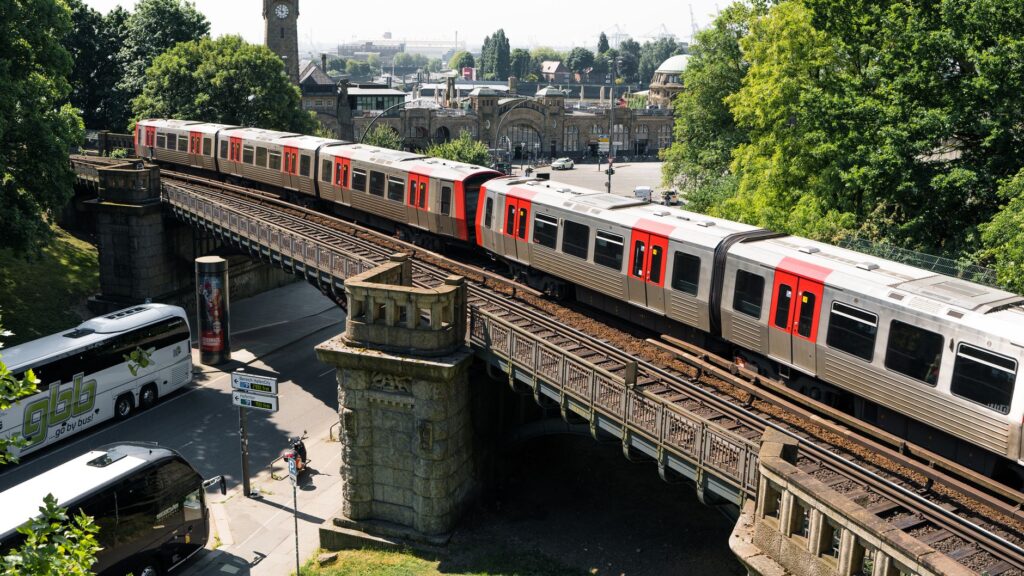
Commuter trains, known as S-Bahn, meander between slag heaps converted into forested hills and giant gasometers now housing immersive art exhibitions. The engineering of these railway layouts demonstrates millimeter precision. 19th-century engineers had to lay routes over terrain profoundly altered by mining subsidence, the sinking of the ground caused by underground tunnels. Track stability required complex technical solutions, such as installing constant leveling systems and flexible bridges capable of withstanding human-induced tectonic movements. Today, riding these trains allows observers to witness how civil engineering adapted to an artificial topography created by human labor.

The Cultural Renaissance on Rails: From Essen to Dortmund
The east-west axis connecting Essen and Dortmund via the main commuter rail line is an authentic showcase of the Ruhr’s cultural transformation. Essen, designated a European Capital of Culture, houses the Zeche Zollverein industrial complex, declared a UNESCO World Heritage Site. The former coal mine, considered the world’s most beautiful for its industrial Bauhaus architecture, is seamlessly connected by tram line 107, departing directly from Essen Central Station in a journey of barely fifteen minutes.
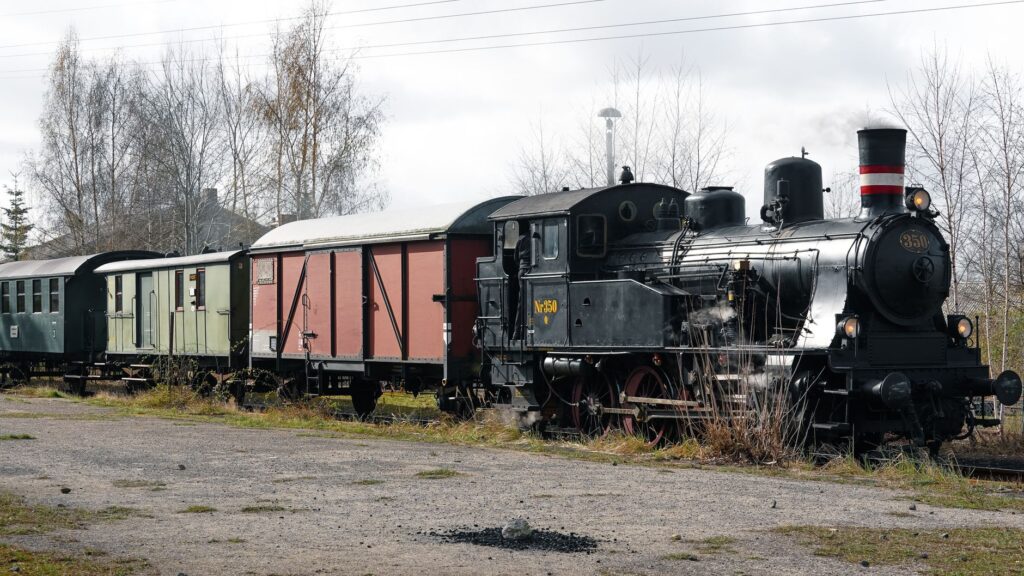
Continuing eastward, the train enters Bochum, where the Railway Museum (Eisenbahnmuseum Bochum-Dahlhausen) preserves the rolling memory of the region with an impressive collection of operational steam and diesel locomotives. This museum is not a static space; during weekends, it organizes special runs along secondary historic tracks, allowing rail enthusiasts to experience the sound and atmosphere of the golden age of coal. The sensory experience aboard these historic convoys contrasts with the silence and smoothness of modern commuter trains, underlining the magnitude of the technological leap achieved in just a few decades.
In Dortmund, the central railway terminal functions as a dynamic nerve center where routes toward the Sauerland and the Netherlands converge. From here, travelers easily access the U-Tower, a former brewery converted into a contemporary art center, using the light rail network (*Stadtbahn*). The region’s tariff integration ensures a single 24-hour ticket covers all these journeys, eliminating bureaucratic friction for international visitors.
Practical guide
- How to get there: The primary gateway to the Ruhr Valley is Düsseldorf Airport (DUS), located less than 30 minutes by regional train (RE) from Essen and Duisburg central stations. Comfortable access is also available via ICE high-speed trains from Frankfurt or Amsterdam.
- Internal transport network: The Ruhr Valley features an integrated system managed by Verkehrsverbund Rhein-Ruhr (VRR). Regional tickets under the Preisstufe D tariff allow unlimited use of S-Bahn trains, regional rail (RE/RB), light rails, trams, and buses throughout the conurbation.
- Recommended accommodation: Essen and Dortmund offer the best railway connectivity as bases. Hotels located within a ten-minute walk of the central stations (*Hauptbahnhof*) are recommended to optimize travel times.
- When to travel: Spring months (May to June) and early autumn (September to October) offer optimal temperatures for combining train journeys with walking and cycling tours through reclaimed industrial parks.
- Mobility tip: Download the official Deutsche Bahn app (DB Navigator) or the VRR app to check real-time connections, minor delays, and platform changes, which are frequent in a high-density rail network.
The Green Silence of the Emscher and the Horizon of the Future
When travelers leave major stations and head into minor branch lines bordering the Emscher River, the region’s pace noticeably slows down. The Emscher, converted during the industrial peak into an open industrial and urban wastewater channel, has undergone one of Europe’s most expensive and complex ecological restoration projects in recent decades. The de-canalization of the river and the creation of an underground purification system have revived its banks, where aquatic birds now nest and lush green corridors accompany the journeys of local trains.
From the carriage window, the contrast between the dark past of coal and the intense green of new metropolitan parks sums up the true essence of this territory. It is not about erasing the past, but integrating it into a narrative of resilience and adaptation. Industrial memory remains intact in the monumental steel structures cutting across the horizon at sunset, but the air breathed is clean, and the murmur of reborn waters accompanies the silent advance of the electric train. It is in this balance that the Ruhr Valley reveals its most mature and hospitable face, proving that transport infrastructure can be the definitive tool to heal and reinvent a region that once helped industrialize the continent.