The air at Wernigerode station smells of an era that modern Europe believes it has left far behind. It is not the aseptic scent of diesel or the imperceptible hum of overhead electric lines; it is a dense blend of damp coal, hot grease, and high-pressure water vapor that clings to your skin and clothes. As the heavy 99.72-series steam locomotive backs up slowly to couple with the red-painted wooden carriages, the platform vibrates with a heavy, almost organic cadence. We are in the heart of Saxony-Anhalt, at the gates of the Harz National Park, ready to embark on a journey that is as much a feat of mountain engineering as it is a living testament to twentieth-century political history.
The Harz Narrow-Gauge Railways (Harzer Schmalspurbahnen or HSB) is no weekend theme park or isolated tourist attraction. Spanning 140 kilometers, it is the longest narrow-gauge railway network in Europe maintaining a regular passenger service powered almost entirely by steam. Its survival is a miracle of local persistence and geopolitical coincidence. Traversing impenetrable forests, climbing impossible slopes without the aid of rack systems, and braving the icy winds of northern Germany, these trains connect isolated villages, carry thousands of hikers, and keep alive an industrial technology that demands monumental human effort for every mile of track.
The Steam Giant on the Mountain of Myth
The line’s most coveted destination is the Brocken, the highest peak in northern Germany at 1,141 meters. This mountain is no ordinary geographical landmark; it is the setting where Johann Wolfgang von Goethe staged Walpurgis Night in his masterpiece, Faust. For centuries, the Brocken has been wrapped in mysticism, perpetual mist, and the optical phenomenon known as the «Brocken spectre»—a giant shadow cast upon the clouds that once terrified local shepherds. The steam train tamed this summit in 1899, allowing Victorian-era travelers to ascend the roof of the Harz effortlessly.

Today’s ascent, however, is vastly different from that of a century ago. The track winds through three-percent gradients, meaning that for every hundred meters of horizontal travel, the line rises three vertical meters. For a simple adhesion locomotive, without rack-and-pinion gears, this represents the absolute limit of railway physics. The driver and fireman must work in perfect synchrony: too much power can cause the wheels to slip on the damp mountain rails, while a lack of boiler pressure can stall the train mid-slope, forcing a highly complex reverse maneuver.
«Steam is not a docile force; it is a living organism that breathes through fire, demanding that the driver constantly read the wind, the gradient, and the quality of the coal.»
Coal, Water, and Fire: 19th-Century Physics in the 21st Century
To understand the technical effort required for this journey, one must peer into the cab of an HSB locomotive. The undisputed queens of the line are the five-coupled-axle locomotives built in the 1950s by the East German state enterprise LKM Babelsberg. These machines, affectionately known as «neubauloks,» burn between 1.5 and 2 metric tons of hard coal on a single round trip to the Brocken. The fireman, working in a tiny space where temperatures near the firebox door can exceed forty degrees Celsius, must shovel coal tirelessly at a pace dictated by the steep incline.
Water is the other critical element. A steam locomotive consumes thousands of liters on each run to generate the necessary pressure. Along the route, there are mandatory stops where the engines replenish their tanks using historic water cranes. This process, lasting only a few minutes, is a choreographed ritual where passengers step down to watch cold mountain stream water fill the locomotive’s side tanks, sending up dense clouds of condensation as it hits the hot boiler casing.
The Green Scar of the Cold War
The history of the HSB is deeply marked by the division of Germany. During the Cold War, the Harz massif was split in two by the Iron Curtain. The Brocken summit, due to its strategic position overlooking the plains of West Germany, was confiscated by the Red Army and the Stasi, becoming an ultra-secret electronic listening post surrounded by concrete walls and minefields. Civil access to the Brocken train was banned in 1961, and the tracks climbing to the summit fell into decay, reclaimed by weeds.
Meanwhile, in the East, the Deutsche Reichsbahn continued to operate the remaining Harz lines (the Selke Valley line and the Trans-Harz line) using steam locomotives simply because the GDR lacked the foreign currency to electrify the network or purchase modern diesel engines. What was once a symbol of technological backwardness became, after the fall of the Berlin Wall in 1989, an unparalleled historical treasure. The reconstruction of the track to the Brocken began almost immediately after reunification, culminating in 1992 with the triumphant return of steam locomotives to the mythical peak.

The Forest Shedding Its Skin Through the Carriage Window
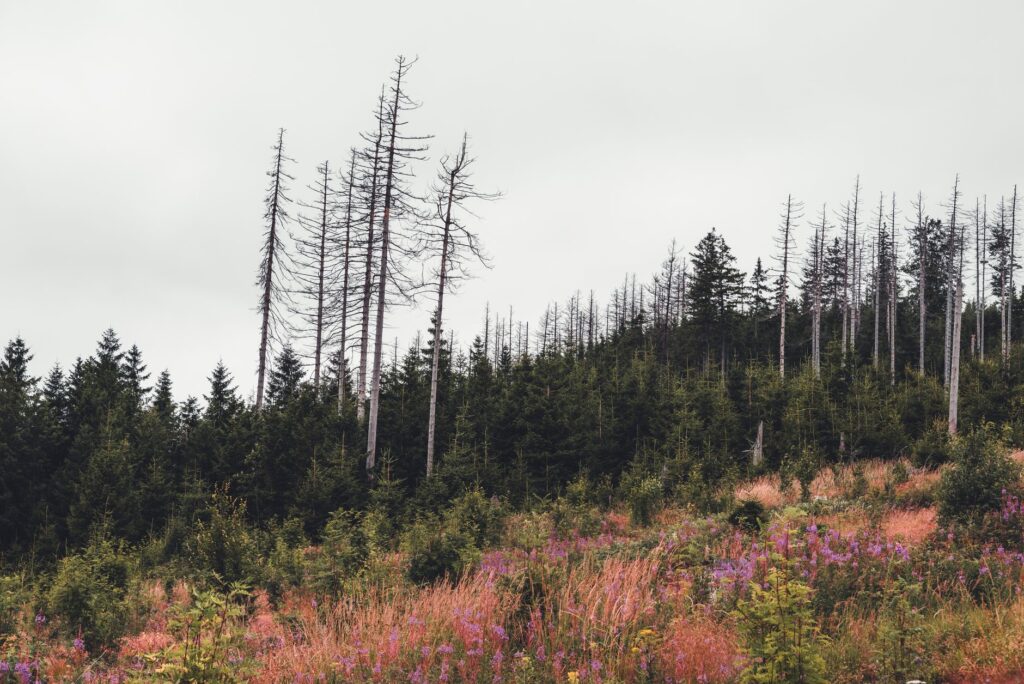
Traveling on the open-air platforms of the carriages, feeling the cold mountain wind and the tiny flecks of soot drifting down from the sky, offers a privileged view of the Harz’s ecological transformation. For decades, these mountains were covered by dense plantations of Norway spruce, a fast-growing species introduced by the German forestry industry. However, climate change, prolonged droughts, and bark beetle infestations have devastated these monocultures, leaving landscapes of dry, gray trunks that look like something out of a Gothic fairy tale.
Despite the initial desolation, the journey reveals nature’s resilience. The Harz National Park has chosen not to intervene in many of the affected areas, allowing the forest to regenerate naturally. Among the skeletons of the old spruces, thousands of beech, birch, and wild willow trees are now sprouting vigorously. The steam train passes through this ecological transition, serving as a mobile observatory from which to witness the importance of biodiversity in the era of global warming.
The Guardians of Fire at the Wernigerode Workshop
Behind every train climbing the mountain lies a titanic maintenance effort carried out at the historic Wernigerode Westerntor workshops. In these industrial halls, smelling of heavy engine oil, machined metal, and coal, a team of highly specialized mechanics dismantles, repairs, and reassembles parts that no longer appear in any commercial catalog. If an axle wears down or a connecting rod breaks, the workers must forge and turn the replacement part by hand, using original blueprints dating back to the beginning of the last century.

Generational renewal is one of the greatest challenges facing the HSB. Keeping alive the skills of a boiler maker or a steam locomotive fitter requires years of practical training. The young apprentices who join the Harz workshops do not just learn mechanics; they acquire a commitment to preserving an intangible industrial heritage. Thanks to them, the locomotives’ whistle continues to echo with the same strength as it did a century ago through the deep valleys of northern Germany.
«Preserving these locomotives is not a matter of aesthetic nostalgia, but of technical rigor; here we work with the tolerances of steel and the raw power of classical thermodynamics.»
The Ultimate Ascent: From Drei Annen Hohne to the Misty Summit
The final leg of the journey begins at Drei Annen Hohne station, the railway junction where the Wernigerode line meets the line coming from the south. Here, the train prepares for its final assault on the Brocken. The locomotive roars with a sharp, intermittent chug, the puffs of black smoke grow denser, and the rhythm of the pistons slows as the gradient steepens. The spruce forest closes in over the track, creating a green tunnel that amplifies the echo of the steam engine.
As the train gains altitude, the vegetation becomes sparser and stunted, adapted to the harsh subalpine climate. The temperature drops rapidly, and the thick northern mist often wraps the train, erasing spatial references. When the train finally reaches Brocken station, situated on a treeless plateau, travelers feel as though they have landed on a different planet—a windswept wasteland where the locomotive’s steam blends with low clouds in a ghostly dance.
Practical guide
To plan a journey aboard the Harz narrow-gauge railways, it is essential to consider regional logistics and the various routes available across this historic network.
- Getting there: The city of Wernigerode, the main starting point for the Brocken line, is excellently connected by regional train to Hanover, Leipzig, and Berlin. From Wernigerode’s central station, you can directly access the HSB platforms.
- Main routes: The network is divided into three main lines: the Brockenbahn (the ascent to the summit), the Harzquerbahn (crossing the massif from north to south, connecting Wernigerode to Nordhausen), and the Selketalbahn (a more winding and quiet route through the romantic valley of the Selke River).
- Fares and tickets: The Brockenbahn ticket has a flat rate regardless of the station of origin, allowing passengers to hop on and off at intermediate stations. It is highly recommended to purchase tickets in advance at the Wernigerode or Drei Annen Hohne ticket offices, especially during autumn and winter weekends.
- Best time to travel: Winter offers some of the most spectacular scenery, when the snowy landscape contrasts sharply with the locomotive’s black smoke. However, autumn, with the changing colors of the deciduous forest, is ideal for nature photography enthusiasts.
- Clothing advice: Even in the height of summer, the Brocken summit can experience very low temperatures and strong winds. It is essential to bring warm, waterproof clothing and suitable hiking footwear if you plan to walk down along the national park’s marked trails.
The Last Breath of Steam Over the Snow
As the sun begins to set behind the ridges of the Harz, the last descending train begins its journey back to the plains. In the twilight, the glow from the locomotive’s firebox casts an orange light over the track ballast and the snow accumulated along the edges. It is in this moment of silence, as the engine’s roar softens into a steady hum and passengers gaze at the twilight landscape through fogged windows, that the true value of this railway is understood. It is not merely a means of transport; it is a steel and coal thread linking Europe’s industrial past with a present desperately searching to reclaim the slow pace and human scale of travel.