


Beyond the Alsatian Myth: The True Scale of Strasbourg
An invisible geography emerges only when the thermometer drops and the canals recover the breath of old chimneys. Strasbourg, long established as the spearhead of winter celebrations in continental Europe, does little to replicate the generic holiday folklore flooding major Western capitals. Here, the cold season acts as a photographic developer, exposing the complex architecture of a city historically split between two distinct worlds. Far from the sugar-coated postcard propagated by travel catalogues, the daily pulse of the Alsatian metropolis during December obeys a millimeter choreography where administrative bodies, a centennial university, and a merchant bourgeoisie deeply anchored in local charters coexist in harmony.
Understanding this urban phenomenon requires moving past surface decorations and descending into the hidden history of traditional neighborhoods. From the moment a flight from Madrid touches down at Entzheim Airport after a two-hour journey, the atmosphere undergoes a subtle yet perceptible mutation. The Rhine mist blankets the docks, and the timber-framed facades acquire an ochre hue reminiscent of a Flemish primitive canvas. This is not a seasonal theme park, but a living organism that has successfully transformed its heritage into a shield against the monotony of the European winter.
The Grande Île: Insular Heart and Defensive Layout
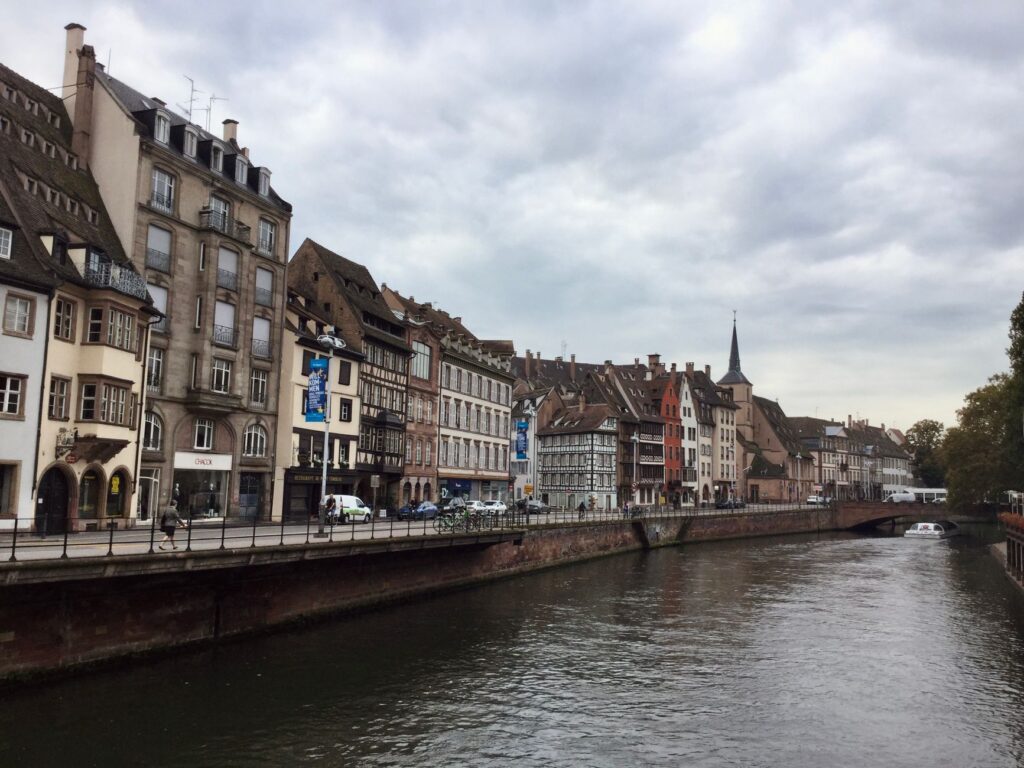
The foundational core of Strasbourg, listed entirely as a UNESCO World Heritage site, rests upon a river island embraced by the arms of the Ill River. This historical isolation has shaped an urban configuration where streets follow no logical grid, but rather the caprices of water and ancient defensive walls. Walking through the Grande Île in the dead of winter means surrendering to a labyrinth of cobblestone alleys opening unexpectedly into Renaissance squares. Each facade recounts a dynastic dispute, a commercial treaty, or a truce signed between medieval guilds.
Human intervention over this insular landscape has remained constant yet respectful of original volumes. Steep gabled roofs, originally designed to shed heavy snowfall from the Alsatian plain, crown structures where red brick merges with Vosges sandstone. During cold months, this architectural conglomerate acquires a fascinating sobriety that contrasts sharply with commercial bustle. Covered bridges flanked by 13th-century defensive towers remind visitors that this city was for centuries a coveted strategic enclave contested by both the French crown and Germanic states.
Notre-Dame Cathedral: Gothic Geometry Against Gray Skies
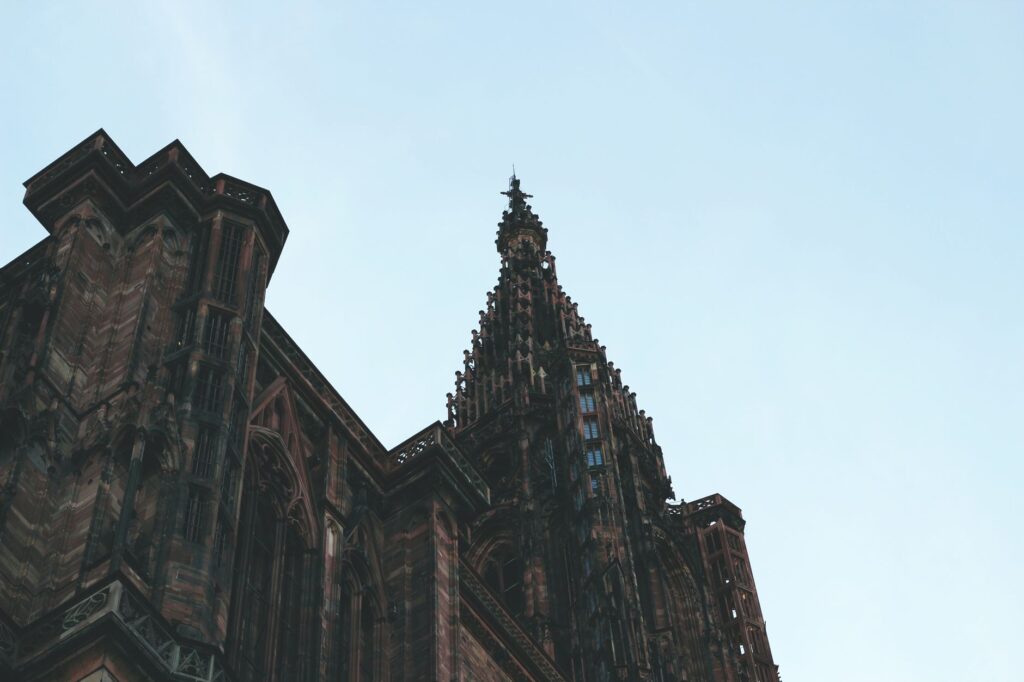
Dominating the urban skyline with a stony arrogance that defies physics, Notre-Dame Cathedral stands as the spiritual and physical lighthouse of the region. Built entirely of pink sandstone, its single bell tower reached a height of 142 meters in 1439, making it the tallest building in the Christian world for over two centuries. When winter light strikes its walls laterally, the stone acquires copper glints that seem to set the overcast December sky ablaze. This is not a monument designed for discretion; its western facade is a genuine stone book where Gothic masters sculpted a theological narrative of staggering complexity.
Inside, the gloom is pierced only by light beams crossing 12th- and 13th-century stained glass windows, true masterpieces of medieval craftsmanship that miraculously survived successive conflicts. The famous astronomical clock, a masterpiece of Renaissance engineering springing to life each noon with the procession of apostles and the figure of death, draws devoted gazes from locals and strangers alike. This artifact measures more than time; it declares the precision and ingenuity of a community that has always looked toward technical vanguard without renouncing spiritual roots.
The true identity of Strasbourg lies not in the accumulation of seasonal symbols, but in its unbreakable capacity to fuse two cultures into a single living stone.
La Petite France: The Tanner’s Quarter and Its Canals
If the cathedral represents vertical power, La Petite France embodies the intimate horizontality of water and artisanal labor. Situated at the western tip of the Grande Île, this district owes its name to a 15th-century military hospital and the historical stigma associated with epidemics plaguing the continent. Once the exclusive territory of fishermen, millers, and skin tanners, it now forms one of Europe’s most photographed architectural ensembles. Sloping roofs shelter attics where hides were once hung to dry, catching drafts rushing down the Ill channels.
Wandering its wooden footbridges at dusk reveals a scene of profound urban melancholy. Sluice gates regulate river flow with a constant murmur contrasting against visitor chatter. Former grain warehouses and timber-framed houses have been rigorously converted into homes, craft workshops, and traditional taverns where local gastronomy is served without touristic artifices. Preservation of this historic fabric demonstrates a fierce institutional commitment to heritage authenticity over real estate speculation.
The Broglie and Kléber Rituals: The Secular Market
Though decentralized today across multiple urban enclaves, Strasbourg’s Christmas market traces its roots to 1570, when Protestant reformers replaced the Catholic feast of Saint Nicholas with the *Christkindelsmärik* (the Christ Child market). Originally held in front of the cathedral, this commercial fair migrated over centuries to Place de Broglie and the imposing Place Kléber. A giant fir tree, meticulously selected from Vosges forests, stands here each year to anchor civic solidarity and encounters.
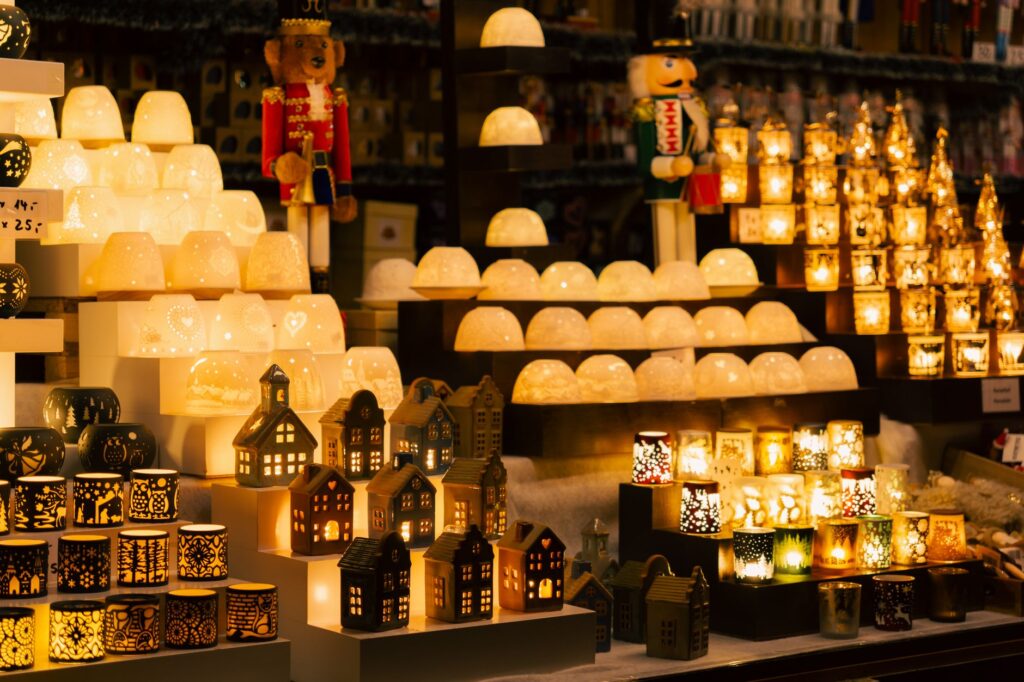
Wooden chalets, standardized under strict municipal regulations to prevent modern over-commercialization, offer everything from hand-blown glass ornaments from Siberia to culinary specialties like *bredle* (small anise biscuits) and mulled wine spiced with local herbs. Eschewing industrial trinkets, local artisans defend a quality standard obliging visitors to pause and converse with producers. This commercial exchange reveals the genuine social health of the Alsatian community, an open forum discussing European politics just as much as recent wine harvests.
Frontier Gastronomy: Between Lard and Haute Cuisine
Understanding Strasbourg requires sitting at the table and accepting a culinary legacy defying contemporary dietetics. Alsatian cuisine stems directly from a permeable frontier where Germanic generosity meets French technical finesse. The flagship dish, *choucroute garnie*, pairs cabbage fermented for weeks in oak barrels with smoked sausages, pork ribs, and steamed potatoes. Far from heavy preparation without purpose, the controlled acidity of cabbage balances meat fat, generating a flavor profile of surprising sophistication.
Delicacies like *baeckeoffe*—a stew of three meats marinated in Riesling white wine with potatoes and vegetables, slow-cooked for hours in a sealed earthenware terrine lined with bread dough—and thin-crust *flammekueche* topped with sour cream, onions, and bacon complete the picture. On the sweet side, *kougelhopf*, a brioche cake with almonds and raisins baked in a distinctive glazed ceramic mold, accompanies winter breakfasts. All of this is washed down by white wines from the Alsatian Wine Route, where Gewürztraminer and Riesling achieve unmatched mineral expression.
The German Quarter and the Neustadt: Imperial Footprint
Crossing the Ill River eastward reveals a completely distinct territory: the *Neustadt* or new city, constructed during the German annexation period between 1871 and 1918. This monumental urban project aimed to transform Strasbourg into the administrative and cultural capital of the *Reich* in the west, equipping it with colossal public buildings rivaling those in Berlin. The result is an eclectic catalog of Neo-Renaissance, Neo-Baroque, and Modernist architecture featuring the imposing Strasbourg University headquarters and the Palace of the Rhine, former imperial residence.
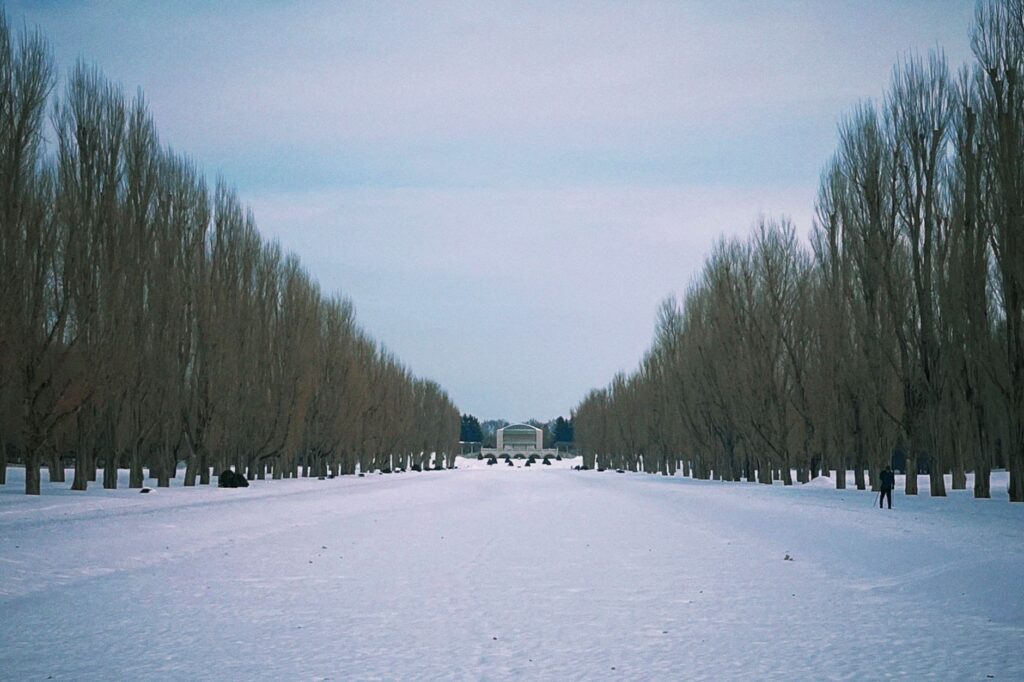
This urban fabric, characterized by straight tree-lined avenues and monumental squares, offers a fascinating historical reading on how architecture served political propaganda. Today, the Neustadt coexists peacefully with the medieval core, symbolizing the definitive overcoming of nationalist feuds that bloodied Europe during the first half of the 20th century. Walking or cycling its boulevards reveals the metropolitan scale of a city now housing key European Union institutions, including the European Parliament and the European Court of Human Rights.

The harmonious coexistence between Alsatian Gothic and monumental German imperialism turns the Neustadt into an open-air manual of European history.
Practical guide
Planning a winter getaway to Strasbourg requires organizational rigor due to high seasonal demand and peculiar meteorological conditions on the Alsatian plain.
- How to get there: Strasbourg-Entzheim International Airport (SXB) connects with Madrid via direct flights or short Layovers depending on the season. From the terminal, a shuttle train (*TGV*) takes travelers to the central station in just nine minutes. Another highly viable option is flying to Basel-Mulhouse-Freiburg Airport and taking a direct one-hour regional train.
- When to go: The official Christmas market period runs from late November until December 24. For a quieter experience with lower tourist density, early December or the months of January and February allow visitors to enjoy architectural heritage in complete tranquility.
- Where to stay: The Grande Île is ideal for exploring on foot, though prices spike in December. Excellent and quieter alternatives lie in the Neustadt or near the train station, perfectly connected by the efficient urban tram network.
- Getting around: Strasbourg is an eminently pedestrian and bicycle-friendly city. CTS tram lines cover all public transport needs with single tickets or highly cost-effective daily passes.
The Intimate Pulse of Docks Under Twilight
When day ends and commercial lights begin reflecting upon the dark waters of the Ill River, Strasbourg distills a melancholic calm disarming even seasoned travelers. On stone benches near the Corbeau lock, nighttime silence is interrupted only by occasional waterfowl calls and distant cathedral bells announcing midnight. At that exact moment, the city ceases being a mass tourism destination and becomes an intimate refuge, a space where European history breathes with the dignity of grand settings safeguarding memory against relentless time.
Source in EN: Diario del Viajero


