The railway line connecting Bergen to Oslo across the Hardangervidda plateau is not merely a means of transport; it is a masterpiece of civil engineering and one of Northern Europe’s most unforgiving expedition routes. Formally inaugurated in 1909 after decades of titanic labor under extreme weather conditions, this track climbs from sea level on the western coast to over 1,200 meters of altitude at Finse station, the highest inhabited point on the Norwegian railway network. Planning a journey of this magnitude requires understanding that nature in Norway does not accommodate the traveler: it tests them.
Over its 300-plus kilometers, the train passes through more than 180 tunnels blasted into living rock and crosses plateaus where winter storms can unleash hurricane-force winds even in late spring. This report examines the logistics, technical history, and indispensable preparation required to face this traverse with safety guarantees, combining the rigor of the explorer with the sensitivity of the contemporary traveler seeking to understand the rawness of the Scandinavian landscape.
The Genesis of an Impossible Route: Engineering Against the Climate
The Bergen Railway (Bergensbanen) project was born out of a geopolitical and economic necessity: to connect Norway’s two most important cities across an almost impenetrable geographical barrier. During the 19th century, traveling between Bergen and Oslo meant circumventing the entire southern coast by ship or undertaking horseback journeys across mountain trails that were impassable for much of the year. The Norwegian Parliament approved construction in 1894, but engineers faced an unprecedented obstacle: the Hardangervidda plateau is a high-altitude arctic desert where temperatures frequently drop below minus thirty degrees Celsius.

Work crews had to operate in absolute isolation, building temporary camps supplied via sledges and skis. To protect the track from avalanches and massive snow accumulations, kilometers of timber galleries and stone walls were erected, which continue to define the severe aesthetic of the route today. Overcoming this hostile environment proved that human engineering could carve a path through the most inaccessible corners of the planet, establishing the line as a global benchmark in high-mountain railway construction.
The Logistics of the Ascent: From Fjords to Alpine Tundra
The journey begins at Bergen station, situated right next to the historic docks of the Byfjorden fjord. In the opening kilometers, the train winds through the Vaksdal valley and the Voss region, skirting rivers of turquoise water fed by seasonal snowmelt. This first phase of the trip is notable for its lush greenery and traditional timber settlements that make the most of every flat meter available between the steep slopes.
As the track gains elevation, the landscape changes radically. Spruce and birch forests give way to wind-whipped alpine meadows and, eventually, bare rock and the permanent icefields of the high plateau. In this section, time management and knowledge of railway protocols are fundamental. Bane NOR authorities constantly monitor wind speed and snow accumulation. A single unforeseen storm can block switches and force the deployment of massive rotary snowplow locomotives, reminding passengers that the line operates under strict high-mountain rules.

Finse: The Arctic Heart and the Station at the End of the World
The nerve center of any expedition along the Bergensbanen is Finse, an isolated station with no road access, reachable only by train or via summer hiking and mountain biking trails. Perched at 1,222 meters above sea level, Finse served as a training ground for the polar expeditions of Fridtjof Nansen and Roald Amundsen due to weather conditions identical to those of the Antarctic continent.
Today, the historic Finse 1222 Hotel hosts ski mountaineers, researchers, and travelers seeking the absolute silence of the high plateau. Legendary routes like the Rallarvegen—the service road built during the railway’s construction, now Norway’s most famous cycling route—start from here. Staying in Finse demands self-sufficiency and absolute respect for local safety regulations, as a sudden shift in visibility can disorient a traveler within minutes.
The wind on the Hardangervidda plateau does not merely blow; it pushes with the force of an invisible wall, reminding the traveler of their own fragility before the arctic immensity.
The Descent Toward the East: The Hallingdal Valley and Arrival in Oslo
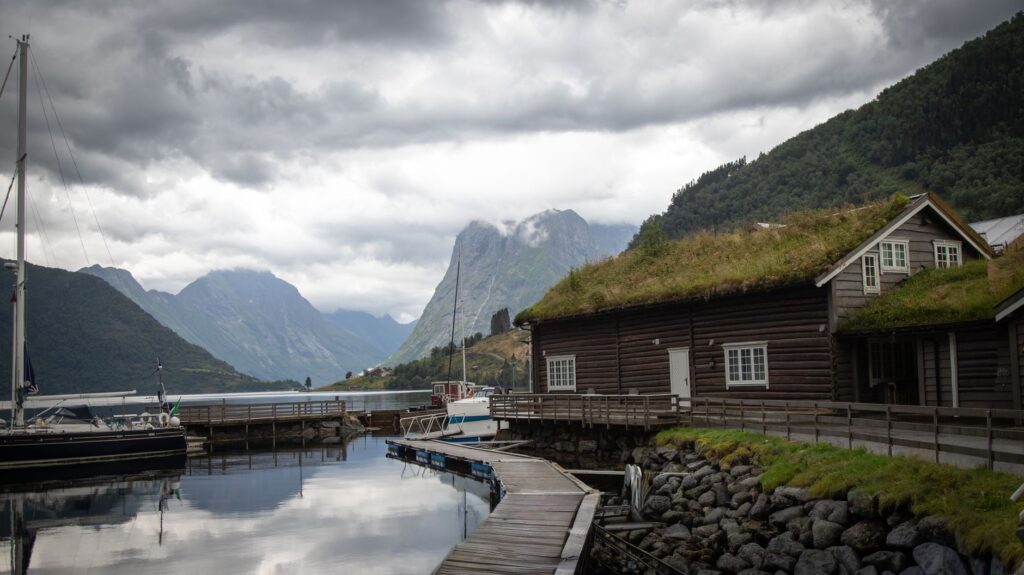
After conquering the summit at Finse and descending through the Grönskelv tunnel, the longest on the route, the train begins its steep eastward descent through the Hallingdal valley. The landscape gradually regains vegetation, rivers widen their beds, and traditional farms with turf-covered roofs—an ancestral thermal insulation technique surviving in rural Norwegian architecture—appear.
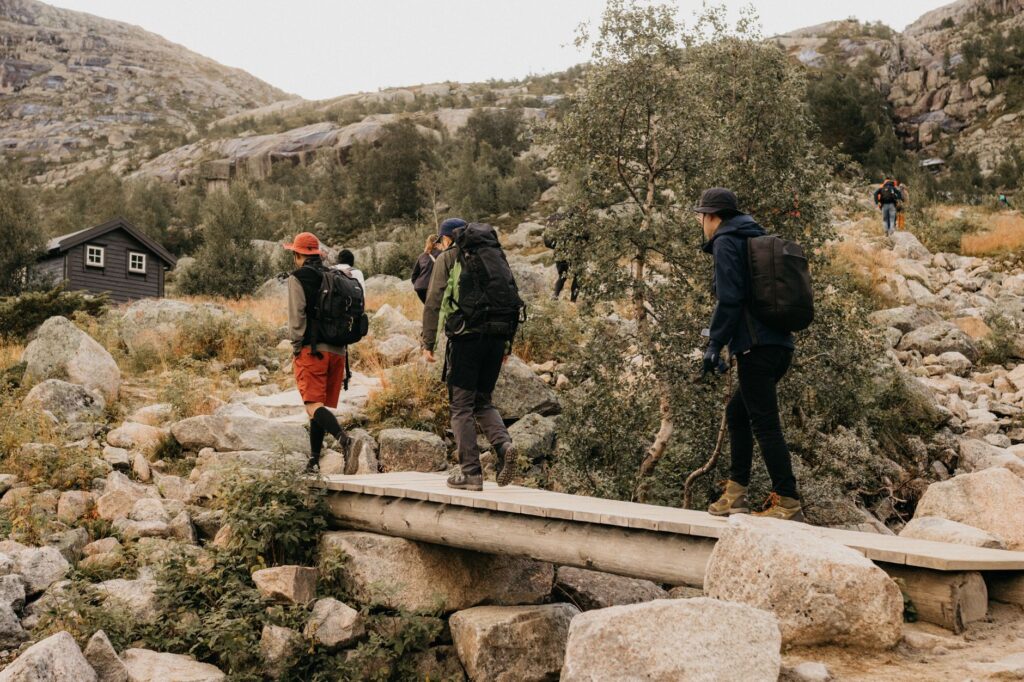
This final stretch offers a smooth transition back to urban civilization, crossing towns like Geilo, a major winter sports hub, and Gol, before leveling out toward the Oslo metropolitan area. The arrival at Oslo Central Station contrasts sharply with the solitude of the high peaks, closing a geographical and visual cycle that synthesizes the extreme diversity of Norway’s geography in just a seven-hour journey.
Safety, Equipment, and Protocols for the Independent Traveler
Tackling the Bergen route as a modern expedition requires rigorous preparation beyond simply purchasing a train ticket. Unlike conventional railway lines, the Bergensbanen traverses remote areas where mobile phone coverage can disappear entirely and rescue services depend heavily on weather conditions to intervene.
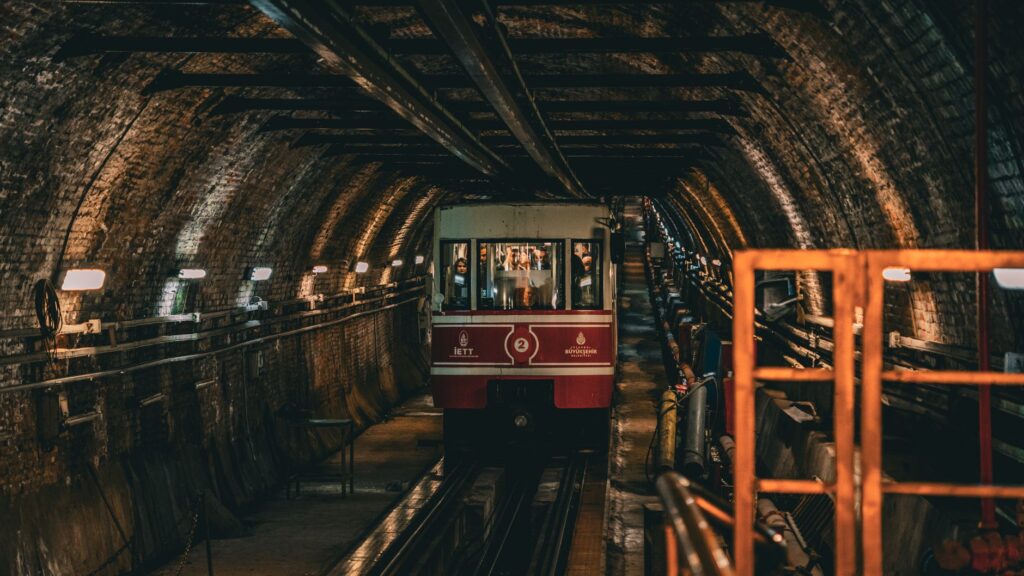
Travelers planning to disembark at intermediate stations like Finse or Myrdal for trekking or cycling must carry appropriate technical gear: three-layer windproof clothing, GPS navigation systems with offline maps, first-aid kits, and emergency rations. The golden rule in the Norwegian high mountains is never to underestimate how quickly the weather can turn lethal, even during summer months when sudden storms can drastically drop body temperature.
Railway Architecture as Living Heritage
Beyond its scenic value, the Bergen Railway constitutes an exceptional catalog of industrial architecture and early 20th-century engineering. The original stations, designed by architect Paul Armin Due, combine neo-Romanesque style with elements of traditional Norwegian timber building (dragestil), blending harmoniously into the natural environment.
Likewise, historic signaling systems, metal lattice bridges, and dry-stone retaining walls flanking the track are subjects of state-funded heritage conservation programs. Preserving these structures is not an exercise in nostalgia, but an operational necessity to guarantee the line’s resilience against the constant erosion of ice and water.
Practical guide
- Getting There: The main terminals are Oslo Central Station (Oslo S) and Bergen Station, both connected to international air and rail networks.
- Best Time for Expedition: March to May for ski touring and extreme snowy landscapes; July to September for hiking and cycling along the Rallarvegen.
- Ticket Booking: Tickets go on sale ninety days in advance via Vy (Norges Statsbaner). Seat reservations are mandatory on long-distance trains.
- Luggage Allowance: Carry-on and large bags are permitted, but outdoor activity operators require protective cases for bicycles and skis.
- Connectivity: Onboard Wi-Fi is free but unstable through tunnels and the high plateau; downloading maps and content beforehand is strongly advised.
- Environmental Regulations: Leaving waste in high mountain stations like Finse is strictly prohibited; a strict zero-trace principle applies across the entire route.
The Echo of Silence on the Tracks of the North
When the last carriage of the Bergen Express comes to a halt on the capital’s platforms, the traveler experiences a strange sense of temporal dissonance. The hours spent contemplating the white immensity of the plateau and the roar of the wind against the train’s windows feel as though they belong to another dimension, far removed from urban bustle. This journey proves that traveling by train through extreme territories remains one of the purest forms of contemporary exploration.
It is not merely about moving from one point on the map to another, but about accepting the tutelage of a landscape that imposes its own rules. At the end of the journey, what lingers in memory is not the comfort of the seat or Swiss-style punctuality, but the silent certainty of having brushed against the limits of the habitable world in the company of iron, rock, and wind.