


Introduction to the Rhine River Corridor
The Middle Rhine Valley, a UNESCO World Heritage site, is not merely a scenic corridor where Germanic myth and commercial navigation converge; it is also a masterpiece of nineteenth-century civil engineering. The construction of the left-bank railway line, known in German as the Linke Rheinstrecke, represented a titanic challenge that permanently altered humanity’s relationship with these slate and schist gorges. Along this route, connecting Mainz to Cologne, the contemporary traveler witnesses a display of tunnels blasted out of living rock, cyclopean retaining walls, and viaducts defying the swift current of the river.
Far from being conceived as a mere high-speed transit medium, this railway acts as a moving viewpoint over one of Europe’s most contested geographies. The tracks run hard against the water, sharing narrow living space with national highways and freight barges steaming upstream laden with coal and containers. Understanding this ecosystem requires abandoning the haste of the modern traveler and adopting the leisurely pace of the technical observer, capable of appreciating the millimeter calculation that reclaimed land from the water in a gorge where every square meter has historically been a matter of military and economic dispute.
The Genesis of Rhenish Railway Engineering
In the 1850s, transport in the Middle Rhine Valley depended almost exclusively on slow paddle-wheel steamers and bridle paths winding across the summits. The arrival of the railway promised to unify the Prussian market and accelerate the transit of goods toward North Sea ports. However, engineers of the era faced a major topographical obstacle: the steep cliffs of the left bank, crowned by medieval fortresses like Rheinstein and Reichenstein, left barely a few meters of alluvial beach.

To lay the tracks, construction companies resorted to systematic blasting of rocky outcrops and the erection of sophisticated dry-stone embankments capable of withstanding the constant pressure of the river flow. Each tunnel excavated in this phase required pioneering timber shoring techniques and the early use of dynamite, transforming the gorge’s geology into a continuous linear infrastructure. Precision curve alignment maintained steady speeds without altering the natural course of the river, preserving the hydraulic balance of a waterway navigable since Roman times.
Heroic Viticulture on Slate Terraces
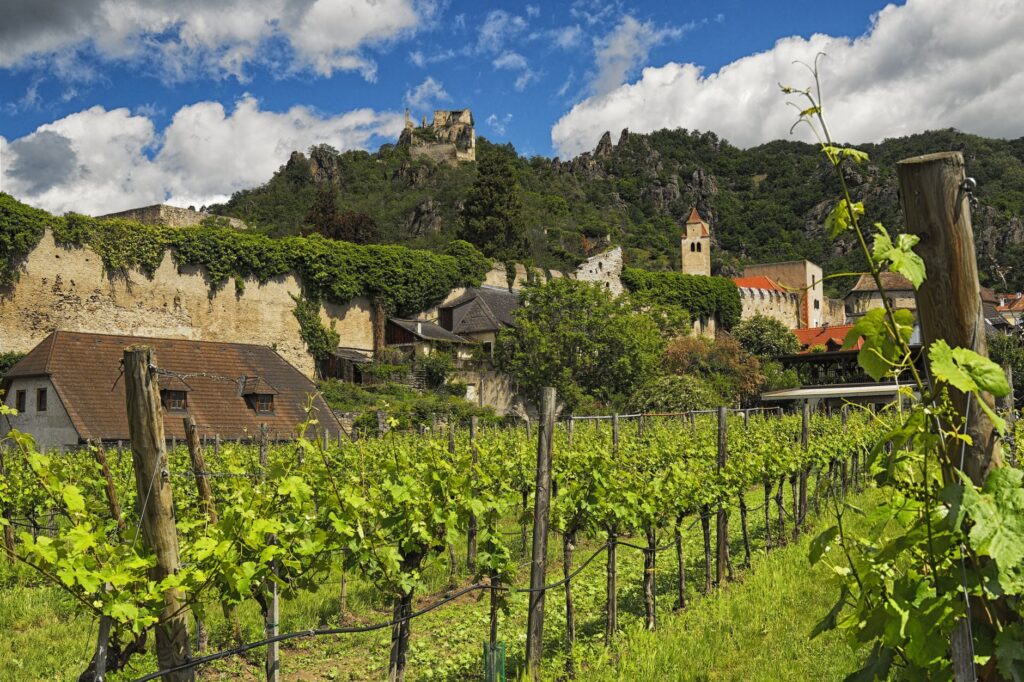
If civil engineering defines the foundation upon which the train runs, the viticulture of the Middle Rhine forms its most prominent aesthetic and agricultural layer. The slopes plunging steeply toward the river present gradients of up to sixty degrees, an angle that turns vine cultivation into an act of true agrarian tightrope walking. These vineyards, planted on soils of blue and red slate, absorb solar heat during the day and slowly radiate it back to the Riesling vines at night, generating a unique microclimate in Central Europe.

From the train window, the dry-stone walls supporting the terraces unfold like a geometric filigree climbing the mountain. Local winemakers, heirs to a centuries-old monastic tradition, continue using monorails and mechanical winches to transport grape crates during harvest, due to the impossibility of accessing the plots with heavy vehicles. This living cultural landscape demonstrates that heritage conservation resides not only in the stones of castles, but in the continuity of human labor that sculpted the territory slope by slope.
Defensive Architecture and Fluvial Geopolitics
The railway journey is punctuated by an exceptional concentration of medieval fortresses that once levied tolls on navigators and controlled overland and river trade routes. Castles such as the imposing Marksburg—the only one in the region never destroyed—or the romantic silhouette of Pfalzgrafenstein, nestled on a rocky island in the middle of the channel, operate today as visual landmarks articulating the narrative of the trip. The intrusion of the railway in the nineteenth century stripped these structures of their military function, integrating them into the imaginary of German Romanticism.
The railway track did not destroy the medieval landscape; it reconfigured it, turning former toll towers into observation posts for the industrial traveler seeking the sublime in tamed nature.
The design of historic stations along the route likewise reflected Prussia’s political and economic status. Exposed-brick buildings with neo-Gothic elements served as gateways to spa and wine-producing towns such as Bacharach and St. Goar. These stops not only facilitated the mobility of the nineteenth-century industrial bourgeoisie but laid the foundations for modern continental tourism, allowing travelers to contemplate the legendary Lorelei rock with unprecedented safety and comfort.

The Geology of the Gorge and River Dynamics
Beneath the railway ties and river waters lies a fascinating geological formation: the Rhenish Massif. This mountainous threshold, uplifted during the Hercynian orogenesis, forced the Rhine to carve its way slowly over millions of years through strata of quartzite and slate. The result is a narrow canyon where water levels experience sharp seasonal variations, requiring constant maintenance of railway abutments and riverside retaining walls.
Modern engineers face challenges similar to those of their nineteenth-century predecessors, albeit with advanced technological tools. Laser sensors installed on rock faces continuously monitor any risk of slate block detachment, while subterranean drainage systems prevent slope saturation during alpine snowmelt periods. This permanent vigilance guarantees the viability of one of Europe’s busiest freight and passenger corridors, where high traffic density demands rigorous safety standards.

Daily Life in Riverside Stations
Stopping at the small stations of the Middle Rhine reveals the resilience of communities rooted in a geographical space as narrow as it is demanding. Towns like Oberwesel or Boppard have historically depended on the balance between cultural tourism, the wine industry, and the constant passage of regional and freight trains. Coexistence with the railway infrastructure is total: tracks run mere meters from timber-framed facades, integrating the metallic rattle into the daily acoustic symphony of the valley.
At these intermediate stops, residents and rare visitors share platforms where time seems measured by Germanic punctuality and the rhythm of river cargo vessels. Here, local commerce maintains an offering focused on earth-born products, from high-acidity white wines to traditional Rhenish gastronomy, resisting the temptation of superficial tourist overcrowding thanks to the valley’s physical limitations.
Practical guide
Planning a journey along the Middle Rhine railway line requires attention to several essential logistical and operational guidelines to make the most of the experience:
- Getting There: Frankfurt am Main Airport (FRA) is the closest international transport hub, directly connected to Mainz and Koblenz via regional and high-speed (ICE) trains in under an hour.
- Railway Layout: The main line runs along both banks, although the Linke Rheinstrecke (left bank) concentrates the highest density of monumental heritage and relevant historical towns.
- Fares and Tickets: It is advisable to purchase the regional Deutschlandticket for unlimited travel on local and regional public transport, or specific network tickets for Rhineland-Palatinate (VRM).
- Best Time to Visit: Spring months (May to June) and autumn (September to October) offer optimal temperatures, lower crowds, and the added appeal of the grape harvest or blooming terraces.
- Accommodation: Small family-run hotels converted from historic winemakers’ mansions in Bacharach, St. Goar, or Boppard guarantee an authentic immersion in local culture.
Emotional Epilogue at the Lorelei Viewpoint
At dusk, when golden light strikes obliquely against the slate walls and the water’s surface acquires a leaden hue, the traveler walking up to the summit of the Lorelei cliff experiences a profound sense of scale. From this legendary promontory, where echoes multiply against the canyon walls, the railway appears below as a tiny metallic thread precisely stitching the shadow of the mountains and the clarity of the river.
In this borderland where history, geology, and technique merge, travel ceases to be physical displacement and becomes a meditation on human persistence against the monumentality of nature.
The distant whistle of a freight train cutting through the gorge resonates in the cool evening air, reminding us that this landscape is not a static postcard, but a living organism in constant motion. Observing the final light fade over the Rhenish castles and vineyards confirms the relevance of a route that, century after century, continues to fascinate those who seek the exact measure of beauty and effort along the road.


