
Introduction to the Planet’s Northern Frontier
The Arctic Ocean is not merely a body of water; it is a dynamic system where the boundary between liquid and solid constantly shifts at the whim of circumpolar currents and summer solar radiation. Venturing into the waters of the Barents Sea aboard a vessel adapted for polar navigation demands absolute respect for the laws of marine thermodynamics and a millimetric understanding of high-latitude nautical cartography. The journey from the northern coasts of Norway to the frozen reaches of Longyearbyen and the eastern glacial fronts represents one of the last true frontiers of contemporary maritime expedition, where reinforced hull technology meets the implacable vastness of pristine wilderness.
Planning an expedition of this nature transcends simply purchasing a commercial passage. It requires a profound grasp of floating ice dynamics, the management of energy autonomy at sub-zero temperatures, and the acceptance that original route plans are, at best, provisional suggestions in the face of sudden boreal gales. This report examines with technical rigor the fundamental pillars for understanding, planning, and successfully executing a nautical traverse in the heart of the Arctic Circle, steering clear of naive romanticism to focus on the operational reality of high-latitude seamanship.
The Science of Sea Ice and Polar Naval Architecture
Understanding sea ice behavior is the sine qua non requirement for any skipper daring to navigate high latitudes. Unlike terrestrial glacial ice, sea ice forms from the direct freezing of the saline ocean surface. This process creates a complex matrix evolving from initial frazil ice to multi-year ice capable of withstanding summer melts and exceeding three meters in thickness. A vessel’s structural strength must be calculated not merely by water displacement, but by the lateral pressure that converging ice fields can exert against the hull.

Modern expedition vessels employ special steels with high yield strength and hull forms optimized to deflect ice downward rather than merely colliding with it. The raked bow and framing curvature allow the ship to ride up onto thinner pack ice, utilizing its own weight to fracture it. However, when ice becomes compacted under persistent northerly winds, even polar-class icebreakers must reduce speed and evaluate drift using high-definition radar and real-time satellite cartography.
Seamanship in the Arctic does not reward reckless audacity, but rather calculated patience and the millimetric reading of fractures in the ice.
The interior design of these vessels also adheres to strict survival and thermal insulation criteria. Main engine cooling systems must feature dual sea-water intakes equipped with steam injection to prevent clogging from slush accumulation—water with high concentrations of suspended ice crystals. Furthermore, double-bottom fuel tanks are designed to minimize spill risks in the event of a collision with submerged blocks, ensuring that navigational autonomy is not compromised during moments of peak technical demand.
Synoptic Meteorology in the Barents Sea
The Barents Sea acts as a thermal cauldron where extremely cold and dense continental polar air masses converge with the warm North Atlantic Current flowing along the Norwegian coast. This perpetual collision generates a highly active atmospheric pressure gradient conducive to rapid development of explosive storms. An experienced mariner in these latitudes knows that 48-hour forecasts carry a considerable margin of error, making direct observation of mercury barometers and lenticular altocumulus cloud formations tools just as vital as computerized numerical prediction models.

Katabatic winds, descending violently from glacial peaks toward the fjords, represent one of the greatest hazards for coastal navigation and anchoring operations. These winds can double in speed within minutes as they channel through coastal valleys, ripping away moorings or dragging anchors even in supposedly sheltered bays. Visibility management constitutes another critical challenge: radiation fog and the phenomenon known as whiteout—where diffuse light eliminates all horizon and relief reference—force complete reliance on differential global positioning systems and navigational radar.
- Constant monitoring of isobaric pressure maps and surface wind fields.
- Evaluation of weather warnings issued by the Norwegian Meteorological Institute for offshore zones.
- Maintenance of alternative sheltered routes behind minor archipelago barrier islands.
- Provision of technical cold-weather gear featuring hydrophobic down insulation and multi-layer windproof membranes.
Provisioning Logistics and Autonomy in Remote Communities
Self-sufficiency in an arctic expedition begins long before setting sail, at supply docks where every kilogram of cargo and every liter of marine diesel fuel is meticulously calculated. Ports such as Tromsø or Longyearbyen serve as the final logistical outposts before operational emptiness. In these latitudes, conventional supply chains cease to exist; there are no specialized mechanical workshops around the corner or roadside assistance services for vessels. Every critical engine component, from raw water pump impellers to high-efficiency fuel filters, must be doubled up on board.
Freshwater management also imposes severe constraints. Although ancient iceberg ice consists of pure fresh water due to the gradual expulsion of brine during centuries of compression, harvesting it requires delicate maneuvers with auxiliary boats and filtration systems capable of removing fine sediments and suspended mineral particles. Regarding provisions, rations must prioritize high caloric density and short cooking times to optimize the consumption of butane or propane gas, whose regulators tend to freeze if not housed in heated compartments.

Safety Protocols Regarding Wildlife and Glacial Environments
Svalbard and its surrounding waters host one of the densest populations of polar bears on the planet, Ursus maritimus. Any shoreline landing for scientific or exploratory purposes demands strict safety protocols prioritizing deterrence over lethal confrontation. Expedition leaders must carry large-caliber rifles and acoustic warning devices, in addition to establishing a system of rotating sentinels who monitor the 360-degree perimeter while the group conducts land activities. The presence of these magnificent predators reminds the traveler that in the Arctic, humans do not occupy the pinnacle of the food chain.
On the other hand, proximity to glacial fronts entails an imminent risk of ice calving. The sudden collapse of hundreds of tons of ice generates shock waves capable of capsizing pneumatic boats and damaging metal hulls if anchored too close to the active wall. The golden rule dictated by polar captains is to maintain a safety distance equivalent to at least twice the estimated height of the glacial face, ensuring an adequate reaction margin against any unforeseen collapse of the ice structure.
Practical guide
How to get there: The primary departure point for expeditions in the Svalbard archipelago is Longyearbyen Airport (LYR), accessible via scheduled flights from Oslo operated by Scandinavian Airlines (SAS) and Norwegian. For private or chartered vessels, the ports of Tromsø and Kirkenes in northern continental Norway serve as mandatory stopovers for customs clearance and maritime safety inspections.

Best time for the traverse: The optimal operational window extends from early July to late August. During this period, sunlight is continuous twenty-four hours a day (midnight sun) and average temperatures range between 0 °C and 7 °C, allowing sea ice to recede sufficiently to open navigable channels toward the eastern coast and northern fjords.
Permits and environmental regulations: The Governor of Svalbard (Sysselmesteren) enforces extremely stringent environmental regulations governed by the Svalbard Environmental Protection Act. It is mandatory to process navigation permits months in advance, demonstrate financial solvency for maritime rescue operations, contract third-party liability insurance with specific polar coverage, and strictly comply with approach guidelines for seabird breeding grounds and protected mammals.
Recommended personal equipment: Technical layering system including merino wool thermal underwear, high-density fleece, waterproof and windproof jacket with marine certification (Gore-Tex Pro or similar), deck boots with non-slip rubber soles for icy surfaces, waterproof gloves with removable thermal liners, and category 4 UV protection sunglasses to prevent snow blindness.

Health precautions and communications: It is essential to secure emergency medical evacuation insurance covering remote areas, as the costs of aerial rescue in the archipelago can reach prohibitive figures. On board, Iridium satellite communication systems and personal locator beacons (PLBs) are mandatory, given that conventional mobile phone coverage disappears just a few nautical miles from settlements.
The Silent Legacy of the Far North
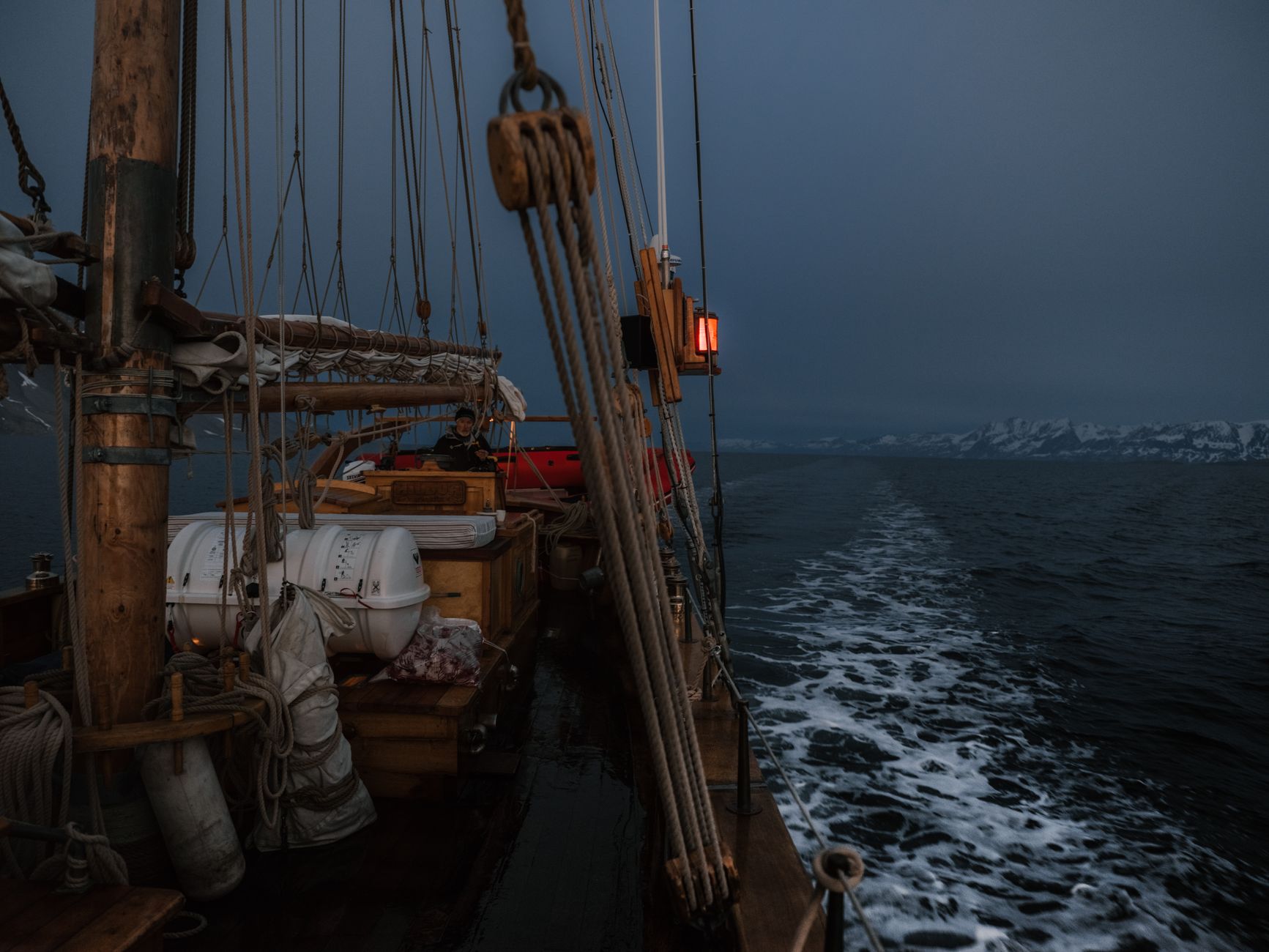
Contemplating the arctic horizon from the deck of a vessel advancing slowly through fog and translucent ice fragments transforms the traveler’s perspective on the scale of the world. This is not a conquest in the 19th-century sense of the word, but rather an exercise in humility before an environment that imposes its own rules with unmistakable clarity. The waters of the Barents Sea hold the memory of explorers, whalers, and scientists who understood that true adventure lies in the fragile balance between human curiosity and reverent respect for the planet’s purest wilderness.
As the midnight sun traces low circles across the horizon without ever setting, golden light strikes the ridges of snow-capped peaks, sculpting cobalt shadows in glacial valleys. In that absolute silence, broken only by the distant cracking of drifting ice and the steady drone of engines idling forward, the expedition achieves its true purpose: recording in memory the physiognomy of a landscape that endures on the threshold of eternity, reminding us of the urgency to preserve its fragile balance for generations to come.