


Introduction to the Narrow-Gauge Railway of the Pyrenees
Journeying through high mountain peaks does not always require the velocity of modern high-speed rolling stock. At the southern edge of Europe, where the Pyrenean mountain range acts as both a natural border and a cultural bridge between France and Spain, one of the continent’s most fascinating railway engineering achievements survives. The Yellow Train of the Eastern Pyrenees, known locally as the Train Jaune, is far more than a mere mode of transport; it operates as a rolling archive of early 20th-century technology and an exceptional vantage point overlooking rugged valleys, dizzying gorges, and stone villages that have withstood centuries of change.
Spanning over sixty kilometers between Villefranche-de-Conflent and Latour-de-Carol, this metric-gauge line ascends impossible gradients utilizing a third-rail electrical power system that has remained operational for over a hundred years. This route represents the pinnacle of Alpine and Pyrenean railway engineering adapted to the most hostile terrain without losing its public service ethos. For the contemporary traveler, embarking on this journey means embracing a deliberate, unhurried pace, where the steady clatter and open windows allow for an intimate connection with the local geography and climate.
Historical Origins and the Conquest of the High Mountains
The genesis of the Yellow Train dates back to the late 19th century, within a political and economic context where French and Spanish authorities sought to break the isolation of the Cerdanya plateau. Overland communications were precarious, relying on bridle paths and horse-drawn carriages that became impassable during long, snowy winters. The railway solution required a monumental effort of design and construction lasting from 1903 to its partial inauguration in 1910 and full completion in 1927.
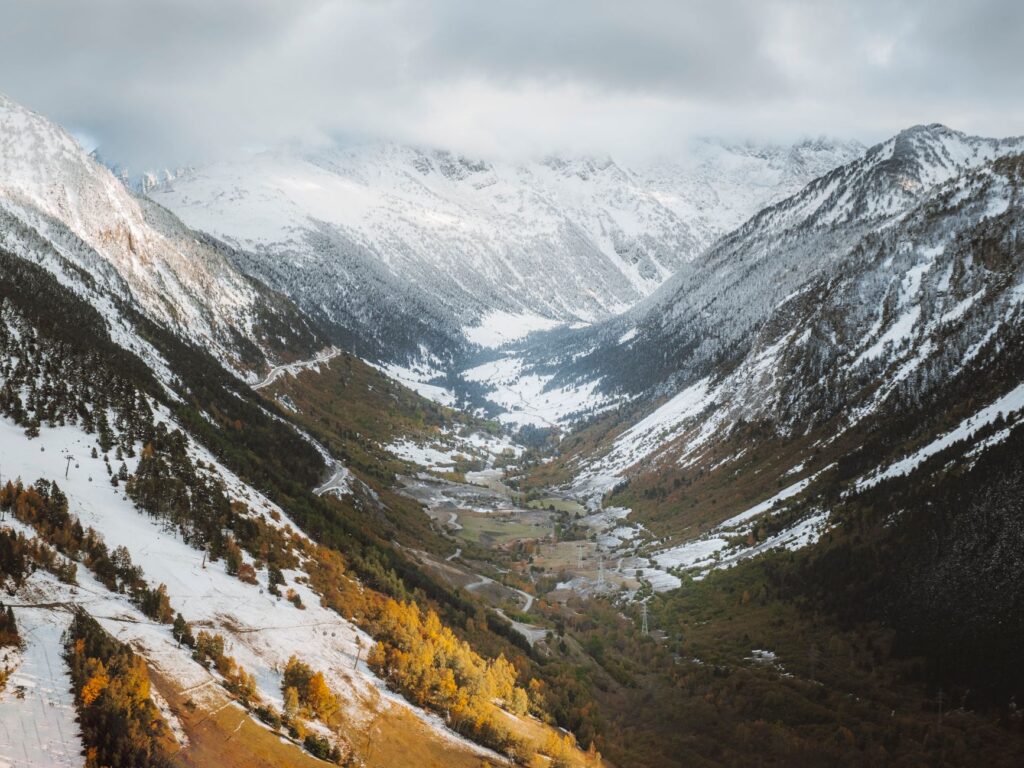
French engineers had to devise a layout capable of overcoming an elevation gain exceeding 1,000 meters within a short distance. To achieve this, they opted for a narrow one-meter track gauge, permitting curves with a much tighter radius than those on standard national networks. Electrical energy, harnessed from hydroelectric plants fed by melting Pyrenean snowpacks, became the ideal motive force, eliminating reliance on coal—a scarce and costly resource at such altitudes. This early commitment to electrification makes the route an absolute pioneer in sustainable mobility.
Monumental Architecture: Viaducts and Suspension Bridges Over Voids
The layout of the Yellow Train is notable for its landscape integration and the audacity of its civil engineering structures. Throughout the route, the train crosses more than six hundred works of art, prominently featuring twenty-two tunnels and numerous bridges and viaducts defying the chasms carved by the Têt and Segre rivers.
Among these structures, two first-order architectural milestones stand out:
- The Gisclard Bridge: Considered the highest railway suspension bridge in France, perched over eighty meters above the riverbed. Its articulated design accommodates extreme thermal expansion in the area without compromising track stability.
- The Séjourné Bridge: An imposing masonry viaduct featuring an eighty-meter main arch span, situated sixty-five meters above ground, demonstrating the mastery of period stonemasons in handling local granite and schist.
These constructions not only facilitated the transit of goods and passengers but now function as visitable monuments attracting industrial heritage enthusiasts from across the globe.
Onboard Experience: Rolling Stock and Classic Design
Riding the Yellow Train delivers an unparalleled sensory experience. The original carriages, painted in the characteristic yellow and red tones evoking the Catalan flag, retain a retro aesthetic that transports passengers back to the Belle Époque. The inclusion of open-air observation cars within the train formation allows for total immersion in the landscape, letting travelers feel the crisp mountain air and the clean sounds of wind and water.
Onboard comfort is modest yet functional. Wooden benches or classic upholstery, large operable windows, and the absence of superfluous luxuries underscore a travel philosophy where the journey matters far more than the destination. There are no entertainment screens or commercial public address systems; the only ambient sound is the metallic rhythm of wheels on rails and the spontaneous explanations shared by local passengers.

The mountain train is not merely a tool to shorten distances, but an instrument designed to understand human scale against the geological immensity of the cordillera.
Biodiversity and Protected Ecosystems Along the Route
The railway corridor traverses areas of profound ecological value, connecting the Catalan Pyrenees Regional Natural Park with strict nature reserves. As the train gains altitude from Villefranche—situated some 430 meters above sea level—to the terminal station of Bolquère-Eyne—the highest open-track railway station in France at 1,593 meters—the plant landscape undergoes a dramatic transformation.
Mediterranean forests of holm oak and downy oak gradually cede ground to Scots pine and mountain pine groves, culminating in high-mountain alpine meadows. This altitudinal gradient hosts a rich fauna comprising emblematic species such as the Pyrenean chamois, the marmot—successfully reintroduced in the 20th century—and raptors like the bearded vulture and golden eagle. Conservation experts emphasize that the railway track itself acts in many segments as a non-invasive boundary respecting natural biological corridors.
Practical Trip Planning: Stations, Connections, and Fares
Embarking on the Trans-Pyrenean train route demands rigorous planning due to the seasonal nature of the service and high demand during summer and winter months. The line operates year-round, though frequencies and the availability of open-air cars fluctuate according to weather conditions.
Useful Information for Travelers
- Departure and Arrival Points: The complete journey runs between the stations of Villefranche-de-Conflent and Latour-de-Carol-Enveitg. Both stations connect to the SNCF regional train network (TER) and, in Latour-de-Carol, to the commuter rail network of Catalonia (Rodalies Renfe).
- Journey Duration: The one-way trip takes approximately three hours to cover 62.5 kilometers, owing to speed limits imposed by the winding alignment.
- Tickets and Reservations: It is advisable to purchase tickets well in advance through official SNCF channels. During peak season, seats on high-demand departures cannot be guaranteed without prior reservation.
- Recommended Equipment: Given that high-mountain weather is notoriously volatile, travelers should pack warm clothing even in summer, along with sun protection and appropriate footwear for walking near stations.
Cultural Heritage and Essential Stops Along the Way
The route’s value is further enriched by the historic heritage of the towns punctuating the itinerary. Villefranche-de-Conflent, the eastern departure point, is a medieval fortified town whose ramparts and Fort Libéria were designed by the celebrated military architect Vauban, forming part of UNESCO’s World Heritage list.
Further along, the train stops at Mont-Louis, another fortified stronghold designed by Vauban, notable for housing the world’s oldest solar furnace, a pioneering testbed for clean energy research. Moreover, passing through Font-Romeu and the Cerdanya valleys opens access to historic thermal springs and long-distance hiking trails, such as the legendary Carlit lakes route.
Sustainable Tourism and Line Conservation
Maintaining a centennial infrastructure in such a demanding geographic environment represents a continuous technical and budgetary challenge for public operators. The long-term viability of the Yellow Train depends on a delicate equilibrium between mass tourism influx and the preservation of a fragile ecosystem that cannot tolerate uncontrolled overcrowding.
In recent years, track renewal programs, slope stabilization works, and historic rolling stock restorations have been jointly funded by French regional administrations and European territorial cohesion funds. The primary objective is to ensure the train remains a local economic driver without sacrificing its heritage identity or compromising passenger safety.
Preserving rail slowness in the 21st century is an act of cultural resistance against the tyranny of speed and accelerated tourism consumption.
Visual Conclusion Over the Pyrenean Horizon
When the convoy reaches its maximum elevation at Bolquère-Eyne and begins its gentle descent toward the Cerdanya plateau, the sensation of having crossed an invisible frontier becomes palpable. The Yellow Train is not simply physical transit between two valleys, but a masterclass in how human intervention can respectfully integrate into the brutal beauty of the high mountains. Alighting at the terminal station of Latour-de-Carol, with the distant echo of the electric whistle bouncing off granite walls, the traveler understands that true contemporary luxury lies in the capacity to stop the clock and behold the world at the exact right speed.


