
Kuopio cannot be understood without water. The Finnish city, administrative capital of North Savo, sits on a peninsula surrounded by Lake Kallavesi, and that geographical fact shapes its pantry, its everyday vocabulary and even the way its residents shop. At Kuopio’s market, fish does not arrive by truck from a distant port: it comes from the lake visible at the end of the street. That detail, which may seem anecdotal, is the key to a regional cuisine that rarely appears on major European gastronomic routes and deserves a closer look.
This report proposes a journey through Kuopio’s food identity: what is sold at its stalls, what is cooked at home, what is preserved as heritage, and what choices a visitor can make to approach that culture without turning it into scenery. There is no spectacular scene here, but a discreet and coherent pantry, sustained by the lake, the forest and a culinary memory that crosses the historical border with Karelia.
A city built on the lake’s pantry
Kuopio grew as a commercial and administrative hub for a region of lakes, forests and lowlands. Its market has functioned for generations as a meeting point between countryside and city: producers from neighbouring municipalities come with vegetables, berries, mushrooms and fish, while peninsula residents come down to buy what they do not grow. That relationship is not folkloric; it is everyday logistics.
Kuopio’s market, located in the city centre, combines covered stalls and an open-air market depending on the season. The offer changes with the calendar: in summer, berries and fresh vegetables dominate; in autumn, mushrooms appear; in winter, the offer concentrates on preserves, breads, smoked fish and stored products. That seasonality is not a commercial strategy but the consequence of a climate that forces planning.

In Kuopio, the market is not an attraction for tourists: it is the pantry where a mid-sized city resolves its week.
Fish from Lake Kallavesi: muikku, vendace and other certainties
Fish is the axis of Kuopio’s cuisine. Lake Kallavesi and the lake system of North Savo provide freshwater species that Finns consume naturally: muikku (a small whitefish, also called vendace), pike-perch, lake salmon, perch and pike. Muikku is especially relevant: it is fried whole, eaten with the hands and served with mashed potatoes or on flatbread. It is a humble, very local bite, and it appears regularly at market stalls.
Smoked fish is another constant. At market stalls you find cold- or hot-smoked lake salmon, and sometimes pike-perch or perch. Smoking is not a decorative technique: it is a form of preservation and flavour that Finnish cuisine has perfected over centuries. Buying a portion of smoked fish at Kuopio’s market and eating it with rye bread is one of the most direct experiences for understanding the local pantry.
A vocabulary for visitors
- Muikku: small lake fish, fried whole, typical of the Savo region.
- Lohi: salmon, often lake salmon, smoked or grilled.
- Kuha: pike-perch, a prized white fish.
- Ruisleipä: rye bread, dark and dense, the base of many meals.
- Karjalanpiirakka: rye pastry filled with rice or potato, a Karelian inheritance.
Rye bread, Karelian pastries and the eastern heritage
Kuopio belongs to North Savo, a region whose history is tied to Karelia, a territory divided by the border with Russia after the Second World War. That heritage can be read on the table: karjalanpiirakka, rye pastries filled with rice or potato, are common in bakeries and markets. So are Karelian casseroles, slow oven stews with meat, fish or vegetables, which Finnish cuisine has integrated as its own.
Rye bread is the other great marker. In Finland, rye is not a health trend: it is the historical basis of diet in regions where wheat grew poorly. In Kuopio it is found in market bakeries and at stalls selling fresh, crusty bread. Accompanied by butter, cheese or smoked fish, ruisleipä sums up Finnish inland cuisine better than any speech.

Kuopio’s pantry is not explained by a signature dish, but by a sum of gestures: smoking, fermenting, baking and preserving what the lake and forest give in each season.
Berries, mushrooms and the forest as a seasonal pantry
Finland has a right of access to nature, jokamiehenoikeus, which allows picking berries and mushrooms on uncultivated land with certain restrictions. In practice, this means many Kuopio families supplement their market shopping with what they gather in the forest. The most common berries are wild blueberry, cloudberry (lakka) and rosehip. Mushrooms such as chanterelle or penny bun appear in autumn.
At the market, that culture translates into seasonal stalls: baskets of fresh berries, jams, juices and dried or preserved mushrooms. For visitors, buying berries at Kuopio’s market in summer is a simple way to enter the local pantry without an excursion. In winter, those same berries reappear transformed into preserves and pantry products.
What to look for each season
- Summer: fresh berries, garden vegetables, smoked fish and freshly baked bread.
- Autumn: mushrooms, small game at some stalls, preserves and jams.
- Winter: rye bread, smoked or preserved fish, fermented products and dairy.
- Spring: early vegetables, bread and Lenten or Easter preparations.
The coffee culture and the Finnish pause
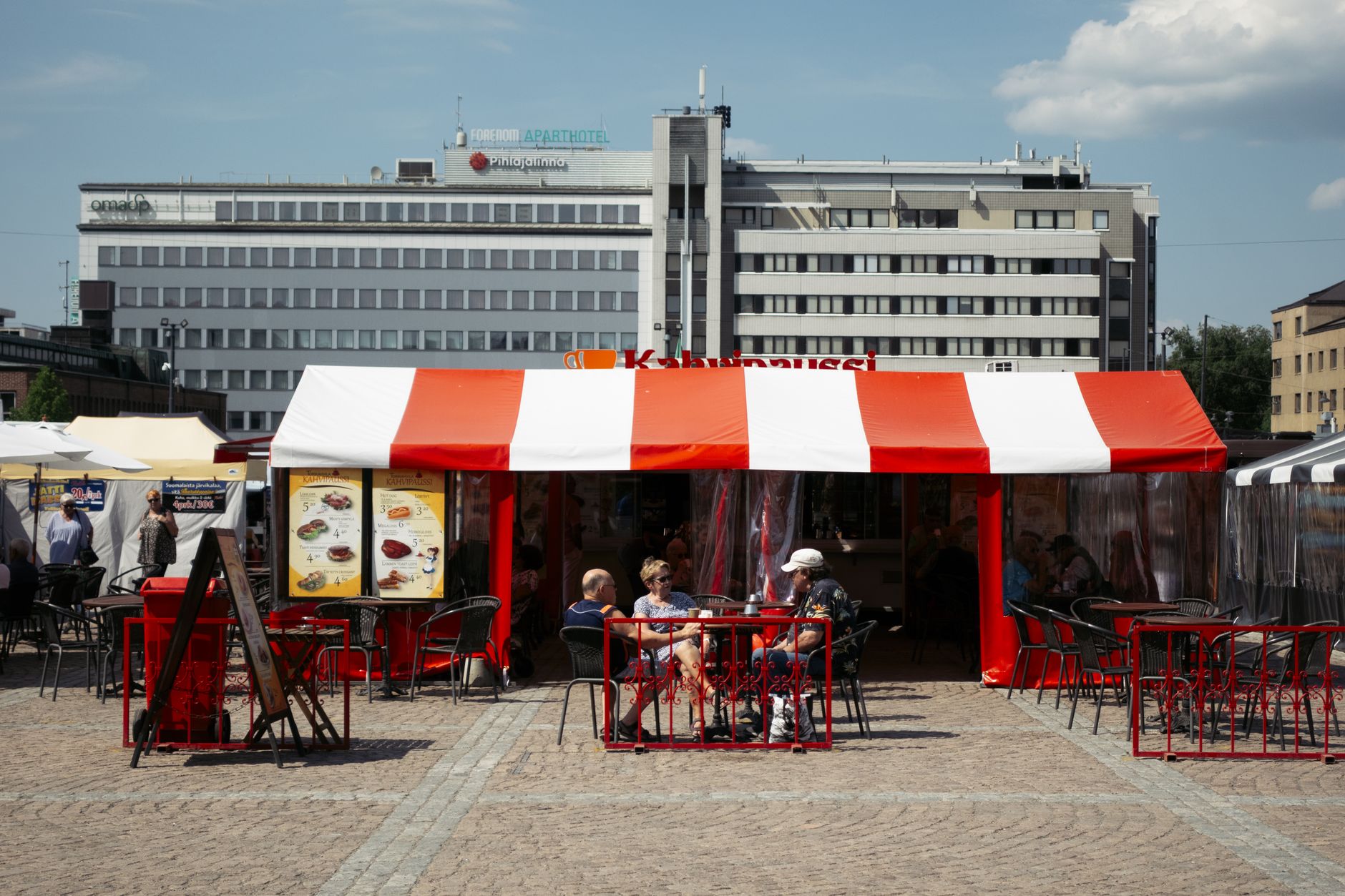
Finland is one of the world’s highest coffee-consuming countries per capita, and Kuopio is no exception. The coffee break, kahvitauko, structures the working day and also the market visit. Many stalls offer coffee and a bun to take away, and sitting down to drink it is a way to observe everyday life without interfering.

The classic accompaniment is pulla, a cardamom bun, or korvapuusti, a cinnamon spiral. These are not high-end pastry products but daily gestures. For visitors, understanding that scale matters: Kuopio’s gastronomy is not measured in stars but in the repetition of a few well-made gestures.
Responsible visitor choices at the market
Kuopio is not an overcrowded destination, and that is an advantage. Visitors can approach the market with simple criteria: buy from small stalls, ask about the origin of the fish, respect opening hours and avoid turning the purchase into a performance. The market is a workplace, not a set.
It is also worth remembering that Finland has rules on picking mushrooms and berries, and that access to nature does not equal free access to any land. Informing yourself before picking is part of a responsible visit. At the market, asking what each product is and how it is cooked is a form of dialogue that vendors usually appreciate.
Common mistakes to avoid
- Assuming all fish is salmon: there are many lake species.
- Treating rye bread as a curiosity: it is the basis of the meal.
- Expecting broad opening hours: the market follows local and seasonal rhythms.
- Ignoring the Karelian context: it explains much of the regional cuisine.
Beyond the market: Kuopio’s table in the city
The market is the starting point, but Kuopio’s pantry is completed in bakeries, fish shops and Finnish cuisine restaurants working with local produce. The city has a university and administrative tradition that sustains stable demand for local food. There is no need to look for an avant-garde dining scene: look for honest, seasonal, territorial cooking.

For visitors, the most coherent experience is simple: buy bread, smoked fish and berries at the market, and eat them on a bench facing the lake. That combination, without spectacle, is the best introduction to Kuopio’s food identity.
Practical guide
Kuopio is located in the North Savo region of eastern Finland and is accessible by train and bus from Helsinki and other Finnish cities. The central market is the gastronomic reference point. The best time to visit with a broad offer is summer and early autumn, when berries, vegetables and fresh fish coincide. In winter, the offer concentrates on bread, preserves and smoked fish.
- When to go: June to September for fresh produce; autumn for mushrooms and berries; winter for pantry goods.
- What to buy: fried muikku, smoked lake salmon, ruisleipä, karjalanpiirakka, berries and jams.
- Getting around: central Kuopio is walkable; the market is in the city centre.
- Budget: the market offers affordable options; smoked fish and berries can be pricier out of season.
- Etiquette: ask before photographing stalls; respect queues and opening hours.
- Language: Finnish and English at most tourist-facing stalls; basic Finnish helps.
Kuopio does not promise a gastronomic revolution. It promises something harder to find: a coherent, seasonal and living pantry, where the lake, the forest and Karelian memory still decide what is eaten. For the traveller willing to listen, that is enough of a lesson.